Transubstantiation
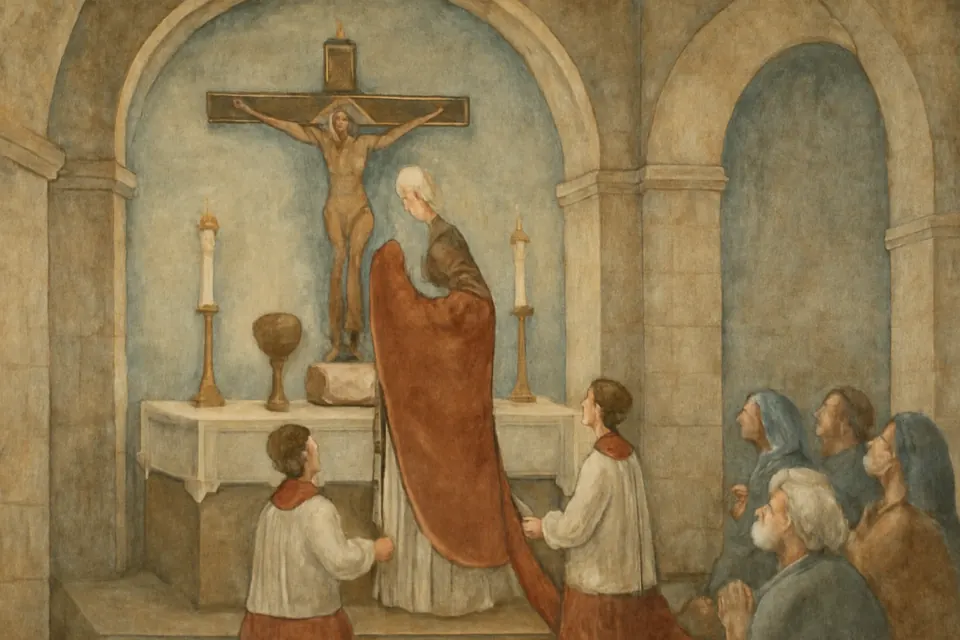
Transubstantiation is the Catholic Church's word for the change that takes place at the consecration of the Mass: the whole substance of the bread becomes the Body of Christ and the whole substance of the wine becomes his Blood, while the appearances of bread and wine remain. It explains how Christ is really present in the Eucharist.
Transubstantiation is the word the Catholic Church uses for what happens on the altar at every Mass. When the priest speaks the words of Christ over the bread and wine, the whole substance of the bread becomes the Body of Christ and the whole substance of the wine becomes his Blood. What we see, touch and taste stays the same. What is there is no longer bread and wine. It is the Lord. This page explains the word in plain language, shows where the faith behind it comes from in Scripture and the early Church, tells how the Church came to use it, and answers the questions people most often ask.
What is transubstantiation?
The Council of Trent gave the Church's definition in 1551, and the Catechism repeats it today:
By the consecration of the bread and of the wine, a conversion is made of the whole substance of the bread into the substance of the body of Christ our Lord, and of the whole substance of the wine into the substance of His blood; which conversion is, by the holy Catholic Church, suitably and properly called Transubstantiation.
The word itself is Latin: trans, "across," and substantia, "substance." It names a change of substance. Not of shape, color or taste, but of what the thing is.
Trent was careful to give the reason first. The Church believes this "because that Christ, our Redeemer, declared that which He offered under the species of bread to be truly His own body." The word was never meant to explain the mystery away. It was chosen to protect the plain meaning of Our Lord's words, "This is my body," against every attempt to make them mean less.
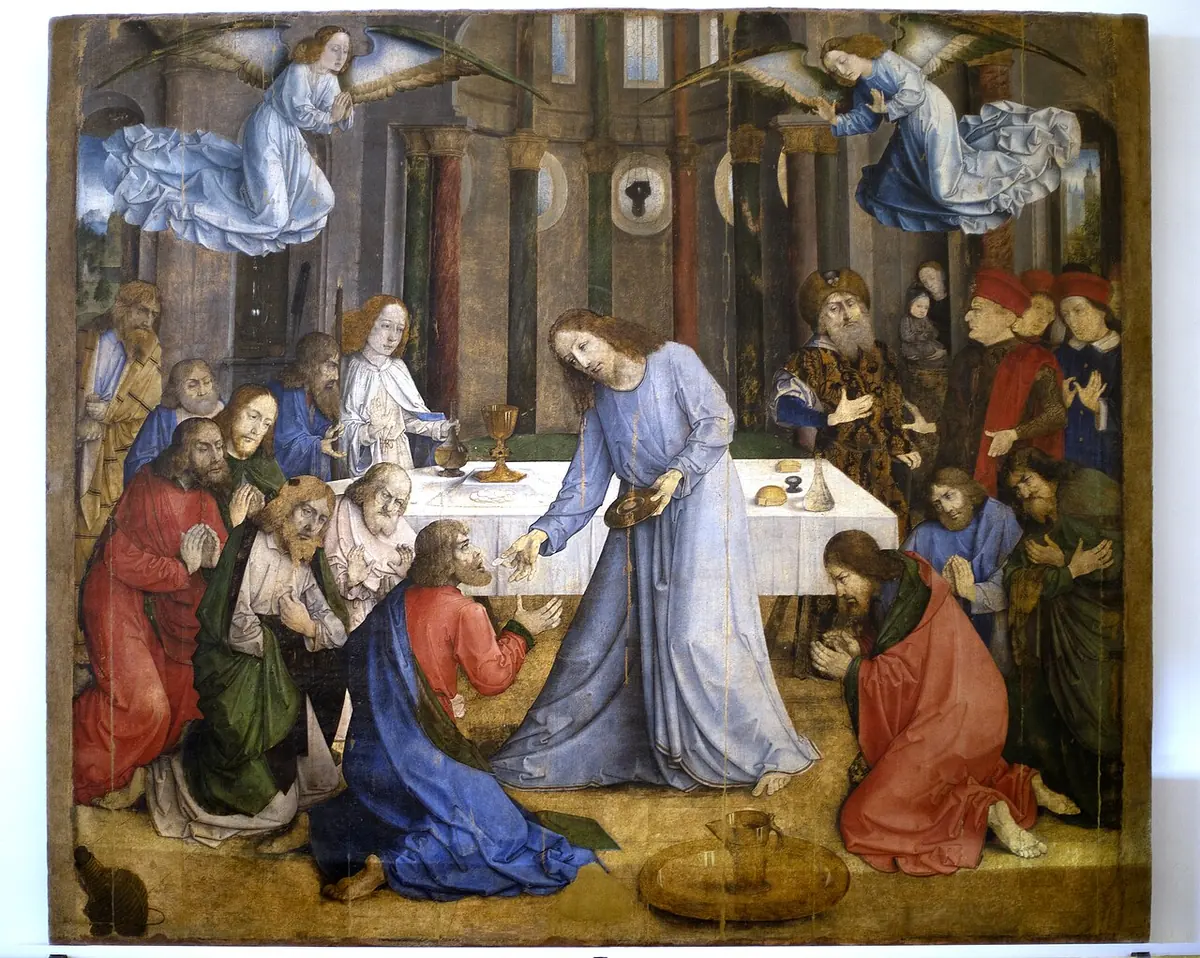
Transubstantiation and the Real Presence
These two terms are often confused, and they go together. The Real Presence is what we believe: that Christ is truly present in the Eucharist. Transubstantiation is how the Church says he becomes present.
The Catechism, quoting Trent, teaches that in the Eucharist "the body and blood, together with the soul and divinity, of our Lord Jesus Christ and, therefore, the whole Christ is truly, really, and substantially contained." Christ is present in many ways, in his word, in the praying Church, in the poor, but this presence is unique. Quoting St. Paul VI, the Catechism calls it "presence in the fullest sense: that is to say, it is a substantial presence by which Christ, God and man, makes himself wholly and entirely present." And it says plainly: "It is by the conversion of the bread and wine into Christ's body and blood that Christ becomes present in this sacrament."
Trent drew the line sharply. Its first canon on the Eucharist condemns anyone who says that Christ is present "only therein as in a sign, or in figure, or virtue." The Eucharist is a sign, as every sacrament is a sign, but it is a sign that contains what it signifies.
Substance and appearances, in plain words
The language of "substance" comes from the philosophy St. Thomas Aquinas used, and it is simpler than it sounds. The substance of a thing is what it is. The accidents (the Church also says species or appearances) are the qualities we perceive: color, shape, size, weight, taste, smell, texture.
In every change we know from nature, the qualities change and the thing stays what it is, as when bread goes stale, or the thing becomes something new and the qualities change with it, as when wood burns to ash. Transubstantiation is the reverse of ordinary experience. The qualities of bread stay exactly as they were, and the substance underneath is changed entirely. The Catholic Encyclopedia offers an image: it is as if wood were "miraculously converted into iron, the substance of the iron remaining hidden under the external appearance" of the wood.
Aquinas knew this is like no natural process. In the Summa Theologiae he writes that "the whole substance of the bread is changed into the whole substance of Christ's body, and the whole substance of the wine into the whole substance of Christ's blood. Hence this is not a formal, but a substantial conversion; nor is it a kind of natural movement: but, with a name of its own, it can be called 'transubstantiation.'"
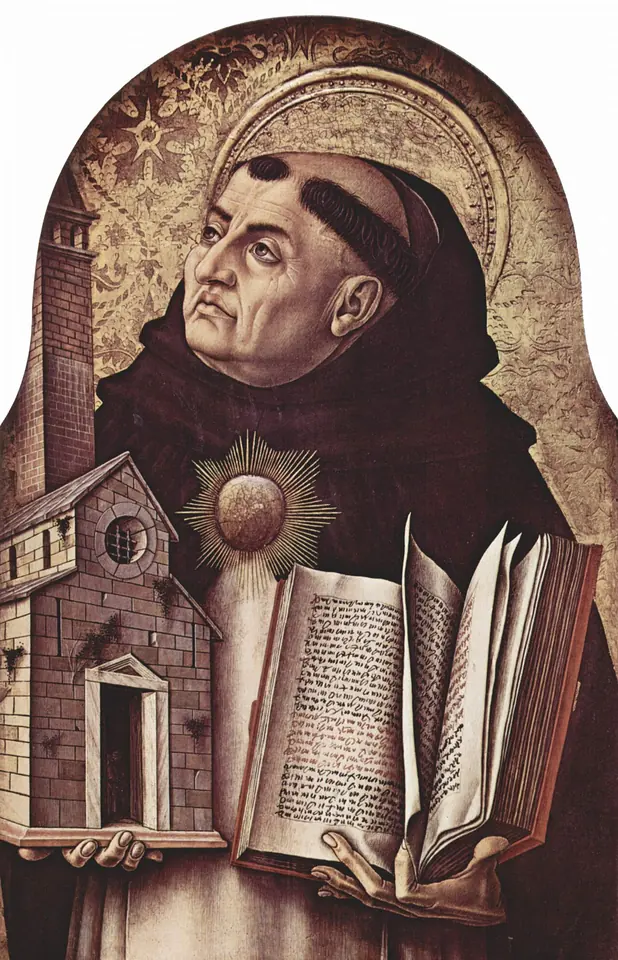
Why do the appearances remain? Aquinas gives three reasons. "It is evident to sense that all the accidents of the bread and wine remain after the consecration. And this is reasonably done by Divine providence. First of all, because it is not customary, but horrible, for men to eat human flesh, and to drink blood. ... Secondly, lest this sacrament might be derided by unbelievers ... Thirdly, that while we receive our Lord's body and blood invisibly, this may redound to the merit of faith."
Two consequences follow, and the Catechism states both. First, Christ is "present whole and entire in each of the species and whole and entire in each of their parts, in such a way that the breaking of the bread does not divide Christ." A tiny fragment of the Host is the whole Lord, and a person who receives under one kind receives the whole Christ. Second, the presence "begins at the moment of the consecration and endures as long as the Eucharistic species subsist." That is why we reserve the Blessed Sacrament in the tabernacle, adore it in the monstrance and carry it to the sick.
What Scripture says
The faith of the Church rests on the words of Christ. At the Last Supper he did not say "this represents my body." St. Paul, writing to the Corinthians little more than twenty years later, hands on what he received (1 Corinthians 11:23–24, Douay-Rheims): "the Lord Jesus, the same night in which he was betrayed, took bread. And giving thanks, broke, and said: Take ye, and eat: this is my body, which shall be delivered for you: this do for the commemoration of me."
A year before, in the synagogue at Capernaum, Jesus had prepared his disciples. When they objected, "How can this man give us his flesh to eat?", he did not soften his words. He made them stronger (John 6:54–57):
Amen, amen I say unto you: Except you eat the flesh of the Son of man, and drink his blood, you shall not have life in you. He that eateth my flesh, and drinketh my blood, hath everlasting life: and I will raise him up in the last day. For my flesh is meat indeed: and my blood is drink indeed. He that eateth my flesh, and drinketh my blood, abideth in me, and I in him.
Many disciples left him that day. He let them go, and turned to the Twelve: "Will you also go away?" St. Peter's answer is the answer of every Catholic before the altar: "Lord, to whom shall we go? thou hast the words of eternal life."
St. Paul draws the conclusion: "whosoever shall eat this bread, or drink the chalice of the Lord unworthily, shall be guilty of the body and of the blood of the Lord" (1 Corinthians 11:27). No one can sin against the body of the Lord by eating a symbol.
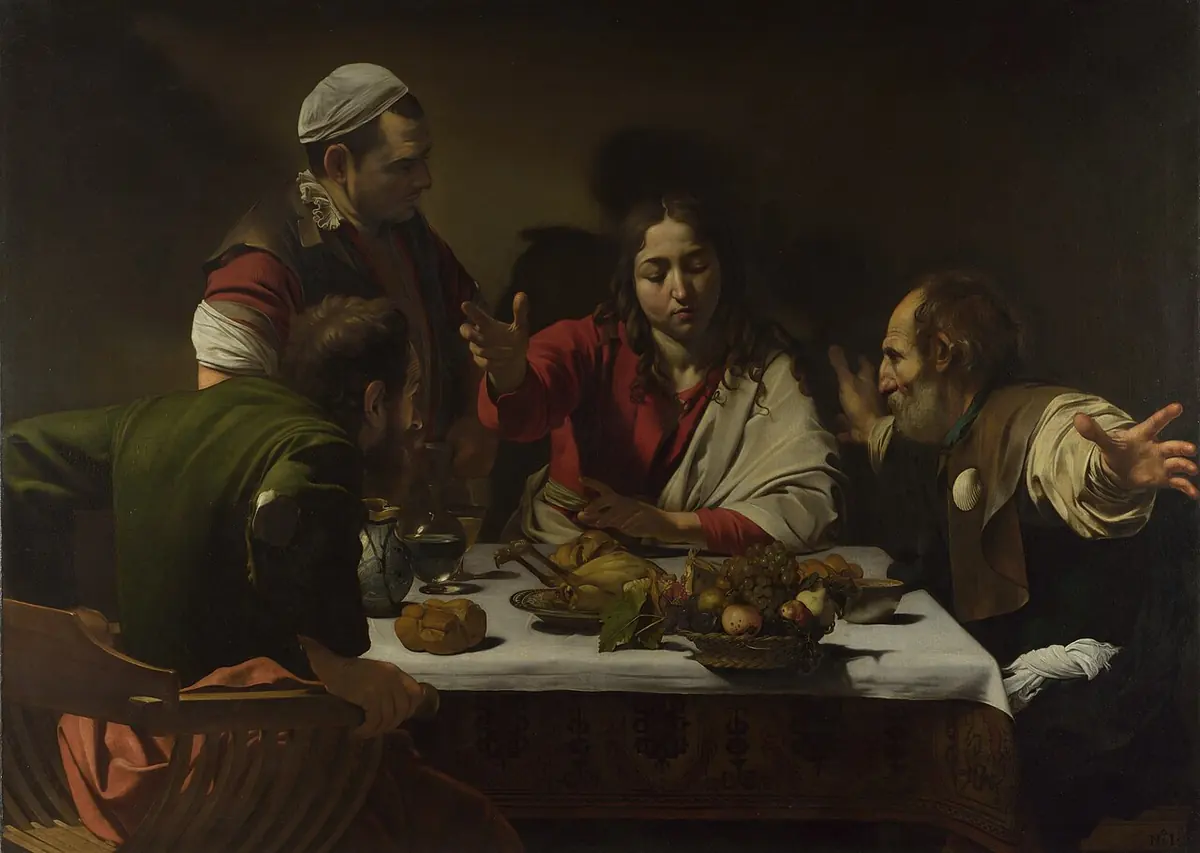
What the early Church believed
The Church Fathers did not use the word transubstantiation, but they believed what it names, and they said so bluntly.
St. Ignatius of Antioch, on his way to martyrdom in Rome about AD 107, warned the Christians of Smyrna against heretics who stayed away from the Eucharist:
They abstain from the Eucharist and from prayer, because they confess not the Eucharist to be the flesh of our Saviour Jesus Christ, which suffered for our sins, and which the Father, of His goodness, raised up again.
St. Justin Martyr, explaining Christian worship to the Roman emperor about AD 155, wrote: "not as common bread and common drink do we receive these; but ... we have been taught that the food which is blessed by the prayer of His word ... is the flesh and blood of that Jesus who was made flesh." (St. Justin Martyr)
St. Cyril of Jerusalem, teaching the newly baptized in the 4th century, put it in the terms we still use: "Since then He Himself declared and said of the Bread, This is My Body, who shall dare to doubt any longer?" And: "the seeming bread is not bread, though sensible to taste, but the Body of Christ; and ... the seeming wine is not wine, though the taste will have it so, but the Blood of Christ." (St. Cyril of Jerusalem)
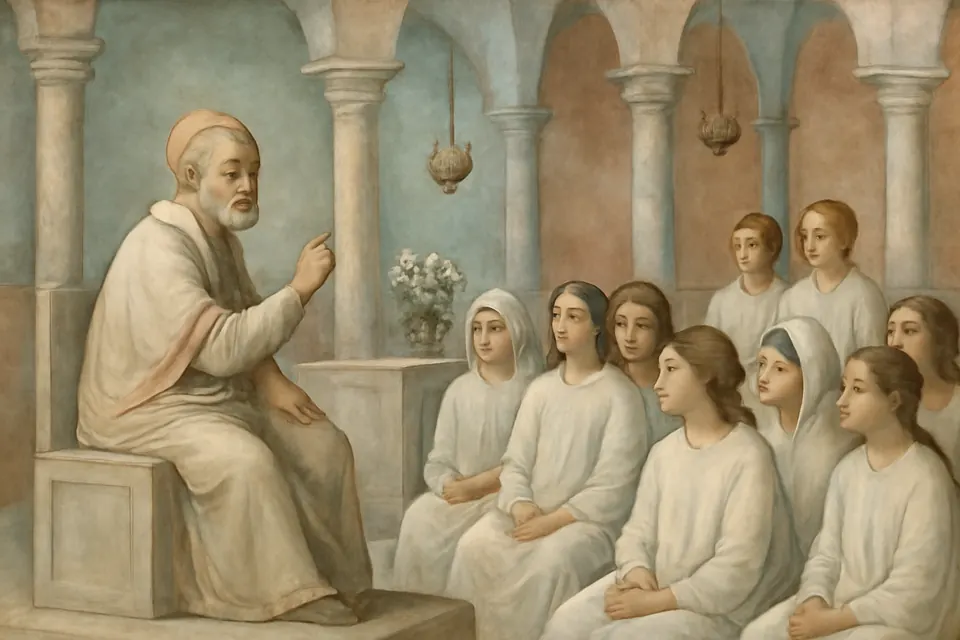
St. Ambrose of Milan taught his catechumens to see beyond nature: "this is not what nature made, but what the blessing consecrated, and the power of blessing is greater than that of nature, because by blessing nature itself is changed." (St. Ambrose)
St. John Chrysostom, quoted in the Catechism, explains who makes the change: "It is not man that causes the things offered to become the Body and Blood of Christ, but he who was crucified for us, Christ himself. The priest, in the role of Christ, pronounces these words, but their power and grace are God's. This is my body, he says. This word transforms the things offered." (St. John Chrysostom)
For more of these witnesses, see our page on the Church Fathers.
How the Church came to use the word
The first debates
For eight centuries the Church's faith in the Eucharist was simply prayed and preached. The first full treatise on the sacrament was written in 831 by St. Paschasius Radbertus, a monk of Corbie, who taught that the Host is the true Body of Christ born of Mary. Another monk of the same abbey, Ratramnus, stressed the spiritual and symbolic side, and their exchange is remembered as the first Eucharistic controversy.
The sharper crisis came with Berengar of Tours in the 11th century, who rejected both the Real Presence and the change of the bread. Councils condemned his teaching several times. At last, the Catholic Encyclopedia records, he "repaired ... the public scandal he had given by a sincere retractation made in the presence of Pope Gregory VII at a synod held in Rome in 1079, and died reconciled to the Church."
A new word for an old faith
Out of these debates came the word itself. The Catholic Encyclopedia credits Hildebert of Tours, about 1079, as the first known writer to use transubstantiation, followed by Stephen of Autun, Peter of Blois and others. In 1215 the Fourth Lateran Council took it into its profession of faith, teaching that Christ's body and blood "are truly contained in the sacrament of the altar under the forms of bread and wine, the bread and wine having been changed in substance, by God's power, into his body and blood." Half a century later St. Thomas Aquinas gave the word its classic explanation.
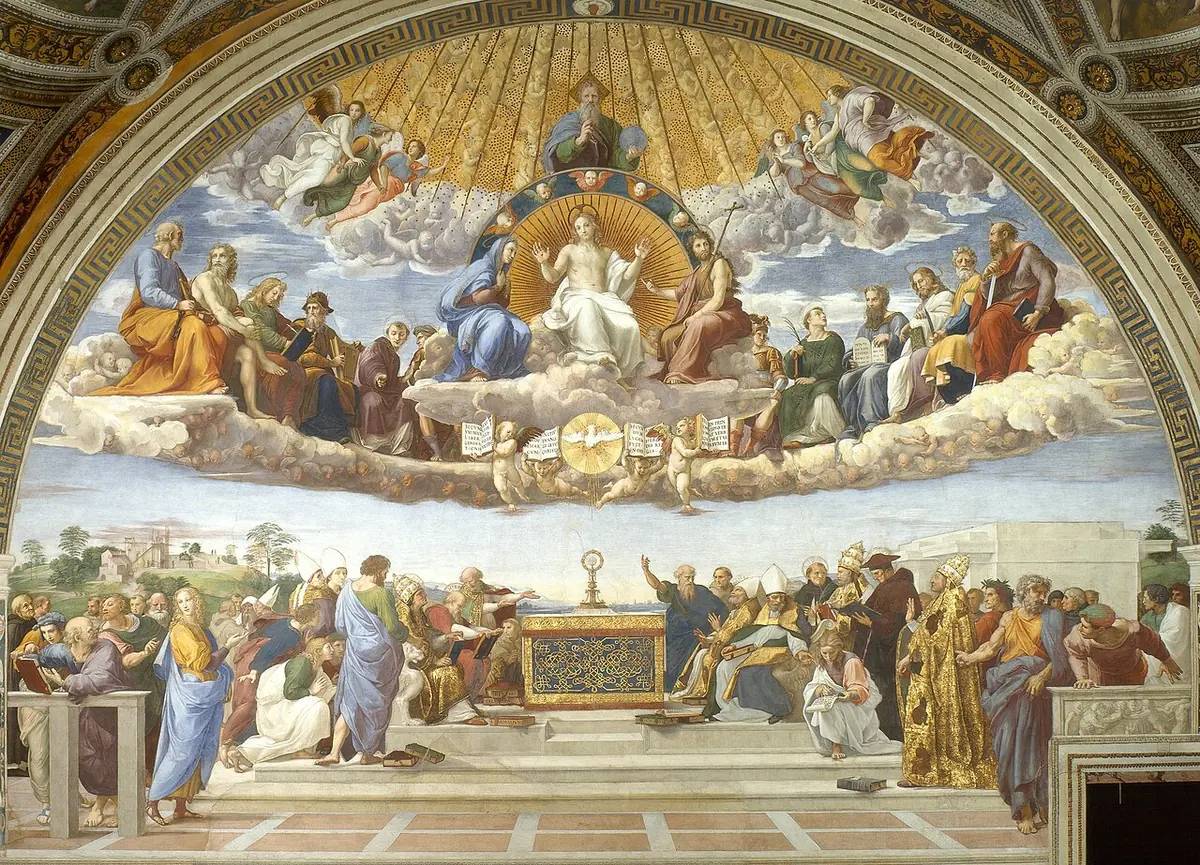
The Council of Trent
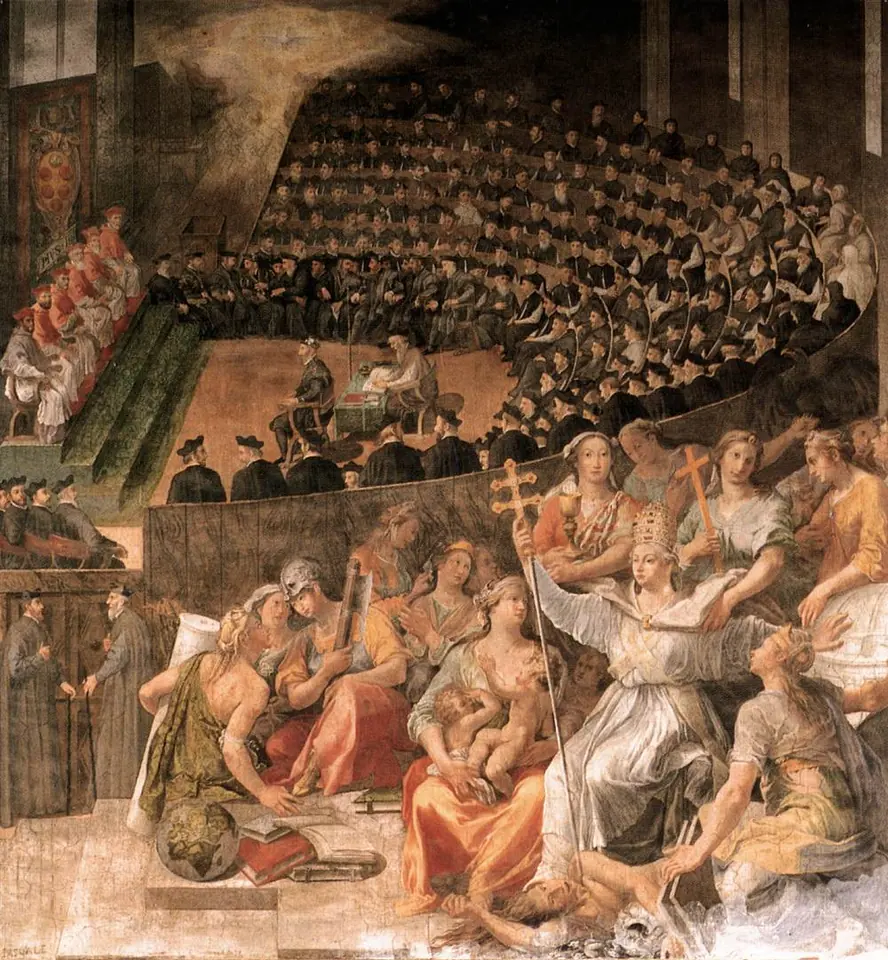
In the 16th century the Reformers divided over the Eucharist. Martin Luther held that Christ is present but that the bread also remains, the view usually called consubstantiation; Ulrich Zwingli taught that the bread signifies Christ's body; John Calvin spoke of a spiritual presence received by faith. The Council of Trent answered all of them in its thirteenth session, on October 11, 1551. It taught that Christ is "truly, really, and substantially contained under the species of those sensible things," condemned anyone who says that "the substance of the bread and wine remains conjointly with the body and blood," and declared that this "wonderful and singular conversion" is what "the Catholic Church most aptly calls Transubstantiation."
In our own time
In 1965, as some theologians proposed speaking only of a change of meaning ("transignification"), St. Paul VI wrote the encyclical Mysterium Fidei. He accepted that the consecrated species "take on a new signification and a new finality," but only "because they contain a new 'reality' which we can rightly call ontological. For what now lies beneath the aforementioned species is not what was there before, but something completely different." The Catechism of 1992 teaches the same.
When does transubstantiation happen?
The change takes place at the consecration, at the center of the Eucharistic Prayer, when the priest speaks Christ's words over the bread and then over the wine. Before them, the Church asks the Father to send the Holy Spirit on the gifts, a prayer called the epiclesis; the Catechism teaches that the change comes about through "the efficacy of the Word of Christ and of the action of the Holy Spirit." The priest acts in persona Christi. He does not work the change by his own power or holiness. As St. John Chrysostom said, the power and grace are God's.
That is why, after each consecration, the priest raises the Host and then the chalice for the people to adore, and genuflects. In many parishes a bell rings, and we look up, or bow, or strike our breast and say silently with St. Thomas the Apostle, "My Lord and my God."
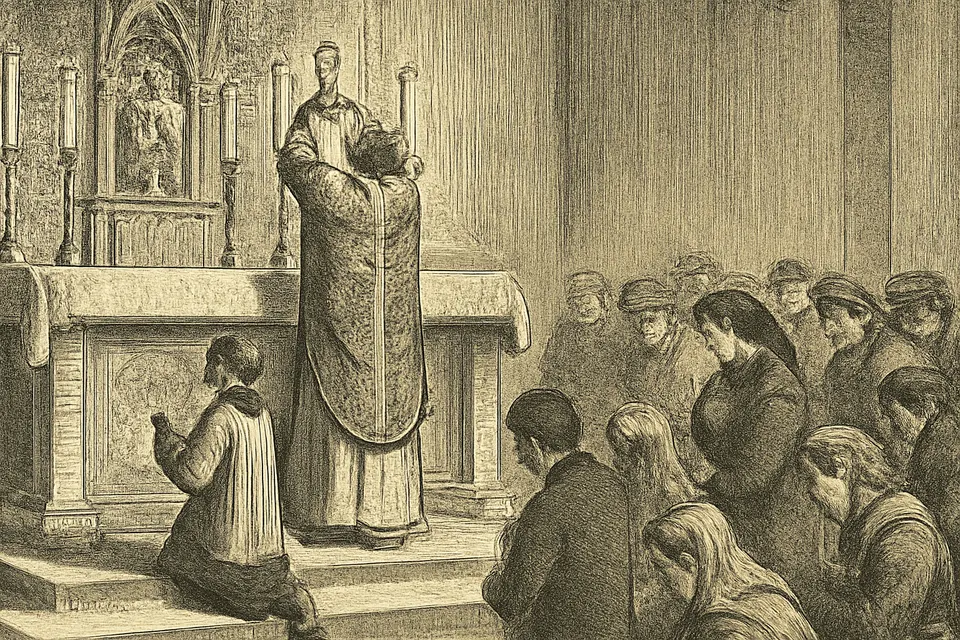
The Eastern Catholic Churches profess the same faith in their own liturgical language, and the Orthodox churches likewise confess that the bread and wine truly become the Body and Blood of Christ, often preferring to leave the manner of the change a mystery.
Living what we believe
Transubstantiation is not a puzzle for theologians only. It changes how we behave in church. We genuflect toward the tabernacle because the Lord is there. We fast for an hour before Communion and come in a state of grace, because we are about to receive God. We say "Amen" when the priest or minister says "The Body of Christ," and that Amen is an act of faith. We make time for Eucharistic adoration, because the Lord who was present at Mass is present still.
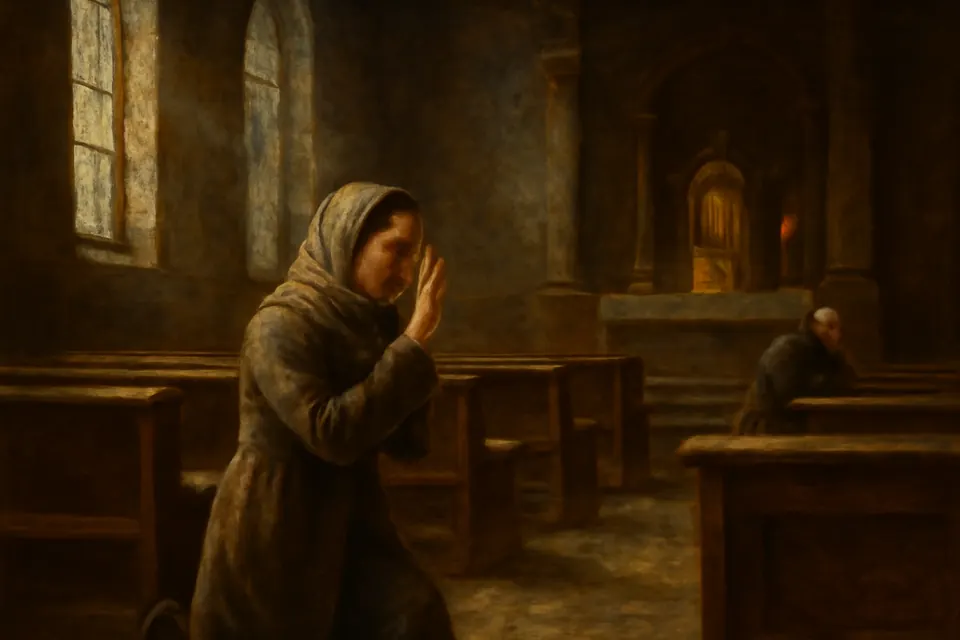
This faith needs renewing. A Pew Research Center survey in 2019 found that only 31% of U.S. Catholics said they believe the bread and wine "actually become the body and blood of Jesus." Many of the rest did not know that this is what the Church teaches. The remedy is the one the saints have always used: teach the faith clearly, celebrate the Mass reverently, and bring people before the Blessed Sacrament.
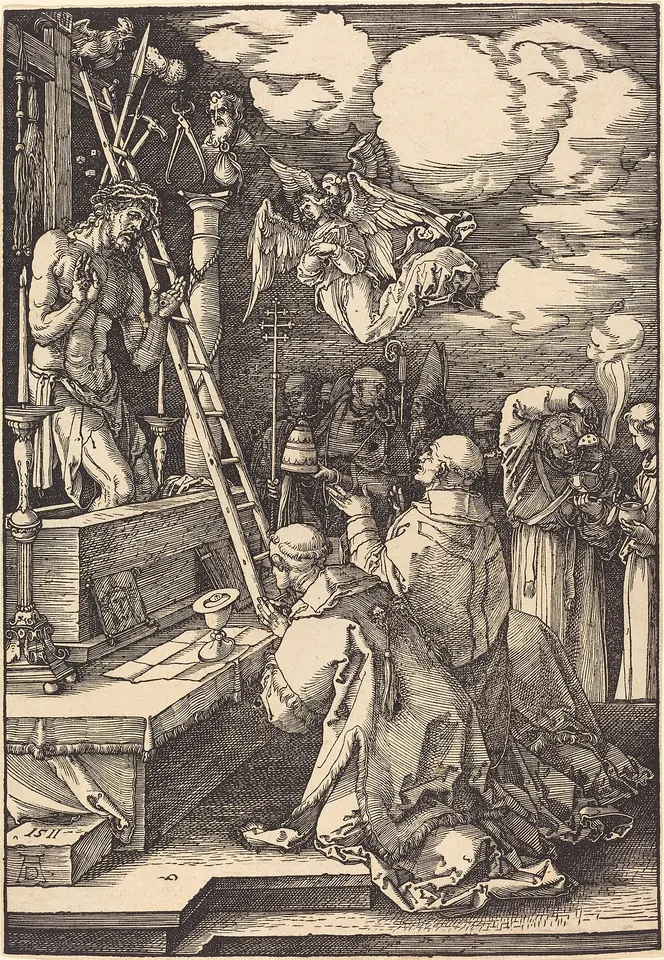
Down the centuries God has sometimes granted a visible sign of this hidden truth. One of the oldest stories is the Mass of St. Gregory, in which, tradition holds, Christ appeared above the altar to a doubter during the pope's Mass. The account is traditional, but artists painted it for centuries. For the cases the Church has studied, see our page on Eucharistic miracles, including Lanciano and Buenos Aires. Our faith never depends on such signs. As the Catechism says, quoting Aquinas, the true Body and Blood of Christ "'cannot be apprehended by the senses,' says St. Thomas, 'but only by faith, which relies on divine authority.'"
Adoro te devote: transubstantiation in a prayer
The most beautiful explanation of transubstantiation is a prayer. The Adoro te devote, traditionally attributed to St. Thomas Aquinas and long said in thanksgiving after Communion, puts the whole doctrine into a few lines of praise. It begins in Latin:
Adoro te devote, latens Deitas, Quae sub his figuris vere latitas.
Here it is in full in Edward Caswall's translation from his Lyra Catholica of 1849, which is in the public domain:
O Godhead hid, devoutly I adore Thee, Who truly art within the forms before me; To Thee my heart I bow with bended knee, As failing quite in contemplating Thee.
Sight, touch, and taste in Thee are each deceiv'd; The ear alone most safely is believ'd: I believe all the Son of God has spoken, Than Truth's own word there is no truer token.
God only on the Cross lay hid from view; But here lies hid at once the Manhood too: And I, in both professing my belief, Make the same prayer as the repentant thief.
Thy wounds, as Thomas saw, I do not see; Yet Thee confess my Lord and God to be: Make me believe Thee ever more and more; In Thee my hope, in Thee my love to store.
O thou Memorial of our Lord's own dying! O living Bread, to mortals life supplying! Make Thou my soul henceforth on Thee to live; Ever a taste of Heavenly sweetness give.
O loving Pelican! O Jesu, Lord! Unclean I am, but cleanse me in thy blood; Of which a single drop, for sinners spilt, Can purge the entire world from all its guilt.
Jesu! whom for the present veil'd I see, What I so thirst for, oh, vouchsafe to me: That I may see thy countenance unfolding, And may be blest thy glory in beholding.
"Sight, touch, and taste in Thee are each deceiv'd; the ear alone most safely is believ'd." Our senses report bread. Our ears have heard the word of Christ, "This is my body," and we believe him. That is transubstantiation, prayed on our knees. For the whole sacrament, read What is the Eucharist?, and for the other prayers the Church gives us, see prayer before Mass and prayer after Communion.
Frequently asked questions
What is transubstantiation in simple terms?
Transubstantiation means that at the consecration of the Mass, what is on the altar stops being bread and wine and becomes the Body and Blood of Jesus Christ, though it still looks, feels and tastes like bread and wine. The reality changes; the appearances stay.
What is the difference between transubstantiation and the Real Presence?
The Real Presence is the truth that Christ is truly, really and substantially present in the Eucharist, Body, Blood, soul and divinity. Transubstantiation is the Church's name for how he becomes present: by the change of the whole substance of the bread and wine into his Body and Blood.
When does transubstantiation happen?
At the consecration, when the priest, acting in the person of Christ, speaks Christ's words over the bread ("This is my body") and over the wine ("This is the chalice of my blood"). The Catechism teaches that the presence "begins at the moment of the consecration and endures as long as the Eucharistic species subsist."
Is transubstantiation in the Bible?
The word is not, but the faith it names is. Jesus said at the Last Supper, "This is my body," and in John 6 he said, "My flesh is meat indeed: and my blood is drink indeed." St. Paul warned that whoever receives unworthily "shall be guilty of the body and of the blood of the Lord" (1 Corinthians 11:27). The Church coined the word later to protect that plain meaning.
When did transubstantiation become Catholic doctrine?
The faith is as old as the Church; St. Ignatius of Antioch wrote about AD 107 that the Eucharist is the flesh of Jesus Christ that suffered for our sins. The word appeared in the 11th and 12th centuries, was used by the Fourth Lateran Council in 1215, and was solemnly defined by the Council of Trent on October 11, 1551.
Does the Host change chemically?
No. Everything a microscope or a chemist could measure, the color, taste, weight and chemistry of bread and wine, remains. What changes is what the thing is, its substance. That is why the change "cannot be apprehended by the senses," as St. Thomas Aquinas says, "but only by faith."
What is consubstantiation?
Consubstantiation is the name usually given to the view, associated with Martin Luther, that the substance of bread and wine remains together with the Body and Blood of Christ. The Council of Trent rejected it, teaching that the whole substance of the bread is changed, so that only the appearances of bread remain.
Is Christ whole in a small piece of the Host?
Yes. The Catechism teaches that Christ is "present whole and entire in each of the species and whole and entire in each of their parts, in such a way that the breaking of the bread does not divide Christ." Someone who receives only the Host, or only the Precious Blood, receives the whole Christ.
Sources
- Council of Trent, Session XIII (October 11, 1551): Decree on the Most Holy Eucharist, chapters I–V and canons
- Catechism of the Catholic Church, 1373–1381
- St. Thomas Aquinas, Summa Theologiae III, q. 75: the change of bread and wine into the Body and Blood of Christ
- St. Paul VI, Mysterium Fidei (1965), on the doctrine and worship of the Holy Eucharist
- St. Cyril of Jerusalem, Catechetical Lecture 22 (Mystagogic 4)
- Catholic Encyclopedia (1909): The Real Presence of Christ in the Eucharist. Berengar's retraction of 1079; Hildebert of Tours as the first known user of the word; the wood-and-iron comparison
- Fourth Lateran Council (1215), constitution 1: On the Catholic faith
- St. Ignatius of Antioch, Epistle to the Smyrnaeans, 7; St. Justin Martyr, First Apology, 66. Justin's First Apology is at https://www.newadvent.org/fathers/0126.htm
- Pew Research Center (2019): One-third of U.S. Catholics believe in transubstantiation
- Edward Caswall, Lyra Catholica (1849): Adoro te devote. Public-domain translation, pp. 247–249