Blessed John Duns Scotus

Blessed John Duns Scotus (about 1265–1308) was a Scottish Franciscan priest, philosopher and theologian, called the Subtle Doctor for the precision of his arguments. He taught at Oxford and Paris, died in Cologne, and is best known for the argument that helped the Church define the Immaculate Conception of Mary. Pope John Paul II confirmed his cult in 1993, and his feast is November 8.
Who was John Duns Scotus?
John Duns Scotus was a Franciscan friar and priest who taught at Oxford, Cambridge and Paris around the year 1300 and died in Cologne in 1308, still in his early forties. His name means John from Duns, the Scot. He was one of the most demanding thinkers of the Middle Ages, and his followers, the Scotists, held chairs in European universities for the next three centuries.
The Church remembers him above all for one argument: the reasoning that showed how Mary could be free from original sin from her conception and still be redeemed by Christ. That argument won the day in the Church over the following centuries and stands behind the dogma of the Immaculate Conception defined in 1854. He is a Blessed, and his feast is November 8.
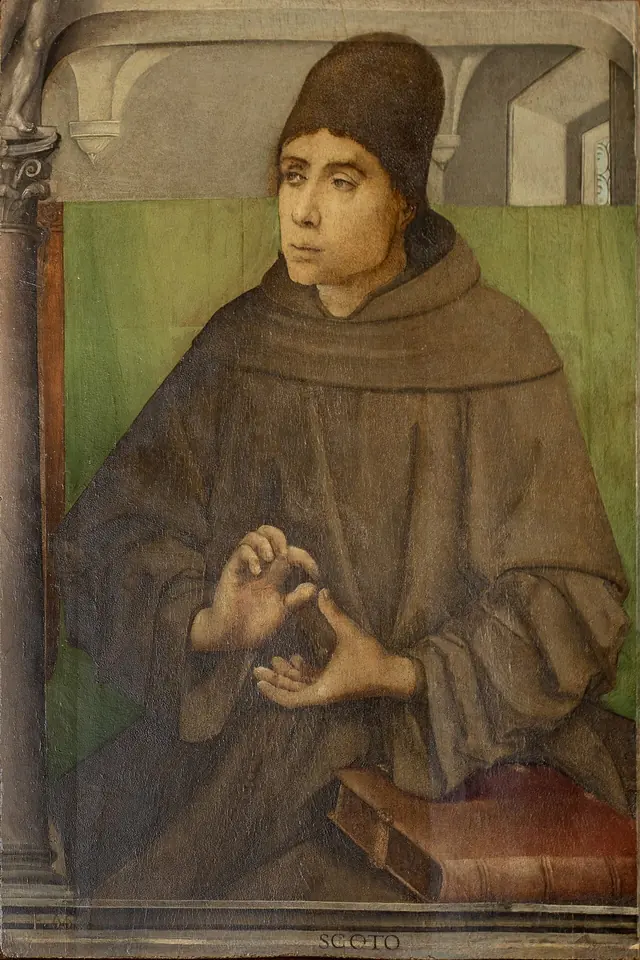
An old epitaph sums up his life in one line, which Pope Benedict XVI quoted when he spoke about him in 2010: "Scotland bore me, England received me, France taught me, Cologne in Germany holds me."
The life of John Duns Scotus
Very little is known about his life for certain. The contemporary sources are thin, and the rest comes from university records, letters and later Franciscan tradition.
From Duns to the Franciscans
He was born in the village of Duns in the Scottish Borders, a few miles from the English border, probably in late 1265 or early 1266. Recent research by the historian Stephen Dumont suggests he may have been a little older, born in 1263 or 1264. Irish and English writers once claimed him too, and the Catholic Encyclopedia of 1909 still treated his birthplace as an open question, but modern scholarship accepts Duns.
The British Franciscans' account says he was educated first near the abbeys of Melrose and Dryburgh and at the friary school in Haddington, and that his uncle Elias of Duns, the Franciscan superior for the region, received him into the order at Dumfries while he was still in his teens. The same account records a traditional story that on Christmas night in 1281, while preparing for his vows, he saw the Child Jesus appear in his arms.
Priest and teacher at Oxford
He was ordained a priest on March 17, 1291, by Oliver Sutton, bishop of Lincoln, in the Church of St. Andrew in Northampton. His studies took him to the Franciscan schools of Paris and Cambridge and then to Oxford, where in 1298 and 1299 he lectured on the Sentences of Peter Lombard, the standard theology textbook of the day. Those lectures grew into his great work, the Ordinatio, which he kept revising until he died and never finished.

Exile from Paris
In 1302 the Franciscans sent him to lecture at the University of Paris. The next year King Philip IV of France, locked in a bitter quarrel with Pope Boniface VIII, had royal agents question every friar in Paris about which side he took. In June 1303 Scotus signed with the pope, along with most of the friars who weren't French, and a royal edict gave them three days to leave the kingdom. Benedict XVI pointed to this moment as an act of loyalty to the See of Peter.

He went back to Oxford. By 1304 the quarrel had cooled, and on November 18 of that year the Franciscan minister general, Gonsalvus of Spain, wrote recommending him for the doctorate at Paris, praising his "laudable life, superb knowledge, most subtle intellect." He became regent master, the head of the Franciscan school at Paris, in 1306.
Cologne
In 1307 his superiors sent him to Cologne to teach at the Franciscan house of studies there. He died on November 8, 1308, about 43 years old, and was buried in the Franciscan church in Cologne, now called the Minoritenkirche.
The ideas of the Subtle Doctor
Scotus wrote commentaries and disputed questions, not a single summary of his system, and his Latin is famously hard. A few of his ideas, though, are well known even outside philosophy.
The Immaculate Conception
In his day most leading theologians, including St. Bonaventure and St. Thomas Aquinas, hesitated to say that Mary was conceived without original sin. Their objection was serious: if she never had original sin, she would seem not to need Christ's redemption, and Christ is the redeemer of all.
Scotus turned the objection around. A perfect redeemer, he argued, would redeem at least one person in the most perfect way possible, and it is more perfect to preserve someone from sin than to free them from it afterward. Mary was therefore redeemed by Christ, but in advance, by being kept from original sin from the first moment of her conception. Benedict XVI called this the argument of "preventive Redemption" and noted that Pope Pius IX used it in 1854 when he defined the doctrine.

Christ first
Scotus taught that the Incarnation was not God's response to sin. God willed from all eternity that his Son become man, and would have done so even if Adam had never fallen. "To think that God would have given up such a task had Adam not sinned would be quite unreasonable!" he wrote, as Benedict XVI quoted him. For Scotus, Christ is the summit of creation, not a repair after an accident.
Univocity: words that mean the same about God
Can our words say anything true about God? Thomas Aquinas held that words like "good" or "wise" apply to God only by analogy, with a meaning related to, but different from, their meaning about creatures. Scotus argued that some concepts, such as "being" and the "pure perfections" like wisdom, can be applied to God and creatures with exactly the same meaning, since all our concepts come from creatures and we have no others to use. This is his doctrine of univocity, and philosophers still argue about it.
Haecceity: what makes you you
Scotus asked what makes a thing this individual and not another. Two people share a common human nature, but something makes each one unrepeatable. He called that principle haecceitas, "thisness." The Stanford Encyclopedia of Philosophy explains it this way: humanity exists in both Socrates and Plato, but in each it is made individual by his own haecceity.
Freedom and love
Scotus put great weight on the will and its freedom, and on love as the highest act of the person. Benedict XVI, who admired him, warned that later thinkers pushed this toward an extreme that separated freedom from truth, but added that Scotus himself avoided it, since for him the will always follows the intellect.
Where "dunce" comes from
The English word "dunce" really does come from his name, and the story is an unhappy one for Scotus's reputation.
For two centuries after his death, his works were textbooks, and Scotists dominated the theology faculties of universities such as Oxford. In the 16th century the humanists, and after them the Protestant reformers, attacked the whole scholastic system with ridicule, as the New English Dictionary of 1897 put it, "as a farrago of needless entities and useless distinctions." The Scotists, called "Dunsmen" or "Dunses," fought back against the new learning.
The name stuck to the losing side. "Duns," already meaning a quibbling sophist, came to mean a dull, obstinate person who couldn't learn. By 1587 a chronicle of Scotland printed in Holinshed's Chronicles used "dunce" in that modern sense. The insult was aimed at his later followers, not at Scotus himself, whose intelligence even his critics admired.
Beatification
Devotion to Scotus began among the Franciscans soon after his death, and the Catholic Encyclopedia reported in 1909 that a cause was under way in Rome on the ground of an immemorial cult. On March 20, 1993, Pope John Paul II confirmed that cult, the form of beatification used for people already venerated for centuries. No new miracle was required, so none is listed here as approved. At vespers in St. Peter's that day, John Paul II called him the "minstrel of the Incarnate Word and defender of Mary's Immaculate Conception."
Is Duns Scotus a patron saint?
No patronage has been formally assigned to him. Because he was one of the great teachers of the medieval universities, the faithful, and Franciscans in particular, look to him as a model for theologians, philosophers and students. He is listed under theologians and philosophers on our patron saints page on that informal basis.
Symbols of Blessed John Duns Scotus in art
Scotus is not shown often, and there is no portrait from his lifetime. Look for:
- The Franciscan habit and cord: the brown or gray habit of the Friars Minor.
- A book or pen: the scholar and writer.
- A doctor's cap: in the Urbino portrait near the top of this page, he wears the dark cap of a master of theology.
- The Immaculate Conception: Mary, often standing on a crescent moon, above or beside him.
- A scroll reading Potuit, decuit, ergo fecit: "He could, it was fitting, therefore he did," a short Latin summary of the case for the Immaculate Conception that later tradition attached to his name, as in the Columbus window below.
- A dragon or serpent underfoot: in Baroque images, the heresies he argued against.
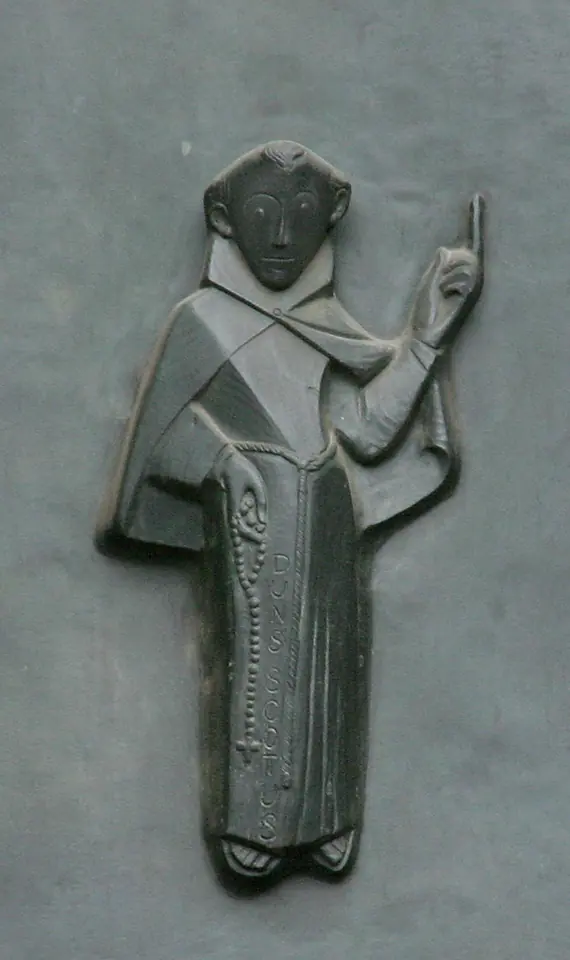
- A raised finger: the gesture of someone making a distinction, seen in both the Urbino portrait and Mataré's relief.

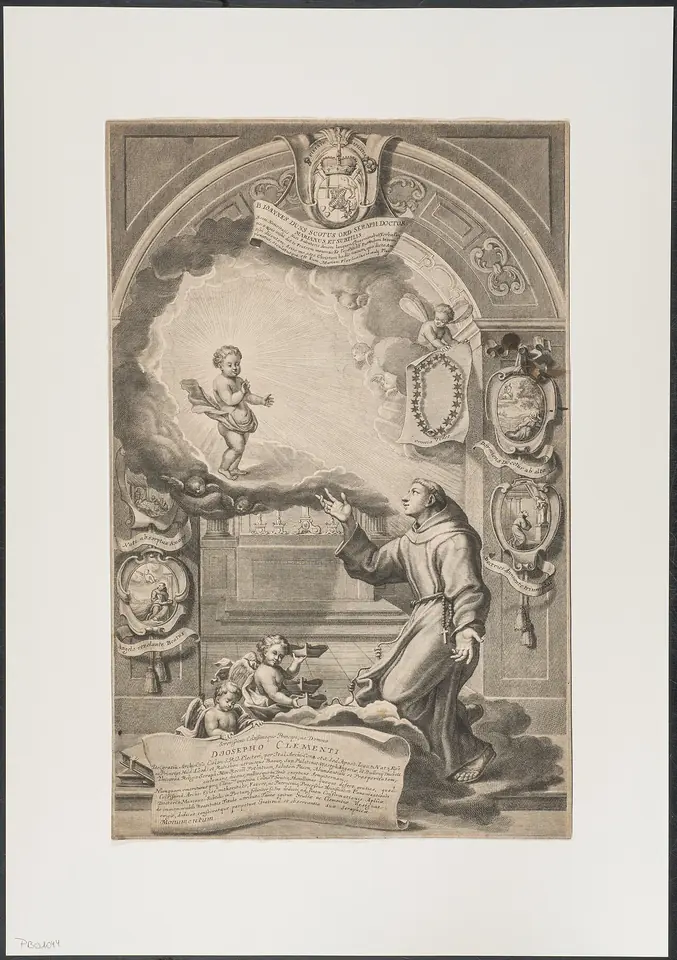
Devotional prints from the 1600s and 1700s, made after the Franciscans began pressing his cause, often show him kneeling in prayer with the Christ Child or the Virgin appearing in clouds, recalling the Christmas vision of Franciscan tradition.
Feast day and where he is honored
His feast is November 8, the day he died. It is a memorial in the Franciscan calendar, and the Roman Martyrology names him on that day. See other saints of the month on our feast days page.
His tomb is in the Minoritenkirche in Cologne, the Franciscan church of the Immaculate Conception, a short walk from the cathedral. Blessed Adolph Kolping, the 19th-century priest who founded the Catholic journeymen's movement, is buried in the same church.

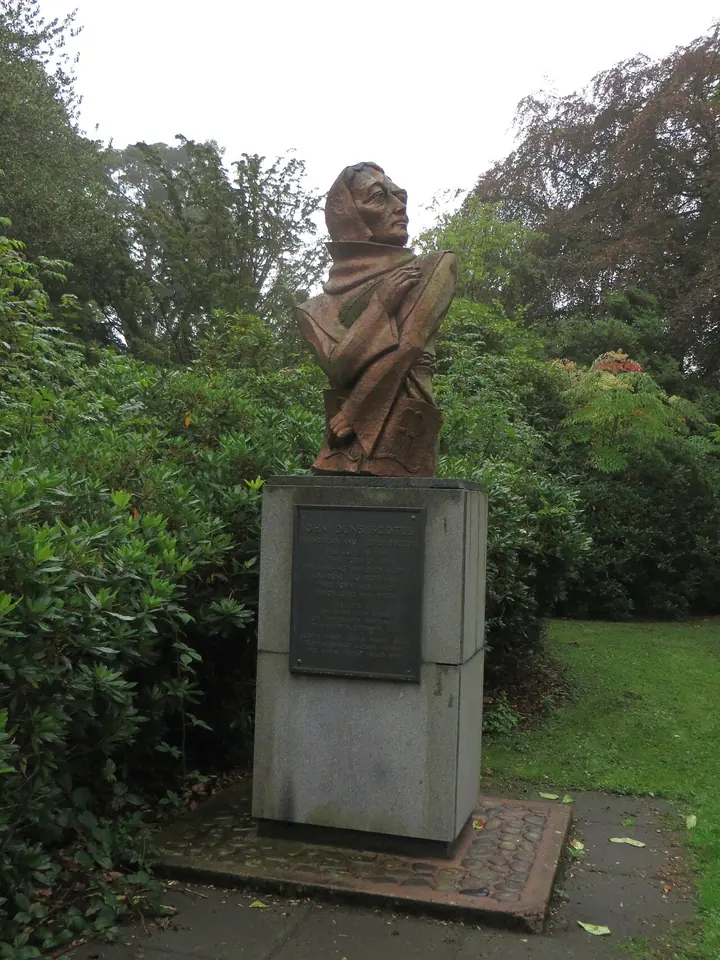
In Duns, a bronze bust stands in the public park, and the town has a cairn marking the traditional site of his birthplace. At Oxford, the poet Gerard Manley Hopkins, a Jesuit who found in Scotus a kindred mind, wrote the sonnet "Duns Scotus's Oxford," which ends with Scotus as:
Of realty the rarest-veinèd unraveller; a not
Rivalled insight, be rival Italy or Greece;
Who fired France for Mary without spot.
Prayer and devotion
There is no traditional popular prayer to Blessed John Duns Scotus in wide use. Franciscans celebrate his memorial with the Mass and Liturgy of the Hours of their order on November 8. We usually ask his intercession in our own words, often for students and teachers of theology, and many of us pray to Mary under the title of the Immaculate Conception, the truth he spent his life defending.
Frequently asked questions
Why is Duns Scotus called the Subtle Doctor?
Because of the fine distinctions and close reasoning in his writing. In 1304 the Franciscan minister general already praised his "most subtle intellect" in a letter recommending him for the doctorate at Paris, and the Latin title Doctor subtilis became his traditional name.
Does the word "dunce" come from Duns Scotus?
Yes. In the 16th century, humanists and then Protestant reformers mocked the followers of Scotus, called Dunsmen or Dunses, as hair-splitting opponents of the new learning. The nickname slid from "quibbler" to "dull person who can't learn," and by 1587 "dunce" was being used in its modern sense. It says nothing about Scotus's own intelligence, which even his opponents respected.
When is the feast of Blessed John Duns Scotus?
November 8, the anniversary of his death in Cologne in 1308. Franciscans keep it as a memorial, and he is listed in the Roman Martyrology for that day.
What did Duns Scotus teach about the Immaculate Conception?
That Christ, as the perfect redeemer, redeemed his mother in the most perfect way, by preserving her from original sin from the first moment of her conception rather than freeing her from it afterward. This "preventive redemption" answered the main objection of his day, and Pope Pius IX used the same reasoning when he defined the doctrine in 1854.
Was Duns Scotus canonized?
No. He is a Blessed. Pope John Paul II confirmed his long-standing cult on March 20, 1993, which is a form of beatification that recognizes veneration already given for centuries instead of requiring a new miracle.
Sources
- Pope Benedict XVI, General Audience of 7 July 2010: John Duns Scotus
- Catholic Encyclopedia (1909): Blessed John Duns Scotus
- Stanford Encyclopedia of Philosophy: John Duns Scotus
- Order of Friars Minor in Great Britain: Blessed John Duns Scotus
- Catholic Culture: Liturgical calendar, November 8 (Roman Martyrology commemorations)
- Word Histories: A dunce was originally a follower of John Duns Scotus (quoting the New English Dictionary, 1897)
- Gerard Manley Hopkins, Duns Scotus's Oxford (Poems, 1918), Wikisource