St. Peter Julian Eymard

St. Peter Julian Eymard (1811–1868) was a French priest, first of the Diocese of Grenoble and then a Marist, who founded the Congregation of the Blessed Sacrament in Paris in 1856 so that Christ in the Eucharist would be adored day and night, and who urged frequent Holy Communion long before it was common. He is called the Apostle of the Eucharist. His feast day is August 2.
Who was St. Peter Julian Eymard?
St. Peter Julian Eymard was a nineteenth-century French priest whose whole life turned on one conviction: that Jesus is truly present in the Blessed Sacrament and waits there for us. Born at La Mure in the French Alps in 1811, he served as a parish priest in the Diocese of Grenoble, became a Marist and a provincial of that society, and then, against every obstacle, founded the Congregation of the Blessed Sacrament in Paris in 1856. Pope John XXIII canonized him in 1962. We keep his feast on August 2.

A boy at the family workshop
Peter Julian came from a family of craftsmen in La Mure, in the Isère. His biographer André Guitton, of the order Eymard founded, writes that he showed a lively devotion to the Blessed Sacrament from boyhood and asked to be a priest at his First Communion in 1823. His father said no. The boy worked in the family workshop and taught himself Latin in secret, finding strength at the Marian shrine of Notre-Dame du Laus. In 1828 his father finally let him enter the Oblates of Mary Immaculate at Marseille, but illness sent him home within months.
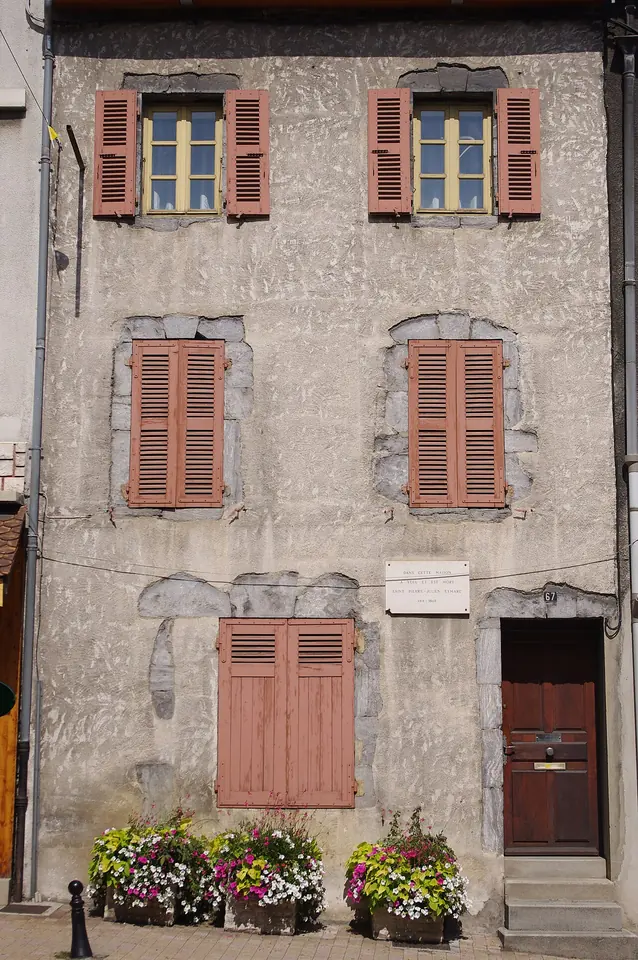
He entered the major seminary of Grenoble after his father's death and was ordained on July 20, 1834. For five years he was a curate at Chatte and then pastor at Monteynard. Guitton describes his early spirituality as austere and touched by Jansenism, centered on the cross in a sorrowful way. A grace he received at the Calvary of Saint-Romans opened him to a spirituality of love.
The Marist years
In 1839 he joined the Society of Mary, the Marists. He was spiritual director at the college of Belley, then provincial at Lyon, and he built up the Marists' Third Order for lay people. Two moments set his course. On May 25, 1845, leading the Corpus Christi procession at the parish of St. Paul in Lyon, he felt himself drawn to preach Jesus Christ in the Eucharist, and he took St. Paul as his patron. On January 21, 1851, praying at Notre-Dame de Fourvière, he was struck by how little the Blessed Sacrament was honored and how poorly lay people and priests were formed, and he felt called to found a community of men devoted to the Eucharist.
His Marist superiors did not see the new work as part of their mission. In April 1856, refused again, Eymard asked to be released from his vows and went to Paris.
Founder in Paris
The archbishop of Paris first thought the plan was purely contemplative. Eymard answered, "We want to adore, but we also want others to adore," and won him over. The Congregation of the Blessed Sacrament dates from May 13, 1856. On January 6, 1857, in a poor house in the rue d'Enfer, the Blessed Sacrament was exposed for the first time, and adoration began.
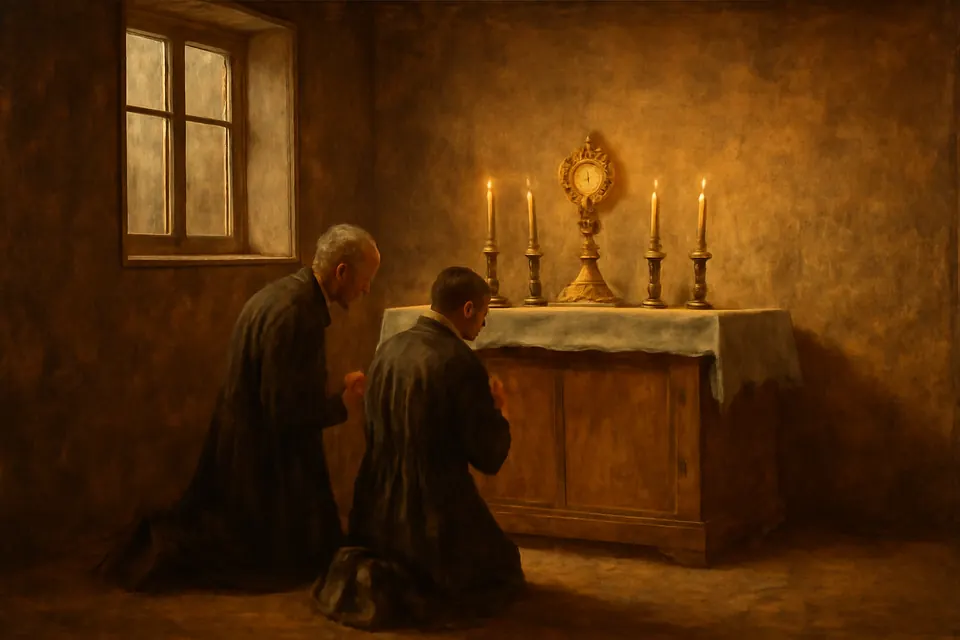
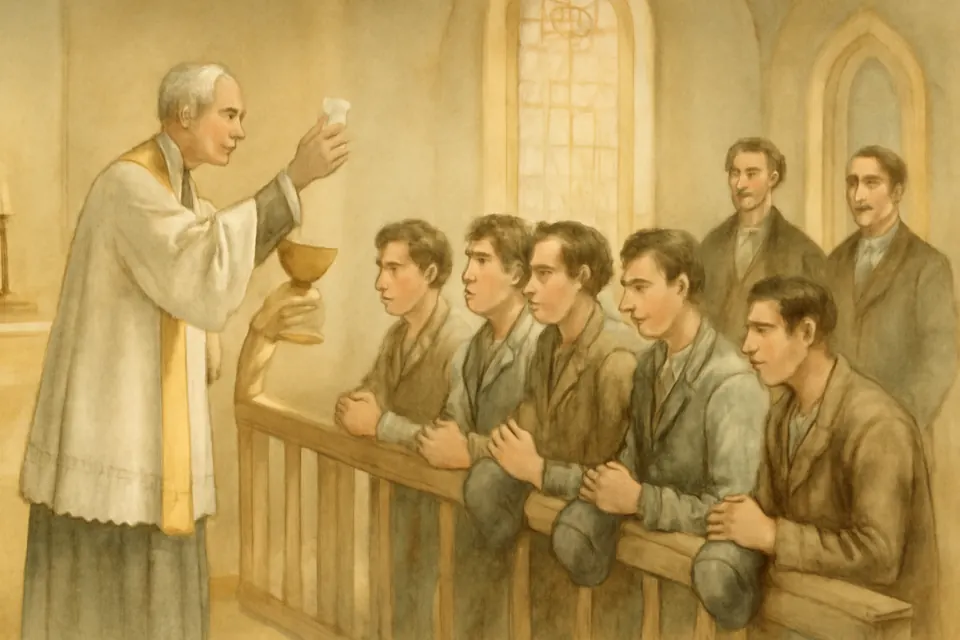
The community was tiny and penniless. Eymard gathered young working men from one of the poorest districts of Paris who had never been taught the faith and prepared them for First Communion; on August 15, 1858, he gave Communion to twelve of them. With Marguerite Guillot he began the women's branch, the Servants of the Blessed Sacrament. Pius IX praised the work in 1859 and approved it in 1863. Eymard pressed for frequent Holy Communion at a time when many Catholics received only rarely, an idea Pope St. Pius X later backed with the Church's full authority.
Friend of the Curé of Ars and of Rodin
St. John Vianney encouraged Eymard from the start and joined his Third Order of Mary. When Eymard visited Ars shortly before the Curé died in 1859, worried about the lack of vocations, the old priest wept and then reminded him that he did not need the Curé's prayers: "You yourself, you have him," he said. "You have him always before you!"
In late 1862 a grieving young man named Auguste Rodin entered the community as Brother Augustin. Eymard saw that his real calling was art, let him use a garden shed as a studio, and sat for him in 1863. The bronze bust Rodin made is now in the Musée Rodin; Eymard complained about the "devil's horns" that seemed to rise from the waves of his hair.

The last years
In 1865, during a long retreat in Rome, Eymard made a vow of the total gift of himself. His last years brought failures, poor health and a long spiritual dryness. Sent to rest in July 1868, he reached his family home at La Mure exhausted and stricken by a blood clot in the brain, and died there on August 1, 1868.
Miracles, beatification and canonization
The people of La Mure called him a saint the day he died. When his body was brought to Paris in 1877, it was found incorrupt; an attempt to preserve it with carbolic acid hastened its decay. We count that finding as reported. The miracles accepted for his beatification by Pius XI on July 12, 1925, and his canonization by John XXIII on December 9, 1962, were approved by the Church in those causes, though the sources we used do not describe them.
Symbols of St. Peter Julian Eymard in art
Eymard is almost always shown with a monstrance, the gold vessel in which the Host is exposed for adoration, held against his chest, raised in blessing or standing on an altar before him. He usually wears a priest's cassock, or a cope and humeral veil for Benediction, as in the marble statue at Grenoble Cathedral. Because he lived into the age of photography, images of him follow his real face: long and lean, with wavy hair swept back. If you see a nineteenth-century priest holding a monstrance in a French, Belgian or Filipino church, it is very likely Eymard.

Feast day and where he is honored
Pope John Paul II added him to the universal calendar on December 9, 1995, with his memorial on August 2, the day after his death. His body rests in a glass shrine in the Chapelle du Corpus-Christi on the avenue de Friedland in Paris; the case once held the remains of his friend the Curé of Ars. His birthplace at La Mure can still be visited. See our feast days page for the saints around August 2.
Prayer to St. Peter Julian Eymard
The Church prays this collect on his memorial in the Roman Missal:
O God, who adorned Saint Peter Julian Eymard with a wonderful love for the sacred mysteries of the Body and Blood of your Son, graciously grant that we, too, may be worthy to receive the delights he drew from this divine banquet. Through our Lord Jesus Christ, your Son, who lives and reigns with you in the unity of the Holy Spirit, God, for ever and ever.
Let us honor him the way he would want: by spending an hour with Jesus in the Blessed Sacrament. St. Peter Julian Eymard, pray for us.
Frequently asked questions
When is the feast of St. Peter Julian Eymard?
August 2, an optional memorial. Pope John Paul II placed him in the universal calendar on December 9, 1995, calling him "an outstanding apostle of the Eucharist."
What did St. Peter Julian Eymard found?
The Congregation of the Blessed Sacrament for men (begun in Paris on May 13, 1856), the Servants of the Blessed Sacrament for contemplative women, with Marguerite Guillot, and the Aggregation of the Blessed Sacrament for lay people, along with the Priests' Eucharistic League.
When was St. Peter Julian Eymard canonized?
Pope John XXIII canonized him on December 9, 1962, the day after the first session of the Second Vatican Council closed. Pius XI had beatified him on July 12, 1925.
Where is St. Peter Julian Eymard buried?
His body rests in the Chapelle du Corpus-Christi on the avenue de Friedland in Paris, near the Arc de Triomphe. He was first buried at La Mure and moved to Paris in 1877.
Keep exploring
Sources
- SSS Congregatio (Congregation of the Blessed Sacrament): St. Peter Julian Eymard, Life Story, by André Guitton, SSS
- Catholic Encyclopedia (1909): Venerable Pierre-Julien Eymard
- Eymardian Places: Musée Rodin
- Eymardian Places: Ars
- Eymardian Places: Chapelle du Corpus-Christi
- Catholic Culture: Optional Memorial of St. Peter Julian Eymard, collect from the Roman Missal