St. Hyacinth of Poland, Apostle of the North
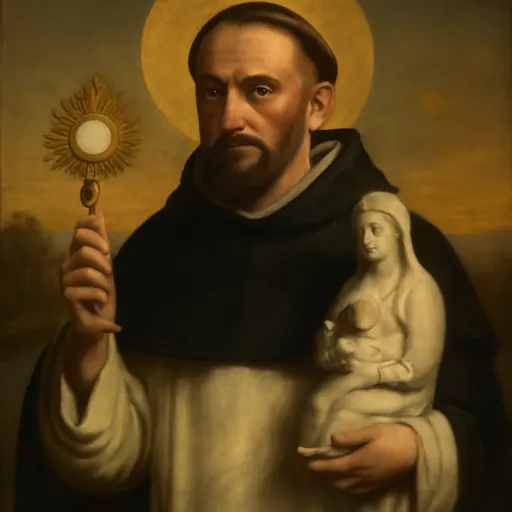
St. Hyacinth of Poland (Jacek Odrowąż, about 1185–1257) was a Polish priest who received the Dominican habit from St. Dominic himself and then preached across Poland, the Baltic lands and Rus', earning the name Apostle of the North. Tradition says he saved the Blessed Sacrament and a statue of Mary when Kiev was sacked. His feast day is August 17, and his relics rest in Kraków, where he is one of the city's patron saints.
Who was St. Hyacinth of Poland?
St. Hyacinth of Poland, known at home as St. Jacek Odrowąż, was a thirteenth-century Polish priest who joined the Order of Preachers in its first years, received the habit from St. Dominic himself, and spent the rest of his life carrying the Gospel north and east. He founded the Dominican priory in Kraków, preached from the Baltic to the Black Sea, and died in Kraków on the feast of the Assumption in 1257. The Church calls him the Apostle of the North, and we keep his feast on August 17.
Hyacinth is the Latin form of Jacek. In Italy he is San Giacinto, in Spain and Latin America San Jacinto, and Dominican churches from Bologna to Quito and Manila keep his image. He shouldn't be confused with the early martyrs of the same name, such as St. Hyacinth of Caesarea or the Hyacinth martyred in Rome with St. Protus.

What we know of his life comes mainly from a Life written in Kraków by a Dominican lector named Stanisław in the 1350s or 1360s, about a century after his death, and from the miracles gathered for his canonization. The bare outline is history. Many of the wonders were added in the telling, and this page labels them as it goes.
The life of St. Hyacinth
A canon of Kraków
Jacek was born about 1185 at Kamień in Silesia, into the noble Odrowąż family. The Catholic Encyclopedia says he was a near relative of Blessed Ceslaus (Czesław), who also became a Dominican, and that he studied at Kraków, Prague and Bologna, where he took a doctorate in law and divinity. Back in Poland he held a prebend at Sandomierz and served as a canon of Kraków under his uncle, Bishop Iwo Odrowąż.
The habit from St. Dominic
Around 1220 he went to Rome with Bishop Iwo. There he met Dominic, who had founded the Order of Preachers only a few years before, and at the convent of Santa Sabina he was one of the first to be clothed in the Dominican habit by the founder's own hands. Butler says that within a year Dominic sent him to plant the Order in Poland.
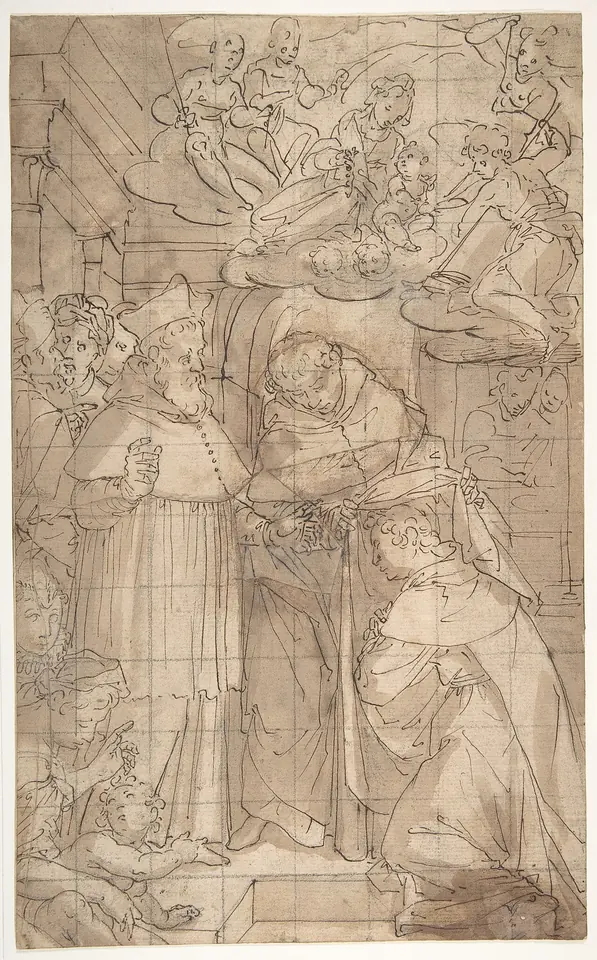
On the way home he founded a priory at Friesach in Carinthia. In Kraków the friars were given the parish church of the Holy Trinity, and Hyacinth became the first prior of the community founded there in 1222. From Kraków the Order spread through Poland, and he founded houses at Sandomierz and Płock and sent friars further still.
Apostle of the North
The Catholic Encyclopedia traces his journeys through Prussia, Pomerania and Lithuania, across the Baltic to Denmark, Sweden and Norway, then into Red Ruthenia, where he founded a community at Lviv, and on to Kiev and the shores of the Black Sea. Butler, writing in the 1700s, stretched the map further, to Tartary and northern China. The distances are not to be taken literally, but Hyacinth was a true missionary of the Order's first generation, preaching on foot to peoples who had barely heard the Gospel or had drifted from it.
The rescue at Kiev
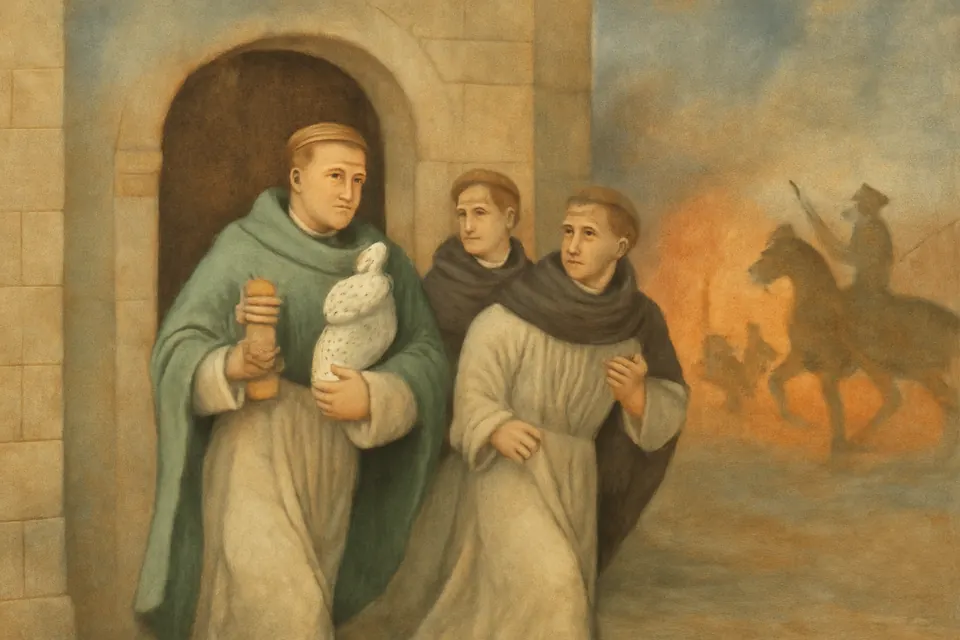
The best-loved story about Hyacinth comes from Kiev, sacked by the Tatars in 1240. As Butler tells it, Hyacinth had just finished Mass when he heard the city was falling. Without taking off his vestments he took the ciborium from the tabernacle and started out of the church. As he passed a statue of Mary, a voice said: "Hyacinth, my son, why dost thou leave me behind? Take me with thee, and leave me not to mine enemies." The statue was heavy alabaster, but in his arms it was light as a reed. Carrying his Lord and His Mother, Hyacinth came to the Dnieper and walked over the water dry-shod. This is a traditional account, and it gave him his two great emblems.
A death on the Assumption
Hyacinth returned to Kraków, the center of all his work. Butler says he was warned of his death on the eve of the Assumption. Though wasted with fever, he offered Mass on the feast, received Communion as a dying man, was anointed at the foot of the altar, and died that same day, August 15, 1257. He was buried in the north aisle of his church of the Holy Trinity.
The miracles of St. Hyacinth
The Catholic Encyclopedia notes that the record of his miracles fills many folio pages of the Bollandists' Acta Sanctorum. Sorted by the labels this encyclopedia uses:
- Miracles at his tomb: reported. Cures were recorded at his grave in Kraków from the thirteenth century on, and they were gathered for the canonization that finally came in 1594. We have not been able to confirm which specific cures the canonization rested on, so we don't call any of them approved.
- The rescue at Kiev and the crossing of the Dnieper: traditional.
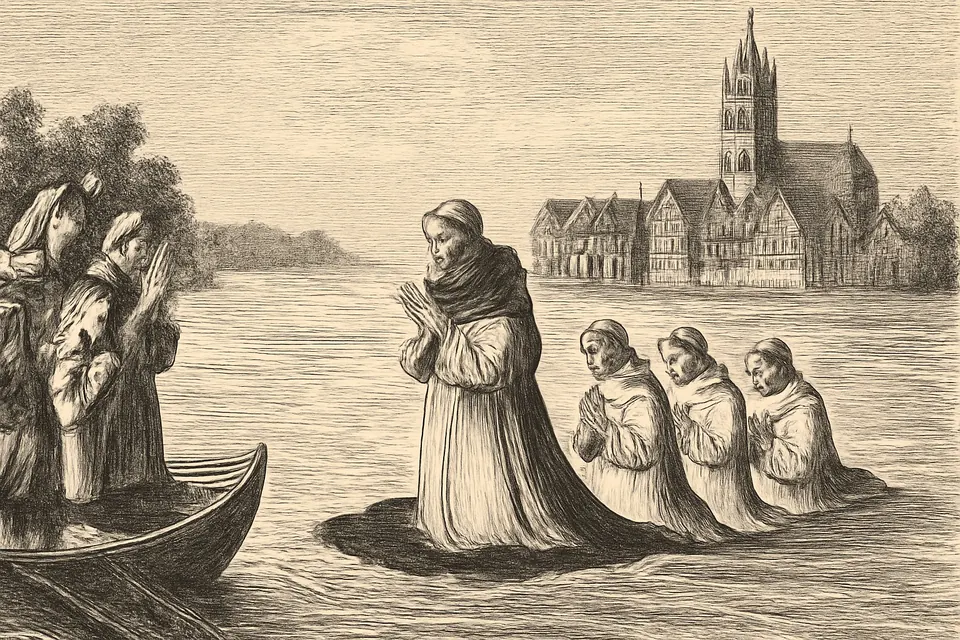
- The crossing of the Vistula on his cloak: traditional. When the river was in flood and no boat could be found, Hyacinth is said to have spread his cloak on the water and crossed on it with his companions. A painting in the cloister of the Holy Trinity in Kraków shows the scene. A very similar story is told of the Spanish Dominican St. Raymond of Penyafort.
- The raising of a dead youth in Kraków: traditional; Butler mentions it in one line.
- The pierogi legends: folk tradition, described below.
Why St. Hyacinth is a patron of Kraków
Hyacinth founded the Dominican life in Kraków, lived and died there, and his body has stayed there for more than seven hundred years. The city counts him among its five patron saints, with St. Stanislaus of Szczepanów, St. Florian, St. John Cantius and St. Joseph, and he is also a patron of the Archdiocese of Kraków. For other cities and causes, see our patron saints page.
St. Hyacinth and pierogi
Poles still say "Święty Jacku z pierogami!" ("St. Hyacinth with your pierogi!") when something surprises them. Several folk legends lie behind it. One, recorded in the village of Nockowa in southeastern Poland and listed by the Polish Ministry of Agriculture with the village's baked pierogi, tells of Hyacinth on his way to Rus', hungry and thirsty, meeting reapers who had no food. He had them thresh and grind a sheaf of wheat, stretch the flour with cottage cheese and fill the dough with cabbage and wild mushrooms. The whole village feasted, and as they ate, people would say:
Św. Jacku z pierogami, módl się do Boga za nami.
That is, "St. Hyacinth with your pierogi, pray to God for us." Other tellings have him feeding the poor with pierogi after a hailstorm or a Tatar raid. None of this is in the medieval Life, and we take it for what it is: the affection of a people for a saint who fed them, body and soul.
Symbols of St. Hyacinth in art
Hyacinth is one of the easiest saints to recognize once you know what to look for:
- The Dominican habit: a white tunic and scapular with a black cloak, often with a rosary at the belt.
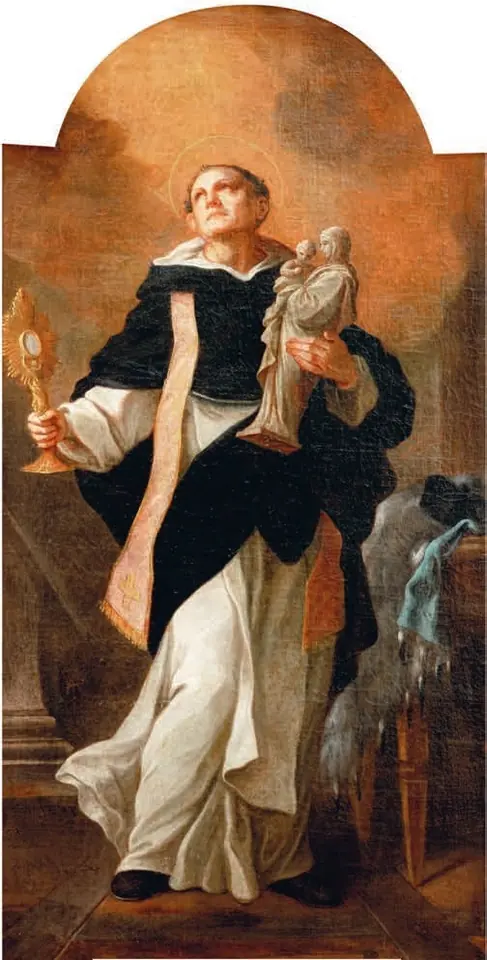
- A monstrance or ciborium: the Blessed Sacrament he carried out of Kiev. Older pictures show a ciborium; Baroque ones often show a sunburst monstrance, though monstrances of that shape came later.
- A statue of the Virgin and Child: the alabaster statue that asked to be saved. When you see a Dominican holding the Host in one hand and Our Lady in the other, it is almost always Hyacinth.
- Water underfoot or a spread cloak: the crossings of the Dnieper and the Vistula.
- A vision of Mary: the subject of Carracci's and El Greco's paintings. Tradition says the Virgin appeared to him and promised that his prayers would be heard.
- A lily: the common sign of purity, as on Carracci's altarpiece.

Spanish and Latin American painters often show him young and clean-shaven, as in the Quito portrait; Italian and Polish painters more often make him a bearded friar of middle age. In El Greco's version he simply stands in a dark church with his hand on his heart as the Virgin and Child appear above him.

Feast day, relics and canonization
His feast is August 17 in Poland and in the Dominican Order. Because he died on the Assumption, the older Roman calendar placed him on August 16. You can find saints of the same week on our feast days page.
Pope Clement VIII canonized Hyacinth in Rome on April 17, 1594. His relics have moved several times within his own church. A study of his tombs published in the Rocznik Krakowski in 2022 traces the story: buried in the north aisle in 1257, moved in 1543 to a chapel built above the choir screen, given a larger chapel with an alabaster tomb in 1581–1583, and finally, in 1615–1618, laid in the present chapel, which is reached by a staircase from the north aisle of the Basilica of the Holy Trinity on Stolarska Street. The Catholic Encyclopedia adds that a portion of his relics went to the Dominicans in Paris.

Prayer to St. Hyacinth
We have not found a traditional prayer to St. Hyacinth with a citable text that we can print here. In Poland the faithful have long used the short rhyme from the Nockowa legend above, "St. Hyacinth with your pierogi, pray to God for us," and at his chapel in Kraków pilgrims simply pray before his relics.
Let us ask St. Hyacinth, who would not leave the Blessed Sacrament or Our Lady behind, to pray that we may carry both with us wherever we go, and to pray for the people of Poland, Ukraine and every land he walked.
Frequently asked questions
Who was St. Hyacinth of Poland?
A Polish nobleman of the Odrowąż family, born about 1185, who studied at Kraków, Prague and Bologna, became a canon of Kraków and then one of the first Dominicans. St. Dominic sent him back to plant the Order in Poland. He founded the priory of the Holy Trinity in Kraków and preached as far as Scandinavia and the Black Sea before dying in Kraków on August 15, 1257.
When is the feast of St. Hyacinth?
August 17 in Poland and in the Dominican calendar. The older General Roman Calendar kept it on August 16, because August 15, the day he died, is the Assumption.
Why is St. Hyacinth shown holding a statue of Mary and a monstrance?
Because of the best-known story about him. When the Tatars sacked Kiev, he left the altar carrying the Blessed Sacrament, and a statue of the Virgin asked him not to leave her behind. He took the heavy alabaster statue too, found it light as a reed, and crossed the Dnieper dry-shod. The story is traditional.
What does "Święty Jacku z pierogami" mean?
"St. Hyacinth with your pierogi!" It is an old Polish exclamation tied to folk legends in which Hyacinth fed hungry villagers with pierogi. In the village of Nockowa, people said a little rhyme while eating them: "St. Hyacinth with your pierogi, pray to God for us." These are folk tales, not part of the oldest life.
When was St. Hyacinth canonized?
Pope Clement VIII canonized him in Rome on April 17, 1594, more than three centuries after his death.
Keep exploring
Sources
- Catholic Encyclopedia (1910): St. Hyacinth. Odrowąż family, studies, the habit from St. Dominic, missions, canonization by Clement VIII, Paris relic
- Alban Butler, Lives of the Saints (Benziger ed., 1894), August 16: St. Hyacinth. The Kiev story with the alabaster statue, the crossing of the Dnieper, the raising of a dead youth
- Czechowicz, Czyżewski, Szyma and Walczak, Grób i nagrobki świętego Jacka w dominikańskim kościele Świętej Trójcy w Krakowie do końca XVI wieku, Rocznik Krakowski 88 (2022). His burial, the chapels of 1543, 1581–1583 and 1615–1618, the life by the lector Stanisław and the canonization date
- Ministry of Agriculture (Poland): Pieczone pierogi św. Jacka. The Nockowa pierogi legend and rhyme, on the official list of traditional products
- City of Kraków: Patroni (patron saints of Kraków)