St. Juliana of Liège: The Nun Behind the Feast of Corpus Christi

St. Juliana of Liège (about 1192–1258), also called Juliana of Cornillon, was a Belgian canoness and mystic whose vision of a darkened moon led the Church to create the feast of Corpus Christi. Her feast day is April 5, and she is honored as an apostle of the Eucharist.
Who was St. Juliana of Liège?
St. Juliana of Liège was a thirteenth-century nun from what is now Belgium, and every Corpus Christi procession in the world owes something to her. She was an Augustinian canoness at Mont-Cornillon, on the edge of Liège, who loved Christ in the Eucharist from childhood. In prayer she saw a vision that told her the Church was missing a feast in honor of the Body and Blood of the Lord. She spent most of her life, and suffered a great deal, to see that feast created.
Pope Benedict XVI called her "little known," yet said the whole Church is "deeply indebted to her." She is also called Juliana of Cornillon or of Mont-Cornillon, after her convent. We keep her feast on April 5, the day she died in 1258.

The life of St. Juliana of Liège
An orphan at Mont-Cornillon
Juliana was born around 1192 at Retinne, near Liège; the Catholic Encyclopedia gives 1193. She and her sister Agnes lost their parents when Juliana was five, and the two girls were entrusted to the Augustinian sisters of Mont-Cornillon, who ran a house for lepers. A sister named Sapientia ("Wisdom") raised her. Juliana became a nun there and grew so learned that she could read St. Augustine and St. Bernard in Latin.
Benedict XVI pointed out that the Diocese of Liège was in those years a kind of "Eucharistic Upper Room," full of theologians who wrote on the Eucharist and groups of women devoted to adoration and frequent Communion. Juliana grew up in that world.
The moon with a dark stripe
When she was sixteen, during adoration, Juliana saw the full moon in all its brightness, crossed by a single dark stripe. The vision came back many times. In time she understood it: the moon was the Church on earth, and the dark line was the absence of a feast in which believers could adore the Eucharist, grow in faith and make reparation for offenses against the Blessed Sacrament.
She told no one for about twenty years. The vision is a reported private revelation, known from her life written by a contemporary cleric; the Church never ruled on it formally, but Urban IV alluded to it in the bull that created the feast.

Prioress, and a feast for Liège
By then Juliana had become prioress of her community. She shared her secret with two women devoted to the Eucharist, the recluse Blessed Eve, who lived as a recluse beside the church of St. Martin, and Isabella, who had joined her at Mont-Cornillon. Together they went to a respected canon of St. Martin's, John of Lausanne, and asked him to consult the theologians. The answers were favorable. The Catholic Encyclopedia names some of the men who heard about her idea: the Dominican Hugh of Saint-Cher, the archdeacon Jacques Pantaléon and Bishop Robert of Liège.
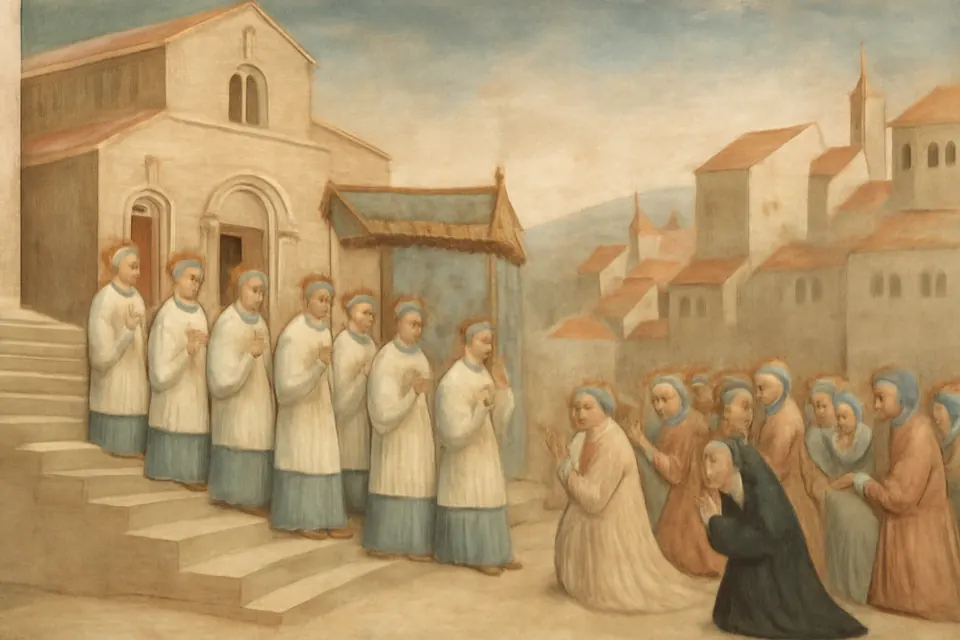
After some hesitation Bishop Robert agreed. At a synod in 1246 he ordered the feast for his diocese. He died that October before he could see it, but the canons of St. Martin kept the first feast of Corpus Christi.
Driven out
Juliana met harsh opposition from some of the clergy and even from the superior on whom her monastery depended, and intrigues drove her from her convent more than once. In 1248 she left the convent for good with a few companions. For the last ten years of her life she lived as a guest in Cistercian convents, and Benedict XVI noted that she never spoke a word of criticism against those who had wronged her.
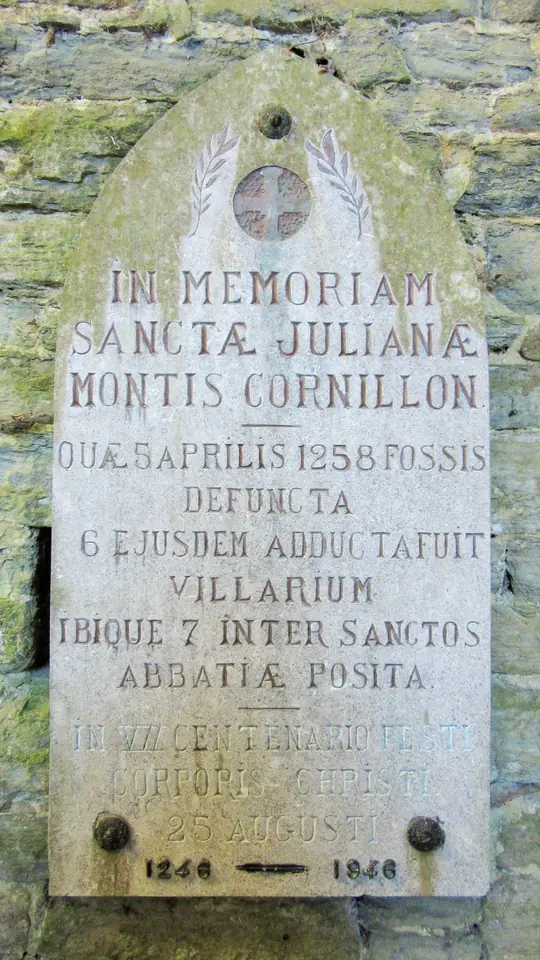
She died on April 5, 1258, at the house of the Cistercian nuns at Fosses, near Namur. According to her biographer the Blessed Sacrament was exposed in her cell, and she died in adoration. She was buried at the Cistercian abbey of Villers.
How Juliana's feast reached the whole Church
The archdeacon Jacques Pantaléon had known Juliana's plans in Liège. In 1261 he was elected pope as Urban IV. In 1264 he extended Corpus Christi to the whole Church, on the Thursday after Trinity Sunday, and in his bull he discreetly referred to her mystical experiences. He asked St. Thomas Aquinas to write the Office and Mass of the feast, the texts that give us the Pange lingua and the Tantum ergo. Urban died that same year, and for a time the feast was kept only in parts of France, Germany, Hungary and northern Italy, until Clement V at the Council of Vienne (1311) and John XXII in 1317 renewed it for the whole Church. Read more about the feast on our Corpus Christi page and about the Eucharistic miracles of the same era.
Symbols of St. Juliana of Liège in art
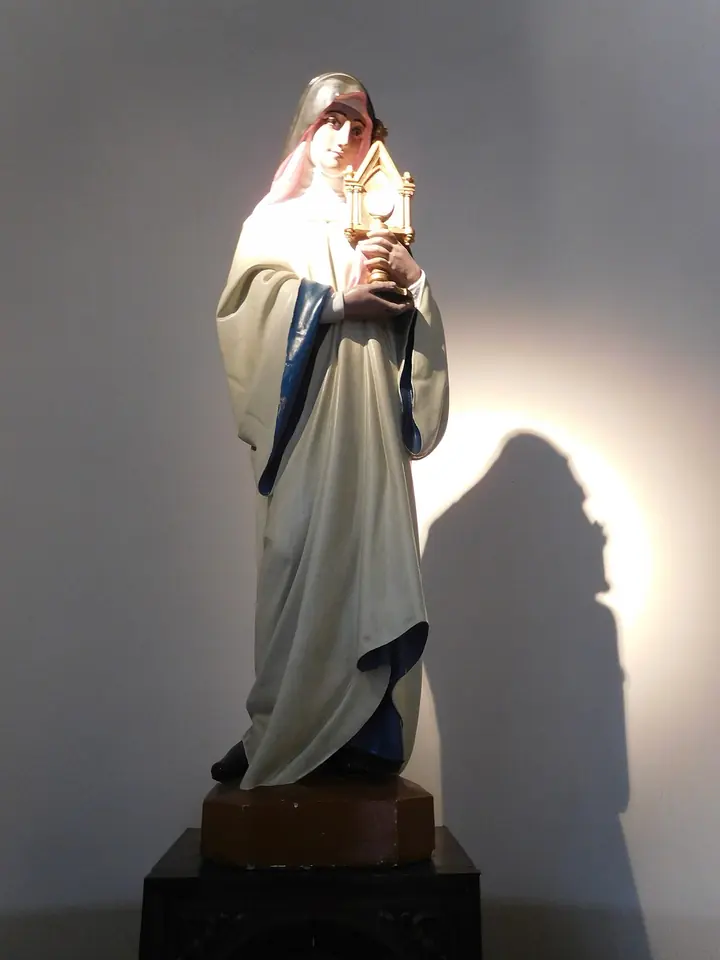
- The monstrance: her life's work, the feast of the Body of Christ. Modern statues, like the one in her church at Salzinnes, put a monstrance in her hands.
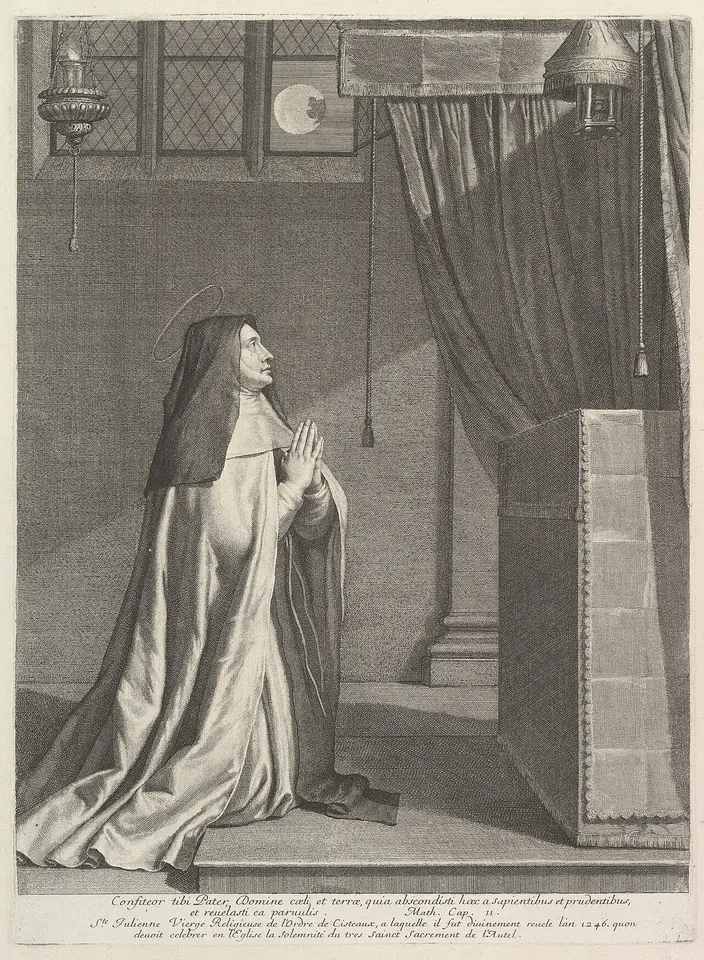
- The full moon with a dark band: her vision. Philippe de Champaigne shows the moon through the chapel window.
- The habit and veil: a white habit and black veil, as Champaigne painted her.
- Kneeling before the altar: her adoration of the Blessed Sacrament.
Champaigne's painting was engraved by Jean Morin, and the print carried her image well beyond Liège.
In Liège, Englebert Fisen painted her in 1690 for the church of St. Martin, where the feast began: the Virgin and angels lift a radiant monstrance above Juliana and her companions.

Feast day and where St. Juliana is honored
Her feast is April 5. In Liège, the Basilica of St. Martin on its hill keeps the memory of the first Corpus Christi. Her grave was at Villers Abbey, now a ruin in Villers-la-Ville in Walloon Brabant, where a stone in her memory stands. See the feast day calendar.
Prayer to St. Juliana of Liège
Juliana left us no written prayer of her own. The prayers that carry her devotion are the ones her feast gave us: the hymns of St. Thomas for Corpus Christi, sung at every Benediction. We can pray with her the Tantum ergo before the Blessed Sacrament and ask her intercession in our own words: "St. Juliana of Liège, pray for us."
Let us ask her to give us her love for Christ in the Eucharist and her patience when good work meets opposition.
Frequently asked questions
When is the feast day of St. Juliana of Liège?
April 5, the day she died in 1258 at Fosses-la-Ville. Some calendars keep her on April 6. She is not on the General Roman Calendar.
What was St. Juliana's vision?
At sixteen, during adoration, she saw the full moon shining but crossed by a dark stripe. She came to understand that the moon was the Church on earth and the dark line was a missing feast in honor of the Body and Blood of Christ. She kept it secret for about twenty years before telling her confessor.
How did St. Juliana start Corpus Christi?
Through her confessor, Canon John of Lausanne, her request reached Bishop Robert of Liège, who ordered the feast for his diocese in 1246. The archdeacon of Liège at the time, Jacques Pantaléon, later became Pope Urban IV and in 1264 extended Corpus Christi to the whole Church.
Where is St. Juliana of Liège buried?
At the Cistercian abbey of Villers in Brabant, now a ruin at Villers-la-Ville in Belgium. A memorial stone in the ruins records that she died at Fosses on April 5, 1258, and was laid among the saints of the abbey.
Keep exploring
Sources
- Benedict XVI, General Audience of November 17, 2010: Saint Juliana of Cornillon. the moon vision at sixteen, the twenty years of silence, Eve and Isabella, exile among Cistercians 1248–1258
- Catholic Encyclopedia (1908): Feast of Corpus Christi. born at Retinne; died April 5, 1258, at Fosses; buried at Villers; synod of 1246; the bull Transiturus