Franciscan Crown rosary
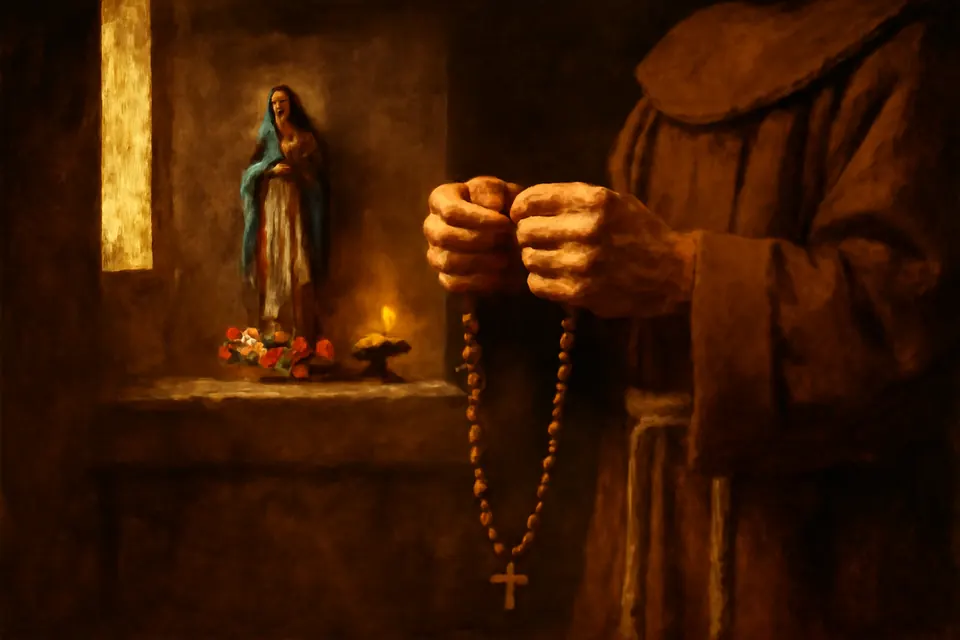
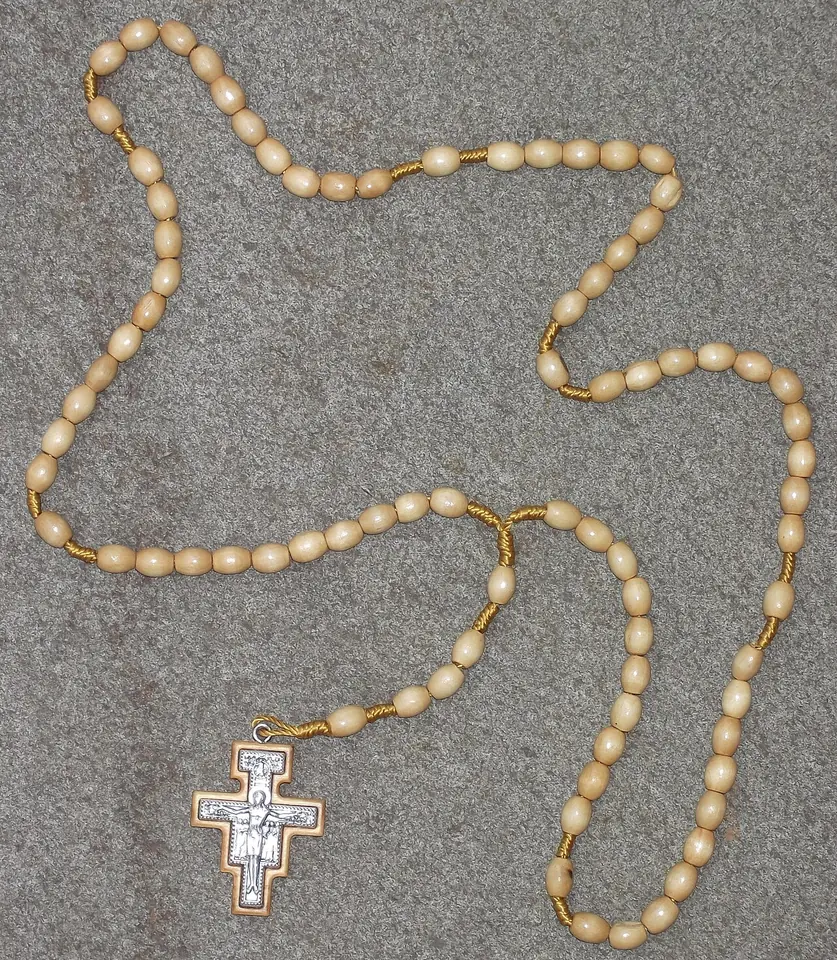
The Franciscan Crown rosary is a seven-decade rosary in honor of the seven joys of Mary: the Annunciation, the Visitation, the Nativity, the Adoration of the Magi, the Finding in the Temple, the Risen Christ's meeting with his Mother, and her Assumption and Coronation. Franciscan tradition dates it to 1422, and its 72 Hail Marys honor the years Mary is said to have lived.
The Franciscan Crown is the friars' own rosary: seven decades instead of five, each one a joy of the Blessed Virgin. Below is how to pray it, then the story of where it came from and what the Church has said about it.
How to pray the Franciscan Crown rosary
The Franciscan Crown has seven decades. Each decade is one Our Father and ten Hail Marys, prayed while we think about one of Mary's joys. Here is the order as it is most often prayed today:
- Begin with the Sign of the Cross. Since the 20th century it has been customary to open with a profession of faith, usually the Apostles' Creed.
- First decade, the Annunciation. Announce the joy, pray one Our Father, then ten Hail Marys.
- Second decade, the Visitation.
- Third decade, the Nativity of our Lord.
- Fourth decade, the Adoration of the Magi.
- Fifth decade, the Finding of Jesus in the Temple.
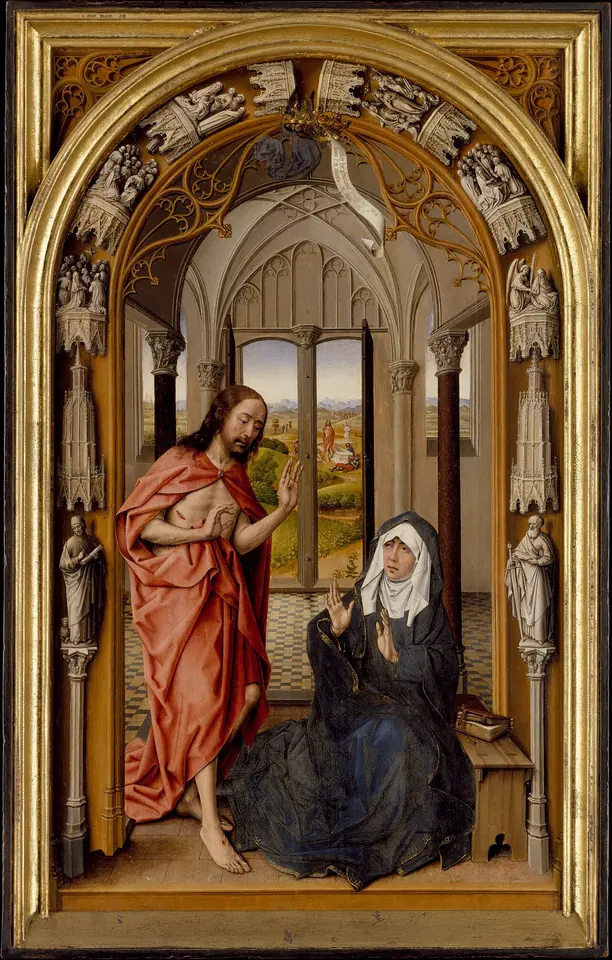
- Sixth decade, the Risen Jesus appears to his Mother.
- Seventh decade, the Assumption and Coronation of Mary.
- Two more Hail Marys, which bring the total to 72.
- One Our Father and one Hail Mary for the intentions of the Holy Father.
Many people close each decade with a Glory Be, as in the Dominican rosary. You can pray the whole crown on special seven-decade beads or simply go around an ordinary rosary a second time.
The Catholic Encyclopedia of 1908 describes an older custom that still shows up in Franciscan prayer books. Instead of only announcing the joy at the start of the decade, the friars named it inside the first Hail Mary, right after the holy name: "Jesus, whom thou didst joyfully conceive," "Jesus, whom thou didst joyfully carry to Elizabeth," and so on through the seven joys.
The seven joys of Mary
The joys follow Mary's life from the angel's greeting to her crowning in heaven. The first five come from the Gospels of St. Luke and St. Matthew; the last two come from the faith and tradition of the Church.
1. The Annunciation
The angel Gabriel greets Mary, "Hail, full of grace, the Lord is with thee" (Luke 1:28, Douay-Rheims), and she says yes to God. Here the Son of God took flesh in her womb.
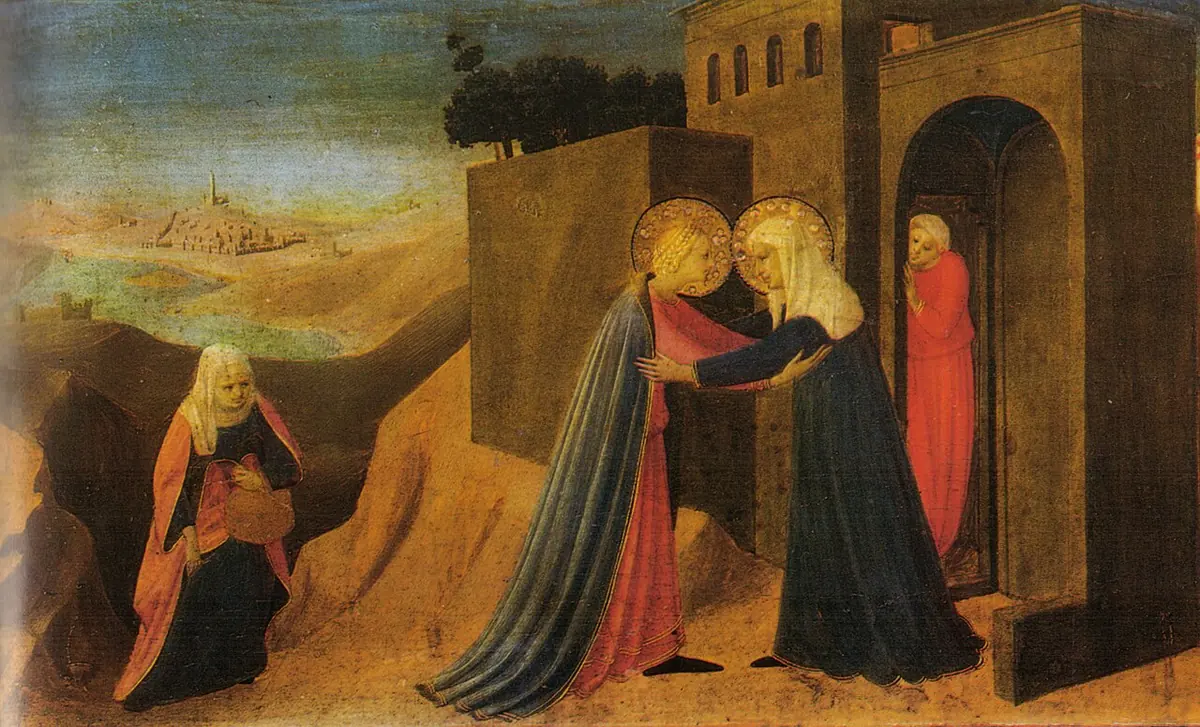
2. The Visitation
Mary hurries into the hill country to help her cousin St. Elizabeth, and the child in Elizabeth's womb, St. John the Baptist, leaps for joy. Mary answers with the Magnificat.
3. The Nativity
Jesus is born in Bethlehem and laid in a manger. The old Franciscan meditation dwells on Mary's happiness as she holds her newborn Son.
4. The Adoration of the Magi
The wise men from the East find the Child with his Mother and offer gold, frankincense and myrrh (Matthew 2:11). Read about them on our page for the Magi.
5. The Finding in the Temple
After three days of searching, Mary and St. Joseph find the twelve-year-old Jesus among the teachers in the Temple. The sorrow of losing him turns to joy.
6. The Risen Jesus appears to his Mother
The Gospels don't describe this meeting, but there is a long tradition that the risen Lord visited his Mother. The great Western painters loved it, and the Franciscans made it a joy of the crown.
7. The Assumption and Coronation
At the end of her earthly life, Mary was taken up body and soul into heaven, as Pius XII defined in 1950, and she reigns there as Queen. The Catholic Encyclopedia lists the Assumption and the Coronation together as the seventh joy.

Where the Franciscan Crown comes from
The story of the novice, 1422 (traditional)
The story comes to us through the Irish Franciscan historian Luke Wadding (1588 to 1657), whose annals of the order date the crown to 1422. A young man entered the Franciscans that year. Before he came to the friary he had a habit of crowning a statue of the Virgin with a wreath of fresh flowers. In the novitiate he could no longer do it, and he grew so unhappy that he decided to leave and go home.

Then, the story goes, Our Lady appeared to him. A 1970 leaflet from the Franciscan Herald Press gives her words this way:
Do not be sad and cast down, my son, because you are no longer permitted to place wreaths of flowers on my statue. I shall teach you to change this pious practice into one that will be far more pleasing to me and far more meritorious to your soul.
She taught him to say an Our Father and ten Hail Marys in honor of each of her seven joys, a crown of prayers in place of a crown of flowers that wither. Later the novice master passed by while the young man was praying and saw an angel weaving a wreath of roses, with a golden lily after every tenth rose, and setting it on the novice's head. Under obedience the novice told him everything, the master told his brothers, and the devotion spread through the whole order.
Some later tellings give the novice the name James and place the vision at Assisi. Wadding's account, as the Catholic Encyclopedia summarizes it, gives neither detail. We tell this story as traditional: a beloved account handed down by the order's historian, not an apparition the Church ever examined.

Older roots
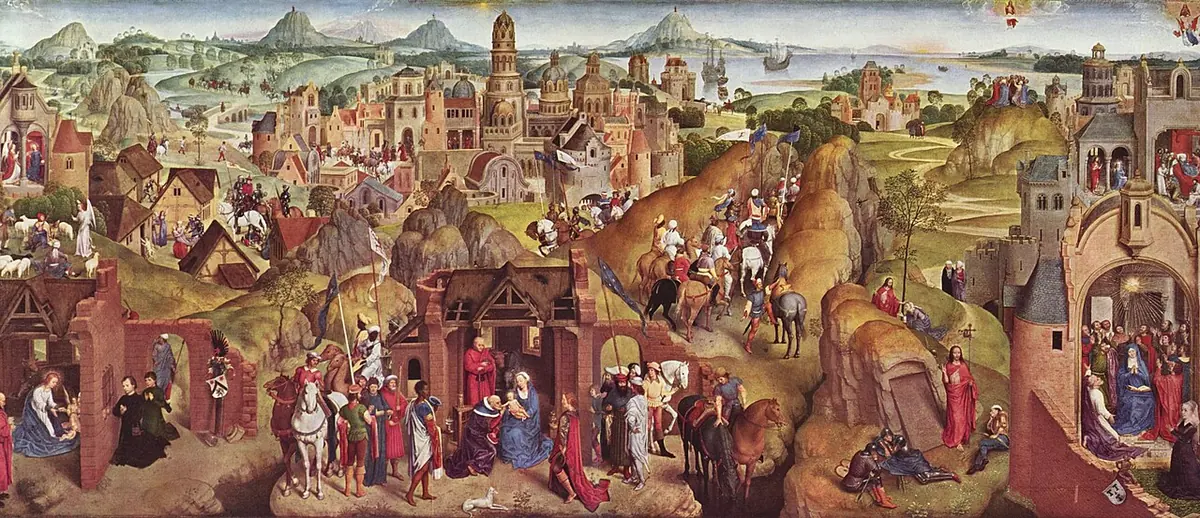
The idea of Mary's joys is older than 1422. The Secular Franciscans of Great Britain point to the 12th-century Gaudes, Latin verses that ask Mary to rejoice because God favored her in one way after another. Medieval painters made whole altarpieces of the joys, sometimes five, sometimes seven or more. The Franciscans gave the seven joys a fixed form on the beads.

The 72 Hail Marys
Later generations added two Hail Marys at the end, bringing the total to 72, "the number of years that the Blessed Virgin is said to have lived on earth," in the words of the Catholic Encyclopedia. That age is a tradition. Scripture doesn't say how old Mary was when her earthly life ended. Then came a final Our Father and Hail Mary for the Pope, which were once required for the indulgences.
The indulgences: what was granted, and what holds today
Few devotions were ever so richly indulgenced, and few have seen those grants change so completely.
- Before 1967. The Catholic Encyclopedia (1908) says that a plenary indulgence, applicable to the souls in purgatory, could be gained every time the crown was prayed, and that it was attached to the prayers themselves, not to the beads. In 1905 St. Pius X added several more indulgences open to all the faithful, at the request of the Friars Minor.
- The 1967 reform. Paul VI's Indulgentiarum Doctrina ordered the Church's collection of indulgences revised so that indulgences would be attached "only to the most important prayers and works," and it ordered the lists of indulgences special to religious orders revised too. The new Enchiridion Indulgentiarum appeared in 1968.
- What the Franciscans themselves said. The Franciscan Herald Press leaflet of 1970 is plain about it: the indulgences previously granted were abrogated, a limited number of new indulgences were granted to the Franciscan orders, "but among these there are none for the praying of the Franciscan Crown." It adds that this is no reason to give up the crown.
- Today. The current Enchiridion (2004) grants a partial indulgence to anyone who devoutly uses a rosary blessed by a priest, and a plenary indulgence for five decades of the Marian rosary prayed in a church, with the family, in a religious community or in a group. The 1970 leaflet suggested a way for Crown users to meet that rule: line up five of the seven decades with the Joyful Mysteries and pray them without a break. If you want an indulgence for a particular prayer, ask your parish priest or a Franciscan friary for the current rules.
So we pray the Franciscan Crown today for the reason the novice first prayed it: to honor Our Lady and to dwell with her on the joys God gave her.
Related prayers and saints
The Franciscan Crown sits beside two other famous chaplets of Mary. The Dominican rosary, with its Joyful, Sorrowful, Glorious and Luminous Mysteries, is explained step by step in our guide on how to pray the rosary, and the Joyful Mysteries share four of the crown's seven joys. The Servite friars have their own crown of seven, the Seven Sorrows rosary, so the joys and the sorrows of Mary each have a chaplet.
We ask the Franciscan saints to pray with us when we take up these beads: St. Francis of Assisi; St. Clare; St. Anthony of Padua; St. Bonaventure; St. Bernardine of Siena, who was preaching across Italy in the very years the crown took shape; and St. Maximilian Kolbe, the Franciscan knight of the Immaculata. Let us ask Mary, who knew every joy and sorrow of her Son's life, to keep us close to him, so that one day we may share the last of her joys in heaven. Holy Mary, Mother of God, pray for us.
Frequently asked questions
What is the Franciscan Crown rosary?
It is a rosary of seven decades instead of five, prayed in honor of seven joys in the life of the Virgin Mary. It is also called the Seraphic Rosary, the Franciscan Rosary or the Rosary of the Seven Joys. The Franciscan orders have prayed it since the 15th century.
What are the seven joys of Mary?
The Annunciation, the Visitation, the birth of Jesus, the Adoration of the Magi, the Finding of Jesus in the Temple, the appearance of the risen Jesus to his Mother, and Mary's Assumption and Coronation in heaven. This is the list given by the Catholic Encyclopedia (1908).
Why does the Franciscan Crown have 72 Hail Marys?
Seven decades make 70 Hail Marys. Two more were added at the end to make 72, in honor of the 72 years that Franciscan tradition says Mary lived on earth. That number is a pious tradition; Scripture doesn't tell us her age. A final Our Father and Hail Mary are said for the Pope's intentions.
How long does it take to pray the Franciscan Crown?
About 25 to 30 minutes for most people when praying slowly, a little longer than five decades of the rosary, because it has seven decades and two extra Hail Marys.
Is there an indulgence for the Franciscan Crown today?
Not by name. The many indulgences once attached to it ended with Paul VI's reform of indulgences, and a 1970 Franciscan Herald Press leaflet says plainly that the new grants for the Franciscan orders include none for the Crown. Using blessed beads devoutly carries a partial indulgence, and the Church grants a plenary indulgence for five decades of the Marian rosary prayed in church or with the family.
Can I pray the Franciscan Crown on ordinary rosary beads?
Yes. The beads only help you count. On a five-decade rosary, go around a second time for decades six and seven, then add two Hail Marys. Even the old indulgences, the Catholic Encyclopedia notes, were attached to the prayers, not to the beads.
Sources
- Catholic Encyclopedia (1908): Franciscan Crown
- EWTN: Franciscan Crown Rosary (from Ann Ball, A Handbook of Catholic Sacramentals)
- Franciscan Herald Press, The Franciscan Crown (1970 leaflet, hosted by the Secular Franciscan Order USA). Wadding's account, the 1968 indulgence changes
- Secular Franciscans of Great Britain: Franciscan Gallery, the Franciscan Crown
- Paul VI, Indulgentiarum Doctrina (1967), norms 13 and 14
- Apostolic Penitentiary, Enchiridion Indulgentiarum, 4th edition (2004)