Catholic prayer for hope
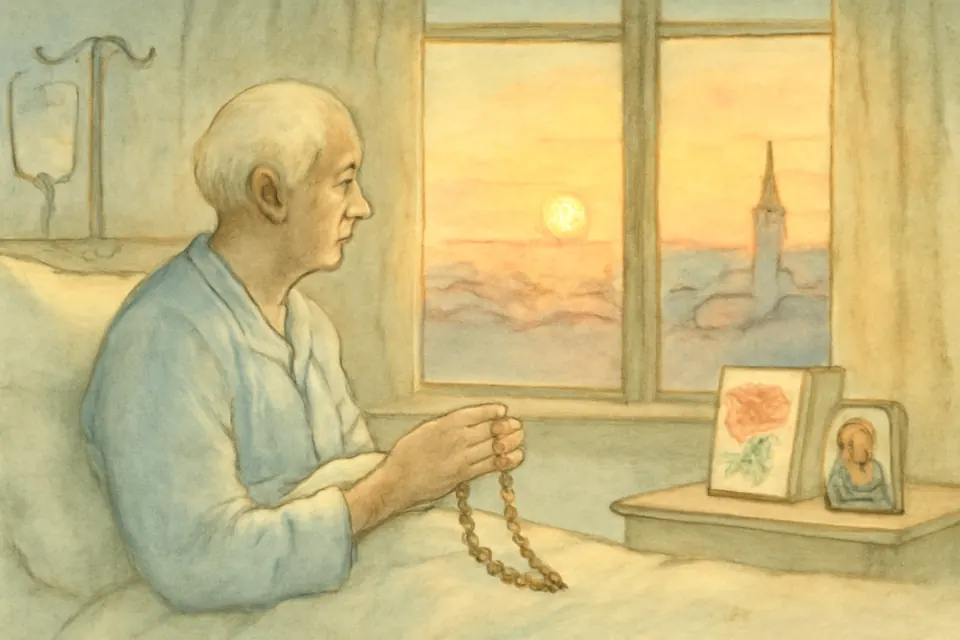
The Church's own prayer for hope is the Act of Hope: "My God, because Thou art almighty, infinitely good and merciful, I hope that, by the merits of the Passion and Death of Jesus Christ our Saviour, Thou wilt grant me eternal life." Pray it with Romans 15:13, "Now the God of hope fill you with all joy and peace in believing," and ask Our Lady of Hope to pray for you.
 Free printable prayer card 5 × 7 inch PDF, ready to print, frame or tuck in a missal.
Hope is the virtue we notice only when it runs low. A long illness, a death, a child far from the faith, a job lost at fifty, a world that seems to be getting worse: there are seasons when it is hard to see any light at all. The Church does not answer those seasons with cheerfulness. She answers with hope, which is something stronger, because it rests on God's promises and not on how things look. Here are the traditional Catholic prayers for hope, word for word and with their sources, with what the Church teaches about hope and the Scripture that has carried believers through their darkest nights.
The Act of Hope
The Act of Hope is the Church's basic prayer for hope, the one generations of Catholic children learned by heart along with the Acts of Faith and Love. Benedict XIII attached an indulgence to these acts in 1728, and Benedict XIV renewed it in 1756. This is the form in the 1910 Raccolta (no. 14):
My God, because Thou art almighty, infinitely good and merciful, I hope that, by the merits of the Passion and Death of Jesus Christ our Saviour, Thou wilt grant me eternal life, which Thou, most faithful, hast promised to all those who shall do the works of a good Christian, as I purpose to do by thy holy help.
Look at the reasons it gives. We hope because God is almighty (he can), because he is good and merciful (he wants to), because Jesus died for us (he already has), and because he is "most faithful" (he keeps his word). None of those reasons depends on how we feel today. That is why the Act of Hope still works on the days we can barely say it.
The more familiar Baltimore Catechism wording, and the Acts of Faith and Love beside it, are on our Acts of Faith, Hope and Love page.

What Christian hope is
Hope is one of the three theological virtues, given to us by God at Baptism along with faith and charity. The Catechism of the Catholic Church (no. 1817) defines it as "the theological virtue by which we desire the kingdom of heaven and eternal life as our happiness, placing our trust in Christ's promises and relying not on our own strength, but on the help of the grace of the Holy Spirit."
So Christian hope is not optimism. Optimism says things will probably turn out well. Hope says God will keep his promises even if things go badly, and that the last word belongs to him. The Catechism (no. 1818) says hope "keeps man from discouragement; it sustains him during times of abandonment."
The anchor
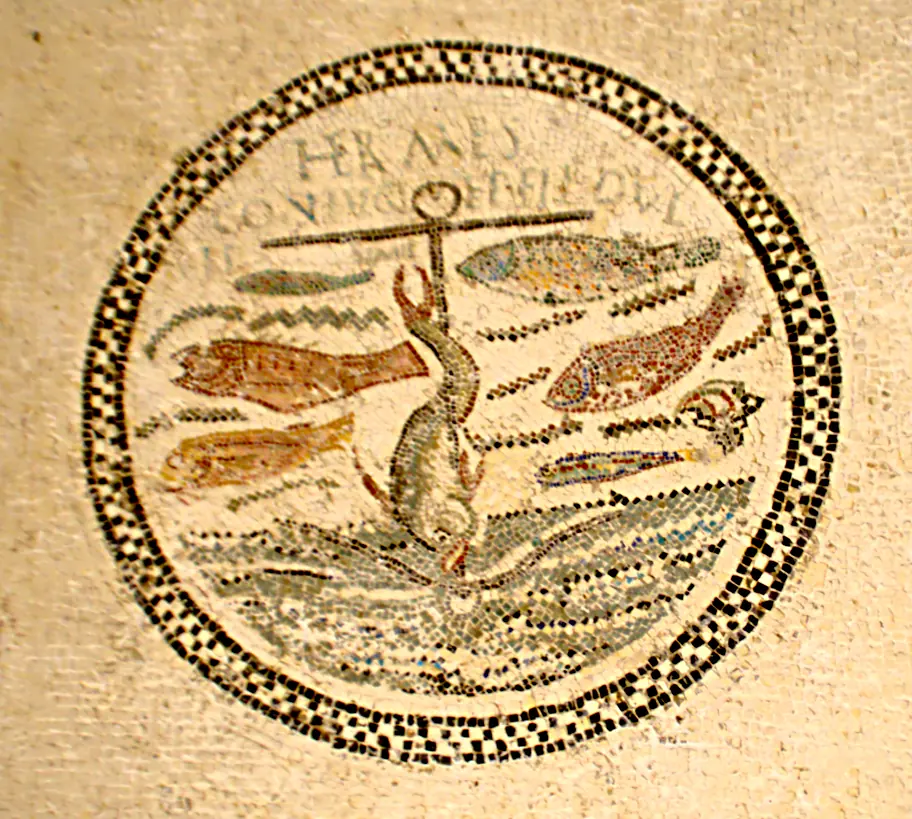
The first Christians drew hope as an anchor. They took the image from the Letter to the Hebrews (6:18–19, Douay-Rheims), which speaks of those "who have fled for refuge to hold fast the hope set before us. Which we have as an anchor of the soul, sure and firm, and which entereth in even within the veil." Anchors are carved on tombs in the Roman catacombs and set in mosaics across the Christian Mediterranean. An anchor does not stop the storm. It keeps the ship from being driven onto the rocks while the storm lasts.
The two sins against hope
The Catechism (no. 2091) names two ways we lose hope. Despair stops hoping that God will save us, help us, or forgive us. Presumption expects heaven without conversion, or thinks we can save ourselves. When you are tempted to think "God could never forgive this" or "nothing will ever change," that is the voice of despair, and the Act of Hope is its answer.
A prayer for hope to Our Lady, Mother of Confidence
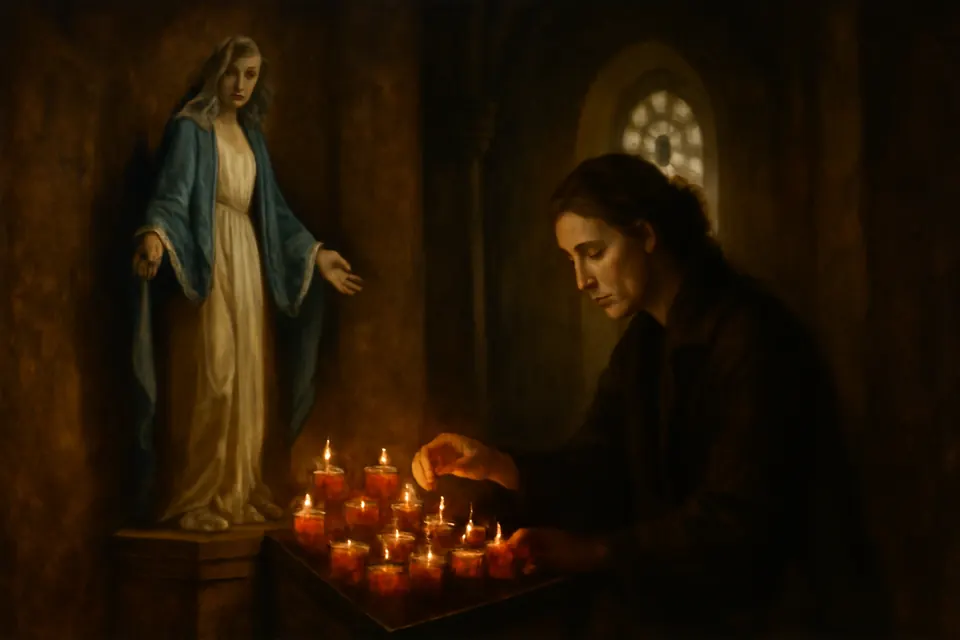
The Church calls Mary "our hope." The Salve Regina greets her as "our life, our sweetness, and our hope" (see the Hail Holy Queen), and the liturgy applies to her the words of Ecclesiasticus 24:24: "I am the mother of fair love, and of fear, and of knowledge, and of holy hope."
Leo XIII indulgenced this prayer to Our Lady under the title "Mother of Confidence" in 1901. From the 1910 Raccolta (no. 279):
Immaculate Mary, when we venerate thee under the gracious title of Mother of Confidence, how our hearts overflow with the sweetest consolation, how we are moved to hope for every good gift from thee! That such a name should have been given to thee is a sign that none have recourse to thee in vain. Receive, then, with a mother's compassion these acts of homage, with which we earnestly pray thee to be propitious to us in every necessity. Above all we ask thee to make us live ever united to thee and thy divine Son Jesus. Under thy escort we shall safely walk along the straight road; and so shall it be our lot to hear on the last day of our lives those consoling words: Come, O faithful servant, enter into the joy of thy Lord. Amen.
Our Lady of Hope at Pontmain
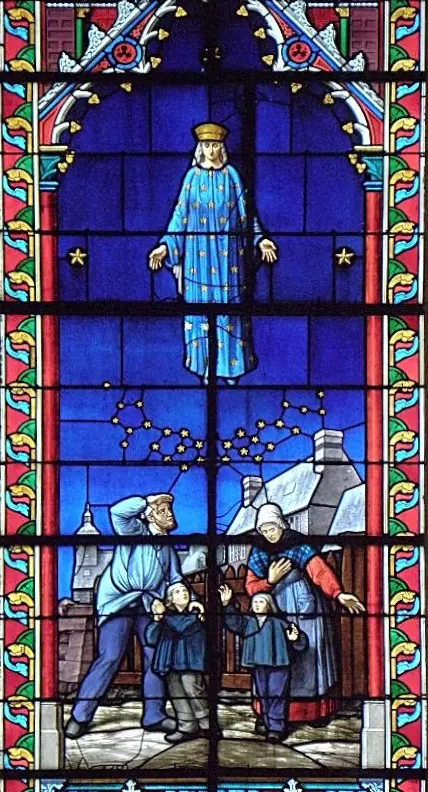
On the evening of January 17, 1871, France was losing a war, the Prussian army was approaching, and many families in the little village of Pontmain in Mayenne had sons away in the army. That night two brothers, Eugène and Joseph Barbedette, and then two other children, saw a beautiful Lady in a blue gown covered with gold stars in the sky above a barn. Beneath her, letters appeared one by one, which the children spelled out: "But oh! do pray, my children; God will answer you very soon. My Son lets his heart be touched." The Bishop of Laval recognized the apparition the following year and approved devotion to Mary under the title Our Lady of Hope. The basilica built at Pontmain bears that name. For the other apparitions the Church has recognized, see Marian apparitions.
St. Lucy's prayer for the virtue of hope
The Raccolta (no. 377) keeps a set of prayers to St. Lucy, indulgenced by Leo XIII in 1886, each asking for one of the virtues she lived. This is the prayer for hope. It recalls her journey with her sick mother to the tomb of St. Agatha and her trust in God through her martyrdom:
Victorious martyr, St Lucy, admirable was thy virtue of hope, which kept alive in thee the desire of heaven and nourished that filial confidence in God, our most loving Father, which possessed thy heart. Animated with this virtue, while praying fervently for thy mother at the tomb of St Agatha, thou didst obtain for her health in sickness. Full of trust in God, in order to become more completely detached from the things of this earth, thou didst willingly distribute to the poor whatever still remained to thee of earthly treasure; and if courage and strength never failed thee in resisting the tyrant, and in standing firm in the faith in the midst of unspeakable torments, it was solely because thou didst place thy hope in Him who has promised never to abandon us in dangers, but to be to us a shield of defence, ready to work even miracles, such as actually happened in thy glorious martyrdom. Let us then freely confess that too great an attachment to things here below and too little confidence in God harden our hearts, and so deprive us of courage that we often miserably succumb to occasions of danger. Obtain for us, we beseech thee, O blessed St Lucy, a more firm trust in our Lord and God, that we may deserve in every untoward event of our lives to have Him for our helper and consoler.
The prayer ends with an Our Father, a Hail Mary and a Glory Be. The healing of Lucy's mother and the wonders at her martyrdom belong to the traditional account of her life; her trust in God is the part every one of us is asked to copy.
Scripture for hope
These passages have carried believers through every kind of darkness. They are given in the Douay-Rheims translation.
Now the God of hope fill you with all joy and peace in believing; that you may abound in hope, and in the power of the Holy Ghost. (Romans 15:13)
Why art thou sad, O my soul? and why dost thou trouble me? Hope in God, for I will still give praise to him. (Psalm 41:6)
The Book of Lamentations, which tradition gives to Jeremias, mourns a city in ruins, and in the middle of it comes this (Lamentations 3:21–26):
These things I shall think over in my heart, therefore will I hope. The mercies of the Lord that we are not consumed: because his commiserations have not failed. They are new every morning, great is thy faithfulness. The Lord is my portion, said my soul: therefore will I wait for him. The Lord is good to them that hope in him, to the soul that seeketh him. It is good to wait with silence for the salvation of God.
Jeremias 29:11 is one of the most loved verses about hope. Modern versions speak of "a future and a hope"; the Douay-Rheims, following the Latin, reads:
For I know the thoughts that I think towards you, saith the Lord, thoughts of peace, and not of affliction, to give you an end and patience.
And St. Paul on how suffering itself can lead to hope (Romans 5:3–5):
And not only so; but we glory also in tribulations, knowing that tribulation worketh patience; And patience trial; and trial hope; And hope confoundeth not: because the charity of God is poured forth in our hearts, by the Holy Ghost, who is given to us.
A witness of hope: St. Josephine Bakhita
In his encyclical on hope, Spe Salvi (2007), Benedict XVI chose one saint to show what hope is: St. Josephine Bakhita. Kidnapped as a child in Sudan, sold five times, flogged until she bore 144 scars, she later came to know in Italy that God, the true "master," loved her. Benedict wrote that she now had "the great hope: 'I am definitively loved and whatever happens to me—I am awaited by this Love. And so my life is good.'"
That is the hope we ask for. It does not erase what has happened. It knows Who is waiting at the end.

The saints to ask for hope
- Our Lady of Hope, Mother of Confidence, who told the children of Pontmain, "do pray."
- St. Jude, patron of hopeless causes and desperate situations. See the St. Jude prayer.
- St. Rita of Cascia, the saint of impossible causes.
- St. Josephine Bakhita, for anyone who has suffered at the hands of others.
- St. Monica, who hoped and prayed for her son Augustine for some seventeen years. See the prayer to St. Monica.
- St. Dymphna, for those whose darkness is depression or mental illness. See our prayer for depression.
When hope is hard, start small. Pray the Act of Hope once in the morning and once at night. Go to Mass, where Christ's victory over death is made present. Tell someone how you are really doing. Let us pray together now with the psalmist: "In thee, O Lord, have I hoped, let me never be confounded." For more, see our prayers for comfort, for strength and for a miracle, and all our Catholic prayers.
Frequently asked questions
What is a good prayer for hope?
The Act of Hope: "My God, because Thou art almighty, infinitely good and merciful, I hope that, by the merits of the Passion and Death of Jesus Christ our Saviour, Thou wilt grant me eternal life." It is short enough to memorize and pray whenever discouragement comes.
What is a short prayer for hope?
Pray Psalm 30:2, "In thee, O Lord, have I hoped, let me never be confounded," or the line of the Litany of the Sacred Heart, "Heart of Jesus, salvation of those who hope in Thee, have mercy on us." Or simply: "Jesus, I trust in you."
What does the Catholic Church teach about hope?
The Catechism (no. 1817) calls hope the theological virtue "by which we desire the kingdom of heaven and eternal life as our happiness, placing our trust in Christ's promises and relying not on our own strength, but on the help of the grace of the Holy Spirit." Its opposites are despair and presumption.
Who is the patron saint of hope?
Our Lady is invoked as Our Lady of Hope, the title the Bishop of Laval gave her after the apparition at Pontmain in 1871. St. Jude is the patron of hopeless causes and St. Rita of impossible ones, and St. Josephine Bakhita is held up by Benedict XVI as a witness of hope.
What Bible verse is about hope?
Romans 15:13: "Now the God of hope fill you with all joy and peace in believing; that you may abound in hope." Also Romans 5:5, "hope confoundeth not," Hebrews 6:19, which calls hope "an anchor of the soul, sure and firm," and Lamentations 3:22–23, "his commiserations have not failed. They are new every morning."
Sources
- The Raccolta, or Collection of Indulgenced Prayers and Good Works (Burns & Oates, 1910), nos. 14 (Act of Hope), 279 (Mother of Confidence) and 377 (prayers to St. Lucy), Internet Archive
- Catechism of the Catholic Church, nos. 1817-1821: the theological virtue of hope (Vatican)
- Catechism of the Catholic Church, nos. 2090-2092: hope, despair and presumption (Vatican)
- Benedict XVI, encyclical Spe Salvi (November 30, 2007), no. 3, on St. Josephine Bakhita (Vatican)
- Marie de Nazareth: Our Lady of Pontmain
- Douay-Rheims Bible, Lamentations chapter 3 (drbo.org)