Baptism of the Lord 2027
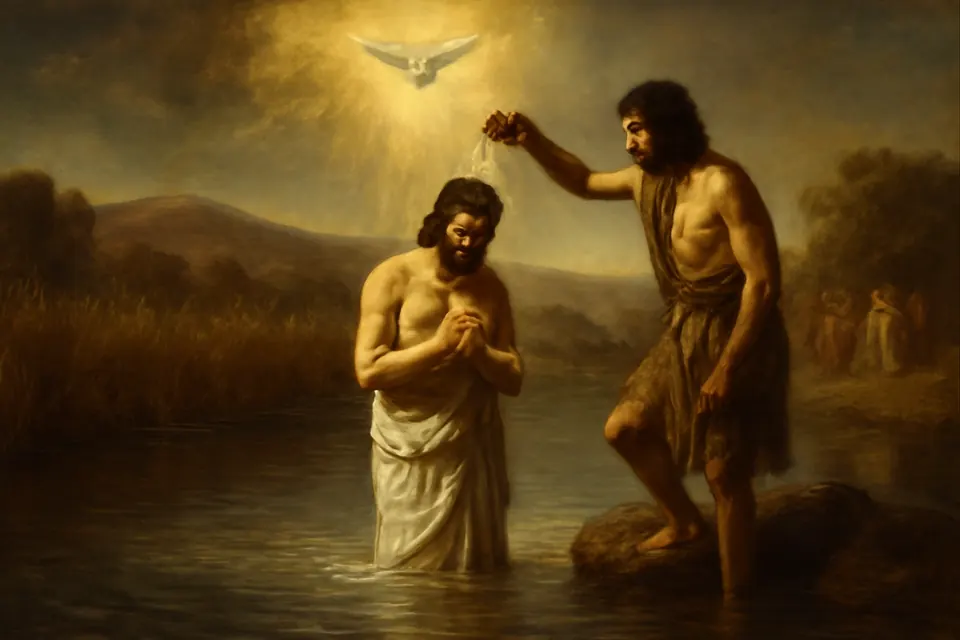
The Baptism of the Lord 2027 is Sunday, January 10, 2027, in the United States and throughout the Roman Church. The feast remembers Jesus being baptized by John in the Jordan, when the Spirit descended as a dove and the Father called him his beloved Son. It closes the Christmas season; Ordinary Time begins Monday, January 11.
The Baptism of the Lord 2027 is Sunday, January 10, 2027. On this feast the Church goes with Jesus to the Jordan River, where John baptized him, the Holy Spirit came down on him like a dove and the Father's voice said, "Thou art my beloved Son; in thee I am well pleased" (Mark 1:11). It is the last day of the Christmas season. The Child the Magi adored a week earlier now stands in the river as a grown man, ready to begin his public ministry.
Baptism of the Lord 2027 at a glance
- Date: Sunday, January 10, 2027, with the Vigil Mass on Saturday evening, January 9
- Rank: feast of the Lord; liturgical color white
- Lectionary: Year B, the year of St. Mark's Gospel
- Readings: Isaiah 42:1-4, 6-7 or Isaiah 55:1-11; Acts 10:34-38 or 1 John 5:1-9; Mark 1:7-11
- The Sunday before: the Epiphany, Sunday, January 3, 2027, in the United States
- The day after: Monday, January 11, 2027, the first weekday of Ordinary Time
- The next Sunday: the Second Sunday in Ordinary Time, January 17, with the Gospel of John 1:35-42, where two of John's disciples follow Jesus
These dates are from the US bishops' liturgical calendar for 2027. In countries that keep the Epiphany on its traditional day, Wednesday, January 6, the Baptism of the Lord also falls on Sunday, January 10, since it is the first Sunday after January 6. So in 2027 the whole Roman Church keeps the feast on the same day.
How the date of the Baptism of the Lord is set
The rule looks complicated, but it comes down to two lines in the Church's Universal Norms on the Liturgical Year, quoted by the liturgist Fr. Edward McNamara:
- "The Sunday falling after 6 January is the feast of the Baptism of the Lord" (no. 38).
- "The Christmas season runs from evening prayer I of Christmas until the Sunday after Epiphany or after 6 January, inclusive" (no. 33).
That works simply where the Epiphany is kept on January 6. The United States, like many countries, moves the Epiphany to a Sunday: the Sunday between January 2 and January 8. In most years the Baptism then falls on the following Sunday, as in 2027 (Epiphany on January 3, Baptism on January 10).
The exception comes when the Epiphany lands on January 7 or 8. Then the "Sunday after January 6" is the Epiphany itself, and there is no room for a second feast that weekend. In that case the Baptism of the Lord moves to the Monday right after the Epiphany. That happened on Monday, January 8, 2024, when the US calendar listed the Epiphany on Sunday, January 7, and the Baptism the next day. On that Monday it is a feast, but not a day of obligation.
Looking ahead:
- 2027: Sunday, January 10 (Epiphany in the US on January 3)
- 2028: Sunday, January 9 (Epiphany in the US on January 2)
- 2029: Monday, January 8, in the US, where the Epiphany is Sunday, January 7; Sunday, January 7, where the Epiphany is kept on Saturday, January 6
- 2030: Sunday, January 13 (Epiphany in the US on January 6)
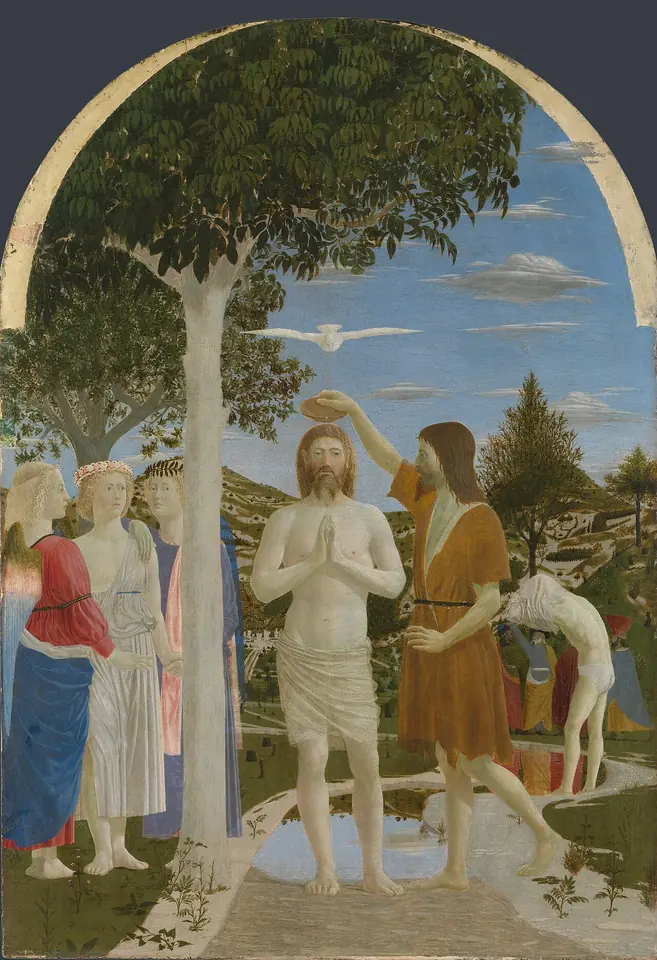
The Gospel of the Baptism of the Lord
In 2027 we hear St. Mark's account, the shortest and swiftest of the four. Here it is in the Douay-Rheims translation:
And he preached, saying: There cometh after me one mightier than I, the latchet of whose shoes I am not worthy to stoop down and loose.
I have baptized you with water; but he shall baptize you with the Holy Ghost.
And it came to pass, in those days, Jesus came from Nazareth of Galilee, and was baptized by John in the Jordan.
And forthwith coming up out of the water, he saw the heavens opened, and the Spirit as a dove descending, and remaining on him.
And there came a voice from heaven: Thou art my beloved Son; in thee I am well pleased. (Mark 1:7-11)
St. Matthew adds a moment that Mark leaves out. When Jesus came to him, John tried to stop him: "I ought to be baptized by thee, and comest thou to me?" And Jesus answered, "Suffer it to be so now. For so it becometh us to fulfill all justice" (Matthew 3:14-15). St. Luke adds that Jesus was praying when the heavens opened (Luke 3:21).
The first reading, from Isaiah 42, is the first of the Servant Songs: "Behold my servant, I will uphold him: my elect, my soul delighteth in him: I have given my spirit upon him." The voice at the Jordan echoes those words. The second reading, from Acts 10, is St. Peter preaching in the house of Cornelius, telling how "God anointed him with the Holy Ghost, and with power" after "the baptism which John preached."
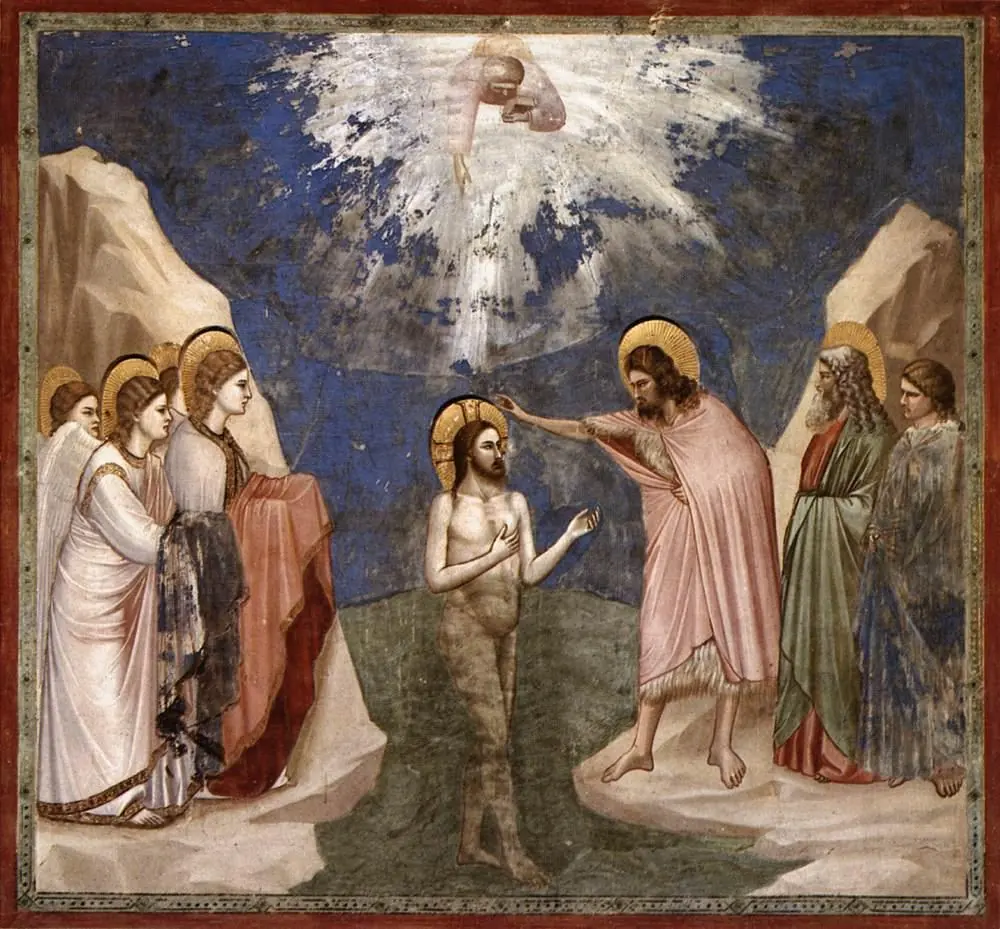
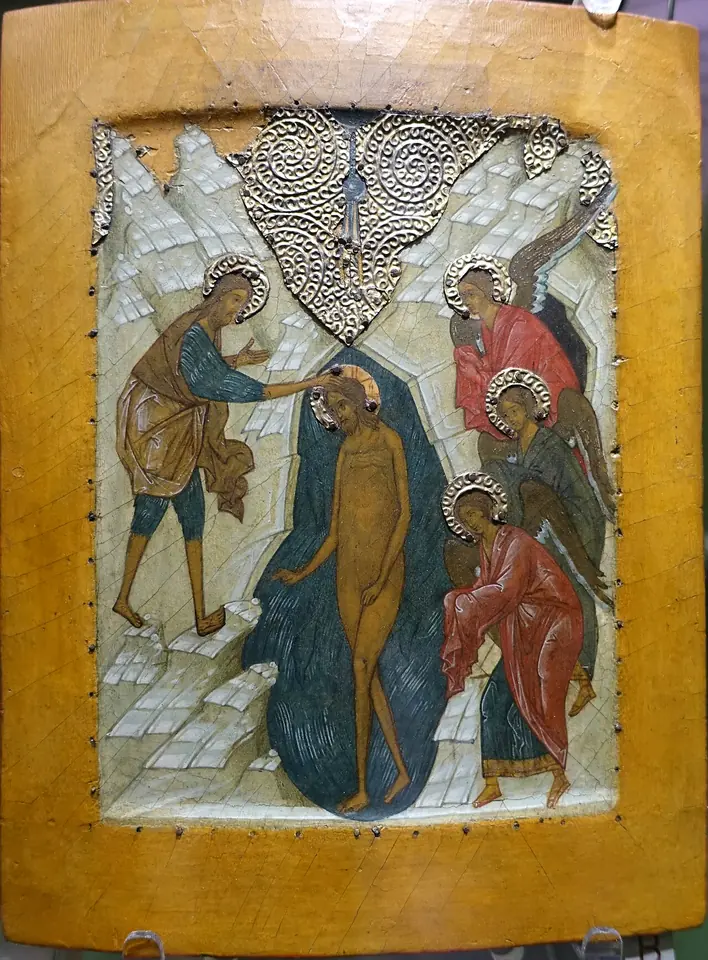
The Baptism of Jesus: what happened at the Jordan
John the Baptist had been preaching in the wilderness and baptizing crowds from Judea and Jerusalem who came "confessing their sins" (Mark 1:5). His baptism was a sign of repentance, a washing that prepared people for the one who was coming. It was not yet the sacrament of Baptism, which Christ himself would give.
Then Jesus came, about thirty years old (Luke 3:23), from the quiet years at Nazareth. Three things happened at once when he came up from the water:
- The heavens were opened. Since Adam, heaven had been closed to us. Now it opens over the man standing in the river.
- The Spirit came down like a dove. The dove recalls the Spirit moving over the waters at creation and the dove that brought Noah the olive branch after the flood. Here begins a new creation.
- The Father spoke. "Thou art my beloved Son." Jesus is shown publicly as the Son of God at the start of his ministry.
That is why the Church has always seen the Baptism of the Lord as a revelation of the Holy Trinity: the Father's voice, the Son in the water, the Spirit in the form of a dove. The Eastern churches call the feast Theophany, "the showing of God," for that reason.
St. John's Gospel gives the Baptist's own testimony: "I saw the Spirit coming down, as a dove from heaven, and he remained upon him ... And I saw, and I gave testimony, that this is the Son of God" (John 1:32, 34). A day later John points to Jesus and says, "Behold the Lamb of God," and two of his disciples, one of them St. Andrew, leave John to follow Jesus. That is the Gospel of the next Sunday, January 17.
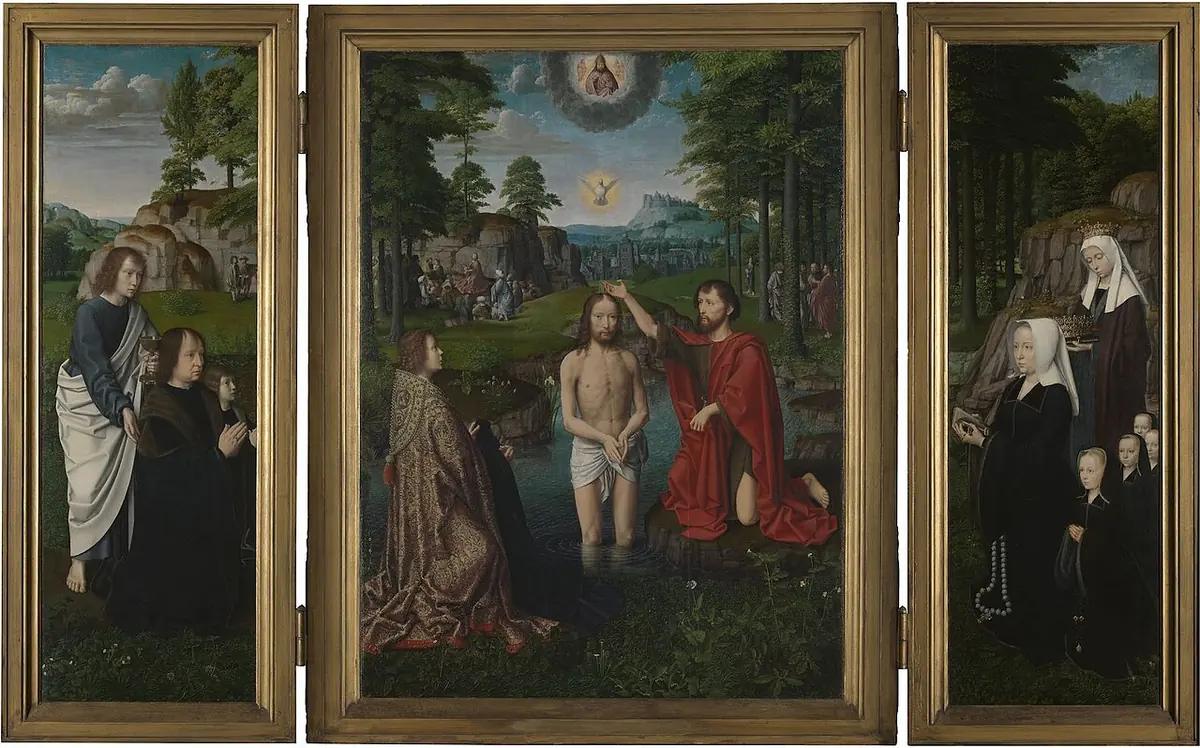
Why was Jesus baptized?
It is the question every child asks, and a good one: if Jesus had no sin, why did he go down into a river of repentance? John himself asked it. St. Thomas Aquinas gathers the answers of the Fathers in his Summa Theologiae (III, q. 39, a. 1):
- To make the waters holy for us. Quoting St. Ambrose: "Our Lord was baptized because He wished, not to be cleansed, but to cleanse the waters, that, being purified by the flesh of Christ that knew no sin, they might have the virtue of baptism." St. John Chrysostom adds that he did it "that He might bequeath the sanctified waters to those who were to be baptized afterwards."
- To take our place. Though he needed no baptism for his own sake, he took on our nature, and our nature needed it. St. Gregory of Nazianzus says, "Christ was baptized that He might plunge the old Adam entirely in the water."
- To go first. With St. Augustine: "because He wished to do what He had commanded all to do." That is what he meant by "so it becometh us to fulfill all justice." Ambrose again: "this is justice, to do first thyself that which thou wishest another to do, and so encourage others by thy example."
Aquinas adds that the Spirit came down on Christ at the Jordan because what happened to him there "is connected with the mystery accomplished in all who were to be baptized afterwards." In other words, the open heaven, the Spirit and the Father's word are what happen to us at our own Baptism. We are washed, the Spirit comes to dwell in us, and the Father calls us his children.
A short history of the feast
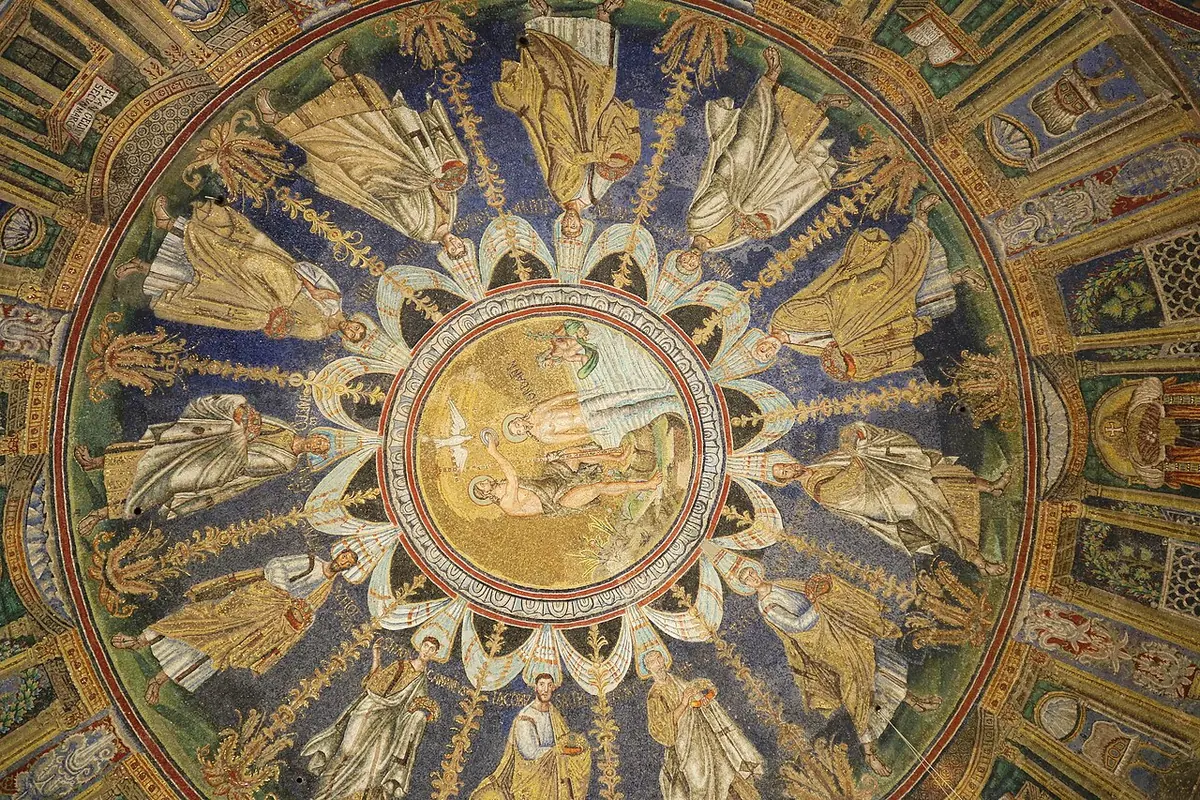
The Baptism of Christ is one of the oldest things the Church celebrated. In the East, January 6 began as a feast of the Lord's birth and his baptism together, and the Orthodox and Eastern Catholic churches still center their Theophany on the Jordan; see our Epiphany 2027 page for the old antiphon that joins the Magi, the Jordan and Cana in one feast.
In the West, the Magi came to fill the Epiphany, and the Baptism was remembered within its octave. Fr. Edward McNamara traces how January 13, the octave day of the Epiphany, became a commemoration of the Lord's Baptism in the reforms of the 1950s and of St. John XXIII in 1960. The reform after the Second Vatican Council then placed the feast on the Sunday after the Epiphany, "thus officially concluding Christmastide and inaugurating ordinary time."
The Baptism also opens the Rosary's mysteries of light. When St. John Paul II added the luminous mysteries in 2002, he made the Baptism in the Jordan the first of them. And on this feast in 1981 he began a custom his successors have kept: the pope baptizes infants, many of them the children of Vatican employees, in the Sistine Chapel.
How we keep the Baptism of the Lord
The feast is about Christ, but it points straight at us. Each of us was carried to a font, or walked down to one, and was baptized "in the name of the Father, and of the Son, and of the Holy Spirit," the same Trinity shown at the Jordan. Here are some ways to keep the day.
Remember your own Baptism
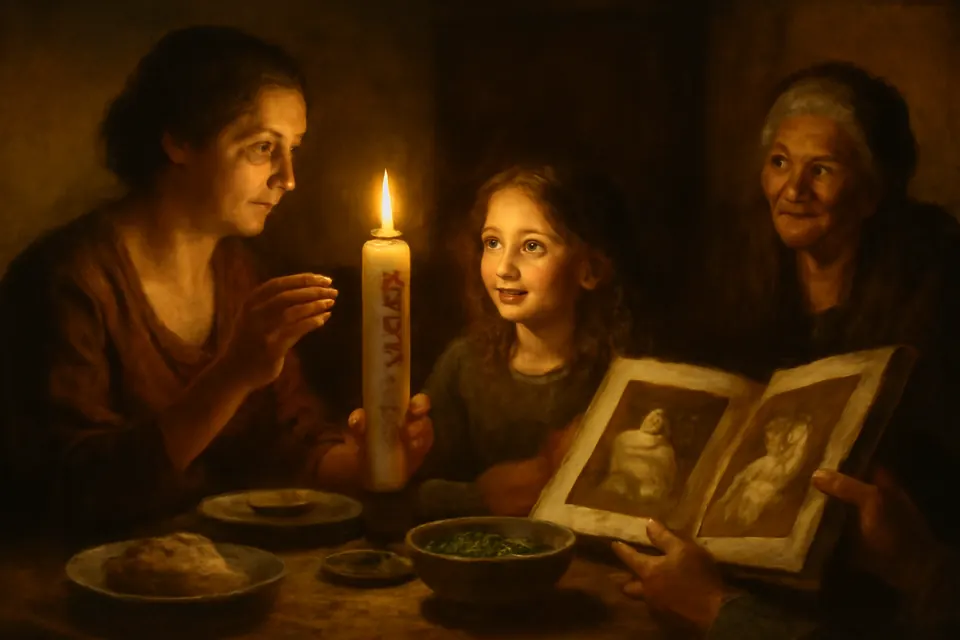
Find out your baptism date and the church where it happened. Most parishes will look it up from their records. Write it on the family calendar beside birthdays and keep it each year. If you still have your baptismal candle, light it at supper on January 10 and tell the children the story of their own baptism day: who their godparents are, who poured the water, what name was given.
Bless yourself with holy water
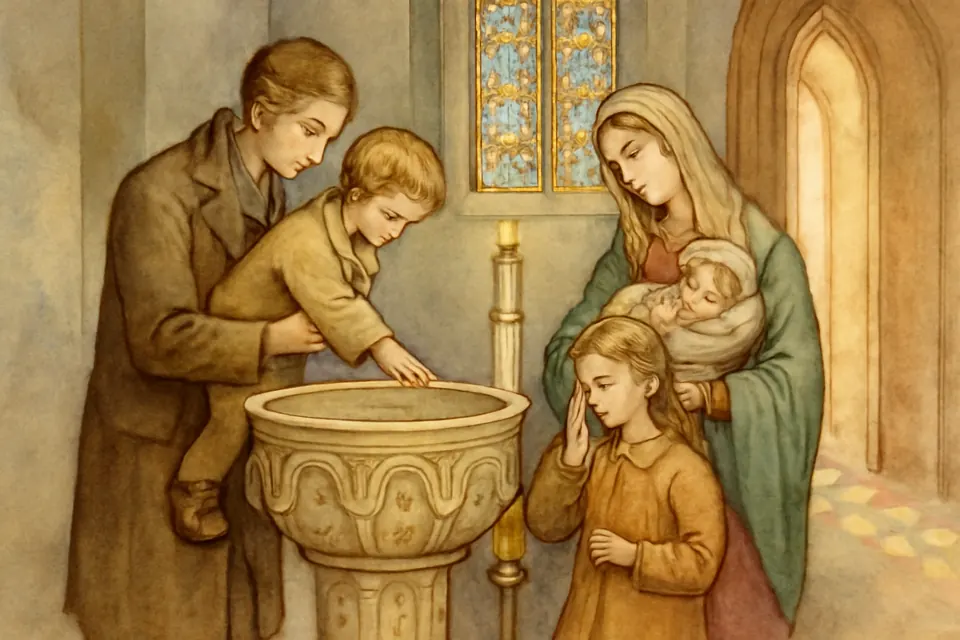
Many churches place the baptismal font at the entrance for a reason: we bless ourselves with water as we come in, remembering the door through which we entered the Church. After Mass on the feast, stop at the font with your family, and take some holy water home for the year. At home, keep a small font by the front door or a bedroom door.
Renew your baptismal promises
At Easter the whole Church renews its baptismal promises: we reject Satan and all his works and profess the Creed. The Baptism of the Lord is a good day to do it again at home. Read Mark 1:7-11 aloud, then pray the Apostles' Creed together as your own profession of the faith you were baptized into. Thank God for your godparents by name, and pray for them.
Pray the first luminous mystery
Pray a decade on the Baptism in the Jordan, with the Our Father, ten Hail Marys and the Glory Be. Our page on how to pray the Rosary has the steps.
The Blessing of Waters
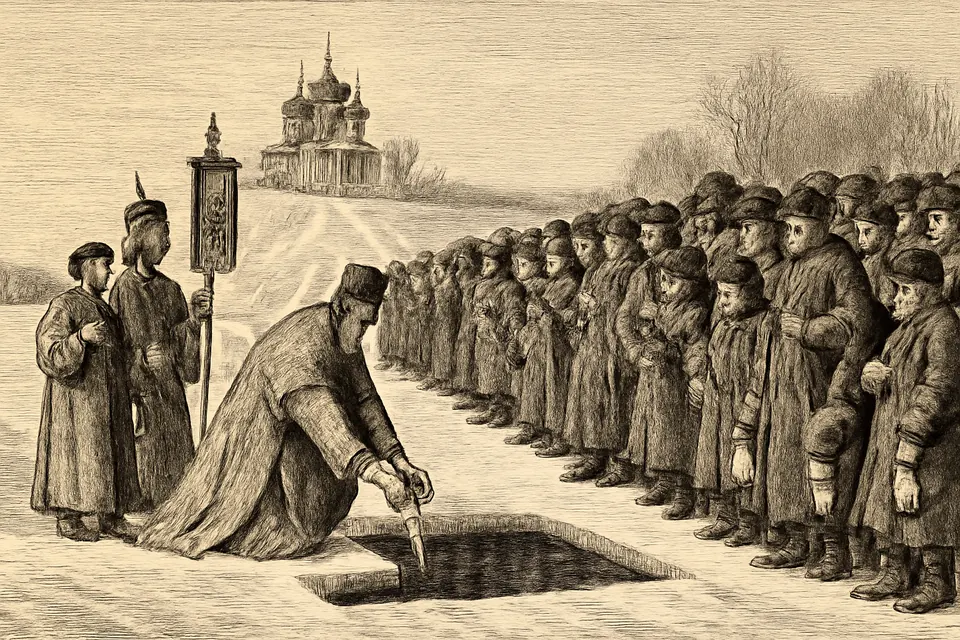
In the Orthodox and Eastern Catholic churches, Theophany brings the Great Blessing of Waters: the priest blesses water in the church or outdoors at a river, lake or the sea, often plunging a cross into it, and the faithful carry the water home. Churches on the Julian calendar keep Theophany on January 19. At the Jordan itself, thousands of pilgrims gather at the traditional site of the Baptism near Jericho.
Where Jesus was baptized
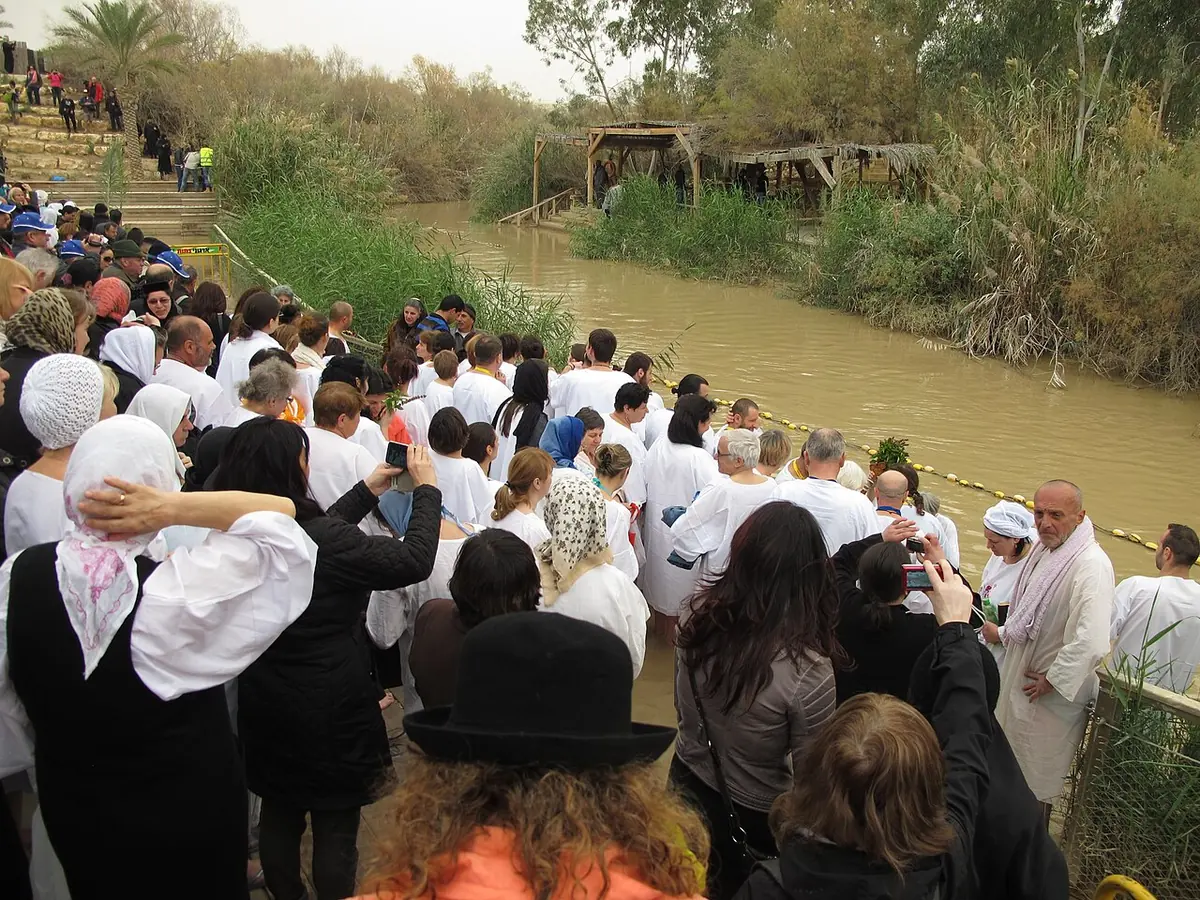
St. John's Gospel says John was baptizing at "Bethania, beyond the Jordan" (John 1:28), on the east bank of the river. Pilgrims today visit two sites facing each other across the Jordan a few miles north of the Dead Sea, near Jericho: Al-Maghtas in Jordan, on the eastern bank, where the remains of early churches and baptismal pools have been uncovered, and Qasr al-Yahud on the western bank. At both, pilgrims renew their baptismal promises, and many wade into the water.
The end of the Christmas season
With the Baptism of the Lord, the Christmas season ends. On Monday, January 11, 2027, green vestments return and the first week of Ordinary Time begins. Many families take down the tree that weekend, though the old custom of keeping the Nativity scene up until Candlemas on February 2, forty days after Christmas, is a lovely one to keep.
The saints of the following week include St. Hilary of Poitiers, the great 4th-century defender of the Trinity, on January 13. For the whole year ahead, see the Catholic calendar 2027 and the holy days of obligation 2027. The feast that opened the season of the Name, the Holy Name of Jesus, and St. John the Baptist, who baptized him, are both worth reading this week.
A prayer for the Baptism of the Lord
Lord Jesus, You stepped into the Jordan though You had no sin, so that the waters might be made holy for us. On the day of our own Baptism You opened heaven over us, sent Your Spirit into our hearts and let the Father call us his children. Help us to live as what we are. Renew in us the grace of that day; make us faithful to the promises spoken for us; bless our parents and godparents; and bring to the waters of Baptism all who have not yet found You. With St. John the Baptist we say: Behold the Lamb of God. Amen.
Pastor Lyvers wrote this prayer for this page.
Frequently asked questions
When is the Baptism of the Lord in 2027?
Sunday, January 10, 2027. The USCCB's liturgical calendar lists it on that day for the United States, and it falls on the same Sunday in countries that keep the Epiphany on January 6, because January 10 is the first Sunday after January 6 either way.
Is the Baptism of the Lord a holy day of obligation?
It is a feast, not a holy day of obligation in itself. In 2027 it falls on a Sunday, so the ordinary Sunday obligation applies. In years when it moves to a Monday in the United States, Mass that day is not required.
Why is the Baptism of the Lord sometimes on a Monday?
The feast belongs on the Sunday after January 6. In the United States the Epiphany is moved to the Sunday between January 2 and 8, so when that Sunday is January 7 or 8, the Baptism of the Lord moves to the next day, a Monday, as on January 8, 2024. The next time this happens is Monday, January 8, 2029.
Does the Baptism of the Lord end the Christmas season?
Yes. The Christmas season runs until the Sunday after the Epiphany, and the Baptism of the Lord is its last day. In 2027 Ordinary Time begins on Monday, January 11. Many families still keep the Nativity scene up until Candlemas on February 2.
Why was Jesus baptized if he had no sin?
St. Thomas Aquinas, following St. Ambrose, answers that Christ was baptized "not to be cleansed, but to cleanse the waters" and give them the power to baptize us; that he took on our nature, which needed baptism; and, with St. Augustine, that he wished to do first what he would command everyone to do.
Where was Jesus baptized?
In the Jordan River. St. John's Gospel places John's baptizing at "Bethania, beyond the Jordan" (John 1:28). Pilgrims today visit two sites facing each other across the river near Jericho: Al-Maghtas in Jordan and Qasr al-Yahud on the western bank.
What are the readings for the Baptism of the Lord 2027?
2027 is Year B. The USCCB calendar gives Isaiah 42:1-4, 6-7 or Isaiah 55:1-11; Acts 10:34-38 or 1 John 5:1-9; and the Gospel of Mark 1:7-11.
What happened at the Baptism of Jesus?
Jesus came from Nazareth to the Jordan and was baptized by John. As he came up out of the water, he saw the heavens opened and the Spirit descending on him as a dove, and a voice from heaven said, "Thou art my beloved Son; in thee I am well pleased" (Mark 1:11). The whole Trinity is shown at once.
Sources
- USCCB: Liturgical Calendar for the Dioceses of the United States of America, 2027 (PDF). January 3, 2027: USA, the Epiphany; January 10: the Baptism of the Lord, with the Year B readings; January 11: First Week in Ordinary Time
- USCCB: Liturgical Calendar for the Dioceses of the United States of America, 2024 (PDF). Epiphany on Sunday, January 7, 2024, and the Baptism of the Lord on Monday, January 8: the Monday rule in practice
- Fr. Edward McNamara, "Baptism of the Lord and Ordinary Time" (ZENIT), EWTN Library. Universal Norms on the Liturgical Year, nos. 33, 38 and 44
- Fr. Edward McNamara, "Baptism and Presentation of Our Lord" (ZENIT, 2008), EWTN Library. The octave of the Epiphany, the January 13 commemoration of the Baptism, and the move to the Sunday after the Epiphany
- St. Thomas Aquinas, Summa Theologiae III, q. 39: The baptizing of Christ (New Advent)
- Douay-Rheims Bible: Mark 1
- National Catholic Register (CNA), "PHOTOS: Pope Francis Baptizes 16 Babies in the Sistine Chapel" (2024). St. John Paul II began the papal baptisms in the Sistine Chapel on this feast on January 11, 1981