St. Hilary of Poitiers
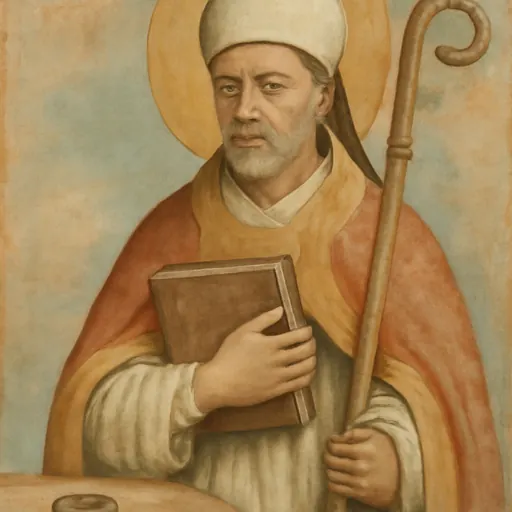
St. Hilary of Poitiers (about 310 to 367) was a convert from paganism who became bishop of Poitiers in Gaul and spent his life defending the divinity of Christ against the Arian heresy. Exiled to Phrygia in 356, he wrote his great work On the Trinity there, and Pope Pius IX named him a Doctor of the Church in 1851. His feast day is January 13.
Who was St. Hilary of Poitiers?
St. Hilary of Poitiers was the bishop of Poitiers, in western France, in the middle of the fourth century, and the first great theologian of the Latin West. He came to the faith as an adult, out of a pagan family, and spent nearly all his years as a bishop fighting Arianism, the teaching that Jesus is the highest of God's creatures but not truly God. For that fight he was sent into exile, and in exile he wrote the work that made him a Doctor of the Church: twelve books On the Trinity.
Pope Benedict XVI, who gave a whole Wednesday audience to Hilary in 2007, put it plainly: he "devoted his whole life to defending faith in the divinity of Jesus Christ, Son of God and God as the Father who generated him from eternity." The Pope also admitted that "we have no reliable information on most of Hilary's life." What we know comes from his own writings, from the letters and histories of his time, and from a Life written about two hundred years later by the poet Venantius Fortunatus, who was himself a priest and later bishop of Poitiers.

The life of St. Hilary
A pagan searching for God
Hilary was born in Poitiers around 310, into a wealthy family that was almost certainly pagan. He received a good classical education, and it shows in his Latin. At the start of On the Trinity he tells the story of his own conversion: he looked for happiness in comfort and leisure, found it empty, and began asking what God must be like. Reading the books of Moses and the prophets, and then the opening of St. John's Gospel, he found the answer. He was baptized around 345, already a married man with a daughter.
Around 350, the people and clergy of Poitiers chose this layman to be their bishop. That was not unusual in the early Church; St. Ambrose was chosen the same way a generation later. From his consecration on, Hilary lived in continence with his wife.
The young soldier Martin
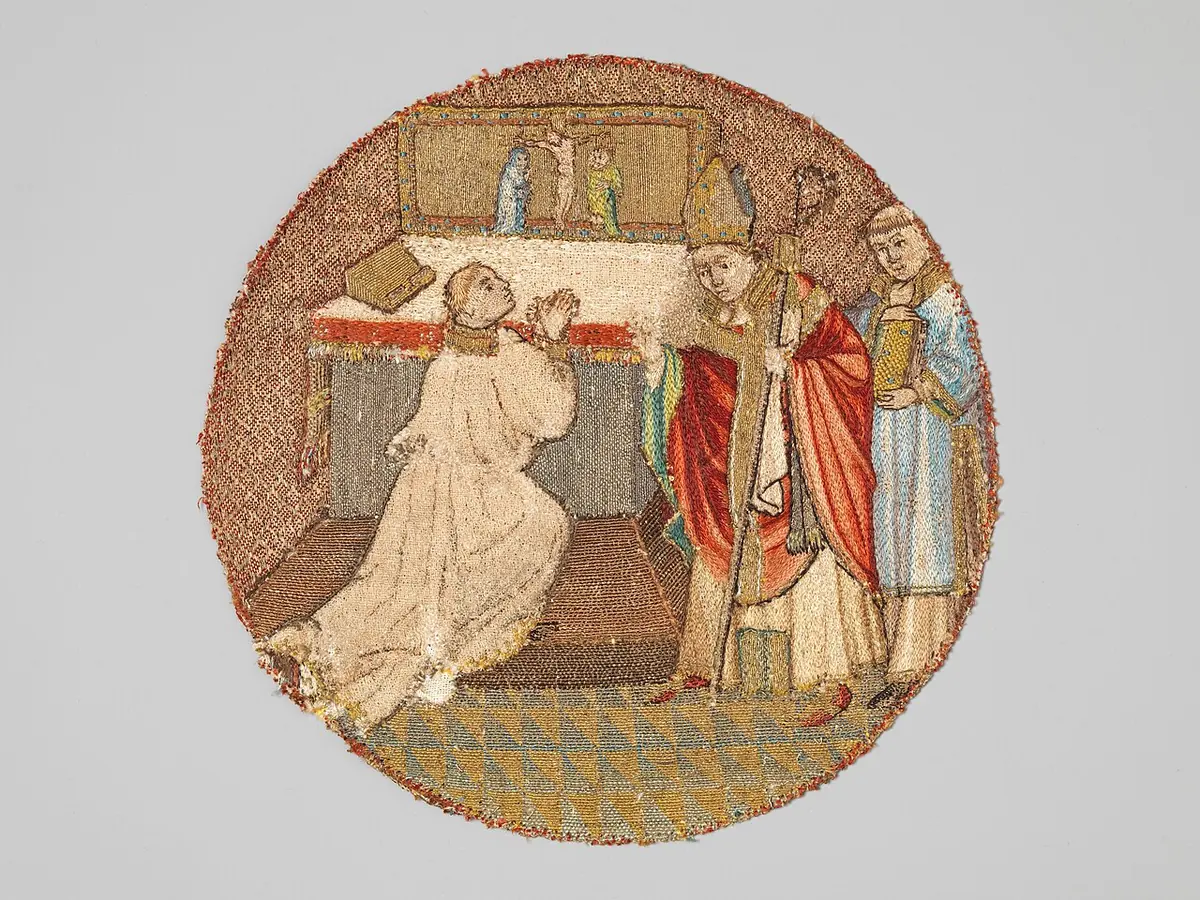
Soon after Hilary became bishop, a former Roman soldier named Martin came to Poitiers to learn from him. Sulpicius Severus, Martin's friend and biographer, tells how Hilary tried to ordain him a deacon, but Martin refused, "crying out that he was unworthy." So Hilary, "as being a man of deep penetration," gave him the humble office of exorcist instead, knowing Martin would not turn down something that looked so lowly. That young man became St. Martin of Tours, the great monk-bishop of Gaul.
Exile in Phrygia
In the 350s the emperor Constantius II favored the Arian party and pressed the bishops of the West to condemn St. Athanasius, the champion of the Council of Nicaea. Hilary refused. In 356 he went to a synod at Béziers, in southern Gaul, where bishops friendly to the Arians held the majority. He later called it the "synod of false apostles." They reported him to the emperor, and that summer Hilary was banished to Phrygia, in the middle of what is now Turkey.
Exile turned out to be a gift to the Church. Living among Greek-speaking Christians, Hilary learned their theology firsthand, and he wrote. On the Trinity came out of those years, along with On the Synods, a careful report to the bishops of Gaul (and Britain) on what the Eastern councils had actually decided. Benedict XVI singled out Hilary's patience with people who were close to the truth but not yet there: he was "adamant in opposing the radical Arians" but conciliatory toward those who were feeling their way toward the full faith.
Home to Poitiers
In 359 Hilary attended the Council of Seleucia and then went on to Constantinople, where he asked to debate the bishop who had engineered his exile. The Arian party found him so troublesome in the East that they persuaded the emperor to send him home, though his sentence was never formally lifted. He reached Poitiers in 360 or 361. Martin, who had been living as a hermit on the island of Gallinaria off the Italian coast, hurried after him and founded a monastery near the city, at Ligugé; it still exists.
Back in Gaul, Hilary helped the bishops recover the faith of Nicaea at a synod in Paris. In 364 he traveled to Milan to oppose its Arian bishop, Auxentius, and was ordered out of the city by the emperor Valentinian. He spent his last years in Poitiers, writing his Treatises on the Psalms, and died there in 367 (some sources say 368).
The miracles of St. Hilary
Hilary's own writings tell of no miracles. The stories come from Fortunatus, writing around 567, and from Gregory of Tours.
- The snakes of Gallinaria: traditional. Fortunatus writes that on his way home from exile Hilary heard that the island of Gallinaria was "infested with unnumbered and enormous coiling snakes." He landed "invoking God's name and with the succour of the cross before him," the snakes fled, and he fixed his staff in the ground as a boundary they never crossed again. This is why he is invoked against snakes.
- Healings at his tomb: reported. Fortunatus wrote a separate book of miracles at Hilary's tomb in Poitiers, and Gregory of Tours vouches for at least one. None was investigated the way modern causes are.
- Light at his death: traditional. The old lives say a brilliant light filled the room where his body lay.

Why St. Hilary is the patron of theologians and against snakes
Hilary is a natural patron for theologians and for anyone who studies and teaches the faith. He wrote the first major Latin work on the Trinity and some of the earliest Latin hymns, and he did his best thinking under pressure, far from home, without a library. The snake patronage comes straight from the Gallinaria story. Poitiers, of course, claims him as its own, and local traditions in France and Italy add others, including La Rochelle, Parma and small children learning to walk.
Symbols of St. Hilary in art
Hilary is shown as a bishop, usually older and bearded, with miter and crozier. What sets him apart:
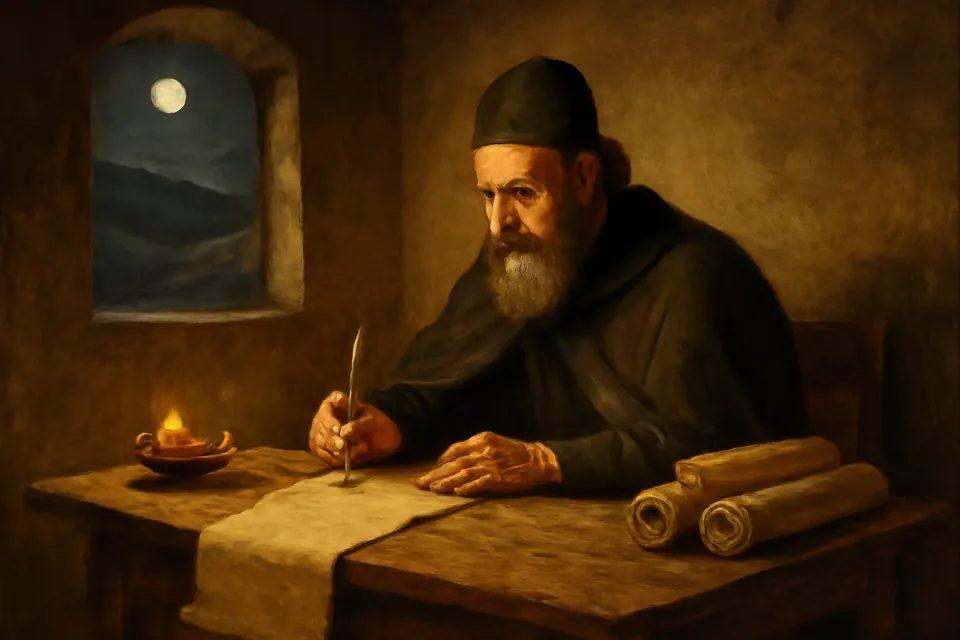
- A book or a pen: for On the Trinity and his other writings, and for his rank as a Doctor of the Church. The window in Omaha below gives him a quill and a scroll.
- Snakes: sometimes under his feet or fleeing from him, for the Gallinaria story.
- Martin of Tours beside him: the two are often paired, especially in France, with Martin kneeling or receiving orders from Hilary, as in the embroidered roundel above.
Modern Orthodox icons, which honor him as a Western father, show him as a gray-bearded hierarch in an omophorion marked with crosses, holding a Gospel book.

Where St. Hilary is honored
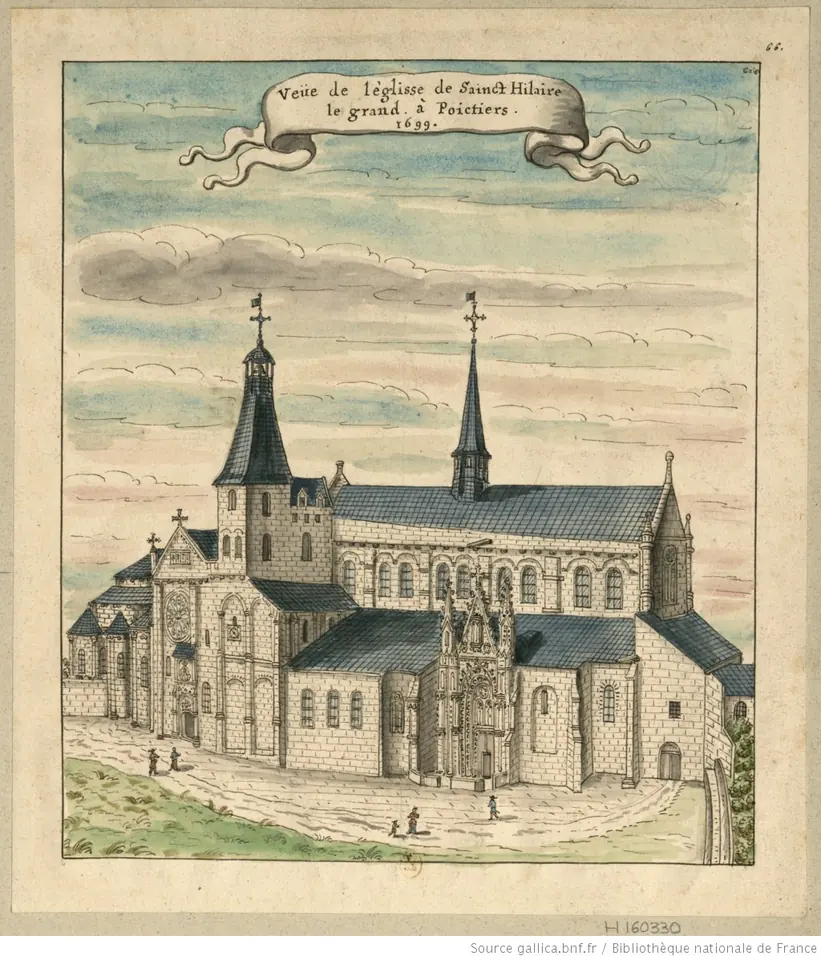
Hilary was buried in a church outside the walls of Poitiers. The church that stands there now, Saint-Hilaire-le-Grand, is an 11th-century Romanesque building on the old pilgrim road to Santiago de Compostela. His tomb is in the crypt. Most of his relics did not survive the Wars of Religion: the Catholic Encyclopedia reports a tradition that Protestants burned his body, and Baring-Gould says his tomb was violated by Calvinists in 1567. The cathedral of Le Puy also claims relics.
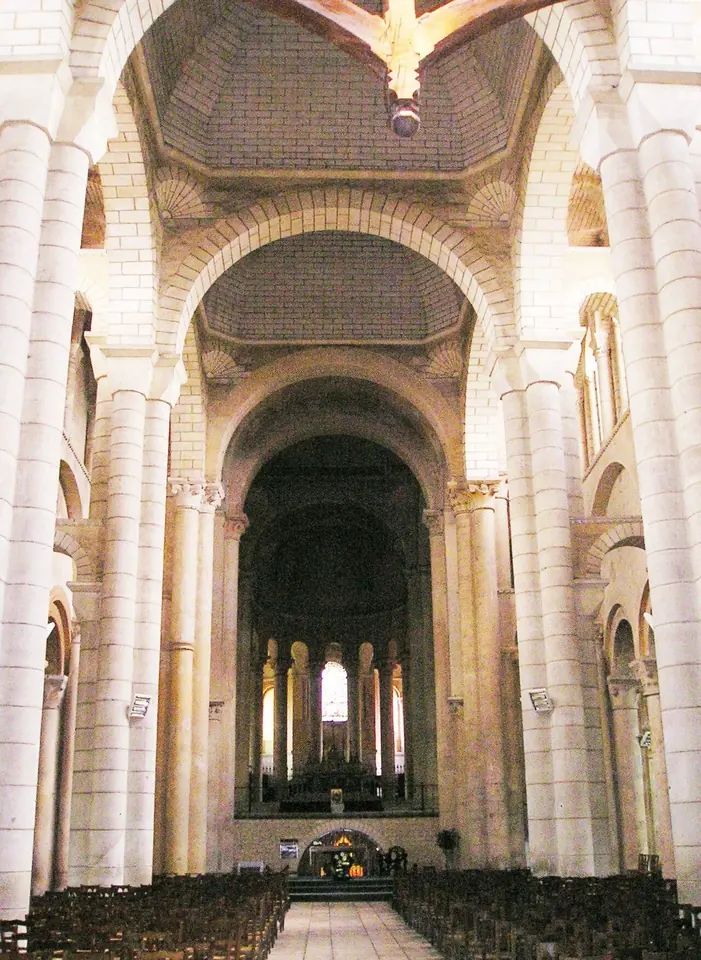
A shrine in the crypt keeps his memory alive, and pilgrims still stop to pray there.

A drawing dated 1639 shows the church with the spires and bell tower it had in the 17th century.

St. Hilary's feast day
We keep Hilary's feast on January 13, an optional memorial. For centuries it was moved to January 14 so as not to collide with the octave day of the Epiphany; the 1969 calendar returned it to the 13th, the date of his death as the Roman Martyrology gives it. In English-speaking countries his January feast gave its name to the Hilary term, the winter session of the law courts and of the universities of Oxford and Dublin. See his neighbors on our feast days page.
Prayer to St. Hilary of Poitiers
The Church's own prayer for his feast is the collect of the day from the Roman Missal:
Grant, we pray, almighty God, that we may rightly understand and truthfully profess the divinity of your Son, which the Bishop Saint Hilary taught with such constancy. Through our Lord Jesus Christ, your Son, who lives and reigns with you in the unity of the Holy Spirit, God, for ever and ever.
Hilary also left us his own prayers. On the Trinity is full of them, and Benedict XVI noted that in this book "reflection is transformed into prayer and prayer returns to reflection." The first book contains this one, a good prayer for anyone who teaches or studies the faith (Book I, 37, in the Nicene and Post-Nicene Fathers translation):
I know, O Lord God Almighty, that I owe You, as the chief duty of my life, the devotion of all my words and thoughts to Yourself. The gift of speech which You have bestowed can bring me no higher reward than the opportunity of service in preaching You and displaying You as You are, as Father and Father of God the Only-begotten, to the world in its blindness and the heretic in his rebellion.
At the very end of the work, he asks for the grace to stay faithful to his baptism. Benedict XVI closed his audience with these words, and we can pray them with Hilary:
Obtain, O Lord, that I may keep ever faithful to what I have professed in the symbol of my regeneration, when I was baptized in the Father, in the Son and in the Holy Spirit. That I may worship you, our Father, and with you, your Son; that I may deserve your Holy Spirit, who proceeds from you through your Only Begotten Son... Amen.
St. Hilary, who held to the truth about Christ in exile and taught it with patience, pray for us.
Frequently asked questions
When is the feast of St. Hilary of Poitiers?
January 13, an optional memorial in the General Roman Calendar. Before 1969 it was kept on January 14, because the 13th was the octave day of the Epiphany. England's Hilary term in the law courts and at Oxford takes its name from his January feast.
Why is St. Hilary called the "Athanasius of the West"?
Because he did for the Latin-speaking Church what St. Athanasius did in the Greek East. He defended the Council of Nicaea's teaching that the Son is fully God, equal to the Father, and he suffered exile for it, as Athanasius did.
What is St. Hilary of Poitiers the patron saint of?
He is the patron of Poitiers and of theologians, and he is invoked against snakes and snakebite because of a story told by Venantius Fortunatus, who wrote that Hilary drove the snakes off the island of Gallinaria. Some places also ask his prayers for small children learning to walk.
Was St. Hilary married?
Yes. He was married before he was baptized, and the old lives say he had a daughter named Abra (also spelled Apra), who is honored as a saint in Poitiers. From the time he became bishop, he lived in continence.
Why is St. Hilary a Doctor of the Church?
For his writings on the Trinity and on Christ, above all the twelve books On the Trinity, the first great Latin treatise on the subject. Pope Pius IX declared him a Doctor of the universal Church in 1851.
Keep exploring
Sources
- Pope Benedict XVI, General Audience on St. Hilary of Poitiers (October 10, 2007)
- St. Hilary of Poitiers, On the Trinity, Book I (Nicene and Post-Nicene Fathers)
- Sulpicius Severus, Life of St. Martin (Nicene and Post-Nicene Fathers)
- Venantius Fortunatus, Life of St. Hilary: the serpents of Gallinaria (tr. Daniel Ogden, Ogden's Dragons' Dens, University of Exeter)
- Catholic Encyclopedia (1910): St. Hilary of Poitiers
- Sabine Baring-Gould, The Lives of the Saints, vol. 1, January 13 (Project Gutenberg)
- Catholic Culture: Optional Memorial of St. Hilary (collect of the day)