Good Friday 2027

Good Friday 2027 is Friday, March 26, 2027, the day the Church keeps the Passion and death of the Lord. It is a day of fasting (ages 18 to 59) and abstinence from meat (14 and older). No Mass is said; in the afternoon the Church celebrates the Lord's Passion and venerates the Cross. Easter follows on March 28.
Good Friday 2027 falls on Friday, March 26, 2027. On this day the whole Church stands with Mary and St. John at the foot of the Cross. Here are the fasting and abstinence rules, what happens at the Good Friday liturgy, the old chants and prayers of the day, and the customs Catholics keep around the world.
Good Friday 2027 at a glance
- Date: Friday, March 26, 2027
- Fast and abstinence: obligatory. No meat for anyone 14 and older; fasting from 18 to 59.
- Mass: none. The Celebration of the Lord's Passion is held in the afternoon, usually around 3 p.m.
- Holy day of obligation: no
- Liturgical color: red
- Divine Mercy novena: begins today and ends Saturday, April 3
- The day before: Holy Thursday, March 25, when the Easter Triduum begins
- Easter Sunday: March 28 (Easter 2027)
- Orthodox Good Friday (Great and Holy Friday): April 30, 2027
- Good Friday in other years: April 3, 2026, and April 14, 2028
Good Friday fasting and abstinence rules
Good Friday is one of only two days in the year, with Ash Wednesday, on which the whole Latin Church both fasts and abstains. The Code of Canon Law sets out the rule in four short canons.
Canon 1250 names the penitential days of the universal Church: every Friday of the year and the season of Lent. Canon 1251 then says: "Abstinence and fasting are to be observed on Ash Wednesday and Good Friday." Canon 1252 sets the ages: "The law of abstinence binds those who have completed their fourteenth year. The law of fasting binds those who have attained their majority, until the beginning of their sixtieth year." Majority in canon law begins at 18. Canon 1253 lets each conference of bishops spell out the details.
In the United States the bishops' conference explains it this way:
- Abstinence (14 and older): no meat, meaning the flesh of mammals and fowl. Fish, eggs, milk products and foods made with animal fats are allowed.
- Fasting (18 to 59): one full meal, plus two smaller meals that together don't equal a full meal. No eating between meals.
- Who is excused: the physically or mentally ill, including people with chronic conditions such as diabetes, and pregnant or nursing women. Pastors and parents are to teach children the meaning of penance even before the law binds them.
The Second Vatican Council asked for more than the minimum. "Let the paschal fast be kept sacred," says Sacrosanctum Concilium. "Let it be celebrated everywhere on Good Friday and, where possible, prolonged throughout Holy Saturday, so that the joys of the Sunday of the resurrection may be attained with uplifted and clear mind." Many families keep Good Friday quietly as well: no television or music, few errands, and silence from noon to three, the hours Christ hung on the Cross.
Eastern Catholics follow the law of their own churches, which usually keeps Great Friday as a day of strict fasting, often without food at all until evening.

The Celebration of the Lord's Passion
No Mass is celebrated on Good Friday or Holy Saturday. The Church's 1988 letter on the Easter feasts says plainly: "All celebration of the sacraments on this day is strictly prohibited, except for the Sacraments of Penance and Anointing of the Sick." In the afternoon the Church gathers instead for the Celebration of the Lord's Passion. The same letter says it "is to take place in the afternoon, at about three o'clock," the hour of the Lord's death, though a parish may choose another hour, "however not later than nine o'clock."
The service is very old. The Catholic Encyclopedia found no office in the whole liturgy "so peculiar, so interesting, so composite, so dramatic," and its first part keeps the shape of the earliest Christian prayer meetings, which had readings, chants and prayers but no Eucharist. Until Pope Pius XII restored the rites of Holy Week in 1955, only the priest received Communion on this day; now all the faithful may. The celebration has three parts.
The priest and deacon, in red vestments, enter in silence. There is no opening song. At the bare altar they lie face down on the floor while the people kneel, and the priest then says the opening prayer.
1. The Liturgy of the Word. The readings are the same every year: Isaiah's fourth song of the suffering servant (Isaiah 52:13–53:12), Psalm 31, with its response from the Lord's words on the Cross, "Father, into your hands I commend my spirit," a reading from the Letter to the Hebrews (4:14–16; 5:7–9), and the Passion according to St. John (18:1–19:42), often sung or read by three voices. At the Lord's death, all kneel in silence for a time.
Then come the Solemn Intercessions, ten great prayers for the whole world: for Holy Church, for the Pope, for all orders and degrees of the faithful, for catechumens, for the unity of Christians, for the Jewish people, for those who do not believe in Christ, for those who do not believe in God, for those in public office, and for those in any tribulation. Each begins with an invitation, a time of silent prayer, often kneeling, and the priest's collect. The Catholic Encyclopedia explains why this form survives here alone: the Church wished "to pray for all classes of men on the day that Christ died for all."
2. The Adoration of the Holy Cross. The Cross is shown to the people and venerated (see below).
3. Holy Communion. The altar is covered with a cloth, and the Blessed Sacrament is brought from the place of repose, where it was kept after the Mass of the Lord's Supper the night before. All pray the Our Father, and the faithful receive Communion. Nothing is consecrated on this day. After a final prayer over the people, all leave in silence, and the altar is stripped again.
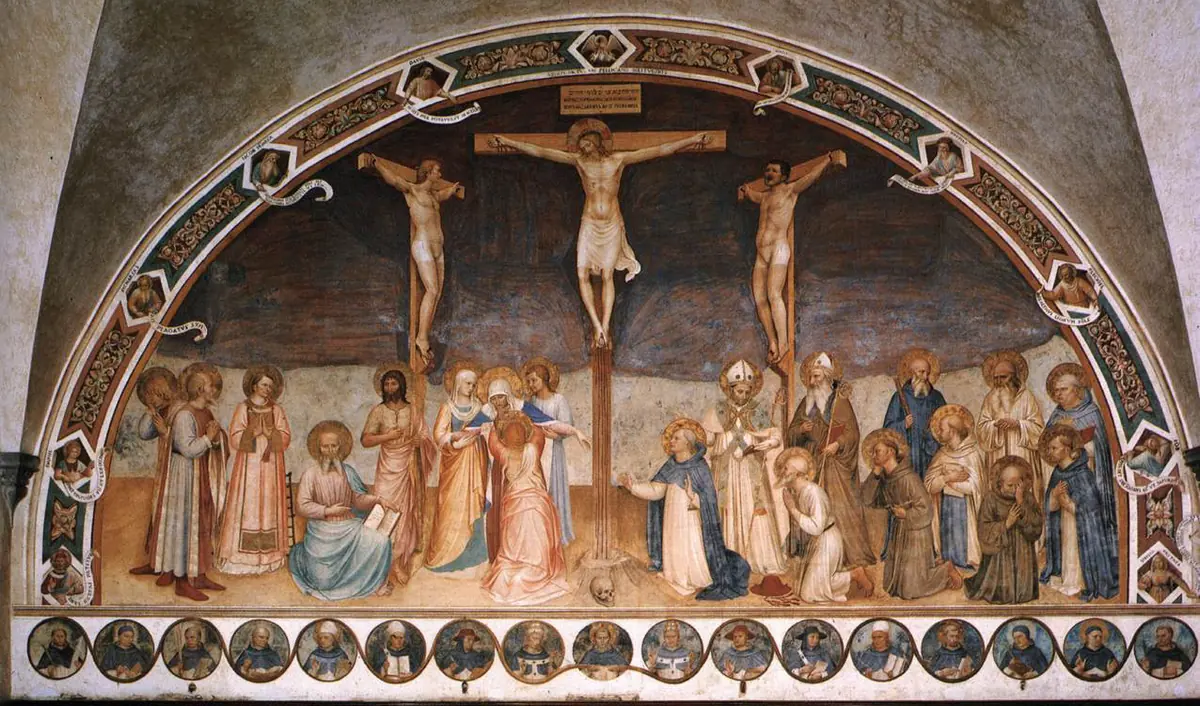
The Veneration of the Cross
The heart of the Good Friday liturgy came from Jerusalem. Late in the fourth century the pilgrim Egeria watched the bishop of Jerusalem sit on Golgotha holding the relic of the True Cross firmly in his hands while "the people, both faithful and catechumens, come one by one and, bowing down at the table, kiss the sacred wood and pass on." The deacons stood guard, she noted, because one pilgrim had once tried to bite off a piece. Churches that had no relic of the Cross took up the rite with an ordinary crucifix, and by the eighth century it was part of the Roman liturgy.
Today the priest or deacon brings the Cross to the sanctuary, either unveiling it in three stages or carrying it in procession and stopping three times. Each time he sings, in Latin or in the language of the people, the words given here in an 1875 translation:
Ecce lignum crucis, in quo salus mundi pependit. Venite, adoremus.
Behold the wood of the cross, in which the Salvation of the world was hanged. Come, let us adore.
Then the faithful come forward, one by one, to venerate the Cross with a genuflection, a bow or a kiss. The 1988 letter asks that "only one Cross should be used for the veneration, as this contributes to the full symbolism of the rite." We adore Christ who hung on it. Pseudo-Alcuin, an early medieval commentator quoted in the Catholic Encyclopedia, put it in a sentence: "While we reverence the cross as the instrument of our redemption, we pray to Him who redeemed us."
The Church grants a plenary indulgence, under the usual conditions, to the faithful who devoutly take part in the adoration of the Cross in the Good Friday liturgy (Enchiridion of Indulgences, grant 13).

The Reproaches (Improperia)
While the people come forward, the choir sings the Reproaches, the Improperia, in which the Lord speaks from the Cross to his people. They appear in Gallican books of the ninth century and entered the Roman rite later. Between the first verses the choir sings the ancient Trisagion in Greek and Latin, "Holy God, Holy and strong God, Holy and immortal God, have mercy on us," a chant shared with the Eastern churches.
The "people" who hear these words are all of us. Each verse sets a gift of God beside the sins that crucified his Son, and every Christian who sings them knows which side of the comparison is his own. Here is the traditional text in the translation printed in The Complete Office of Holy Week (Benziger Brothers, 1875):
My people! what have I done to thee? Or in what have I grieved thee? Answer me.
Because I brought thee out of the land of Egypt: thou hast prepared a cross for thy Saviour.
Because I led thee through the desert forty years and fed thee with manna and brought thee into an excellent land; thou hast prepared a cross for thy Saviour.
What more should I have done to thee, and have not done? I have planted thee for my most beautiful vineyard: and thou hast proved very bitter to me: for in my thirst thou gavest me vinegar to drink; and with a spear thou hast pierced the side of thy Saviour.
The second part of the Reproaches follows, each verse answered by "My people! what have I done to thee?":
For thy sake I scourged Egypt with her first-born; and thou hast delivered me to be scourged.
I brought thee out of Egypt, having drowned Pharao in the Red Sea; and thou hast delivered me over to the chief priests.
I opened the sea before thee; and thou with a spear hast opened my side.
I went before thee in a pillar of the cloud; and thou hast brought me to the palace of Pilate.
I fed thee with manna in the desert; and thou hast beaten me with buffets and scourges.
I gave thee wholesome water to drink out of the rock; and thou hast given me gall and vinegar.
For thy sake I struck the kings of the Chanaanites; and thou hast struck my head with a reed.
I gave thee a royal sceptre; and thou hast given me a crown of thorns.
I have exalted thee with great strength; and thou hast hanged me on the gibbet of the cross.
The veneration closes with the antiphon "We adore thy cross, O Lord! and we praise and glorify thy holy resurrection: for by the wood of the cross the whole earth is filled with joy," and then the hymn Pange lingua gloriosi proelium certaminis by St. Venantius Fortunatus, written in the sixth century for a relic of the True Cross. Its refrain, the Crux fidelis, appears in the same 1875 book in this verse translation:
O faithful cross! O noblest tree! In all our woods there's none like thee: No earthly groves, no shady bowers, Produce such leaves, such fruit, such flowers. Sweet are the nails, and sweet the wood, That bears a weight so sweet and good.
The Stations of the Cross on Good Friday
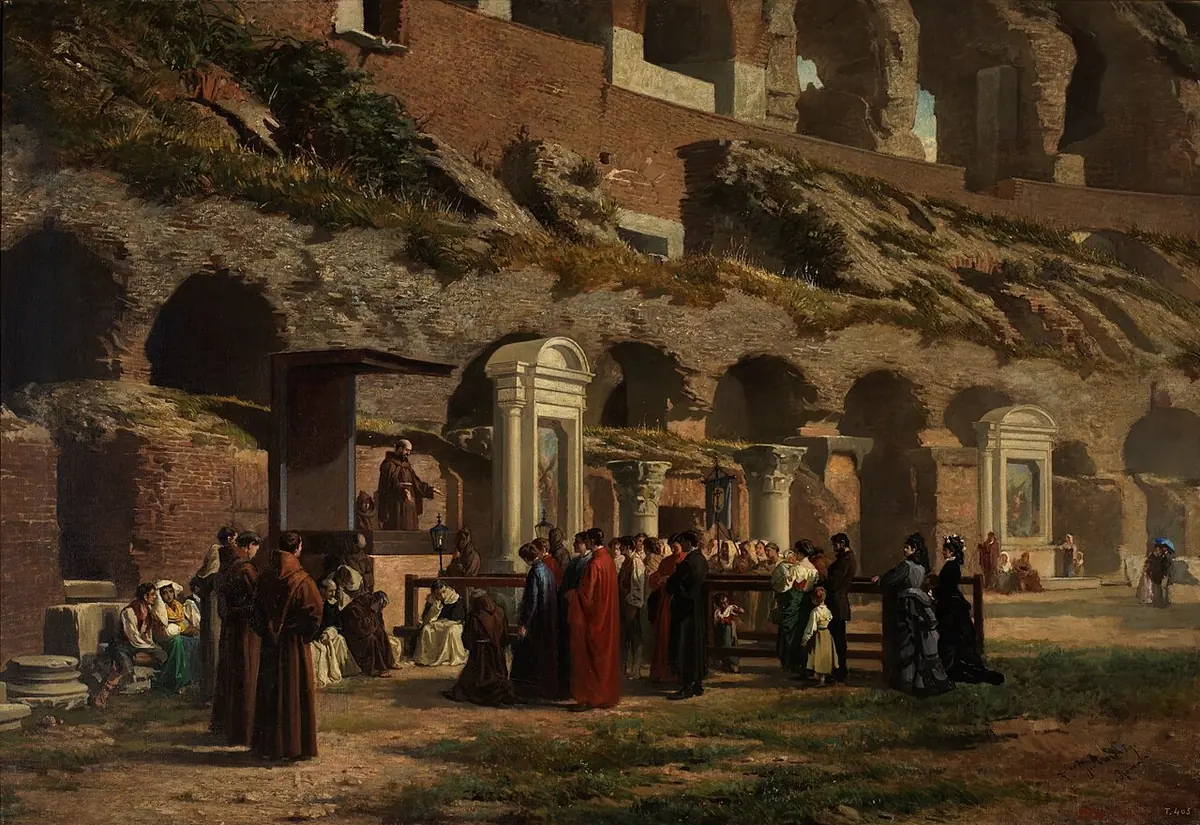
The 1988 letter asks that popular devotions "such as the Way of the Cross" not be neglected on Good Friday, provided they are scheduled so the liturgy keeps first place. Many parishes pray the Stations of the Cross at noon or in the evening, and in many towns the Stations are walked outdoors through the streets.
On Good Friday night the Pope leads the Way of the Cross at the Colosseum in Rome, where St. Leonard of Port Maurice set up the stations in 1750. In Jerusalem the Franciscans lead the faithful along the Via Dolorosa. The Church grants a plenary indulgence for making the Way of the Cross, and the same grant covers those who devoutly join the Pope's Way of the Cross live on television or radio.
The Stations bring us to the people of the Passion: St. Simon of Cyrene, who carried the Cross; St. Veronica, who tradition says wiped the Lord's face; St. Dismas, the good thief, who heard "this day thou shalt be with me in paradise"; St. Longinus, the centurion who said, "Indeed this man was the son of God"; and St. Joseph of Arimathea, who laid the body in his own new tomb. The relics tied to that day, the Holy Lance, the seamless robe, the Veil of Veronica and the Shroud of Turin, have their own pages.
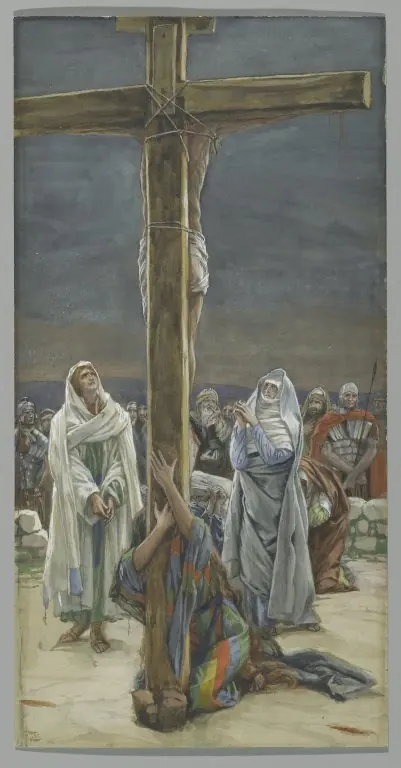
The Stabat Mater
No prayer stays closer to Good Friday than the Stabat Mater dolorosa, the sorrowing Mother standing by the Cross. It was well known across Europe by the end of the 1300s. The Catholic Encyclopedia weighs the claims of seven authors and judges only two probable: Pope Innocent III and the Franciscan poet Jacopone da Todi. It entered the Roman Missal in 1727 as the sequence for Our Lady of Sorrows, and its verses are often sung between the Stations of the Cross. Its ten Latin double stanzas start with what Mary saw and end with our own plea to stand there with her.
Of more than sixty English versions, the most widely used is Father Edward Caswall's. Here it is in full, as printed in his Lyra Catholica (1849):
At the Cross her station keeping, Stood the mournful Mother weeping, Close to Jesus to the last:
Through her heart, his sorrow sharing, All his bitter anguish bearing, Now at length the sword had pass'd.
Oh, how sad and sore distress'd Was that Mother highly blest Of the sole-begotten One!
Christ above in torment hangs; She beneath beholds the pangs Of her dying glorious Son.
Is there one who would not weep, Whelm'd in miseries so deep Christ's dear Mother to behold?
Can the human heart refrain From partaking in her pain, In that Mother's pain untold?
Bruis'd, derided, curs'd, defil'd, She beheld her tender Child All with bloody scourges rent;
For the sins of his own nation, Saw Him hang in desolation, Till his Spirit forth He sent.
O thou Mother! fount of love! Touch my spirit from above, Make my heart with thine accord:
Make me feel as thou hast felt; Make my soul to glow and melt With the love of Christ my Lord.
Holy Mother! pierce me through; In my heart each wound renew Of my Saviour crucified:
Let me share with thee His pain, Who for all my sins was slain, Who for me in torments died.
Let me mingle tears with thee, Mourning Him who mourn'd for me, All the days that I may live:
By the Cross with thee to stay; There with thee to weep and pray; Is all I ask of thee to give.
Virgin of all virgins best! Listen to my fond request: Let me share thy grief divine;
Let me, to my latest breath, In my body bear the death Of that dying Son of thine.
Wounded with his every wound, Steep my soul till it hath swoon'd In his very blood away;
Be to me, O Virgin, nigh, Lest in flames I burn and die, In his awful Judgment day.
Christ, when Thou shalt call me hence, Be thy Mother my defence, Be thy Cross my victory;
While my body here decays, May my soul thy goodness praise, Safe in Paradise with Thee.
For more prayer with Our Lady on this day, pray the Sorrowful Mysteries of the rosary or the Seven Sorrows rosary.
The Divine Mercy novena begins on Good Friday
In her Diary, St. Faustina recorded a novena that the Lord asked her to make in preparation for the Feast of Mercy, beginning on Good Friday, with a different group of souls brought to his mercy on each of the nine days. In 2027 the first day is Good Friday, March 26, and the ninth is Saturday, April 3. The feast itself is Divine Mercy Sunday 2027, April 4. The daily intentions and prayers are on our page for the Divine Mercy novena, and many people add the Divine Mercy chaplet at three o'clock each day.
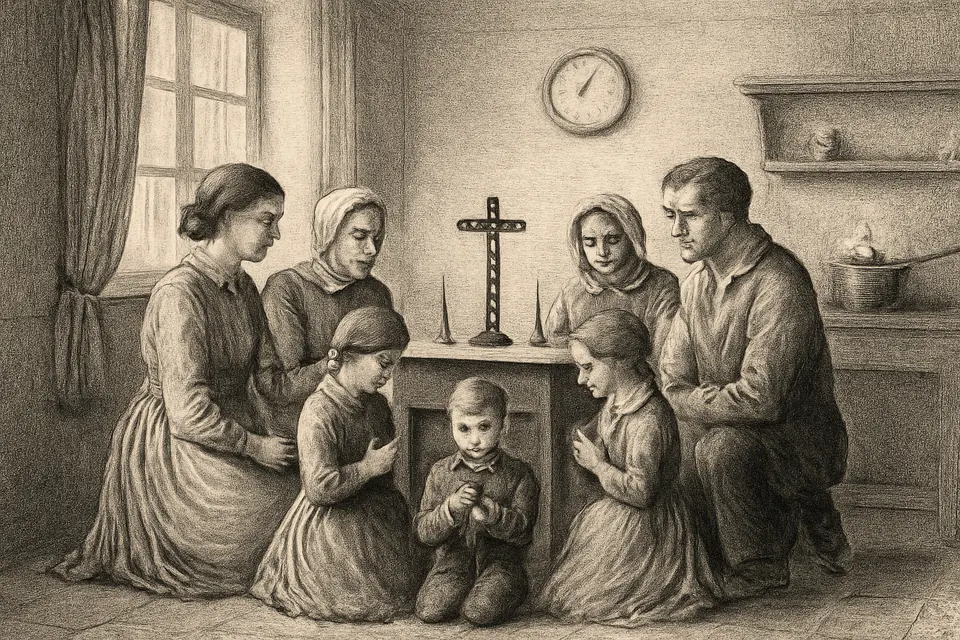
Good Friday customs around the world
The liturgy is the same everywhere, but every Catholic people has added its own ways of keeping vigil with the dead Christ.
Spain and Latin America. In Seville, Málaga and hundreds of other towns, brotherhoods (cofradías) carry great carved images of the suffering Christ and of Our Lady of Sorrows through the streets during Holy Week. Penitents in long robes and pointed hoods walk barefoot beside them carrying candles or crosses, and the processions of Good Friday night and the early hours before it are the most solemn of all. The Catholic Encyclopedia notes that processions with a statue of Our Lady of Sorrows on this day were expressly permitted by the Holy See.

Malta. Nearly every Maltese parish holds a Good Friday procession of life-size statues of the Passion, carried by robed bearers, with townspeople in biblical costume and penitents in hoods, some dragging chains or carrying heavy crosses barefoot.

The Philippines. Many towns stage a Senakulo, a Passion play, and the Siete Palabras, preaching on the Seven Last Words, fills the hours from noon to three. That devotion, known in English as the Three Hours' Agony or Tre Ore, began among the Jesuits of Lima, Peru, in the late 1600s and is usually credited to Fr. Alonso Messía. It spread throughout the world. Some Filipino penitents also have themselves flogged or even nailed to crosses; the bishops of the Philippines have long discouraged this, asking the faithful to keep their penance within prayer, fasting and charity.
Poland and Central Europe. After the liturgy the Blessed Sacrament is placed, veiled, in a decorated "tomb of the Lord" (Grób Pański), often with a figure of the dead Christ, and the faithful keep watch there until the Easter Vigil. Scouts or firefighters often stand as a guard of honor.
The Eastern churches. The Orthodox and many Eastern Catholics carry the Epitaphios, an embroidered icon of Christ laid in the tomb, in a funeral procession on Good Friday evening, and the faithful bow to pass beneath it at the church door.

Everywhere. Church bells stay silent from the Gloria of Holy Thursday until the Gloria of the Easter Vigil. The tabernacle stands open and empty, and holy water fonts are often drained. Parishes take up the Good Friday collection for the Christians and holy places of the Holy Land. In England, hot cross buns were long the Good Friday bread, marked with the sign of the Cross.
Why is it called Good Friday?
The name is English, and its origin is not clear. The Catholic Encyclopedia reports that some trace it to "God's Friday," while others connect it with the German Gute Freitag; "good" in older English also meant holy. The Anglo-Saxons sometimes called it Long Friday. Most languages simply say Holy Friday: Viernes Santo, Venerdì Santo, Vendredi saint. The Greeks call it Holy and Great Friday, and German speakers call it Karfreitag, Sorrowful Friday. The Roman Missal's own name is the Friday of the Passion of the Lord.
It is good because of what was won on it. The Church never keeps Good Friday as a funeral without hope; the antiphon at the Cross sings of the "holy resurrection" in the same breath as the wood of the Cross.
Keeping Good Friday 2027
Plan the day around the afternoon liturgy on March 26, and if you can, keep the hours from noon to three in quiet. Make the Stations of the Cross with your parish or at home, begin the Divine Mercy novena, and go to confession if you have not yet made your Easter confession; many parishes hear confessions on Good Friday. Keep the fast, and if your health allows, extend it into Holy Saturday as the Council asks, until the joy of the Easter Vigil on the night of March 27.
Let us kneel before the Cross with Mary, with John, with Mary Magdalene and the holy women, and say with the whole Church: we adore you, O Christ, and we bless you, because by your holy Cross you have redeemed the world.
Frequently asked questions
When is Good Friday 2027?
Good Friday 2027 is Friday, March 26, 2027, two days before Easter Sunday on March 28. Orthodox Christians keep Great and Holy Friday on April 30, 2027.
Can Catholics eat meat on Good Friday?
No. Canon 1251 makes Good Friday a day of both fasting and abstinence. Everyone 14 and older abstains from meat; fish, eggs and dairy are allowed. Catholics from 18 to 59 also fast, which in the United States means one full meal and two smaller meals that together don't equal a full one.
Is Good Friday a holy day of obligation?
No. There is no obligation to attend the Good Friday liturgy, but the fast and abstinence are obligatory, and the Church urges every Catholic who can to come and venerate the Cross. It is one of the most moving services of the year.
Why is there no Mass on Good Friday?
From the earliest centuries the Church has not celebrated Mass on the day Christ offered himself on the Cross. Instead she keeps the Celebration of the Lord's Passion, and Holy Communion is given from hosts consecrated at the Mass of the Lord's Supper the night before.
What time is the Good Friday service?
The Church's norms ask that the Celebration of the Lord's Passion take place "at about three o'clock," the hour of the Lord's death. For pastoral reasons a parish may choose another time, from shortly after midday to no later than nine in the evening.
Why is it called Good Friday?
No one is certain. The Catholic Encyclopedia notes that some derive it from "God's Friday," while others point out that the word "good" once also meant holy. Most other languages simply call it Holy Friday or Great Friday.
Can you go to confession on Good Friday?
Yes. All other sacraments are suspended on Good Friday, but the Church's norms make an exception for Penance and the Anointing of the Sick, and many parishes hear confessions that day.
When does the Divine Mercy novena start in 2027?
It begins on Good Friday, March 26, 2027, and ends on Saturday, April 3, the eve of Divine Mercy Sunday.
Sources
- Code of Canon Law, canons 1249–1253 (days of penance)
- Congregation for Divine Worship, Circular Letter on the Preparation and Celebration of the Easter Feasts (1988), via EWTN
- Second Vatican Council, Sacrosanctum Concilium, no. 110 (the paschal fast)
- Catholic Encyclopedia: Good Friday
- The Complete Office of Holy Week, in Latin and English (Benziger Brothers, 1875), source of the Reproaches text
- Edward Caswall, Lyra Catholica (1849), source of the Stabat Mater translation
- Catholic Encyclopedia: Stabat Mater
- Apostolic Penitentiary, Enchiridion Indulgentiarum, 4th edition (1999), Latin text