St. Rosalia of Palermo: Hermit of Monte Pellegrino and Patron Against Plague
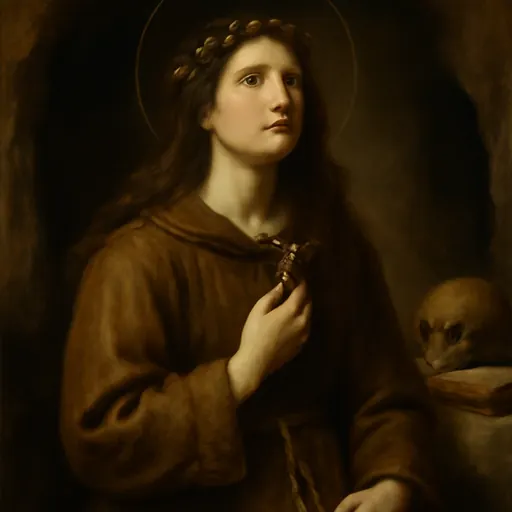
St. Rosalia of Palermo was a young noblewoman of 12th-century Sicily who left home to live as a hermit and died, around 1170, in a cave on Monte Pellegrino above the city. Her bones were found there in 1624, during a terrible plague, and Palermo's tradition holds that the epidemic lifted after they were carried through the streets. She is the patron saint of Palermo and is invoked against plague; her feast day is September 4, and the city keeps its great Festino every July 14 and 15.
Who was St. Rosalia?
St. Rosalia of Palermo was a hermit of the 12th century, a young woman of the Norman Kingdom of Sicily who gave up a comfortable life to pray alone in mountain caves. She lived roughly from 1130 to 1170, in the reign of King William I, and died in a cave on Monte Pellegrino, the great limestone headland that rises over the bay of Palermo. The people of Palermo call her simply "la Santuzza," the little saint, and she has been the city's patron since 1624.
She is not to be confused with the Mexican town of Santa Rosalía or with anyone else who bears her name. This is the Rosalia of Palermo, whose feast falls on September 4.
Almost nothing about her life comes from her own time. The Catholic Encyclopedia notes that no written account of her survives from before Valerio Rossi, around 1590, though churches were already dedicated to her by 1237. The Bollandist Jean Stilting judged that her later Life was pieced together from local tradition, paintings and inscriptions. So her story has two halves: a few traditions about a holy recluse, and a well-documented 17th-century event that made her one of the best-loved saints of southern Italy.

The life of St. Rosalia
A noble girl at the Norman court
Tradition makes her the daughter of Sinibaldo, lord of Quisquina and of the "Mount of the Roses," and of a noblewoman named Maria Guiscardi. The sanctuary on Monte Pellegrino is frank that there is no historical documentation of her family. Ottavio Gaetani, a Jesuit who gathered the traditions of Sicilian saints around 1620, recorded that she served as a lady-in-waiting to Queen Margaret, the wife of William I.
The story goes on that her father promised her in marriage to a Count Baldwin, who had saved the king from a wild beast. Rosalia refused and left home for a life of prayer. Some traditions say she first lived for a short time as a nun under the Rule of St. Basil, as the Greek-speaking monasteries of Sicily did; an altarpiece from the 13th century shows her in a monastic habit, and the Basilians list her in their martyrology.
The cave at Quisquina
She is said to have spent about twelve years in a small cave in the woods near Bivona, in what is now the territory of Santo Stefano Quisquina, in the hills of southwestern Sicily. In 1624 two masons working there found words cut into the rock, in which Rosalia names herself the daughter of Sinibaldo, lord of Quisquina and of the Roses, and says she chose to live in that cave for love of her Lord Jesus Christ. The sanctuary's own historians note that many regard the inscription as a later work rather than something she carved herself. A hermitage grew up around the cave in the 1600s, and pilgrims still walk out to it.
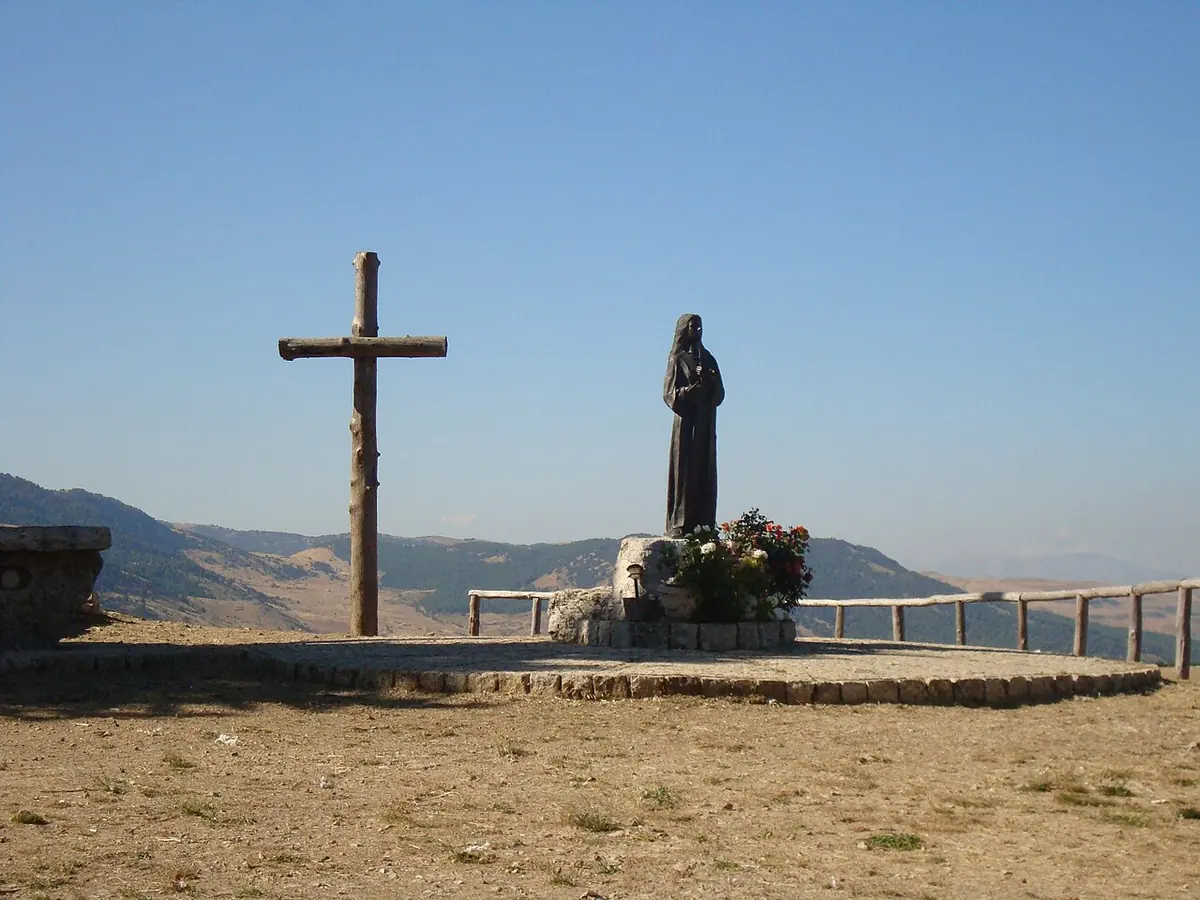
The cave on Monte Pellegrino
At last, tradition says, she walked back to Palermo and climbed Monte Pellegrino, where she lived for eight or ten more years in a damp cave with water dripping from the rock. She died there, most likely around 1170, and was buried where she lay. For four and a half centuries her bones stayed hidden in that cave.
The plague of 1624 and the finding of her bones
The rest of her story is history, with dates and names written down by notaries, doctors and the city Senate.
On May 7, 1624, a ship from Tunis carrying ransomed Christian captives docked at Palermo. The viceroy, Emanuele Filiberto of Savoy, let it land despite the Senate's fear that it carried plague, and the disease spread through the city. The viceroy himself died of it on August 3.
The finding of the bones began with a poor woman named Girolama (or Geronima) La Gattuta, from Ciminna. In October 1623, close to death in Palermo's Ospedale Grande, she saw a young nun who told her she would recover and should make a vow to go to Monte Pellegrino. She recovered but didn't keep the vow. On Pentecost Sunday, May 26, 1624, sick again with malaria, she finally climbed the mountain with two other women, drank the water dripping in the cave and fell asleep. In a dream the Virgin Mary told her she was healed, and she saw a young woman in sackcloth kneeling in prayer at the back of the cave, where she was told to dig.

Digging began in June. On July 15, 1624, the diggers found human bones encrusted in limestone at the spot she had pointed out. They were taken to the archbishop, Cardinal Giannettino Doria, who was not convinced. The Senate was quicker: on July 27, 1624, it chose Rosalia as patron of the city.
The doctors on the cardinal's commission couldn't say for certain whose bones these were. Then, on February 13, 1625, a soap maker named Vincenzo Bonelli, whose young wife had died of the plague two days earlier, went up Monte Pellegrino dressed as a hunter, intending to throw himself off the cliff. According to the testimony recorded a few days later, a young woman "with the face of an angel" stopped him and said, "Io sono Rosalia" ("I am Rosalia"). She showed him her cave and told him to confess and receive Communion, to tell the cardinal to stop doubting the bones and to carry them in procession, and that he himself would soon die of the plague. He did die, after telling his confessor everything.
On February 18 the commission certified that among the remains was a body encased in stone with the small skull of a young woman, and on February 22, 1625, the relics were formally handed over to the Senate.
The miracles of St. Rosalia
The miracles attributed to Rosalia are traditional or reported. None has gone through the kind of formal investigation modern canonizations require; her cult is far older than that process.
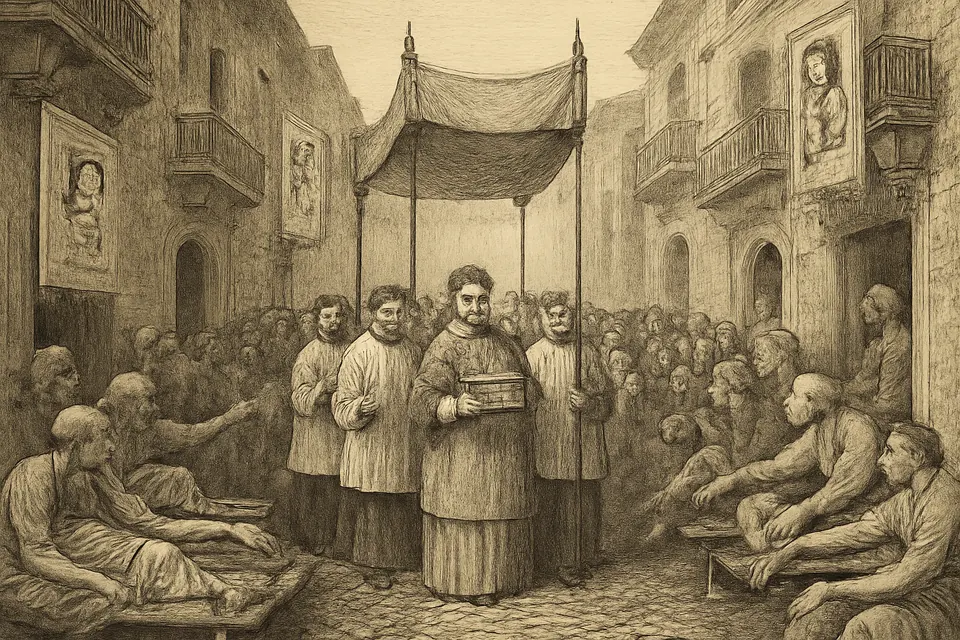
- The end of the plague in Palermo, 1625: traditional. On June 9, 1625, her bones were carried through the city in a great procession. The sanctuary's account says that at the singing of the Te Deum the sick were healed before everyone's eyes and the contagion stopped, and that the king's clerks recorded the names of those cured. On September 3, 1625, Cardinal Doria declared that, since deliverance had been obtained through St. Rosalia's intercession, people, animals and goods could move freely again. Historians of medicine date the end of the epidemic to February 1626 and credit the quarantine rules of the city's chief physician, Marco Antonio Alaimo, so we can say plainly that Palermo's prayer and its doctors' work went side by side.
- Girolama La Gattuta's healings, 1623 and 1624: reported, from her own testimony.
- Vincenzo Bonelli's vision, 1625: reported, recorded by the priest Pietro Lo Monaco of the church of Sts. Cosmas and Damian on February 18, 1625.
- Healings on Monte Pellegrino: reported. Many people climbed to the cave in the summer of 1624, prayed and drank its water, and cures were told of from the start.
Why St. Rosalia is the patron saint of plague
Because of 1624 and 1625, Rosalia became, after St. Roch and St. Sebastian, one of the saints Catholics call on in epidemics. Pope Urban VIII entered her name in the Roman Martyrology, and Van Dyck's paintings of her carried her image north to Flanders and west to Spain.
She is first of all the patron of Palermo, and of Sicily with it. Before her, the city honored several virgin saints, among them St. Agatha and St. Christina, whose relics shared the cathedral chapel where Rosalia's bones were first placed. Italian fishermen carried her devotion across the ocean.
In Monterey, California, a bronze statue honors Santa Rosalia as the patron saint of the city's Italian fishermen. You can find her alongside other protectors on our patron saints page.
Symbols of St. Rosalia in art
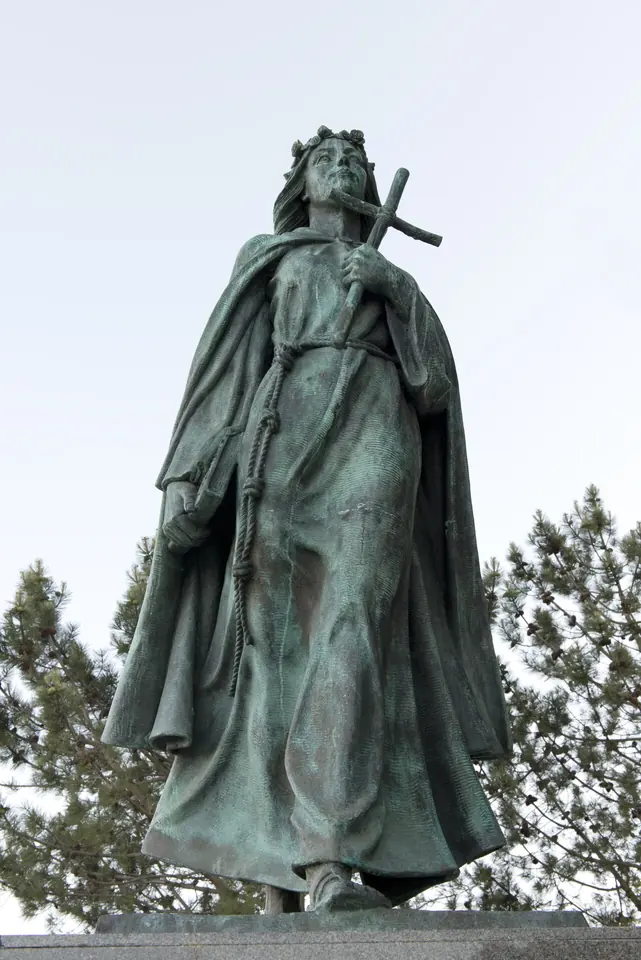
Almost every image of Rosalia comes from after 1624, when painters across Europe suddenly had a new saint to paint. Look for:
- A wreath of roses: a play on her name and on her family title, "lord of the Roses." In Van Dyck's paintings small angels lower the wreath onto her head.
- A skull: the hermit's companion in meditation on death, and a reminder of the bones found in her cave.
- A brown or dark habit: the plain dress of a hermit. Older Sicilian images show her as a Basilian nun, sometimes holding a Greek cross.
- A crucifix, a book or a rosary: her prayer. Girolama saw her kneeling with prayer beads.
- A cave, and below it a bay and a city: Monte Pellegrino and Palermo. Some paintings show plague victims below and Rosalia pleading for them.
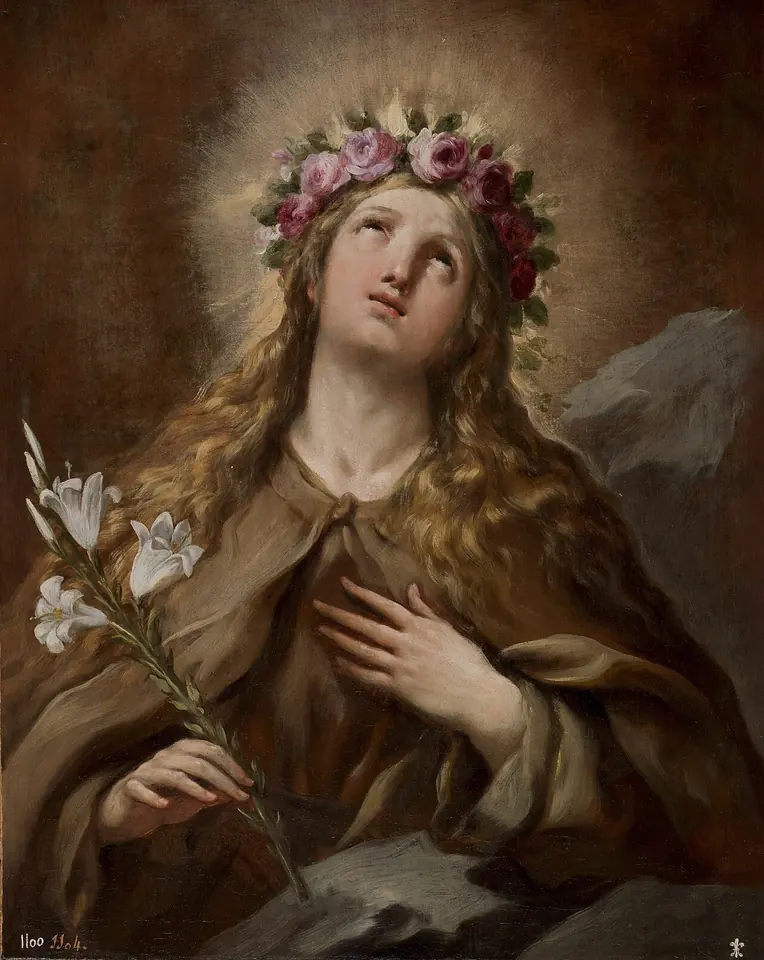
- A lily: her virginity, as in Luca Giordano's half-length painting.
Anthony van Dyck, the young Flemish painter, was in Palermo when the plague broke out and painted her several times between 1624 and 1629. His pictures fixed the image the world still knows: a young woman with loose hair, eyes raised, hand on her heart.

Later painters followed his lead. Luca Giordano's Rosalia, painted around 1697, keeps the roses and adds a lily.
Feast day, the Festino and the climb up Monte Pellegrino
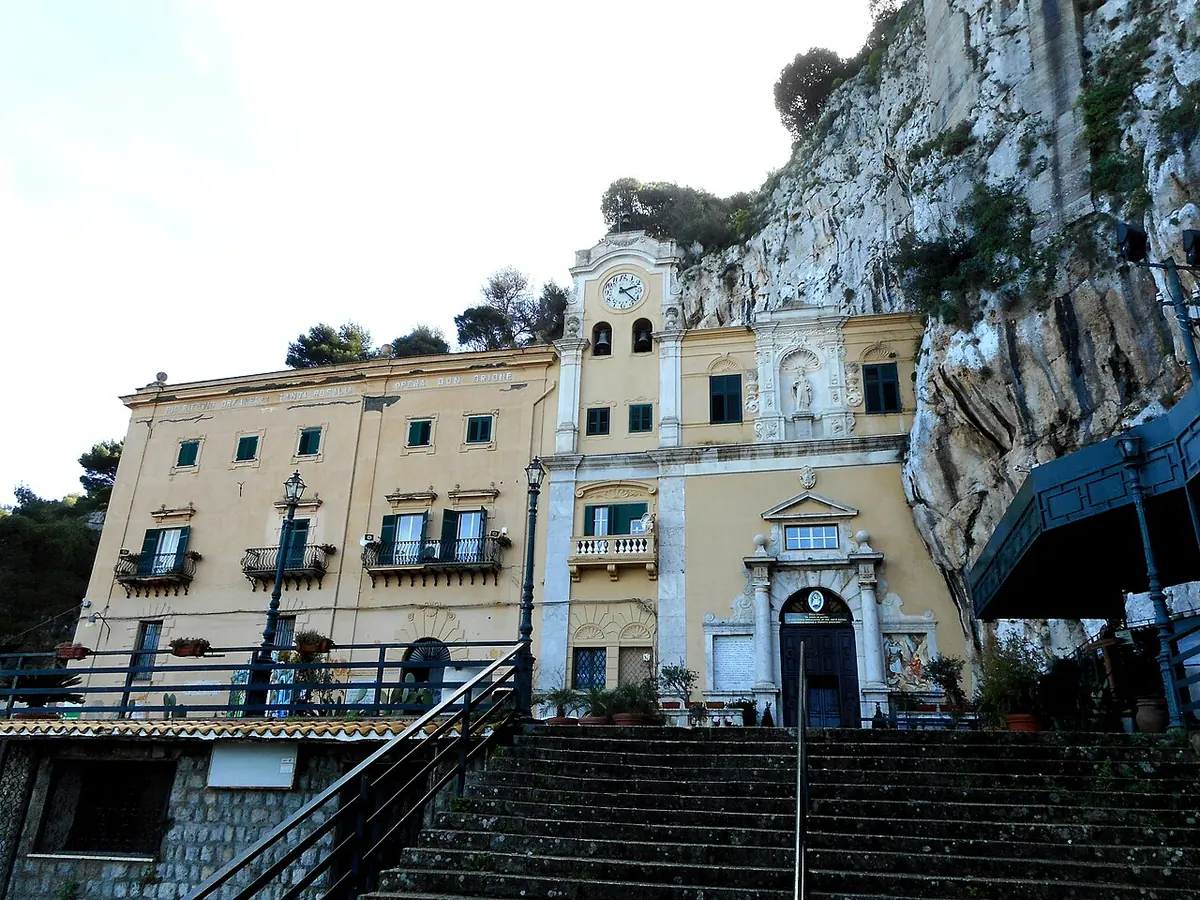
Rosalia's feast day is September 4, the traditional day of her death. On the night of September 3, thousands of people make the acchianata, Sicilian for "the climb": the 4-kilometer walk up the old pilgrims' road, built by the Senate between 1674 and 1725, from near sea level to the sanctuary at about 455 meters. Some climb the last stairs on their knees, in penance or in thanks.
The sanctuary itself, finished in 1629, is built straight into the rock. Past a 17th-century facade and a vestibule, the visitor walks into the cave where her bones were found. Since 1946 it has been in the care of the religious of the Opera Don Orione.
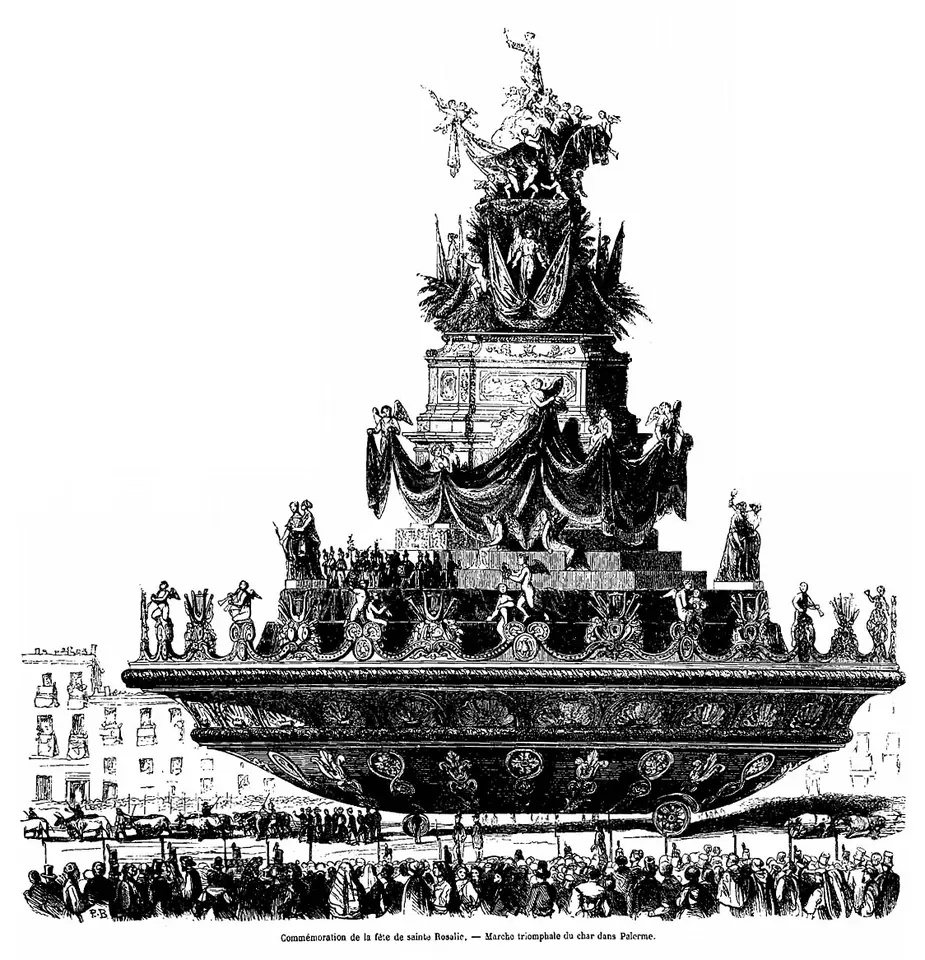
In the city, Palermo keeps the anniversary of the 1625 procession with the Festino, from July 10 to 15. On the 14th a triumphal cart shaped like a ship, built anew each year, carries her statue from the cathedral toward the sea, and the night ends in fireworks over the waterfront. On the 15th, the feast of the finding of her relics, the bones are carried through the streets in their silver urn. The crowd's cry is "Viva Palermo e Santa Rosalia!"
Her relics have rested in a silver urn in the Chapel of St. Rosalia in Palermo Cathedral since 1631, the year the Senate's promise to make one was fulfilled.

Prayer to St. Rosalia
Rosalia left no writings, and no prayer comes down from her. The prayers the Church of Palermo uses today were written by its archbishops. The sanctuary on Monte Pellegrino publishes one by Cardinal Salvatore De Giorgi, archbishop of Palermo, which begins:
Fulgidissima gemma di Verginale santità / della nostra Città di Palermo / a Te con fiducia / rivolgiamo la nostra preghiera / Tu che ti ritirasti / nella solitudine di Monte Pellegrino, / non per evadere dalla Città, / ma per vegliare su di essa con la preghiera / e con la penitenza
In our translation: "Most radiant jewel of virginal holiness of our city of Palermo, to you we turn our prayer with trust. You withdrew into the solitude of Monte Pellegrino not to escape the city, but to keep watch over it with prayer and penance." The prayer goes on to ask her help to be freed from sin, "the root of all social ills," and to live out our baptism.
Let us ask St. Rosalia to pray for us, for the sick and for every city struck by epidemic, that God may keep us, as she kept watch over Palermo from her mountain.
Frequently asked questions
Who was St. Rosalia?
St. Rosalia was a hermit of Norman Sicily who lived about 1130 to 1170. By tradition she was the daughter of Sinibaldo, lord of Quisquina, and left the court of Palermo to pray alone, first in a cave near Santo Stefano Quisquina and then in a cave on Monte Pellegrino, where she died. Little about her life is documented, but churches were already dedicated to her by 1237.
When is St. Rosalia's feast day?
September 4, the day of her death, which is how she is listed in the Roman Martyrology. Palermo also celebrates July 15, the anniversary of the finding of her relics, with the Festino from July 10 to 15. On the night of September 3 to 4, thousands of people climb Monte Pellegrino on foot to her sanctuary.
Why is St. Rosalia the patron saint of plague?
In 1624 plague reached Palermo on a ship from Tunis. That July bones were found in her cave after a sick woman's vision. In February 1625 Rosalia was said to have appeared to a grieving soap maker, Vincenzo Bonelli, asking that her bones be carried through the city. The procession took place on June 9, 1625, and the tradition holds that the sick were healed and the plague began to lift. This is a traditional miracle; the Church has not formally investigated it.
Why is St. Rosalia shown with roses and a skull?
The roses play on her name and on the "lord of the Roses" in her traditional family title; painters such as Anthony van Dyck showed angels crowning her with them. The skull is the hermit's sign of meditation on death, and it also recalls the bones that were found in her cave.
What is the Festino of St. Rosalia?
The Festino ("U Fistinu" in Sicilian) is Palermo's summer festival in her honor, held July 10 to 15. On July 14 a huge boat-shaped triumphal cart carries her statue from the cathedral toward the sea, followed by fireworks, and on July 15 her relics are carried in their silver urn in a solemn procession.
Keep exploring
- Patron saint pages
- Sailors
- Appears in
- Female saints
- Feast-day calendar
- Saints remembered in SeptemberSaint of the day
- More
- Saints A to ZPatron saints A to ZExplore every section
Sources
- Catholic Encyclopedia (1912): St. Rosalia
- Santuario di Santa Rosalia: Ritrovamento delle ossa (Gaetano Ceravolo and Girolamo Mazzola)
- Santuario di Santa Rosalia: Peste e guarigione
- Santuario di Santa Rosalia: Il suo tempo, la vita
- Santuario di Santa Rosalia: Festa e Festino
- Santuario di Santa Rosalia: prayer "O Santa Rosalia" by Cardinal Salvatore De Giorgi
- Balarm: Le visioni e la scoperta delle ossa (with quotations from the 1624–1625 testimonies)