St. Hilarion of Gaza
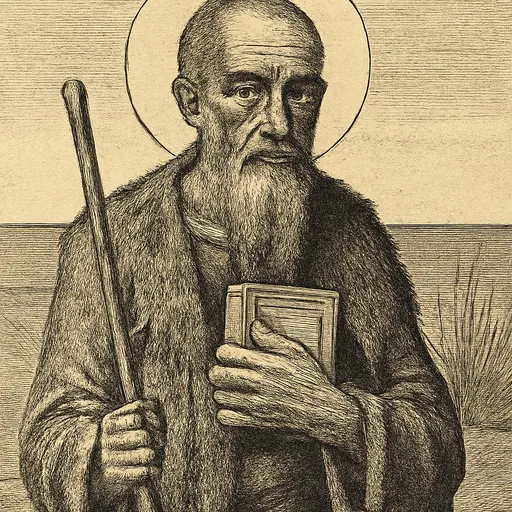
St. Hilarion of Gaza (about 291–371) was the hermit who brought monastic life to Palestine. A disciple of St. Antony of Egypt, he lived for decades in the desert near Gaza, then fled his own fame as far as Cyprus and died near Paphos. His feast is October 21, and he is a patron of hermits and monks.
Who was St. Hilarion?
St. Hilarion of Gaza is the father of monastic life in the Holy Land. Born around 291 to pagan parents in Thabatha, a village about five miles south of Gaza, he was sent to study in Alexandria and there became a Christian. Hearing of St. Antony, he went into the Egyptian desert to see him, stayed about two months, and came home to live the same life on the coast of Palestine.
We know him mainly through St. Jerome, who wrote The Life of St. Hilarion at Bethlehem around 390, some twenty years after the saint's death. Jerome drew on a letter by St. Epiphanius of Salamis, who had known Hilarion personally. The historian Sozomen, himself from a family near Gaza, adds details of his own. So Hilarion is a real figure of history, though Jerome's book, as its translator noted, mixes much legend with its facts.
The life of St. Hilarion
A boy in a hut of reeds
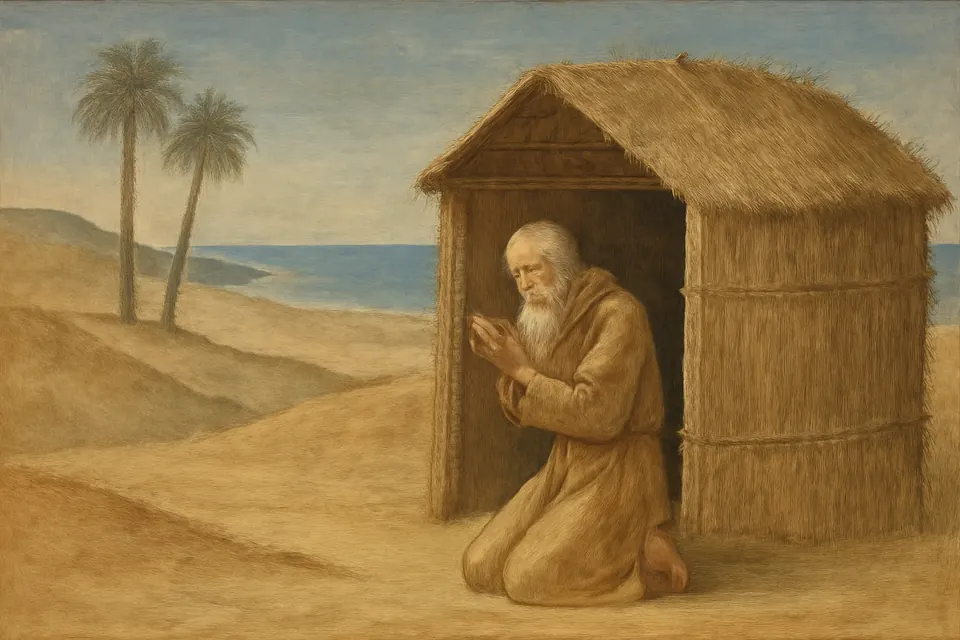
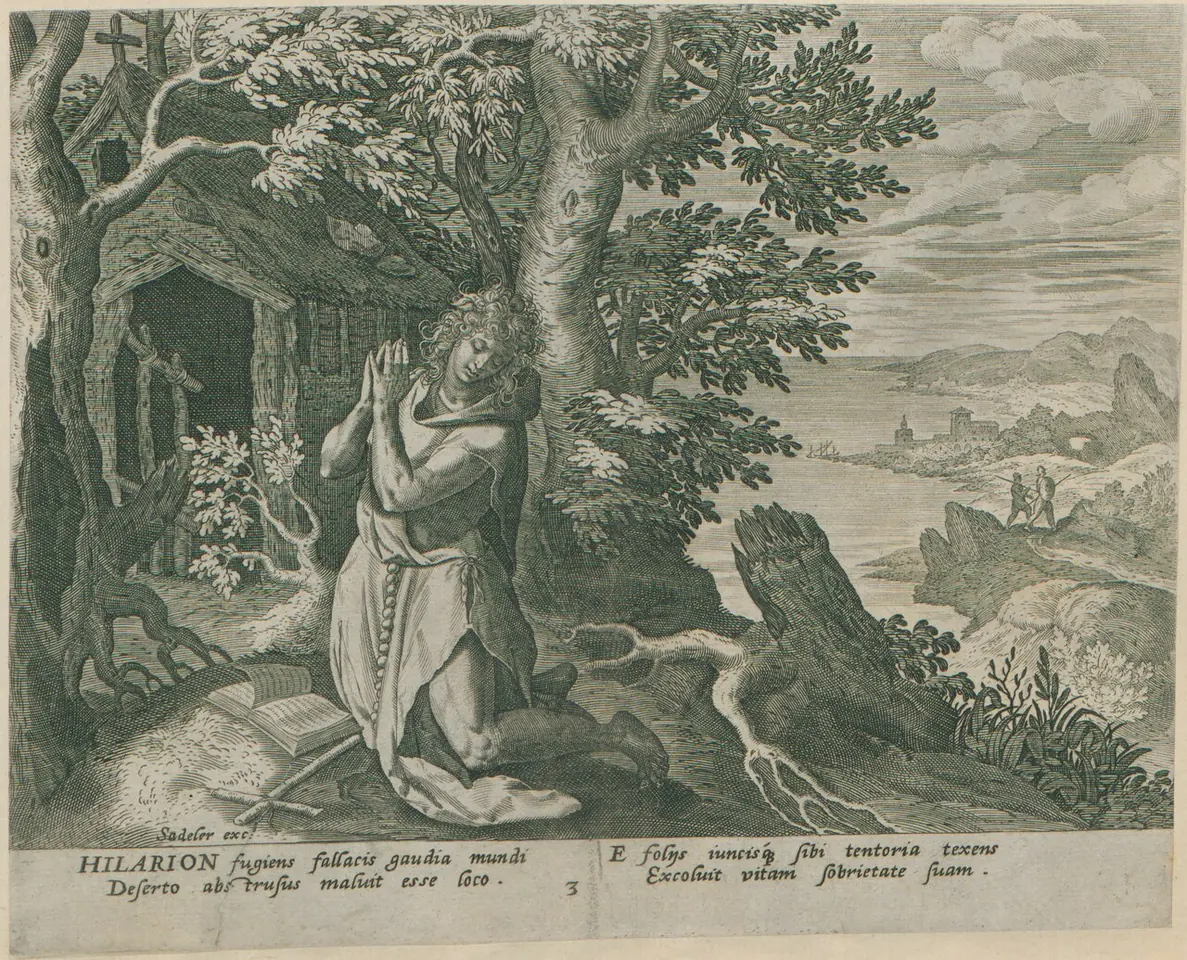
Back from Egypt, his parents now dead, Hilarion gave part of his inheritance to his brothers and the rest to the poor. He was still a boy. He went out to a stretch of wilderness "with the sea on one side and the marshland on the other," dressed in sackcloth and a cloak of skins Antony had given him, and lived on fifteen dried figs a day, eaten after sunset.
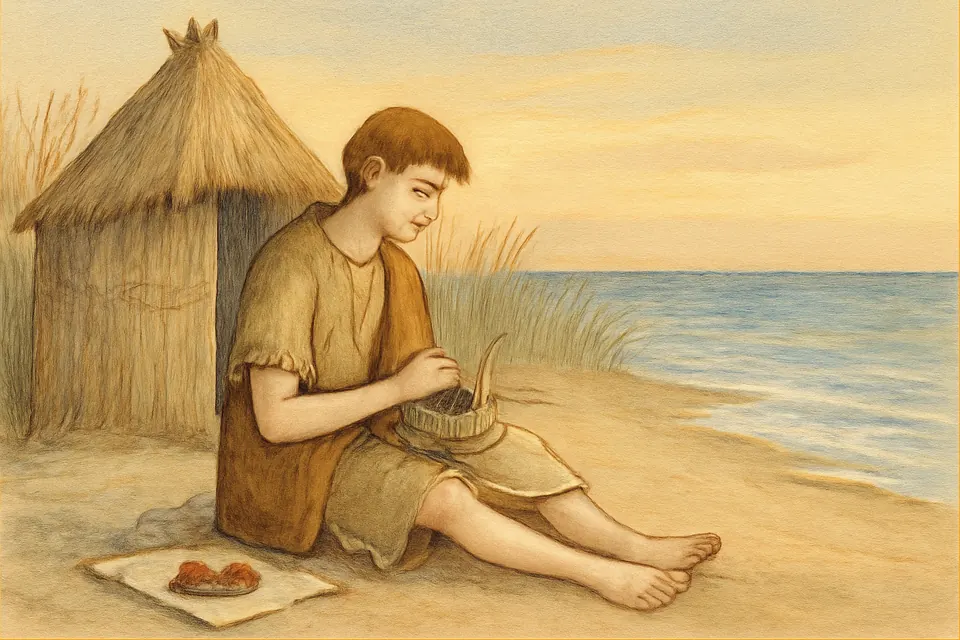
From sixteen to twenty he slept in a hut of reeds and sedge. Later he built a cell five feet high, lower than his own height. "One might suppose it a tomb rather than a house," Jerome wrote, adding that it was still standing in his day. Hilarion wove baskets of rushes, dug the ground and recited the Scriptures, which he knew by heart.
When robbers found the boy and asked what he would do if thieves came, he answered: "He that has nothing does not fear robbers."
The first monasteries of Palestine
After twenty-two years alone, Hilarion was known all over Palestine. The sick, the possessed and the curious came, and so did men who wanted to live as he lived. Monasteries sprang up across the region. Jerome says that when Hilarion visited them before the grape harvest, as many as two thousand monks walked with him. Antony himself, Jerome adds, sent Syrian pilgrims home with the words: "Why have you taken the trouble to come so far, when you have there my son Hilarion?"
In 2024 UNESCO inscribed the ruins of St. Hilarion Monastery at Tell Umm Amer, in Nuseirat in the Gaza Strip, as a World Heritage Site and placed it on the List in Danger. The excavated complex, with its churches, crypts and pilgrim hostel, grew up around the memory of the saint.
Flight from fame
Fame grieved him. In his sixties, Jerome says, he wept that he had "returned again to the world." He tried to leave, and ten thousand people gathered to stop him; he fasted seven days until they let him go. He went to Egypt to visit the places where Antony had lived. Under the emperor Julian (361–363) the city of Gaza asked for his death, and his monastery was destroyed. He fled to the oasis, then sailed to Sicily, where he and a disciple sold bundles of firewood to buy bread. Sozomen confirms the story of the firewood.
His disciple Hesychius searched for him for three years and found him. From Sicily Hilarion went to Dalmatia and finally to Cyprus. He spent his last five years in a remote place in the mountains near Paphos.
"Go forth, my soul"
In his eightieth year he wrote a short will leaving Hesychius all he owned: a book of the Gospels, a sackcloth tunic, a cowl and a cloak. Jerome gives his last words:
Go forth, what do you fear? Go forth, my soul, why do you hesitate? You have served Christ nearly seventy years, and do you fear death?
He was buried at once in his garden, as he had asked. About ten months later Hesychius secretly took the body back to Palestine and laid it in the old monastery. Jerome says it was found whole and fragrant, and that the Palestinians and the Cypriots argued over which of them had the body and which the spirit of Hilarion.
The miracles of St. Hilarion
All of Hilarion's miracles come from Jerome's Life, written within living memory but in the style of the time, so we count them as traditional:
- A woman of Eleutheropolis, childless for fifteen years, asked his prayers; within a year she had a son. Jerome calls it his first miracle (traditional).
- He prayed over the three dying sons of Aristaenete, wife of a future praetorian prefect, and they recovered (traditional).
- He freed many people from demons, including a giant of a man from near Jerusalem brought to him in chains (traditional).
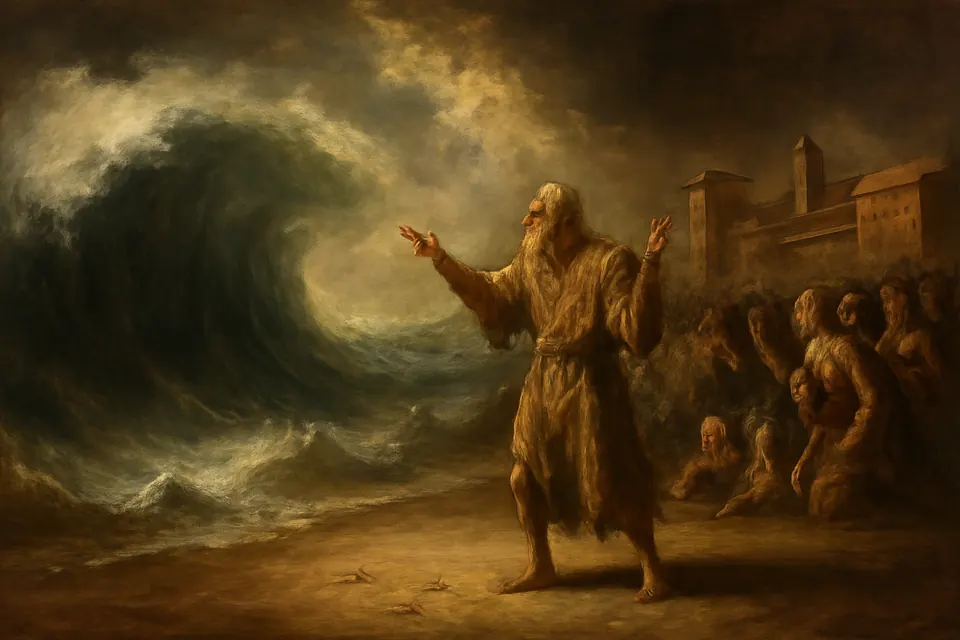
- At Epidaurus in Dalmatia, after the great earthquake that followed Julian's death, he traced three crosses in the sand and held back a huge wave. Jerome says "mothers teach their children" the story there (traditional).
Sozomen adds a family memory. His grandfather's household at Bethelia, near Gaza, became Christian after Hilarion freed a man named Alaphion from a demon "by simply calling on the name of Christ" (reported).
Why St. Hilarion is the patron of hermits and monks
Hilarion took the desert life of Egypt and planted it in Palestine, the first to do so. He lived for decades as a hermit, then guided a great number of monks, then fled back into solitude. Hermits and monks of every later century have seen their own path in his, and the Church honors him as their patron.
Symbols of St. Hilarion in art
- Sackcloth and a cloak of skins: the clothes Jerome describes, the cloak a gift from Antony.
- A long beard, divided into points: the OCA describes the Orthodox icon of Hilarion as an old man with a brown beard divided into three.
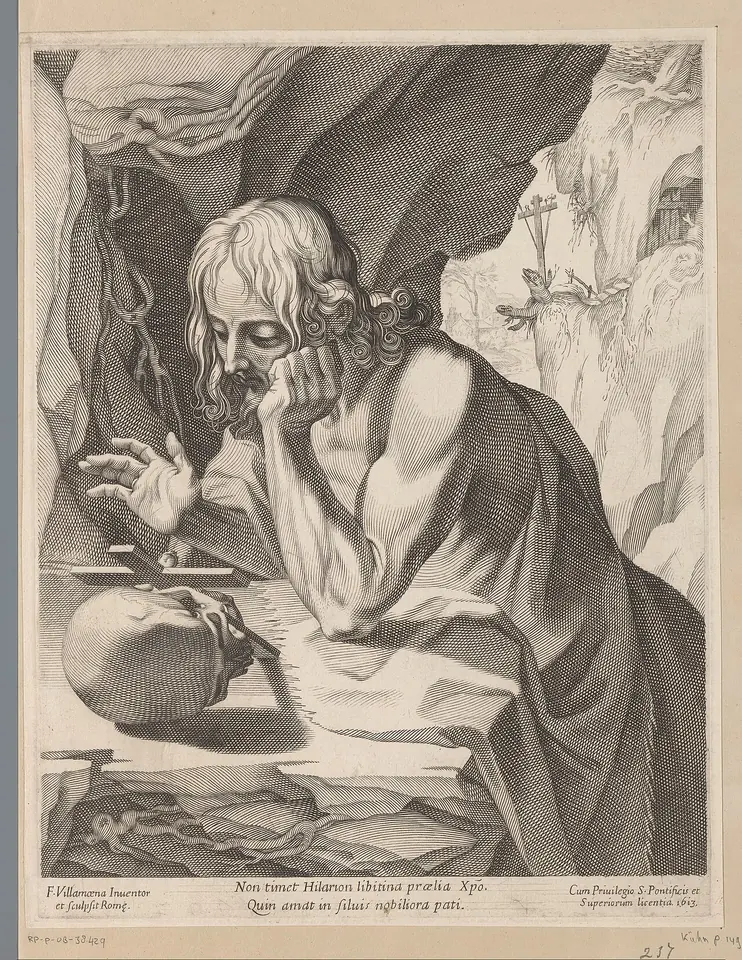
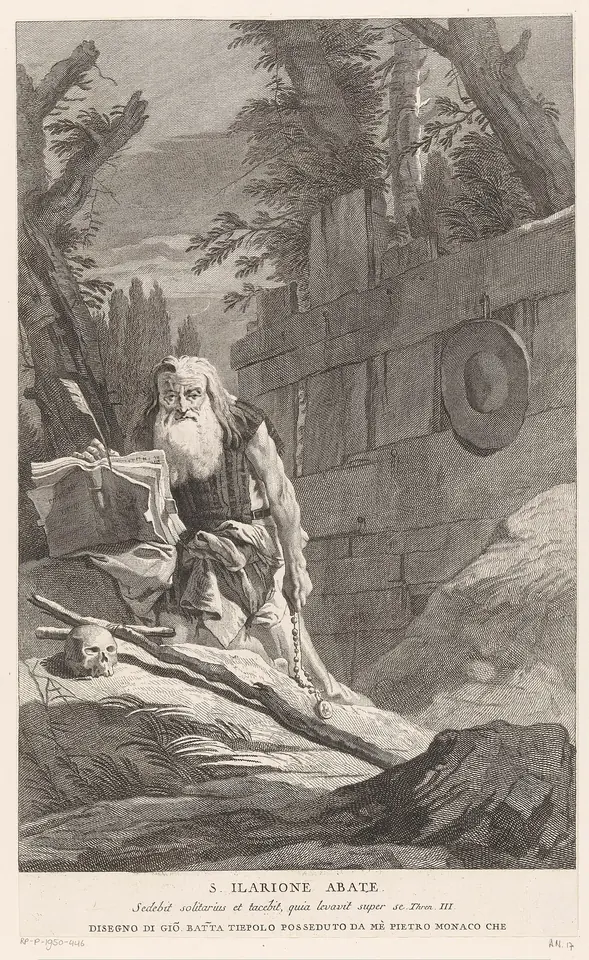
- Skull and cross: Western prints, like Villamena's, give him the attributes of a penitent hermit.
- A book: his handwritten Gospels, the one thing he owned.
- A scroll: in icons he sometimes holds one reading, in the OCA's translation, "The tools of a monk are steadfastness, humility, and love according to God."
In Byzantine art he usually stands or prays in a mountain landscape, as in the Menologion of Basil II. In Western prints he sits in a cave or before a ruined wall with a book. Don't confuse him with St. Hilary of Poitiers, who appears in a bishop's miter.
Feast day and where St. Hilarion is honored
We keep St. Hilarion's feast on October 21, the day of the Roman Martyrology and of the Byzantine churches. You can see the other saints of late October on our feast days page. His monastery near Gaza, a ruin today, is the main place tied to his memory; in Cyprus his name survives in churches and in the castle above Kyrenia.

Prayer to St. Hilarion
There is no traditional Western prayer to St. Hilarion with a known origin. The Orthodox Church sings a troparion and kontakion on his feast. Let us ask him, in our own words, for what he loved most: freedom from the things that own us, and the courage to say with him, "Go forth, my soul," when our hour comes. St. Hilarion, pray for us.
Frequently asked questions
Who was St. Hilarion?
He was a fourth-century monk from Thabatha, near Gaza, the son of pagan parents, who became a Christian while studying in Alexandria. After a short stay with St. Antony in the Egyptian desert, he went home, gave away his inheritance and lived as a hermit by the sea. Monks gathered around him and he became the founder of monastic life in Palestine.
When is the feast day of St. Hilarion?
October 21, in both the Roman Martyrology and the Byzantine calendar, where he is called Hilarion the Great.
Is St. Hilarion the same as St. Hilary of Poitiers?
No. St. Hilary of Poitiers was a bishop and Doctor of the Church in Gaul who died around 368. St. Hilarion was a hermit in Palestine. They lived at the same time and their names come from the same Latin root, but they are different men.
Is St. Hilarion Castle in Cyprus named after him?
The castle above Kyrenia in northern Cyprus bears the name of a hermit Hilarion. Local tradition connects it with a holy man who lived on that mountain, and whether he is the Hilarion of Gaza is uncertain: St. Jerome places Hilarion's last years near Paphos, on the other side of the island.
Keep exploring
Sources
- St. Jerome, The Life of St. Hilarion, trans. W. H. Fremantle (Nicene and Post-Nicene Fathers, 1893), New Advent
- Sozomen, Ecclesiastical History, Book V, chapters 10 and 15 (New Advent). Hilarion's flight under Julian and the conversion of Sozomen's own family
- Sozomen, Ecclesiastical History, Book III, chapter 14 (New Advent)
- Venerable Hilarion the Great, Orthodox Church in America
- Saint Hilarion Monastery/Tell Umm Amer, UNESCO World Heritage Centre