St. Lawrence of Brindisi, Capuchin and Doctor of the Church
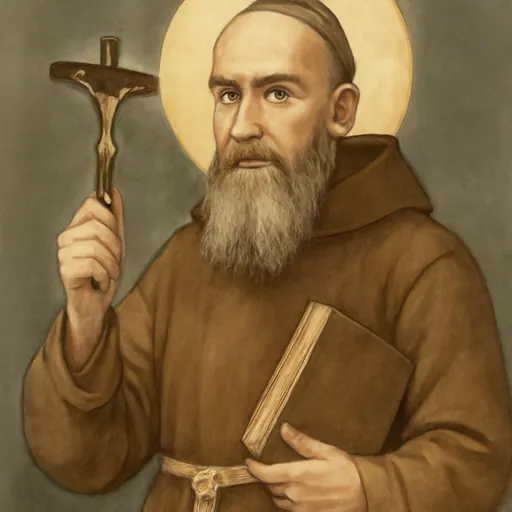
St. Lawrence of Brindisi (1559–1619) was an Italian Capuchin friar, a gifted linguist and preacher, who served popes and emperors as a diplomat and famously led an imperial army against the Ottoman Turks in 1601 holding only a crucifix. He was canonized in 1881 and named a Doctor of the Church, the "Apostolic Doctor," in 1959. His feast day is July 21, and he is the patron saint of Brindisi, his birthplace.
Who was St. Lawrence of Brindisi?
St. Lawrence of Brindisi was a Capuchin Franciscan friar from southern Italy, born in 1559 and dead in 1619, who did more in sixty years than seems possible. He preached across Italy and much of Europe, mastered something like eight languages, wrote fifteen volumes of sermons and commentaries, served as minister general of his order, founded friaries in Vienna, Prague and Graz, and carried out delicate missions for popes, emperors and kings. In 1601 he rode at the head of an imperial army against the Ottoman Turks with nothing in his hand but a crucifix.
Under all of it was a life of prayer. Lawrence often wept during Mass and stayed at the altar for hours. Pope St. John XXIII named him a Doctor of the Church in 1959 with the title Doctor Apostolicus, the "Apostolic Doctor." His feast is July 21.
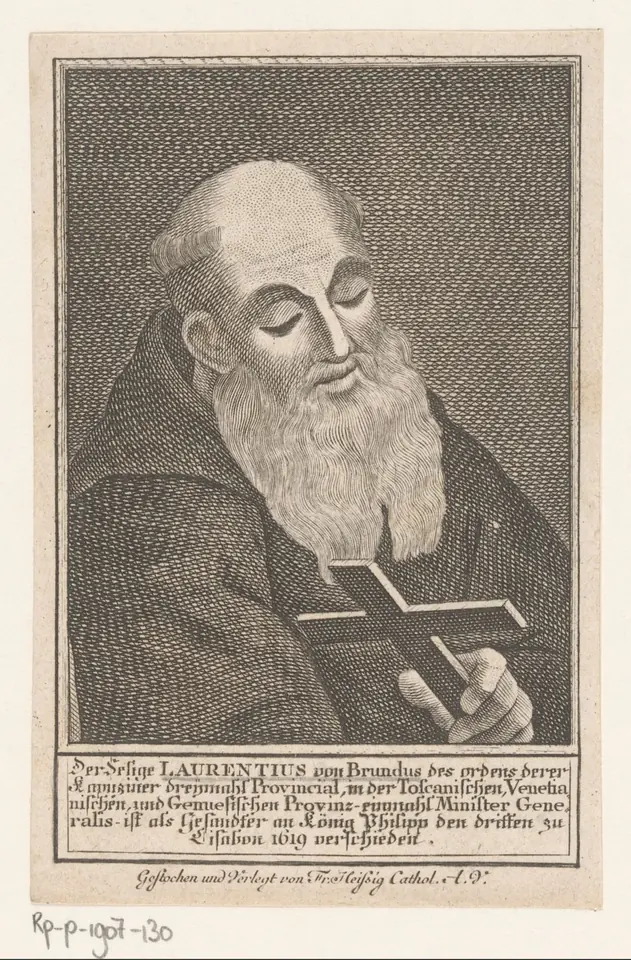
The life of St. Lawrence of Brindisi
A boy preacher from Brindisi
He was born in Brindisi, the port on the heel of Italy, and baptized Giulio Cesare, Julius Caesar, the son of Guglielmo Russo and Elisabetta Masella. The Conventual Franciscans of the town taught him, and the Catholic Encyclopedia says that at six he was already the boy chosen to give the little Christmas sermon on the Infant Jesus. His father died while he was still a boy, and he went on to study in Venice.
In Venice he met the Capuchins, a young reform branch of the Franciscans, and in 1575, at sixteen, he entered the order and took the name Lawrence. He studied philosophy and theology at the University of Padua and was ordained a priest in 1582. While still a deacon he preached the Lenten sermons in Venice, and from then on cities all over Italy asked for him.
Scholar of Scripture
His memory was extraordinary. Pope Benedict XVI, speaking about him in 2011, said he learned Greek, Hebrew and Syriac "with ease," along with French and German. He knew the Bible in its original languages so thoroughly that he said he could have rewritten it from memory, and he considered his command of Hebrew a gift from God. Popes Gregory XIII and Clement VIII sent him to preach to the Jewish communities of Rome and other cities, and Benedict XVI notes that the rabbis themselves treated him with respect for his knowledge of their literature.

Into the German lands
In 1599 he was sent with twelve friars into Austria and Bohemia, then sharply divided between Catholics and Protestants. He founded Capuchin houses in Vienna, Prague and Graz. His preaching in Prague drew such crowds that Protestant leaders asked Emperor Rudolf II, without success, to expel him. He debated the Lutheran court preacher Polycarp Leyser and answered him in a three-volume work, the Lutheranismi hypotyposis.
The crucifix at Székesfehérvár
In 1601 the emperor's army was preparing to fight the Ottoman Turks, who had overrun much of Hungary, and Lawrence was named chief chaplain. Before the attack on Székesfehérvár (Stuhlweissenburg) in October, the generals hesitated: the Catholic Encyclopedia puts their force at 18,000 against 80,000. Lawrence spoke to the whole army, then mounted a horse and rode in front of it, crucifix raised. He came through the fighting unhurt, and when the Turks regrouped a few days later he led again, calling out, "Forward! Victory is ours." The general and the army gave him the credit for both victories. Lawrence later wrote his own account and admitted he was sorry to have missed the chance of dying a martyr.

The Capuchins still keep the cross he carried, and the Capuchin historian Cuthbert Gumbinger wrote that the order's superiors general still used it.
Minister general, diplomat and peacemaker
The next year, 1602, the Capuchins elected him their vicar general, the head of the order. He visited the provinces, from Milan and Marseille to Spain, and declined a second term in 1605. Popes and princes kept sending him on missions: to Philip III of Spain to win his support for the Catholic League, to Munich as papal nuncio at the court of Duke Maximilian of Bavaria, and to settle quarrels between Catholic princes. Benedict XVI called this "his action for peace."
Last journey to Lisbon
In 1618 he retired to the friary at Caserta, hoping for quiet. The leading men of Naples begged him to go to Spain and tell King Philip III how the viceroy, the Duke of Osuna, was oppressing them. Lawrence went, and he found the king at Lisbon and pleaded the people's case. The journey wore him out. He died in Lisbon on July 22, 1619, his sixtieth birthday, as he had foretold when he set out.

Miracles of St. Lawrence of Brindisi
The Church examined his life and miracles in a long process that ended with his beatification by Pope Pius VI in 1783 and his canonization by Pope Leo XIII on December 8, 1881. The miracles approved for those steps are recorded in the acts of the cause; we have not found a reliable published account of them, so we don't describe them here.
What the early accounts tell:
- Protection in battle: reported. At Székesfehérvár Lawrence rode in the most exposed place and was not wounded, which the Catholic Encyclopedia says was "universally regarded as due to a miraculous protection."
- Healings and wonders in Mary's name: reported. The Catholic Encyclopedia says "it was in Mary's name that he worked his miracles," and the Capuchin breviary spoke of the "signs" by which God confirmed his preaching and of his gifts of prophecy and reading hearts.
- Foretelling his death: reported. He said before leaving for Spain that he would die in Lisbon.
Why St. Lawrence of Brindisi is the patron saint of Brindisi
Brindisi claims him as its own son, and he is patron of the city and of the Archdiocese of Brindisi-Ostuni. Pope Benedict XVI visited Brindisi in 2008 and spoke to its priests in the cathedral about Lawrence and the priority of prayer. Lawrence has no other formal patronages, though his life makes him an easy saint to ask for help in study, in preaching and in making peace. Find other patrons on our patron saints page.
Symbols of St. Lawrence of Brindisi in art
Lawrence is easy to recognize once you know the signs. He is shown as:
- A Capuchin with a long beard: the brown habit with the long pointed hood and the white cord, and a full beard, as the Capuchins wore them.
- Holding a crucifix high: the cross of Székesfehérvár, sometimes with soldiers, horses and a battle behind him.
- With a book or pen: his sermons and commentaries, and the title of Doctor.
- At Mass, with the Child Jesus: Gumbinger writes that he is often painted celebrating Mass with the Infant appearing to him, a reminder of his long, tearful Masses.


Feast day and where St. Lawrence is honored
We keep his memorial on July 21. See the month's other saints on our feast days page. The Mass prayers call him a man of "counsel and fortitude," and the antiphon for his feast says, "In the midst of the Church he opened his mouth and the Lord filled him with the spirit of wisdom and understanding."
His body lies far from Brindisi, in the Poor Clares' Monastery of Nuestra Señora de la Anunciada at Villafranca del Bierzo, a town on the Camino de Santiago in northwest Spain. The monastery's founder, Pedro de Toledo, Marquis of Villafranca, was Lawrence's personal friend and brought his body there from Lisbon. The relics rest in a gilded bronze urn in a tomb niche on the left side of the sanctuary. When the body arrived, the founding abbess planted a cypress in the cloister that still stands; the regional government of Castile and León calls it the oldest cypress in Spain. In January 2024 the monastery was declared a protected monument.


His words on Scripture and prayer
Lawrence's whole life came out of the Bible. In a sermon quoted by Pope Benedict XVI, he said:
The word of the Lord is a light for the mind and a fire for the will, so that man may know and love God.
On prayer, Benedict quotes him: "God is truly present to us when we speak to him in prayer; that he truly listens to our prayers, even if we pray only with our hearts and minds." His favorite blessing was a Latin verse about Our Lady: Nos cum prole pia benedicat Virgo Maria, "May the Virgin Mary, with her loving Child, bless us."
Prayer to St. Lawrence of Brindisi
The Church's prayer for his feast is the Collect of the Mass in the Roman Missal (English translation, 2011):
O God, who for the glory of your name and the salvation of souls bestowed on the Priest Saint Lawrence of Brindisi a spirit of counsel and fortitude, grant, we pray, that in the same spirit, we may know what must be done and, through his intercession, bring it to completion. Through our Lord Jesus Christ, your Son, who lives and reigns with you in the unity of the Holy Spirit, God, for ever and ever.
Catholic Culture's prayer collection also includes a Litany of St. Lawrence of Brindisi. When we have a hard decision to make, let us ask him for that same spirit of counsel and fortitude, and use his own Marian blessing as a short prayer before study or work.
Frequently asked questions
When is the feast of St. Lawrence of Brindisi?
July 21, an optional memorial in the General Roman Calendar. He died on July 22, 1619, but that day belongs to St. Mary Magdalene, so his memorial is kept the day before.
Why is St. Lawrence of Brindisi a Doctor of the Church?
Pope St. John XXIII declared him a Doctor on March 19, 1959, the fourth centenary of his birth, with the title "Apostolic Doctor." Pope Benedict XVI explained that the honor recognized his many works of biblical commentary, theology and preaching, including his sermons on Our Lady, the Mariale. He was the first Capuchin to be named a Doctor.
What happened at the Battle of Székesfehérvár?
In October 1601, as chaplain of the imperial army fighting the Ottoman Turks in Hungary, Lawrence rode at the head of the troops with a crucifix in his hand. The Catholic Encyclopedia says about 18,000 Christian soldiers faced 80,000 Turks and won, and that the general and the army gave the credit to Lawrence. He was never wounded, which his comrades took as a sign of God's protection.
How many languages did St. Lawrence of Brindisi speak?
Pope Benedict XVI lists Greek, Hebrew and Syriac among the ancient languages he mastered, and French and German among the modern ones, besides his native Italian and Latin. Other accounts add Spanish and Czech. He knew the Bible so well in its original languages that he said he could have rewritten it from memory.
Where is St. Lawrence of Brindisi buried?
He died in Lisbon, and his body was taken to Spain, to the Poor Clares' Monastery of La Anunciada in Villafranca del Bierzo, on the Camino de Santiago. His relics rest there in a gilded bronze urn in a niche beside the sanctuary.
Sources
- Catholic Encyclopedia (1910): St. Lorenzo da Brindisi
- Pope Benedict XVI, General Audience of 23 March 2011: Saint Lawrence of Brindisi
- Cuthbert Gumbinger, O.F.M. Cap., St. Lawrence of Brindisi, Apostolic Doctor (Catholic Culture library)
- Catholic Culture, Liturgical Year: St. Lawrence of Brindisi, July 21 (Collect)
- Boletín Oficial de Castilla y León, 15 January 2024: Monastery of Nuestra Señora de la Anunciada, Villafranca del Bierzo, declared a Bien de Interés Cultural