Catholic prayer for help
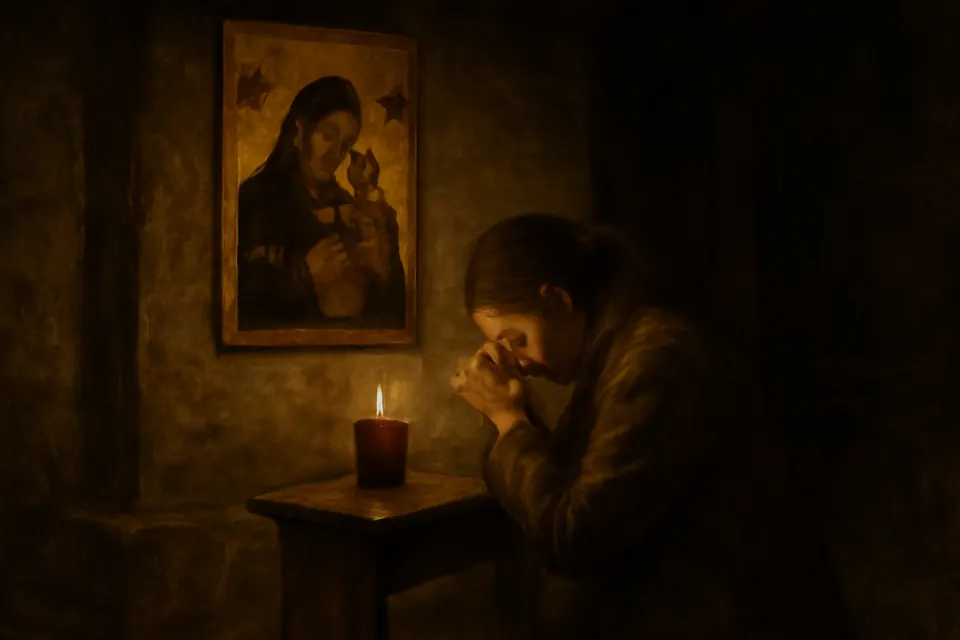
The classic Catholic prayer for help is the prayer to Our Lady of Perpetual Help: "Assist me, for the love of Jesus Christ; stretch forth thy hand to a miserable fallen creature." Pray it with the Church's shortest cry for help, "O God, come to my assistance; O Lord, make haste to help me," and ask the Fourteen Holy Helpers to pray for you.
 Free printable prayer card 5 × 7 inch PDF, ready to print, frame or tuck in a missal.
Sooner or later every one of us reaches the end of what we can manage. The bills don't add up, the diagnosis is bad, a marriage is coming apart, a child won't come home. The Church has never told us to keep that to ourselves. She teaches us to ask, plainly and often, and she gives us the words. Here are the traditional Catholic prayers for help, printed word for word from the old prayer books and the Douay-Rheims Bible, with the saints the faithful have called on in hard times for centuries.
The prayer to Our Lady of Perpetual Help
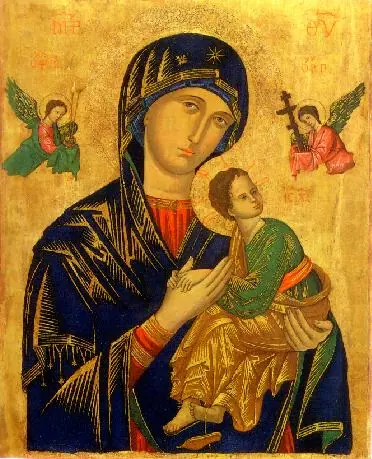
When we don't know where to turn, we turn to our Mother. The icon of Our Lady of Perpetual Help shows the Child Jesus running to her in fright at the sight of the cross and nails the angels carry, one sandal slipping from his foot, his hands gripping hers. That is the posture of this prayer.
Pius IX enriched three prayers to "Our Lady of Perpetual Succour" with an indulgence in 1866, the year the icon was enthroned in the Redemptorists' church in Rome. This is the first of them, in the English of the 1910 Raccolta (no. 268):
Behold at thy feet, O Mother of Perpetual Succour, a wretched sinner who has recourse to thee, and confides in thee. O Mother of mercy, have pity on me. I hear thee called by all, the refuge and the hope of sinners: be, then, my refuge and my hope. Assist me, for the love of Jesus Christ; stretch forth thy hand to a miserable fallen creature who recommends himself to thee, and who devotes himself to thy service for ever. I bless and thank Almighty God, who in mercy has given me this confidence in thee, which I hold to be a pledge of my eternal salvation. It is true that in the past I have miserably fallen into sin, because I had not recourse to thee. I know that, with thy help, I shall conquer. I know, too, that thou wilt assist me, if I recommend myself to thee; but I fear that, in time of danger, I may neglect to call on thee, and thus lose my soul. This grace, then, I ask of thee, and this I beg, with all the fervour of my soul, that, in all the attacks of hell, I may ever have recourse to thee. O Mary, help me. O Mother of Perpetual Succour, never suffer me to lose my God.
Notice what it fears most. Not the trouble itself, but forgetting to ask. "O Mary, help me" is a whole prayer on its own, and the one to keep on your lips through a hard day. For the icon's story and the Wednesday novena, see Our Lady of Perpetual Help.
"O God, come to my assistance": the Church's cry for help
The shortest prayer for help in the Bible is the one the Church prays most. Psalm 69 (Psalm 70 in most modern Bibles) opens with it, and since at least the Rule of St. Benedict in the sixth century it has opened the hours of the Divine Office, said by priests and religious many times every day:
O God, come to my assistance; O Lord, make haste to help me. (Psalm 69:2)
The Litany of the Saints keeps the rest of the psalm in its closing versicles. In the 1908 prayer book My Prayer Book by Father F. X. Lasance:
But I am needy and poor: O God, help me. Thou art my helper and my deliverer: O Lord, make no delay.
Pray it when you wake at three in the morning with your heart racing. Pray it on the way into the meeting, the courtroom, the hospital. It takes four seconds, and it is never the wrong prayer.
Psalm 120, the pilgrim's psalm, gives the answer:
I have lifted up my eyes to the mountains, from whence help shall come to me. My help is from the Lord, who made heaven and earth. (Psalm 120:1–2)
At the start of many blessings the priest still says its echo from Psalm 123, "Our help is in the name of the Lord," and the people answer, "Who made heaven and earth."
A prayer for help in difficult times: the Fourteen Holy Helpers
In the plague years of the 14th and 15th centuries, the people of Germany began to call on a group of fourteen saints together in every kind of need. They were mostly martyrs of the early Church: St. George, St. Blaise, St. Erasmus, St. Pantaleon, St. Vitus, St. Christopher, St. Denis, St. Cyriacus, St. Achatius, St. Eustace, St. Giles, St. Catherine of Alexandria, St. Margaret of Antioch and St. Barbara.
Father Bonaventure Hammer's 1909 book on the devotion tells the story of their shrine. In 1445 and 1446 a young shepherd of the abbey of Langheim in Bavaria, Herman Leicht, reported seeing a child in a field, and the second time thirteen more children with him, who said, "We are the Fourteen Helpers, and desire that a chapel be built for us." The monks were skeptical, but favors were reported by people who prayed at the spot, and a chapel was built there in 1447 and 1448. The shepherd's vision is a traditional account that the Church never formally judged; what is documented is that the bishop and Pope Nicholas V granted indulgences to the chapel, and pilgrims have never stopped coming. The present basilica of Vierzehnheiligen, "Fourteen Saints," was begun in 1743 and finished in 1772.
This is the first of the "Three Invocations" from Hammer's prayer book, which carries the imprimatur of the Archdiocese of New York. It asks exactly what we need in a hard season:
Great friends of God, Holy Helpers, humbly saluting and venerating you, I implore your help and intercession. Bring my prayers before the throne of the Most Holy Trinity, so that I may experience in all the difficulties and trials of life the mercy of the eternal Father, the love of the incarnate divine Son, and the assistance of the Holy Ghost; that despondency may not depress me when God's wise decree imposes on my shoulders a heavy burden. Above all, I implore your assistance at the hour of death. Help me then to gain the victory over the temptations and assaults of Satan, and to leave this world hopefully trusting in God's mercy, to join you in heaven, there to praise Him for ever and ever. Amen.
"That despondency may not depress me." The saints don't promise that the burden will be lifted tomorrow. They pray that it won't crush us while we carry it.

We fly to thy patronage
This short prayer to Our Lady is very old; the faithful were praying it in Greek long before the Hail Mary took its present form. The Raccolta (no. 184) gives it as an evening prayer:
We fly to thy patronage, O Holy Mother of God; despise not thou our petitions in our necessities, but deliver us always from all dangers, O glorious and blessed Virgin.
"In our necessities" is the key phrase. She is not put off by how ordinary or how messy our needs are. For the other great prayer of confidence in Mary's help, see the Memorare: "never was it known that any one who fled to thy protection, implored thy help, and sought thy intercession, was left unaided."
Prayers for help from Scripture
The Bible is full of people who had run out of options. Their prayers are short and unpolished, and that is why they help.
Esther: "I have no other helper but thee"
Queen Esther had to go uninvited before a king who could put her to death, to plead for her people. Before she went, she prayed (Esther 14:3, 14, Douay-Rheims):
O my Lord, who alone art our king, help me a desolate woman, and who have no other helper but thee.
But deliver us by thy hand, and help me, who have no other helper, but thee, O Lord, who hast the knowledge of all things.
Peter: "Lord, save me"
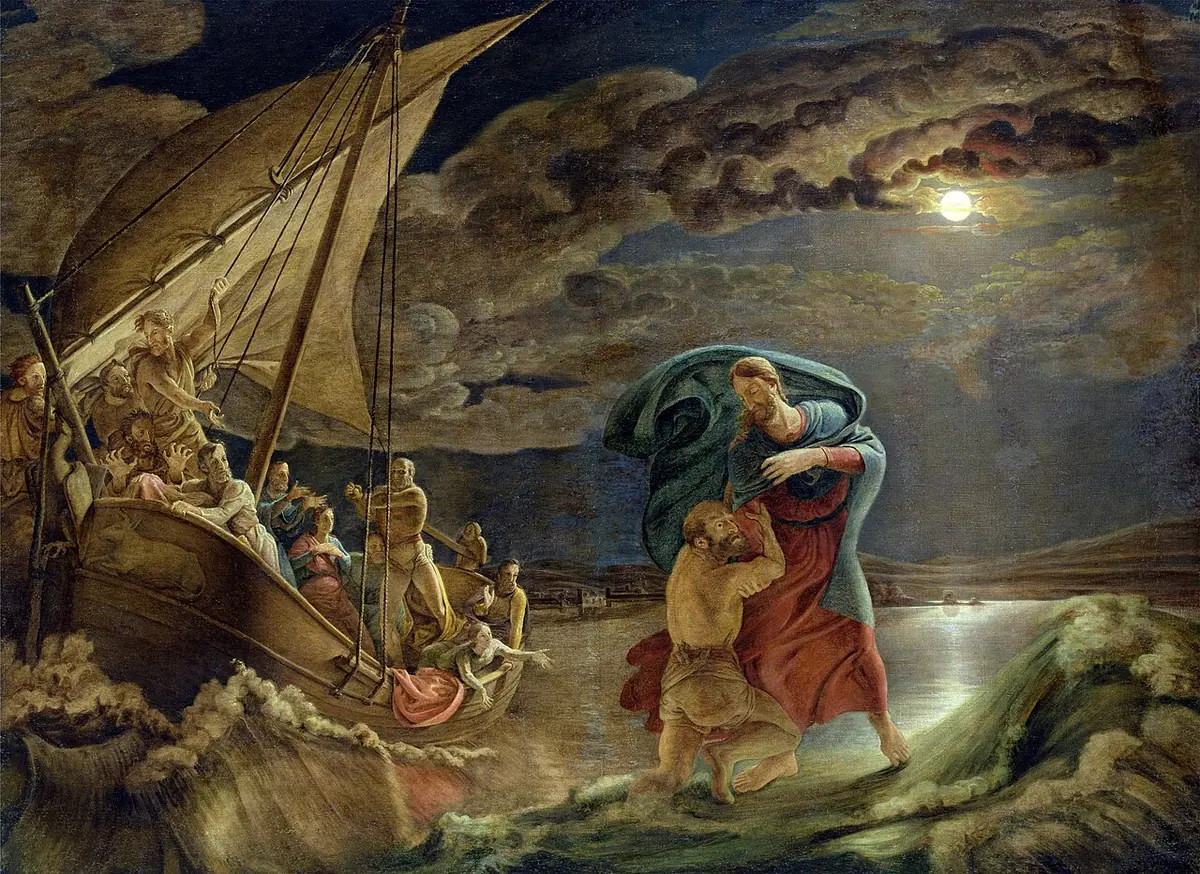
When Peter stepped out of the boat and began to sink, he didn't compose a prayer. He shouted three words, and "immediately Jesus stretching forth his hand took hold of him" (Matthew 14:30–31).
The father of the sick boy: "Help my unbelief"
When even our faith feels thin, we can pray what this desperate father prayed "with tears" (Mark 9:23):
I do believe, Lord: help my unbelief.
God's promise
Fear not, for I am with thee: turn not aside, for I am thy God: I have strengthened thee, and have helped thee, and the right hand of my just one hath upheld thee. (Isaias 41:10)
Let us go therefore with confidence to the throne of grace: that we may obtain mercy, and find grace in seasonable aid. (Hebrews 4:16)
The saints to ask for help
We ask the saints to pray for us the way we would ask a friend. They help by their intercession; every grace comes from God.
- Our Lady of Perpetual Help and Mary, Help of Christians, the title St. John Bosco loved, for every need.
- St. Joseph, for the needs of the family, work and a home. See the St. Joseph prayer.
- St. Jude and St. Rita of Cascia, for desperate and seemingly impossible cases. See the St. Jude prayer and our prayer for a miracle.
- St. Michael the Archangel, when the trouble is spiritual. See the St. Michael prayer.
- The Fourteen Holy Helpers, for every kind of affliction.
For particular troubles, see our prayers for financial help, for anxiety, for strength and for comfort.
How to ask God for help
- Say exactly what you need. Jesus asked the blind man, "What wilt thou that I should do to thee?" (Mark 10:51), though he already knew. Name it.
- Go to confession if sin is part of the burden. Nothing lightens a load like that.
- Ask a priest, a friend or your parish to pray with you, and let them know what is going on. The Church is a family.
- Have a Mass offered for your intention.
- Take the practical help God sends: a doctor, a counselor, a food pantry, the St. Vincent de Paul Society. God very often answers prayer through other people.
- Keep asking. The Perpetual Help prayer's one fear is that we will stop.
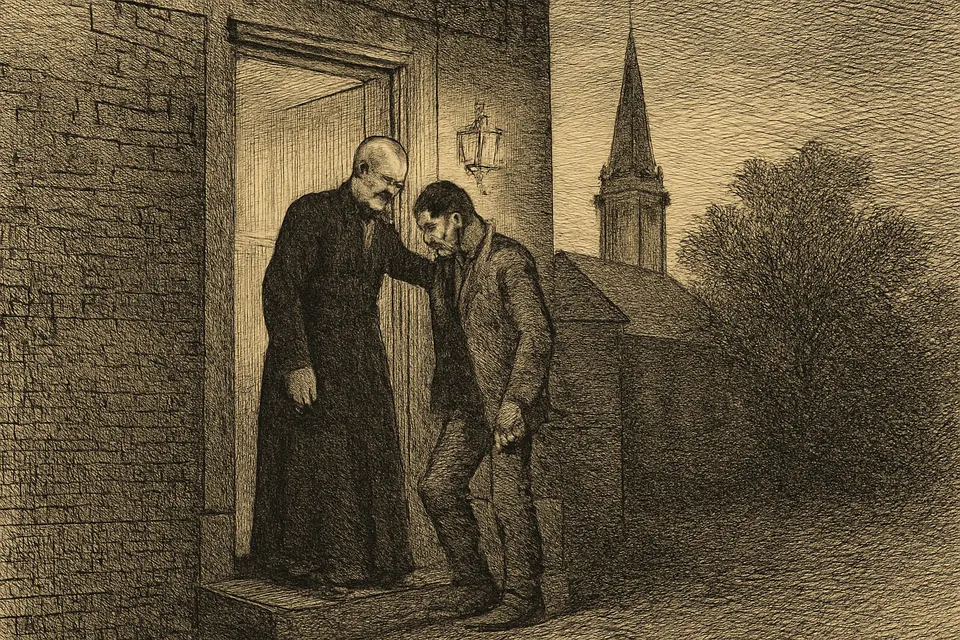
When help seems slow, we keep the same trust the psalmist did. Let us pray it together now: "O God, come to my assistance; O Lord, make haste to help me." Then go on to the next thing, knowing you are not carrying it alone. For more prayers for every need, browse all our Catholic prayers.
Frequently asked questions
What is the most powerful prayer for help?
No prayer works like a formula, but the Church's own cry, "O God, come to my assistance; O Lord, make haste to help me" (Psalm 69:2), opens every hour of her daily prayer, and the Mass is the greatest prayer of all. Among private prayers, the Memorare and the prayer to Our Lady of Perpetual Help are the ones the faithful have turned to most in trouble.
What is a short prayer for help in difficult times?
Pray Peter's three words when he began to sink: "Lord, save me" (Matthew 14:30). Or the father's cry in Mark 9:23, "I do believe, Lord: help my unbelief." Or simply, "Mary, help of Christians, pray for us."
Who is the patron saint of help?
Our Lady is invoked as Our Lady of Perpetual Help and as Mary, Help of Christians. The Fourteen Holy Helpers are a group of saints invoked together in every kind of need, and St. Jude and St. Rita are asked to pray in desperate cases.
Who are the Fourteen Holy Helpers?
Sts. George, Blaise, Erasmus, Pantaleon, Vitus, Christopher, Denis, Cyriacus, Achatius, Eustace, Giles, Catherine of Alexandria, Margaret of Antioch and Barbara. The devotion grew in Germany in the plague years, and their great shrine is the basilica of Vierzehnheiligen in Bavaria.
What should I do if I am in danger or thinking of harming myself?
Pray, and get help now. In the United States, call or text 988 to reach the Suicide and Crisis Lifeline, or call 911 in an emergency. Then call a priest. Asking for help from people is not a failure of faith; very often it is how God answers.
Sources
- The Raccolta, or Collection of Indulgenced Prayers and Good Works (Burns & Oates, 1910), nos. 184 (Sub tuum praesidium) and 268 (prayers to Our Lady of Perpetual Succour), Internet Archive
- Bonaventure Hammer, Mary, Help of Christians, and the Fourteen Saints Invoked as Holy Helpers (Benziger, 1909), Project Gutenberg. History of the devotion, the Langheim apparition account and the three invocations
- F. X. Lasance, My Prayer Book: Happiness in Goodness (Benziger, 1908), the Litany of the Saints, Internet Archive
- Douay-Rheims Bible, Esther chapter 14 (drbo.org)
- Douay-Rheims Bible, Psalm 120 (drbo.org)