Where are the saints buried?

Where are the saints buried? Most rest beneath the altars of churches built over their graves: St. Peter under St. Peter's Basilica in Vatican City, St. Paul at St. Paul Outside the Walls in Rome, St. Francis in Assisi, Padre Pio in San Giovanni Rotondo, St. Anthony in Padua and St. Thérèse in Lisieux. Mary has no grave: the Church teaches she was taken up body and soul into heaven.
Where are the saints buried?
Most of the great saints rest exactly where the Church has prayed over them for centuries: beneath the altar of a church raised over their graves. St. Peter lies under the high altar of St. Peter's Basilica, St. Paul under the papal altar of St. Paul Outside the Walls, St. Francis in the crypt of his basilica in Assisi. Some have been moved, some divided among several churches, and a few, like the Virgin Mary, have no grave at all.
The custom began with the martyrs of Rome. Christians buried them in cemeteries outside the city walls and gathered at their tombs on the anniversary of their deaths, which they called the martyr's birthday into heaven, to celebrate Mass there. When the persecutions ended, churches went up over the graves, and the altar was set directly above the body. The Book of Revelation had already pictured "the souls of them that were slain for the word of God" resting "under the altar" (Revelation 6:9, Douay-Rheims). From there the practice spread: when a saint's body could not stay where it lay, it was carried in procession to a new church, an event the Church calls a translation, and relics were placed in altars far from the original grave.
So when we ask where a saint is buried, the answer is often a story. Here are the seven tombs people ask about most, told as honestly as the evidence allows, with links to each saint's full entry. For the wider subject of relics, see relics and incorruptible saints.
Where is St. Peter buried?
St. Peter is buried beneath the high altar of St. Peter's Basilica in Vatican City. He was martyred in Rome under Nero, by tradition crucified head downward, and buried in a cemetery on the Vatican Hill beside the circus where he died.
The early witnesses are short and plain. Around the year 200 a Roman priest named Gaius told an opponent he could show "the trophies of the apostles," one on the Vatican and one on the road to Ostia, and Eusebius preserved his words in his Church History. In the 4th century Constantine leveled part of the hillside, at enormous cost, so that the first St. Peter's Basilica could be built with its altar over one small monument. The present basilica, begun in 1506, keeps the same center: Bernini's bronze canopy and Michelangelo's dome rise directly above the grave.
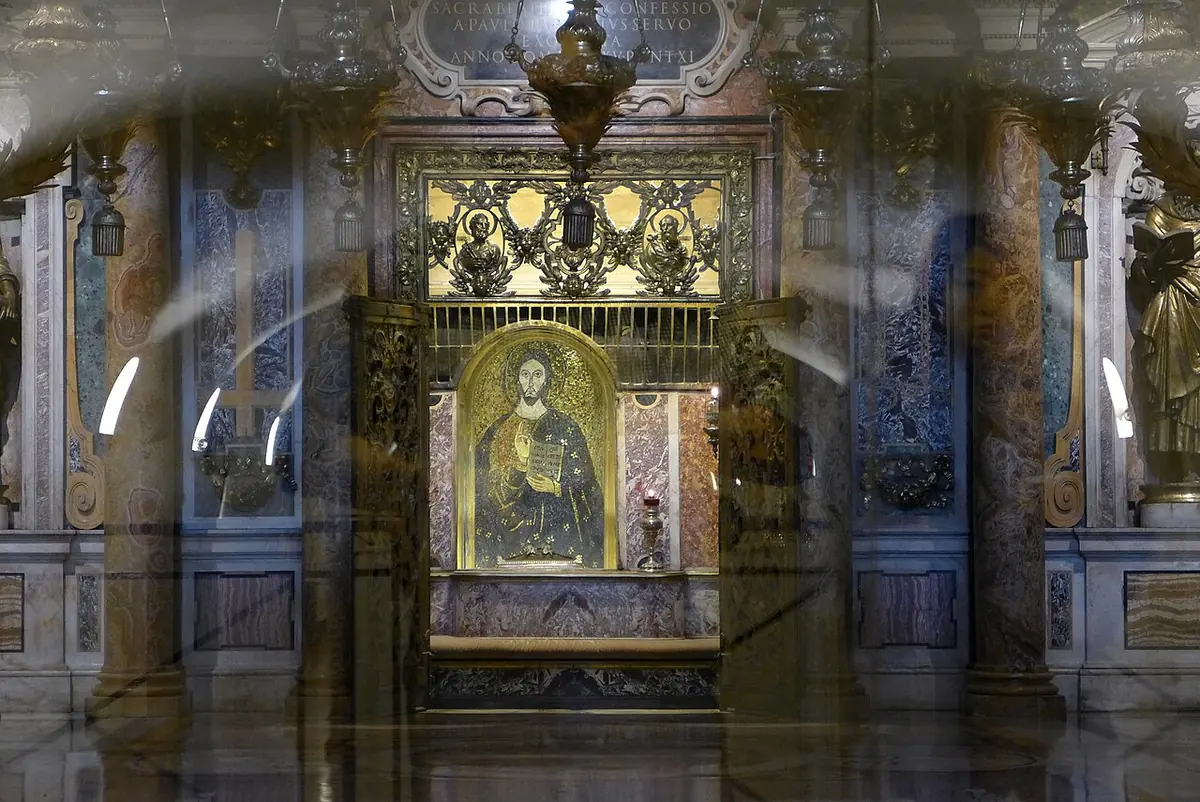
In 1939, right after his election, Pius XII ordered excavations beneath the altar. Over the next decade archaeologists uncovered a street of Roman tombs and, directly under the altar, a small 2nd-century shrine set against a red-plastered wall, the "trophy" Gaius had described. Pius XII announced in 1950 that the tomb had been found, but left open whether the bones had been.
The rest is reported, and more complicated. The epigrapher Margherita Guarducci learned in the 1950s that bones had been taken from a small repository in a graffiti-covered wall beside the shrine and set aside. On June 26, 1968, Paul VI told a general audience that the relics of St. Peter had been identified in a manner the Holy See considered convincing, while expecting study and debate to continue, and the bones were returned to their place the next day. Some scholars still doubt the identification. Pilgrims can visit the excavations, the scavi, on a guided tour booked through the Vatican's Excavations Office, and pray at the grave from the grottoes beneath the basilica floor.
Read the full story in our entry on St. Peter.
Where is St. Paul buried?
St. Paul is buried in the Basilica of St. Paul Outside the Walls, on the Via Ostiense in Rome. As a Roman citizen he was beheaded rather than crucified, by tradition at the place now called Tre Fontane, and buried about two miles from the city on land that a 4th-century account says belonged to a Christian matron named Lucina.
Constantine built a first church over the grave, and later emperors enlarged it into one of the largest churches in the Christian world. A fire in 1823 destroyed most of it, and the present basilica was rebuilt on the same plan. The tomb lies beneath the papal altar, covered by an ancient marble slab inscribed PAULO APOSTOLO MART, "to Paul, apostle and martyr." Today pilgrims can see the slab through a window below the altar.
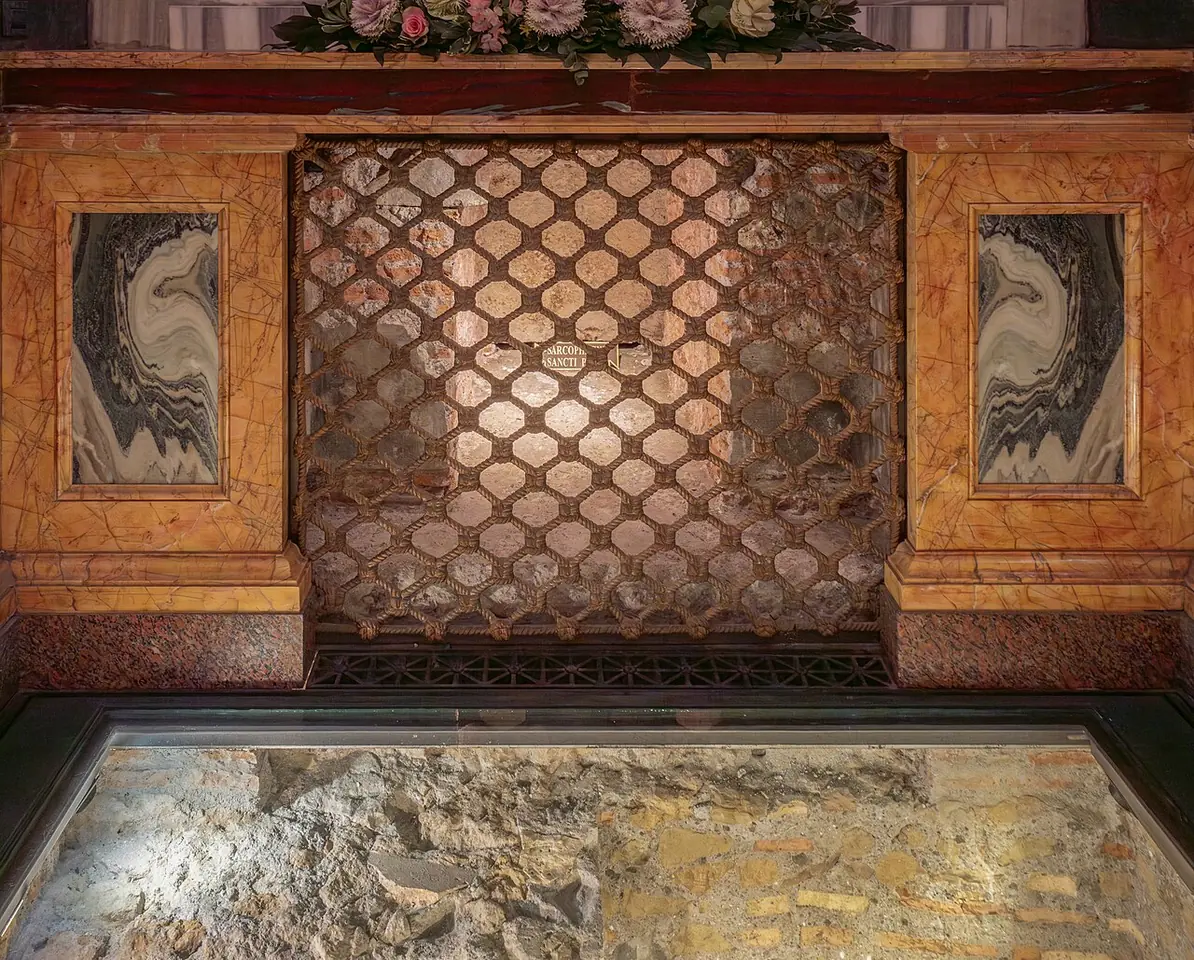
The sarcophagus itself has never been opened. On June 28, 2009, closing the Pauline Year, Benedict XVI announced that a tiny hole had been drilled into it and a probe inserted. It found traces of purple linen with a gold-leaf design, grains of red incense, and minute fragments of bone, which carbon-14 testing dated to someone who lived between the 1st and 2nd centuries. The pope said the findings "would seem to confirm the unanimous and undisputed tradition" that the tomb holds the apostle's remains. These are reported findings, and the Church has not asked anyone to treat them as more.
The Lateran Basilica also keeps reliquary heads of Peter and Paul in the canopy over its papal altar, a claimed relic tradition of the Middle Ages. More in our entry on St. Paul.
Where is St. Francis buried?
St. Francis of Assisi is buried in the crypt of the Basilica of St. Francis in Assisi, Italy. He died at the Porziuncola below the town on the evening of October 3, 1226, and the friars carried his body up the hill the next morning.

He was first buried in the little church of San Giorgio, where he had learned to read as a boy. Gregory IX canonized him there on July 16, 1228, and laid the first stone of a great double church on the western edge of Assisi the next day. The Catholic Encyclopedia tells what happened next: on May 25, 1230, Brother Elias had the remains "secretly transferred" to the new basilica and "buried far down under the high altar in the lower church." The secrecy was deliberate: in the Middle Ages, the bodies of famous saints were sometimes carried off by rival towns.

It worked too well. For almost six centuries nobody knew exactly where the body lay. In 1818, with the permission of Pius VII, the friars dug at night for fifty-two nights and on December 12 found the stone coffin in the rock beneath the altar. A crypt was opened around it, and it was remade in its present plain style in the 20th century.
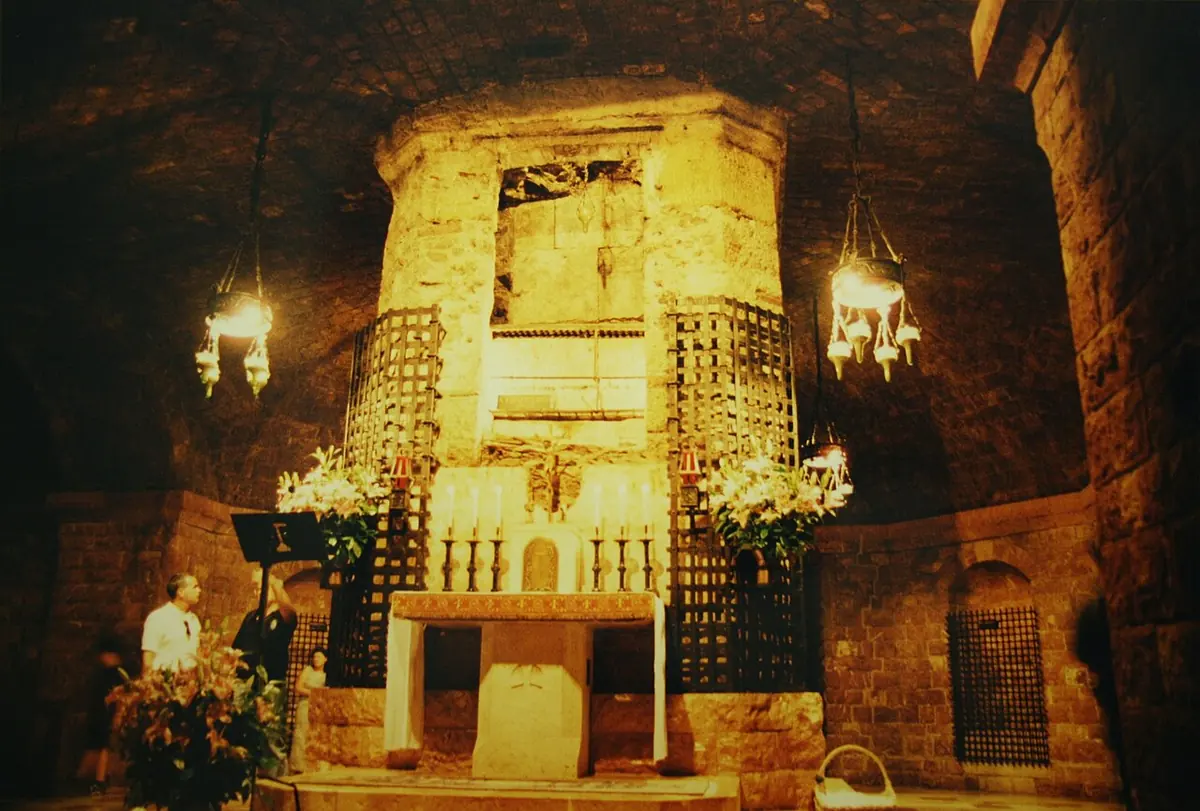
Today pilgrims walk down from the Lower Church into the crypt and pray before the rough stone pillar that holds the coffin. Four of his first companions, Brothers Leo, Rufino, Masseo and Angelo, are buried in the walls around him. Close by, St. Clare lies in the crypt of the Basilica of Santa Chiara on the other side of town. See our entries on St. Francis of Assisi and St. Clare.
Where is Padre Pio buried?
Padre Pio is buried in San Giovanni Rotondo, in the province of Foggia in southern Italy, the hilltop town where he lived as a Capuchin friar for fifty-two years. Since 2010 his body has rested in the lower church of the large Church of St. Pio, next to the old friary of Santa Maria delle Grazie.
He died on September 23, 1968, and about 100,000 people came to his funeral. He was buried in the crypt of the friary church of Santa Maria delle Grazie, and his tomb drew pilgrims from all over the world. Both healings the Church approved for his beatification and canonization involved prayer at that tomb.

In March 2008, forty years after his death, the body was exhumed and found in what Church officials called "fair condition." It was put on display in the crypt in a glass coffin, dressed in his Capuchin habit, with a lifelike silicone mask over the face. On April 19, 2010, it was moved to the lower church of the new Church of St. Pio, designed by Renzo Piano and dedicated in 2004. The transfer had its critics, some of whom felt the new church was too grand for so poor a friar; EWTN News reported the debate at the time. Pilgrims can see the body there, and in February 2016 Pope Francis had it brought to St. Peter's for the Jubilee of Mercy, as a model for confessors.
Our full entry is Padre Pio, and his prayers are on the Padre Pio prayer page.
Where is St. Anthony buried?
St. Anthony of Padua is buried in the Basilica of St. Anthony in Padua, Italy, which the city simply calls il Santo, "the Saint." He died on June 13, 1231, at the friary of Arcella just outside Padua, and the town quarreled over his body before he was buried in the friars' church of Santa Maria Mater Domini. The great basilica rose around that church over the next century.
When the tomb was opened in 1263 to move the remains into the new church, the friars found the body reduced to bones and dust, but the tongue still soft and red. St. Bonaventure, then minister general of the Franciscans, took it in his hands and praised the tongue that had always blessed the Lord. That account is reported by the Franciscan tradition; the National Catholic Register tells the story of the openings and the "Feast of the Tongue" Padua still keeps.

His tomb stands in the Chapel of St. Anthony, rebuilt in white marble in the early 1500s, with large reliefs of his miracles by Tullio Lombardo, Jacopo Sansovino and others. Pilgrims file around the back of the altar to lay a hand on the stone and leave written petitions. The tongue, the jaw and the vocal cords are kept in gold reliquaries in the Chapel of the Relics behind the high altar. More in our entry on St. Anthony of Padua and on the St. Anthony prayer page.
Where is St. Thérèse buried?
St. Thérèse of Lisieux is buried in the chapel of the Carmel of Lisieux in Normandy, France, the convent where she lived as a cloistered nun from age fifteen until her death at twenty-four on September 30, 1897.
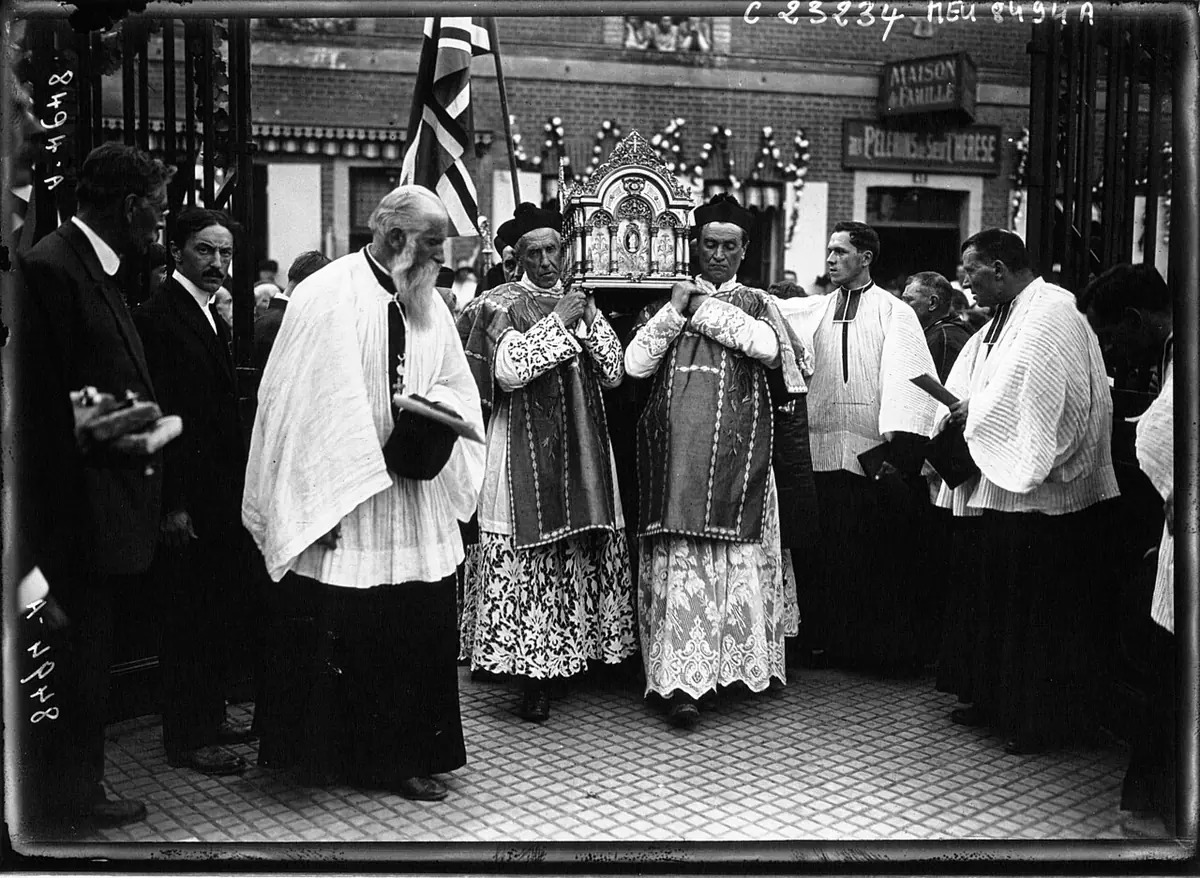
She was first buried in the town cemetery. As the favors attributed to her intercession multiplied after Story of a Soul was published, so did the pilgrims at her grave. Her remains were exhumed three times during her cause, in 1910, 1917 and 1923. Her body had not stayed incorrupt, and the Carmel has never claimed otherwise. On March 26, 1923, a month before her beatification, her remains were carried in procession to the Carmel chapel. The Carmel's archives describe that day and the later journeys of her relics.
Today her remains rest in a side chapel beneath a reclining figure of her in her Carmelite habit, holding roses and a crucifix. Above it stands the statue of the Virgin of the Smile that was at her bedside when she was healed as a child. The nuns' cloister can't be visited, but the chapel is open every day.
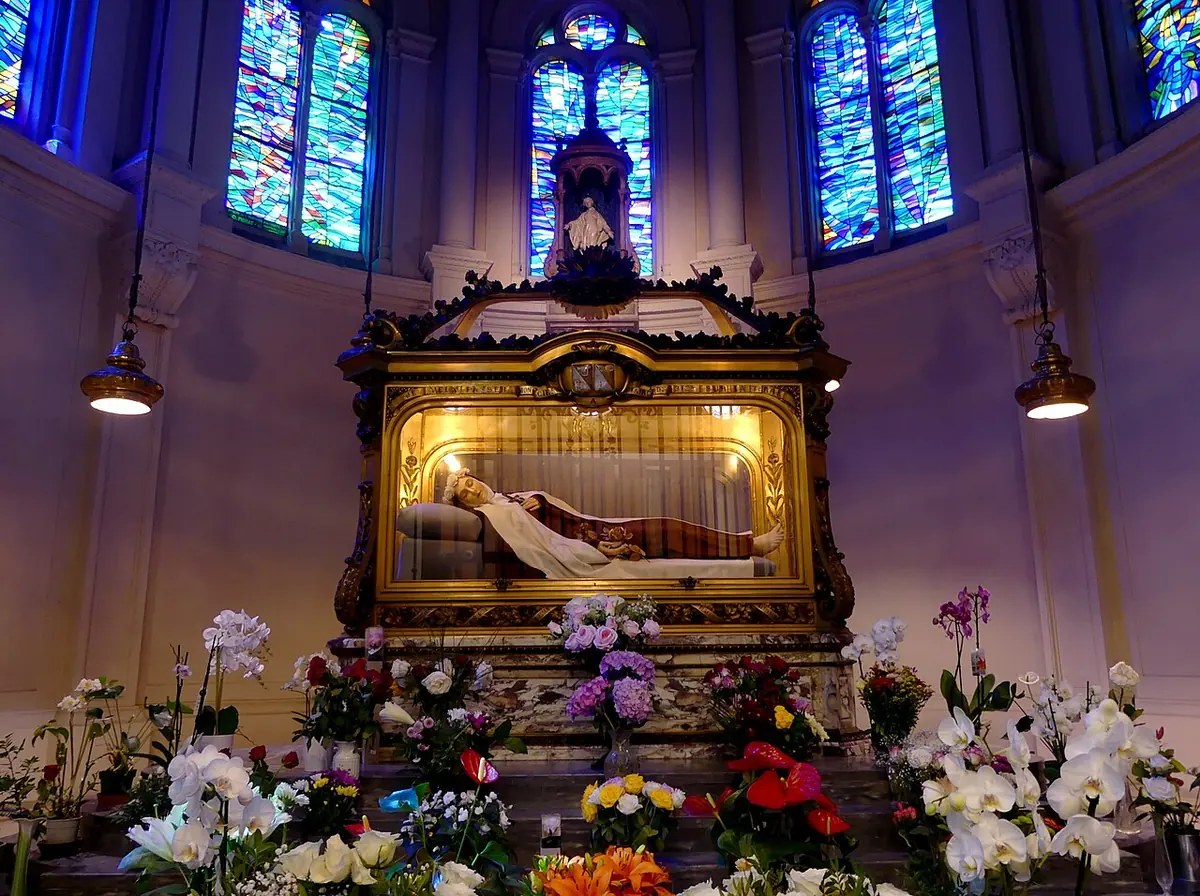
Pilgrims often confuse the Carmel with the Basilica of St. Thérèse, the domed church on the hill above Lisieux, consecrated in 1954. The basilica keeps a reliquary with one of her bones, and her parents, Sts. Louis and Zélie Martin, are buried there. Her tomb is in the Carmel. Read more in our entry on St. Thérèse of Lisieux.
Where is Mary buried?
The Blessed Virgin Mary has no grave holding her body. The Church teaches that she was taken up body and soul into heaven. On November 1, 1950, Pius XII defined in Munificentissimus Deus that "the Immaculate Mother of God, the ever Virgin Mary, having completed the course of her earthly life, was assumed body and soul into heavenly glory." The definition does not say whether she died first. We keep the mystery on August 15, the Solemnity of the Assumption.
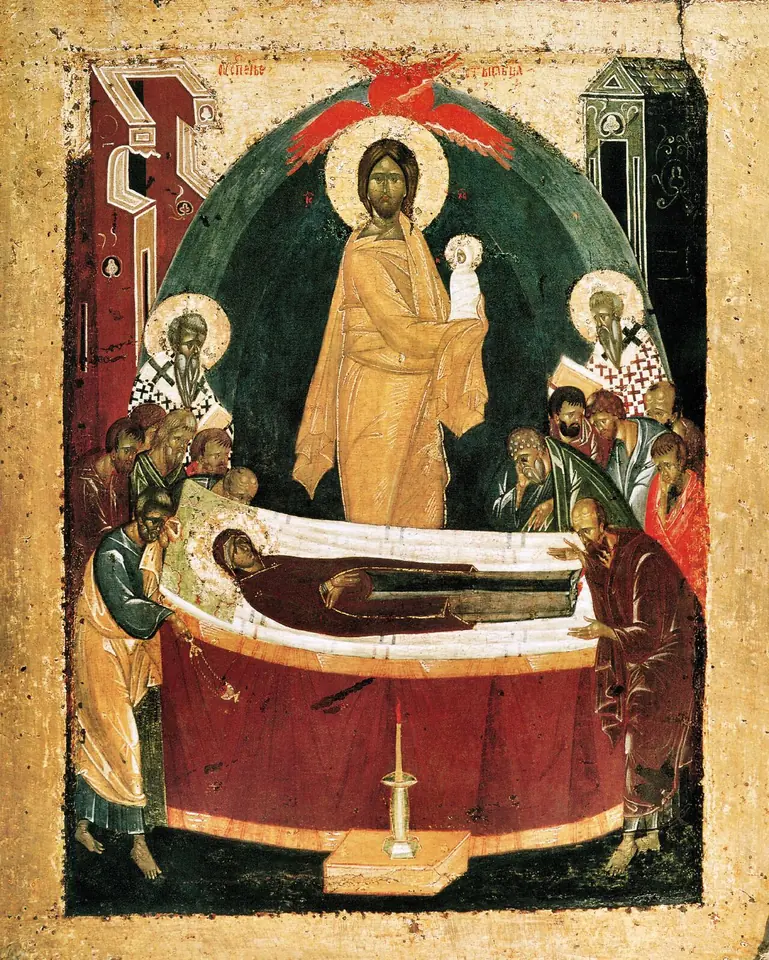
Scripture is silent about where her earthly life ended, and two places are honored.
Jerusalem. The older tradition, kept by the Orthodox Church, says that the apostles gathered at her deathbed in Jerusalem and laid her in a tomb at Gethsemane, and that when St. Thomas arrived three days later and the tomb was opened, her body was gone. The Eastern churches keep August 15 as the Dormition, the "falling asleep" of the Mother of God. The Catholic Encyclopedia (1907) gives Jerusalem the stronger claim, since "her tomb is shown" there, while noting honestly that "the first six centuries did not know of the tomb of Mary at Jerusalem." The story of the empty tomb first appears in writings of the 4th or 5th century, so it is traditional.

The Church of the Sepulchre of Mary still stands in the Kidron Valley, at the foot of the Mount of Olives. A broad staircase leads far down to a small rock-cut chamber, empty, honored as her tomb. The church belongs today to the Greek Orthodox and Armenian Apostolic churches, and Catholic pilgrims are welcome to pray there.
Ephesus. A later tradition says that Mary went to Ephesus with St. John, to whom Jesus entrusted her from the cross. The Catholic Encyclopedia judged in 1909 that this tradition "rests on no ancient testimony." In 1891, following the visions of Blessed Anne Catherine Emmerich, Lazarist priests rediscovered a ruined stone house on a hill above Ephesus that the Christians of a nearby village had long honored. The Church has never ruled on whether Mary lived there, but Paul VI, St. John Paul II and Benedict XVI all prayed at Meryem Ana Evi, "the House of Mother Mary."

Either way, we go to these places to honor her, not to find her remains. She has gone before us, body and soul, where we hope to follow. See our entry on the Blessed Virgin Mary.
Where other famous saints are buried
The same pattern holds across the calendar: a church over the grave, or a church that received the body in a translation. Here are some resting places people often ask about, with the honest status of each:
- St. James the Greater: Cathedral of Santiago de Compostela, Spain, in a silver reliquary in the crypt; the goal of the Camino. St. James.
- St. Mark: St. Mark's Basilica, Venice, brought from Alexandria in 828 or 829; Coptic tradition holds that his head stayed in Alexandria. St. Mark.
- St. Nicholas: Basilica of San Nicola, Bari, Italy, since 1087. St. Nicholas.
- St. Andrew: most of his body in the crypt of Amalfi Cathedral; his head in Patras, Greece, returned by Paul VI in 1964. St. Andrew.
- St. Catherine of Siena: her body beneath the high altar of Santa Maria sopra Minerva in Rome; her head in San Domenico, Siena. St. Catherine of Siena.
- St. Augustine: San Pietro in Ciel d'Oro, Pavia, Italy. St. Augustine.
- St. Bernadette: her incorrupt body in the chapel of her convent at Nevers, France. St. Bernadette.
- St. Rita: her incorrupt body in the Basilica of St. Rita, Cascia, Italy. St. Rita.
- St. John Paul II: the Chapel of St. Sebastian in St. Peter's Basilica, since 2011. St. John Paul II.
- St. Patrick: by tradition, the grounds of Down Cathedral, Downpatrick, Northern Ireland; the grave is traditional, not proven. St. Patrick.
- St. Joseph: no known grave. Scripture says nothing of his death, and no church claims his body. St. Joseph.
For saints buried in the United States, from St. John Neumann in Philadelphia to Blessed Solanus Casey in Detroit, see national shrines in the US. For the great pilgrimage routes of Europe and the Holy Land, see Catholic pilgrimage sites.
Praying at a saint's tomb
We don't visit a saint's tomb as tourists visit a monument. We go to pray, and to ask the saint who lies there to pray with us and for us, as the first Christians did at the graves of the martyrs. The Church honors the bodies of the saints because they were temples of the Holy Spirit and will rise again in glory.
A simple way to pray at a tomb: make the Sign of the Cross, thank God for the grace he gave this saint, and then speak plainly, as you would to a friend in the family of God: "St. Anthony, pray for me." Many pilgrims leave a written petition, light a candle, or kneel for a decade of the rosary. Wherever Mass is celebrated over the tomb, take part in it if you can; that is why the altar was built there in the first place. And if you never make the journey, take heart. Every Catholic altar holds the same faith, and the saints hear us from heaven, not only from their graves.
Let us ask them, then, wherever they rest: all you holy men and women, saints of God, pray for us.
Frequently asked questions
Where is St. Peter buried?
Beneath the high altar of St. Peter's Basilica in Vatican City. Excavations ordered by Pius XII in 1939 found a 2nd-century monument over a simple grave, and on June 26, 1968, Paul VI announced that bones found in a wall beside it had been identified as Peter's "in a manner which we believe convincing."
Where is St. Paul buried?
In the Basilica of St. Paul Outside the Walls, on the road to Ostia in Rome. His sarcophagus lies beneath the papal altar. It has never been opened, but in 2009 Benedict XVI announced that bone fragments drawn out through a tiny hole dated to the 1st or 2nd century.
Where is St. Francis of Assisi buried?
In the crypt of the Basilica of St. Francis in Assisi, Italy. Brother Elias hid the body deep under the high altar of the Lower Church in 1230, and it stayed hidden until December 12, 1818. Pilgrims now pray at the stone tomb in the crypt.
Where is Padre Pio buried, and can you see his body?
In San Giovanni Rotondo, in the province of Foggia in southern Italy. He was buried in the crypt of Santa Maria delle Grazie in 1968, exhumed in 2008, and moved on April 19, 2010, to the lower church of the newer Church of St. Pio, where pilgrims can see his body in a glass coffin, the face covered by a mask.
Where is St. Anthony of Padua buried?
In the Basilica of St. Anthony in Padua, Italy, which the Paduans simply call the Santo. His tomb stands in the marble Chapel of St. Anthony, and his tongue and jaw are kept in reliquaries in the Chapel of the Relics behind the high altar.
Where is St. Thérèse of Lisieux buried?
In the chapel of the Carmel of Lisieux in Normandy, France. Her remains were brought there from the town cemetery on March 26, 1923, shortly before her beatification, and rest beneath a reclining figure of her. The great basilica on the hill above the town holds a relic, not her tomb.
Where is the Virgin Mary buried?
The Church teaches that Mary was assumed body and soul into heaven, so there is no grave with her body in it. Two places are honored for the end of her earthly life. An ancient tradition shows her empty tomb in Jerusalem's Kidron Valley, near Gethsemane, and a later tradition places her last years at a house near Ephesus in Turkey.
Why are saints buried under altars?
The custom goes back to the Roman martyrs, when Christians celebrated Mass at their tombs on the anniversary of their deaths. Churches were then built over the graves, with the altar directly above the body, and relics were later placed in or beneath altars everywhere. Revelation 6:9 speaks of the souls of the martyrs "under the altar."
Sources
- Paul VI, General Audience of June 26, 1968 (Italian), on the identification of the relics of St. Peter
- Benedict XVI, Homily at First Vespers closing the Pauline Year (June 28, 2009). The probe of St. Paul's sarcophagus and the carbon-14 dating
- Catholic Encyclopedia (1909): St. Francis of Assisi. The secret burial of May 25, 1230, and the finding of December 12, 1818
- EWTN News: Decision to transfer Padre Pio's body causes a stir (April 2010)
- National Catholic Register: The Opening of St. Anthony's Tomb and the 'Feast of the Tongue'
- Carmel of Lisieux Archives: The journeys of the relics
- Pius XII, Munificentissimus Deus (November 1, 1950)
- Catholic Encyclopedia (1907): The Feast of the Assumption. Jerusalem and Ephesus; "The first six centuries did not know of the tomb of Mary at Jerusalem"