Catholic prayer for protection
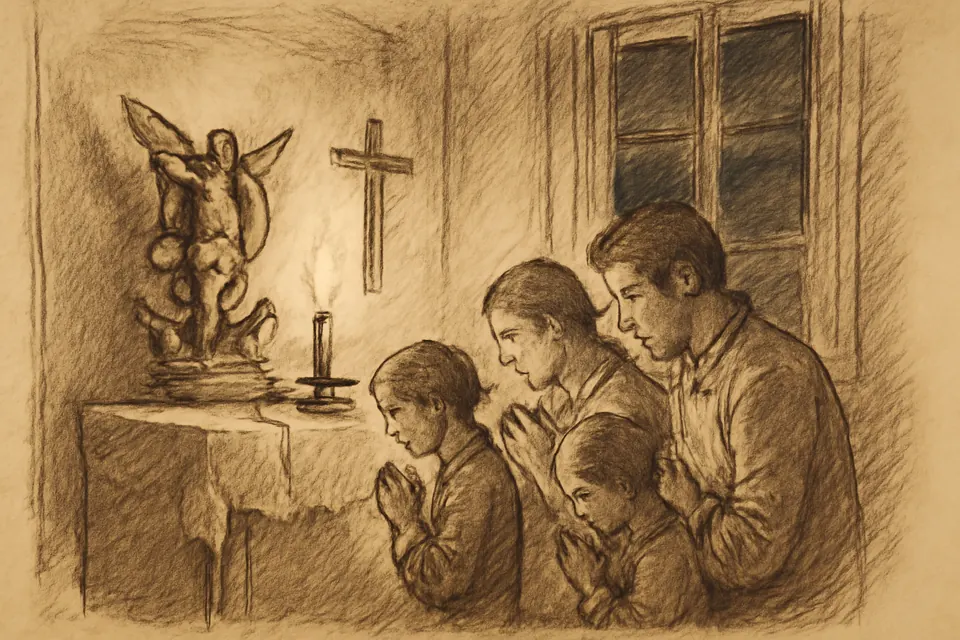
The best-known Catholic prayer for protection is the prayer to St. Michael the Archangel: "St. Michael, the Archangel, defend us in battle; be our protection against the malice and snares of the devil." We also pray Psalm 90 (Psalm 91 in most modern Bibles), the Angel of God prayer to our guardian angel, and the ancient "We fly to thy patronage" to Our Lady.
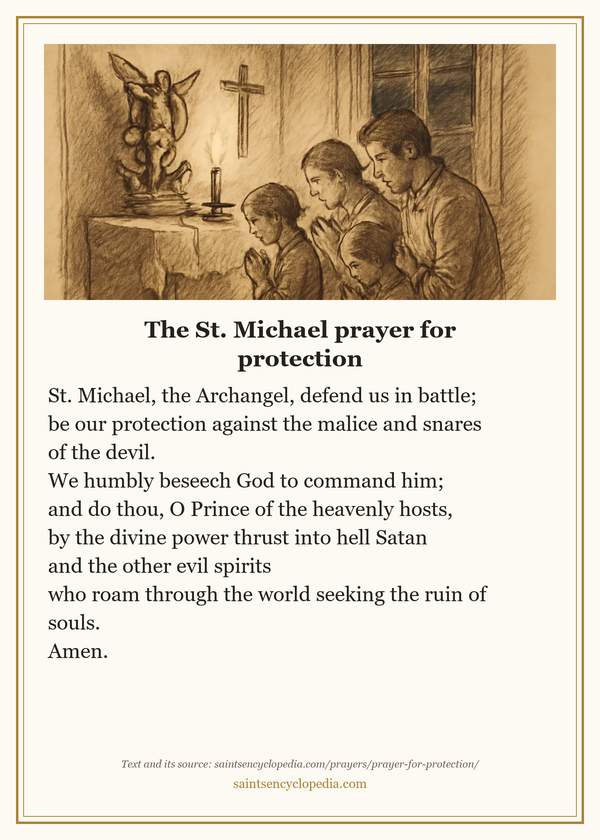 Free printable prayer card 5 × 7 inch PDF, ready to print, frame or tuck in a missal.
When we ask God for protection, we are praying one of the oldest prayers there is. The psalmists prayed it, the martyrs prayed it, and every generation of Catholics since has handed down its own words for it: for the night, for the road, for our children, for the hour of temptation. Below are seven of those traditional prayers, each printed word for word from the old prayer books where we found it, with the saints we ask to stand beside us and a few words on how to pray them.
The St. Michael prayer for protection
Pope Leo XIII wrote this prayer in Latin and, in 1886, ordered it said at the end of every Low Mass. This is the English as it was printed under "Prayers after Low Mass" in The Little Month of November, a Catholic booklet published in Boston in 1912:
St. Michael, the Archangel, defend us in battle; be our protection against the malice and snares of the devil. We humbly beseech God to command him; and do thou, O Prince of the heavenly hosts, by the divine power thrust into hell Satan and the other evil spirits who roam through the world seeking the ruin of souls. Amen.
Most prayer cards today say "St. Michael the Archangel, defend us in battle. Be our defense against the wickedness and snares of the Devil." It is the same prayer in a slightly later translation. The Latin word Leo used, praesidium, means a guard or garrison, so "protection" is the closer English.
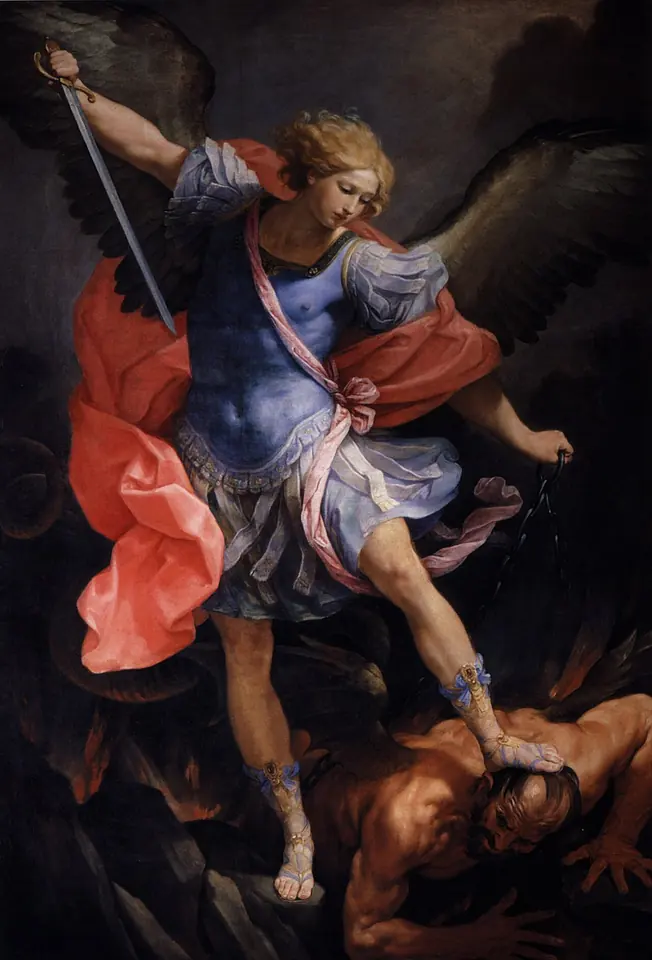
Notice whom the prayer asks for what. We ask St. Michael to defend us, and we ask God to command the devil. The archangel fights "by the divine power," never by his own. That is why the Church has always been at ease asking his help: it is God's protection we want, and Michael is the captain God has set over his angels (Revelation 12:7). The full history of the prayer, the Latin text and the story behind it are on our page The St. Michael prayer.
Psalm 90: the Bible's prayer for protection
If you are looking for the "prayer for protection" in Scripture, this is it. Catholics who use the Douay-Rheims or the old Latin Vulgate know it as Psalm 90; in most modern Bibles it is Psalm 91. The numbers differ because the Greek and Latin Bibles join Psalms 9 and 10 into one, so from there on their psalm numbers run one behind the Hebrew. The words are the same psalm.
This is the full psalm in the Douay-Rheims translation:
He that dwelleth in the aid of the most High, shall abide under the protection of the God of Jacob. He shall say to the Lord: Thou art my protector, and my refuge: my God, in him will I trust. For he hath delivered me from the snare of the hunters: and from the sharp word. He will overshadow thee with his shoulders: and under his wings thou shalt trust. His truth shall compass thee with a shield: thou shalt not be afraid of the terror of the night. Of the arrow that flieth in the day, of the business that walketh about in the dark: of invasion, or of the noonday devil. A thousand shall fall at thy side, and ten thousand at thy right hand: but it shall not come nigh thee. But thou shalt consider with thy eyes: and shalt see the reward of the wicked. Because thou, O Lord, art my hope: thou hast made the most High thy refuge. There shall no evil come to thee: nor shall the scourge come near thy dwelling. For he hath given his angels charge over thee; to keep thee in all thy ways. In their hands they shall bear thee up: lest thou dash thy foot against a stone. Thou shalt walk upon the asp and the basilisk: and thou shalt trample under foot the lion and the dragon. Because he hoped in me I will deliver him: I will protect him because he hath known my name. He shall cry to me, and I will hear him: I am with him in tribulation, I will deliver him, and I will glorify him. I will fill him with length of days; and I will shew him my salvation.
How the Church has prayed Psalm 90
For centuries this psalm belonged to the night. It is sung at Compline, the last hour of the Church's daily prayer, and monks and priests have closed the day with it for well over a thousand years. Its lines about "the terror of the night" and the "business that walketh about in the dark" were meant for the hour before sleep. In the old Roman Missal it was also the long chant before the Gospel on the First Sunday of Lent, the Sunday when we hear how the devil tempted Jesus in the desert. The choice was pointed: in that Gospel the devil quotes this very psalm, "He hath given his angels charge over thee," and Jesus answers him, "Thou shalt not tempt the Lord thy God" (Matthew 4:6–7).
The Church also gave it to the sick. In the Roman Ritual's order for visiting the sick, as printed in the 1889 Manual of Prayers of the Third Plenary Council of Baltimore, the priest prays Psalm 90 at the bedside before laying his hand on the sick person's head.

The mosaic above shows how early Christians read the psalm. In the small chapel of the bishops of Ravenna, Christ stands dressed as a Roman soldier, the cross over his shoulder like a weapon, his feet on a lion and a snake. The psalm's promise, "thou shalt trample under foot the lion and the dragon," is fulfilled in him first, and through him in us.
The guardian angel prayer
Psalm 90 promises that God has given "his angels charge over thee." The Church teaches that each of us has a guardian angel, and children learn this prayer to theirs almost before any other. This is the English version printed in the 1857 English Raccolta, the collection of prayers the popes had indulgenced:
Angel of God, my guardian dear, To whom His love commits me here, Ever this day be at my side, To light and guard, to rule and guide. Amen.
At night, change "this day" to "this night." The Latin original, Angele Dei, comes from a poem by an 11th-century monk of Canterbury; the whole story is on our guardian angel prayer page, and the Church's teaching on angels is on guardian angels.
The Church's own prayer on the feast of the Guardian Angels, October 2, asks the same thing in grown-up words. The 1889 Manual of Prayers gives it in Latin and English in the blessing of children:
O God, who, in Thine unspeakable Providence, art pleased to send Thy holy Angels to watch over us: mercifully grant unto Thy humble servants, both that we be always defended by their protection here, and rejoice for ever in their company hereafter. Through Christ our Lord. Amen.

"We fly to thy patronage": the oldest prayer to Our Lady
When Catholics are afraid, we run to our Mother. The prayer called the Sub tuum praesidium, "under thy protection," is the oldest prayer to Mary we have in writing. Its earliest known copy is a small Greek papyrus now in the John Rylands Library in Manchester. Its first editor, C. H. Roberts, dated it to the 300s when he published it in 1938, and other scholars place it later, as late as the 700s. Either way, Christians were already asking the Theotokos, the Mother of God, to shelter them, in nearly the words we use today.
This is the Latin and English as printed in the 1910 English Raccolta, number 184:
Sub tuum praesidium confugimus, Sancta Dei Genitrix; nostras deprecationes ne despicias in necessitatibus nostris, et a periculis cunctis libera nos semper, Virgo gloriosa et benedicta.
We fly to thy patronage, O Holy Mother of God; despise not thou our petitions in our necessities, but deliver us always from all dangers, O glorious and blessed Virgin.
It is short enough to learn in a day. Pray it at the start of a car trip, in a hospital waiting room, or when the news frightens you. For a longer prayer in the same spirit, pray the Memorare: "never was it known that any one who fled to thy protection... was left unaided."

Painters gave this prayer a picture. The "Madonna of Mercy," with her cloak opened wide over the faithful, was a favorite image of Italian confraternities, and Piero della Francesca painted the most famous one for his hometown. In the East the same trust is honored in the feast of the Protection of the Theotokos, Pokrov, kept on October 1, which remembers a vision of Mary spreading her veil over the people praying in the church of Blachernae in Constantinople.
Christ be with me: from St. Patrick's Breastplate
Ireland's great prayer for protection is the Lorica, or Breastplate, of St. Patrick. Irish tradition gives it to Patrick himself; the Old Irish text we have was probably written down a few centuries after him, so its authorship is traditional. Its heart is this passage, in Kuno Meyer's translation of 1911:
Christ to shield me to-day Against poison, against burning, Against drowning, against wounding, So that there may come to me abundance of reward. Christ with me, Christ before me, Christ behind me, Christ in me, Christ beneath me, Christ above me, Christ on my right, Christ on my left, Christ when I lie down, Christ when I sit down, Christ when I arise, Christ in the heart of every man who thinks of me, Christ in the mouth of every one who speaks of me, Christ in every eye that sees me, Christ in every ear that hears me.
The Breastplate does not ask for a wall. It asks to be surrounded by a Person. That is the Catholic idea of protection in one stanza: we are safe because Christ is with us on every side. The whole prayer, the Old Irish preface and the hymn "I bind unto myself today" are on our St. Patrick's Breastplate page.

A prayer for the protection of the home at night
Every night for centuries, the Church has ended her prayer with this collect from Compline, asking God to guard the place where we sleep. This is the English of the 1889 Manual of Prayers, which gave it to American Catholics for their own night prayers:
Visit, we beseech Thee, O Lord, this habitation, and drive far from it all snares of the enemy: let Thy holy Angels dwell therein to keep us in peace: and may Thy blessing be upon us always. Through our Lord. Amen.
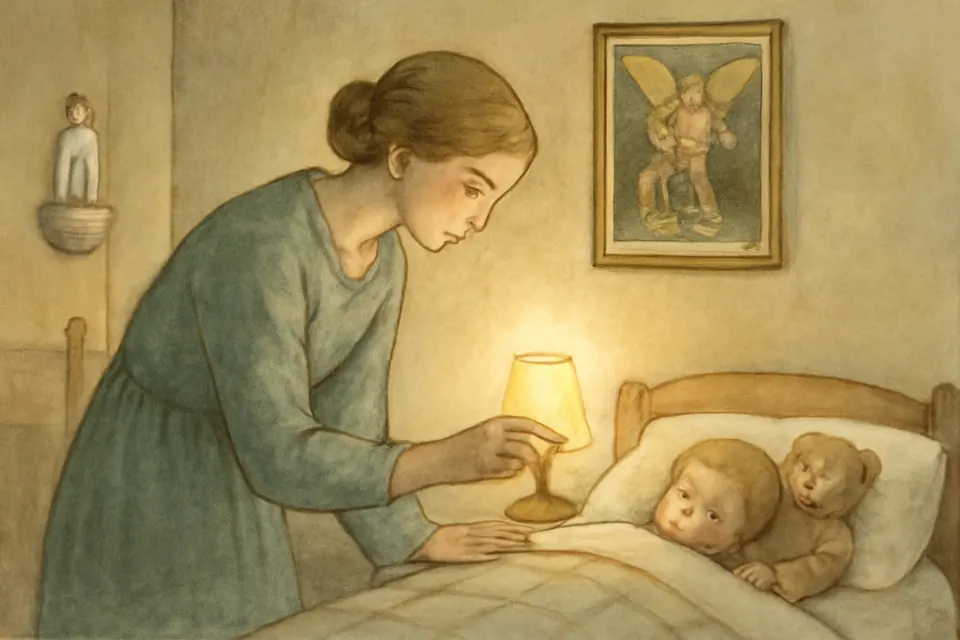
It belongs on the lips of parents at bedtime, and it is a beautiful prayer to say as you walk through a new house or apartment for the first time. For more prayers for the end of the day, see our page on night prayer.
A prayer for the protection of a family
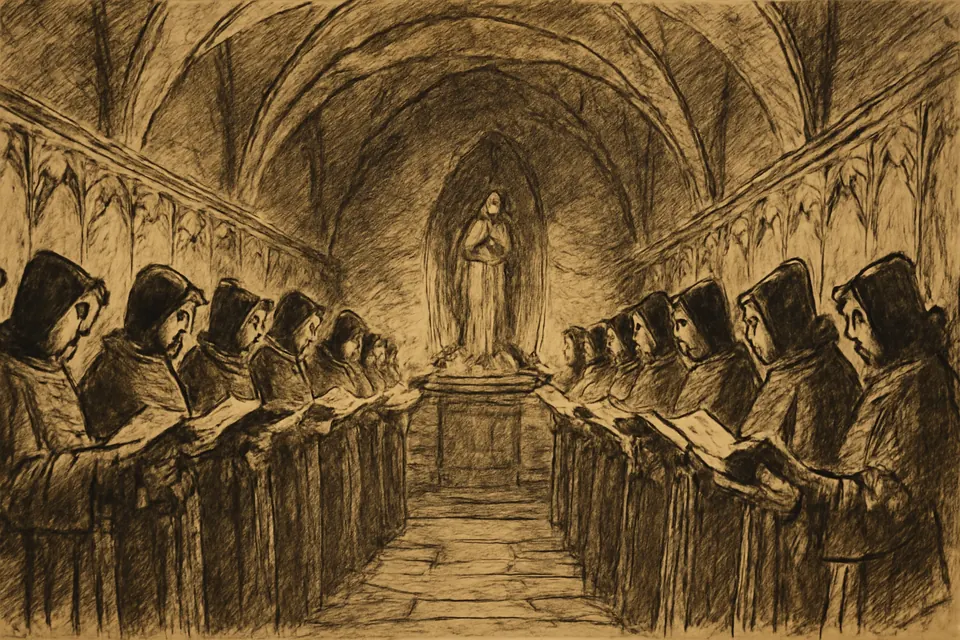
The same Manual prints, in the blessing of children, an old collect that asks Our Lady's intercession for a whole household. Pray it for your own family, naming each one:
Defend, we beseech Thee, O Lord, through the intercession of Blessed Mary, ever Virgin, this Thy family from all adversity; and as in all humility they prostrate themselves before Thee, do Thou graciously protect them against all the snares of their enemies. Through Christ our Lord. Amen.
The Church's prayers for the family go on from there. Our page on a prayer for family gathers more of them, with the Holy Family to ask.
Against temptation and evil: the St. Benedict prayer
Some dangers are not on the road but in the heart. For those, Catholics have long prayed the Latin verse whose initials are stamped on the back of the St. Benedict medal. This is the text and translation given by Dom Prosper Guéranger, abbot of Solesmes, in his book on the medal, published in English in 1880:
Crux sacra sit mihi lux. Non draco sit mihi dux. Vade retro, Satana; nunquam suade mihi vana. Sunt mala quae libas; ipse venena bibas.
May the Holy Cross be my Light. Let not the Dragon be my Guide. Begone, Satan! and suggest not to me thy vain things: the cup thou profferest me is evil; drink thou thy poison.
Guéranger wrote that the Christian "may make use of these same words as often as he finds himself tormented by the temptations and insults of the invisible enemy." The words "Begone, Satan" are Christ's own (Mark 8:33). More on the verse is on our St. Benedict prayer page, and on the medal itself at the St. Benedict medal.
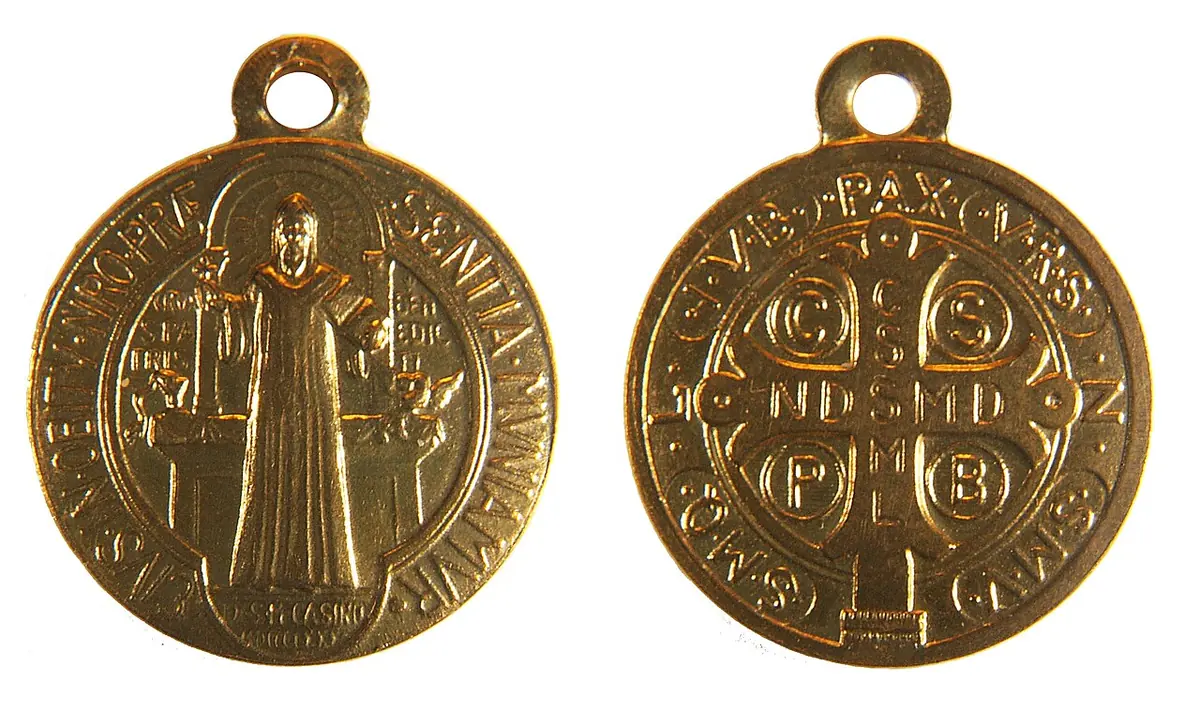
A word the Church always adds: medals, holy water and blessed objects are sacramentals, not charms. They have no power of their own. They help us pray, and God works through the prayer of the Church and our faith.
The saints we ask for protection
The saints don't protect us by their own power. They are our brothers and sisters in heaven, and we ask them to pray for us, as we would ask a friend. These are the ones the Church has long turned to for protection:
- St. Michael the Archangel, the prince of the heavenly host, against the devil and in every spiritual battle. Police officers and soldiers have taken him as their patron. See also the Chaplet of St. Michael.
- Our guardian angel, given to each of us by God to "light and guard, to rule and guide."
- The Blessed Virgin Mary, to whom Christians have fled since the days of the Rylands papyrus.
- St. Joseph, who protected the Child Jesus and His Mother on the flight into Egypt, and whom the Church honors as protector of the Holy Family and of the whole Church. Pray the St. Joseph prayer.
- St. Benedict, patron against temptation and of a holy death.
- St. Patrick, whose Breastplate the Irish have carried into every danger.
- St. Raphael the Archangel, who guarded young Tobias on his journey, and St. Christopher, for travelers. See our patron saints of travelers.
- St. Barbara, asked since the Middle Ages for protection against storms and sudden death, and St. Florian, against fire.
How to pray for protection
There is no formula that makes a prayer for protection "work." There is only trust. Still, Catholic practice offers a few good habits.
- Begin with the Sign of the Cross. It is a prayer for protection in itself, the oldest one we have, and it places us under the name of the Trinity.
- Pray in the morning and at night. Morning is for the Angel of God or the Breastplate ("I arise to-day..."); night is for Psalm 90 and "Visit, we beseech Thee." See our pages on morning prayer and night prayer.
- Name the person and the danger. "St. Michael, defend my son on the highway tonight." God already knows; we name it so we can let go of it.
- Use holy water. Bless yourself and your children when you leave the house or go to bed. The Church blesses holy water with prayers that ask God to drive away every power of the enemy.
- Go to confession and to Mass. The surest protection against evil is a soul in God's grace. The sacraments are where Christ himself meets us.

When you are afraid for someone you love
Many people come looking for a prayer for protection because someone they love is far away: a son deployed overseas, a daughter driving home late, a husband on a dangerous job. Pray for them by name, and then do what Psalm 90 does. Hand them over: "Thou art my protector, and my refuge: my God, in him will I trust." Light a candle before an image of Our Lady and leave it burning as your prayer. If the fear won't settle, our page on a prayer for anxiety may help, and for a hard day ahead, see prayer for strength.
Related prayers
- The St. Michael prayer: the full history, the Latin and Leo XIII's story.
- The guardian angel prayer: the Angel of God and its medieval origin.
- St. Patrick's Breastplate: the whole Lorica.
- The Memorare: "never was it known that any one who fled to thy protection..."
- Prayer for healing and prayer for the sick, when the danger is illness.
- Prayer for peace, for protection of nations and homes from war and violence.
St. Michael the Archangel, defend us in battle. Holy Mother of God, deliver us always from all dangers. Amen.
Frequently asked questions
What is the most powerful Catholic prayer for protection?
No prayer works like a charm; every prayer is powerful because it asks God, who loves us. That said, the prayer to St. Michael the Archangel is the one the Church prayed after every Low Mass for nearly eighty years, from 1886 until 1964, and it remains the best-known Catholic prayer for protection against evil. Psalm 90, which the Church prayed at night for centuries, is the Bible's own prayer for protection.
Which psalm is the prayer for protection?
Psalm 90 in the Douay-Rheims and the old Latin Vulgate, which is Psalm 91 in most modern Bibles. It begins "He that dwelleth in the aid of the most High, shall abide under the protection of the God of Jacob" and promises that God "hath given his angels charge over thee; to keep thee in all thy ways."
Why is Psalm 91 called Psalm 90 in Catholic Bibles?
The Greek Septuagint and the Latin Vulgate join Psalms 9 and 10 of the Hebrew text into one psalm, so from there to Psalm 147 their numbers run one lower. The Douay-Rheims follows the Vulgate, so it numbers this psalm 90. Modern Catholic Bibles such as the NABRE follow the Hebrew numbering and call it 91. It is the same psalm.
What saint do you pray to for protection?
St. Michael the Archangel first, the leader of God's angels against the devil. We also ask our guardian angel, Our Lady, St. Benedict (against temptation and evil), St. Joseph, the protector of the Holy Family, St. Christopher and St. Raphael for travelers, and St. Florian for firefighters. They pray for us; the protection comes from God.
What is a short Catholic prayer for protection?
"St. Michael the Archangel, defend us in battle" is the shortest form of the St. Michael prayer. Others are the line from the Breastplate, "Christ with me, Christ before me, Christ behind me," and the old Marian prayer "We fly to thy patronage, O Holy Mother of God."
Is there a Catholic prayer for protection of my home?
Yes. The closing prayer of Compline, the Church's night prayer, asks God to visit our dwelling: "Visit, we beseech Thee, O Lord, this habitation, and drive far from it all snares of the enemy: let Thy holy Angels dwell therein to keep us in peace." Many families also keep holy water and ask a priest to bless the house.
Can I pray for protection for someone else?
Yes, and the Church does it in her own prayers. Put the person's name into any prayer on this page ("St. Michael, defend N. in battle..."), or pray the old collect for a family: "Defend, we beseech Thee, O Lord, through the intercession of Blessed Mary, ever Virgin, this Thy family from all adversity."
Sources
- The Little Month of November (Boston, 1912), Prayers after Low Mass, pp. 29-31, Internet Archive. Source of the St. Michael prayer text
- The Raccolta, or Collection of Indulgenced Prayers, tr. Ambrose St. John (1857), no. 112, The Angel Guardian, Internet Archive. Source of the Angel of God text
- The Raccolta, or Collection of Indulgenced Prayers and Good Works (London: Burns & Oates, 1910), no. 184, the Sub tuum praesidium, Internet Archive. Source of the Latin and English Sub tuum
- A Manual of Prayers for the Use of the Catholic Laity, prepared by order of the Third Plenary Council of Baltimore (New York, 1889), Compline and the Blessing of Children, Internet Archive. Source of the Visita quaesumus and the collects for a family and for the guardian angels
- Douay-Rheims Bible: Psalm 90
- Kuno Meyer, Selections from Ancient Irish Poetry (1911): The Deer's Cry (Project Gutenberg)
- Prosper Guéranger, The Medal or Cross of St. Benedict: Its Origin, Meaning, and Privileges (London: Burns and Oates, 1880), Internet Archive
- Kyprianos Database of Ancient Ritual Texts (University of Würzburg): P. Ryl. III 470, prayer to the Theotokos. Dating of the oldest copy of the Sub tuum