St. Peter Damian
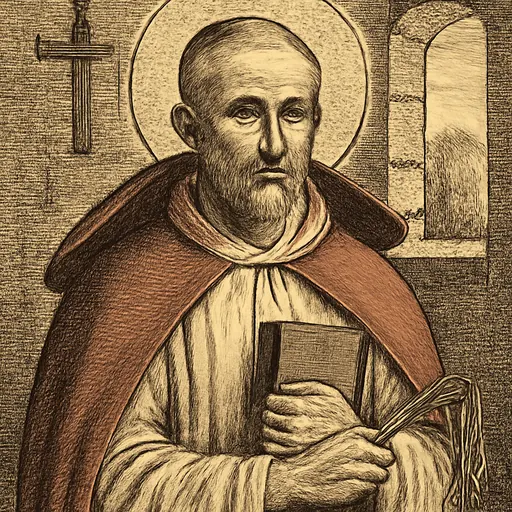
St. Peter Damian (1007–1072) was a Benedictine hermit and prior of Fonte Avellana who became cardinal-bishop of Ostia and one of the great reformers of the eleventh-century Church, writing and preaching against simony and clerical corruption. Pope Leo XII declared him a Doctor of the Church in 1828. His feast day is February 21.
Who was St. Peter Damian?
Peter Damian was a hermit who never wanted to leave his cell and spent the last fifteen years of his life on the roads of Europe doing the Church's hardest errands. Born in Ravenna in 1007, he became a monk at the hermitage of Fonte Avellana in the Apennines, its prior, and in 1057 cardinal-bishop of Ostia. Working alongside the reforming popes and his friend Hildebrand, the future Pope Gregory VII, he fought simony (the buying and selling of Church offices) and the moral decay of the clergy. He signed his letters "Peter the Sinner" and "the lowliest servant of the monks."
A hard childhood
The Catholic Encyclopedia tells the story of his early years. He was the youngest of a large noble family that had fallen on hard times. Orphaned young, he was taken in by an older brother who underfed him and sent him out to herd pigs. Another brother, Damian, an archpriest in Ravenna, rescued him and paid for his schooling, and Peter took his name out of gratitude. Benedict XVI added that his sister Roselinda tried to be a mother to him.

He studied at Ravenna, Faenza and Parma and was a celebrated teacher of rhetoric by about twenty-five. Benedict XVI quoted the judgment of the historian Jean Leclercq that he became "one of the most accomplished Latinists of his time."
The hermit of Fonte Avellana
Around 1035 Peter met two hermits of Fonte Avellana, a community founded under the inspiration of St. Romuald on the slopes of Monte Catria, and secretly left the world to join them. He fasted so hard that he damaged his health, and used his recovery to study Scripture. In 1043 he became prior, and under him the house founded new hermitages, built up its library and adopted his rule for hermits. He wrote the Life of St. Romuald for them. The hermitage was dedicated to the Holy Cross, and Benedict XVI quoted his line, "Those who do not love the Cross of Christ do not love Christ."

Cardinal, legate and reformer
Pope Stephen IX made him cardinal-bishop of Ostia in 1057, threatening him with excommunication when he refused. As papal legate he went to Milan in 1059, where clergy were openly buying offices and living with women. Faced with a riot in the cathedral, he defended the authority of the Holy See until all sides accepted his judgment. He made the archbishop and clergy swear to end simony, imposed penances, and restored those who promised to live chastely. Later missions took him to Cluny, to Florence, and in 1069 to Frankfurt, where he persuaded King Henry IV not to divorce his wife, Bertha.

His most famous treatise on clerical sin, the Liber Gomorrhianus (about 1050), addressed grave sexual sins among some clergy and asked Pope Leo IX to remove the guilty from the altar. The pope first praised it and then thought it too severe, and Peter protested. The Liber Gratissimus (about 1053) took a gentler line on another question, holding that ordinations by simoniac bishops were valid; that view eventually prevailed. In 1067 he was finally allowed to give up Ostia and return to his hermitage.

His death at Faenza
Returning from a peace mission to Ravenna early in 1072, he fell ill with fever and stopped at the monastery of Santa Maria degli Angeli outside Faenza. On the eve of the feast of the Chair of St. Peter he had the Office of the feast recited, and died at the end of Lauds. The monks buried him at once, afraid others would claim his body.
Writings and the letter on divine omnipotence
Peter Damian wrote about 180 letters, along with sermons, prayers, poems and hymns. His Letter 28 is a small treatise on the Church as communion, in which, Benedict XVI noted, each soul "is considered fully Church." He also revised and promoted the Little Office of the Blessed Virgin.
His best-known theological work is Letter 119, On Divine Omnipotence, written in 1065 to Abbot Desiderius and the monks of Monte Cassino after a conversation at table. He takes up two questions: can God restore virginity to someone who has lost it, and can God make what has happened not to have happened? Against those who pushed logic too far into theology, he insisted that human learning should serve theology "as a maid serves her mistress." The Stanford Encyclopedia of Philosophy notes that his old reputation for denying the principle of non-contradiction is largely unfounded.
Miracles
Peter himself believed his sudden recovery after seven weeks of illness at Fonte Avellana, around 1057, came by a miracle; that cure is reported, not formally examined. His cult began at his death, so no miracles were ever investigated for a canonization.
Symbols of St. Peter Damian in art
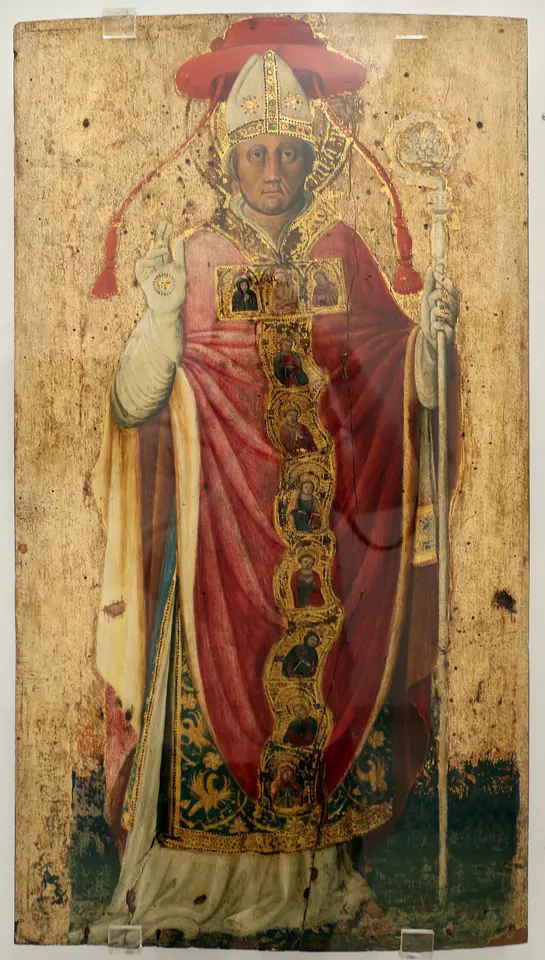
The Catholic Encyclopedia gives his two classic images: a cardinal holding a discipline, the small scourge of cords monks used for penance, which he promoted among his hermits; or a pilgrim holding a papal bull, for his many journeys as legate. Often he simply wears the cardinal's red hat and cape over a monk's habit, sometimes with the miter and crozier of the bishop of Ostia, as in the Faenza panel above. Baroque painters liked to show him writing, with his cardinal's hat set aside.

Peter Damian in Dante's Paradise
Dante meets him in the heaven of Saturn among the contemplatives, beside a golden ladder rising out of sight. In Paradiso 21 he describes Fonte Avellana under Catria and says, in Longfellow's translation: "I in that place was Peter Damiano; / And Peter the Sinner was I in the house / Of Our Lady on the Adriatic shore." He then rebukes worldly prelates so heavy "that two beasts go underneath one skin."

Feast day and relics
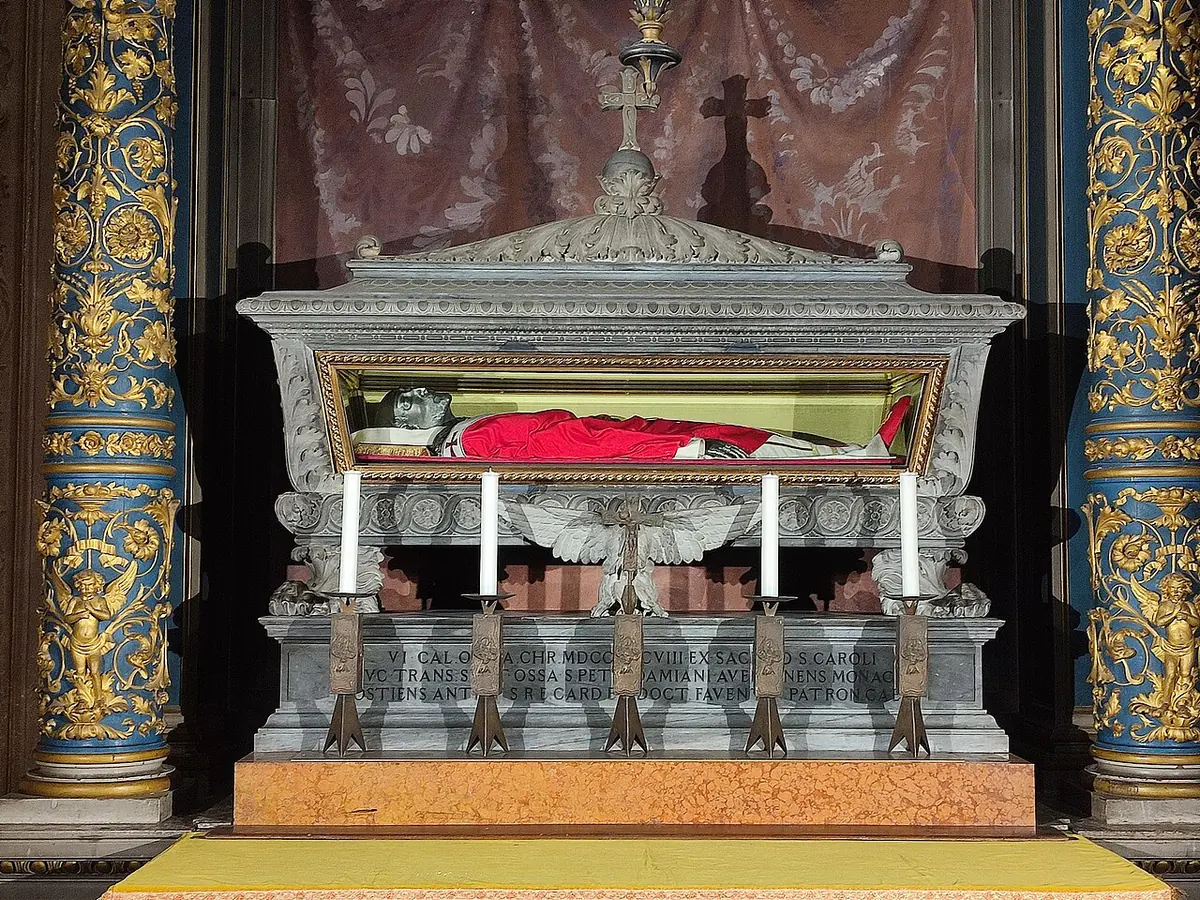
We keep his feast on February 21 as an optional memorial; Leo XII extended it to the whole Church when he named him a Doctor in 1828. See our feast days page for the saints around it, including the Chair of St. Peter on February 22. His body has been moved six times and since 1898 has rested in his own chapel in Faenza Cathedral. Faenza honors him as a patron.
Prayer to St. Peter Damian
The Church prays this collect on his memorial in the Roman Missal:
Grant, we pray, almighty God, that we may so follow the teaching and example of the Bishop Saint Peter Damian, that, putting nothing before Christ and always ardent in the service of your Church, we may be led to the joys of eternal light. Through our Lord Jesus Christ, your Son, who lives and reigns with you in the unity of the Holy Spirit, God, for ever and ever.
St. Peter Damian, pray for the Church, and for all who work to renew her in holiness.
Frequently asked questions
When is the feast of St. Peter Damian?
February 21, an optional memorial in the General Roman Calendar. Until the 1969 calendar reform it was kept on February 23.
Why is St. Peter Damian a Doctor of the Church?
For the soundness and influence of his writings on the spiritual life, the Church and reform. Pope Leo XII declared him a Doctor in 1828 (the decree is dated October 1, 1828; some older reference works give 1823) and extended his feast to the whole Church.
What did St. Peter Damian write?
About 180 letters, many of them really treatises, plus sermons, prayers, poems and saints' lives, including the Life of St. Romuald. The best known are the Liber Gratissimus on the validity of ordinations, the Liber Gomorrhianus against clerical vice, and Letter 119, On Divine Omnipotence.
Was St. Peter Damian canonized?
No formal canonization ever took place. He was venerated as a saint from the moment of his death at Faenza, Fonte Avellana, Monte Cassino and Cluny, and the Church confirmed that cult when Leo XII extended his feast and named him a Doctor.
Keep exploring
- Appears in
- Doctors of the Church
- Feast-day calendar
- Saints remembered in FebruarySaint of the day
- More
- Saints A to ZPatron saints A to ZExplore every section
Sources
- Catholic Encyclopedia (1911): St. Peter Damian
- Benedict XVI, General Audience of September 9, 2009: Saint Peter Damian
- The Cardinals of the Holy Roman Church (Salvador Miranda, FIU): Consistory of 1058, Pietro Damiano
- Stanford Encyclopedia of Philosophy: Peter Damian
- Dante, Paradiso, Canto XXI (trans. Henry Wadsworth Longfellow)
- Roman Missal: Collect for the Optional Memorial of St. Peter Damian (Catholic Culture)