St. Peter Chrysologus, Bishop of Ravenna and Doctor of the Church
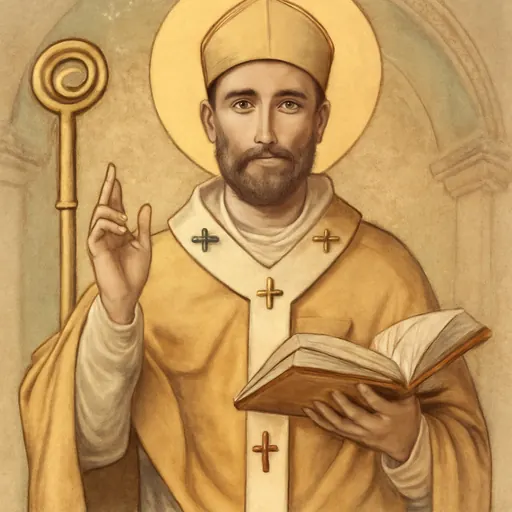
St. Peter Chrysologus (about 400 to 450) was the bishop of Ravenna, then the capital of the Western Roman Empire, and one of the great preachers of the early Church; Chrysologus means "golden-worded." About 180 of his short sermons survive. Pope Benedict XIII named him a Doctor of the Church in 1729, and we keep his feast on July 30.
Who was St. Peter Chrysologus?
St. Peter Chrysologus was the bishop of Ravenna in the middle of the fifth century, and not to be confused with the Apostle Peter or with any place that bears the name St. Peter. He was born at Imola, a small city on the Via Emilia in northern Italy, about the year 400, and he died there around 450. In between, he led the Church in Ravenna for about seventeen years, at the very moment when that marshy city on the Adriatic was the capital of the Western Roman Empire.
He is remembered for one gift above all: preaching. He is known as Chrysologus, Greek for "golden-worded," much as the East called St. John Chrysostom "golden-mouthed." His sermons are short, often under ten minutes read aloud, and they still sound fresh. In 1729 Pope Benedict XIII declared him a Doctor of the Church.
What we know of his life is thin. The Catholic Encyclopedia notes that his first biography was written by Agnellus, a priest of Ravenna, in the ninth century, four hundred years after his death, and that it "gives but scanty information about him." Most of what follows comes from Agnellus, from the sermons themselves, and from one surviving letter.
The life of St. Peter Chrysologus
Deacon of Imola
Peter was baptized, educated and ordained a deacon by Cornelius, the bishop of Imola. He seems to have been close to his bishop, who brought him along on important business.
Chosen by the pope
In 433 the bishop of Ravenna died. The clergy and people of Ravenna chose a successor and sent a delegation to Rome, led by Bishop Cornelius, to ask Pope Sixtus III to confirm their choice. Cornelius took his deacon Peter with him. When the pope saw Peter, he set aside Ravenna's candidate and consecrated the young deacon instead.
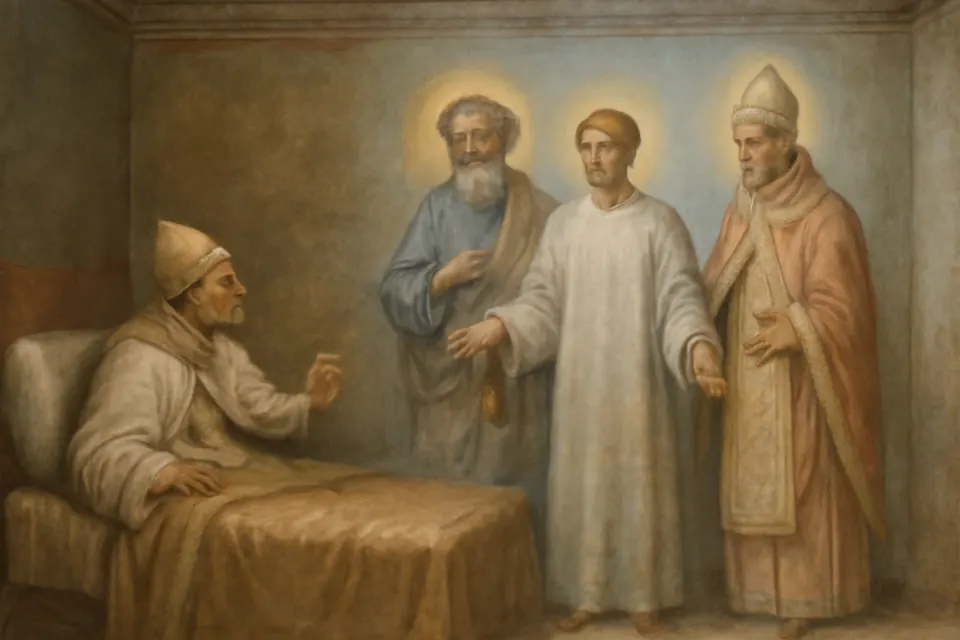
Agnellus explains the surprise with a story. The night before, he says, St. Peter the Apostle and St. Apollinaris, the first bishop of Ravenna, appeared to Pope Sixtus in a dream and showed him the deacon who should be bishop; when the delegation arrived the next day, the pope recognized him at once. The vision is traditional, recorded only centuries later. Ravenna, Catholic Culture's account says, accepted its new bishop "somewhat grudgingly at first."
Bishop of an imperial city
Ravenna under Peter was a city of emperors. The empress Galla Placidia governed the West for her young son Valentinian III, and the Catholic Encyclopedia says Peter "enjoyed the patronage" of the empress. Valentinian himself, who held court in Ravenna, came to favor the bishop. The little mausoleum that bears Galla Placidia's name, with its starry blue vault and its mosaic of Christ the Good Shepherd, was built in Ravenna during these very years. It is the closest we can come to seeing the city as Peter saw it.

Ravenna had recently been raised to a metropolitan see, with authority over the bishops of the surrounding region, and Peter was its first great metropolitan. According to Catholic Culture's account, he "rooted out all remaining traces of paganism, as well as a number of abuses among the Christians." The same account preserves one of his sharpest lines: "If you jest with the devil, you cannot rejoice with Christ."
The holy bishop Germanus of Auxerre, from Gaul, came to Ravenna on business with the imperial court. Peter welcomed him, and when Germanus died in the city, Peter officiated at his funeral.
The letter to Eutyches
The great doctrinal storm of Peter's last years was the teaching of Eutyches, a monk of Constantinople who held that after the Incarnation Christ had only one nature, the divine. A synod at Constantinople condemned him in 448, and Eutyches wrote to several bishops of the West looking for support. Peter's reply is the only letter of his that survives, preserved among the letters of Pope St. Leo the Great.
Peter told Eutyches, kindly but firmly, to stop searching into the mystery of Christ's birth with curiosity and to accept, in humility, what the Bishop of Rome had written. He would not, he said, judge a question of faith apart from the consent of the Roman bishop, because St. Peter still lives and presides in his own see and gives the truth of the faith to those who seek it. Two years later the Council of Chalcedon defined the faith in Christ's two natures in the words of Pope Leo.
Death at Imola
Sensing that his death was near, Peter went home to Imola. He urged the clergy of Ravenna to take great care in choosing his successor, and he died about the year 450. He was buried in the church of St. Cassian, Imola's martyr-patron.
The sermons of St. Peter Chrysologus
Long before Agnellus wrote, a later bishop of Ravenna made sure that Peter's preaching survived. Bishop Felix (707 to 717) gathered a collection of 176 sermons. The Catholic Encyclopedia adds that a few in Felix's set are not Peter's, while more of his homilies lie hidden in other collections under other names. Catholic Culture puts the number that remain at some two hundred.
They are short, warm, and full of contrast and wordplay. He preached on the Incarnation, on the Apostles' Creed for those about to be baptized, on the Lord's Prayer, on the Blessed Virgin and on St. John the Baptist. His most famous lines are still read in the Church's Liturgy of the Hours.
In a Lenten sermon (Sermon 43, read on Tuesday of the third week of Lent), he binds three practices together:
There are three things, my brethren, by which faith stands firm, devotion remains constant, and virtue endures. They are prayer, fasting and almsgiving. Prayer knocks at the door, fasting obtains, mercy receives.
"If you hope for mercy, show mercy," he goes on, and if you want God to know that you are hungry, know that another is hungry.
In an Easter sermon (Sermon 108) on St. Paul's words "present your bodies as a living sacrifice," he tells every baptized Christian: "Each of us is called to be both a sacrifice to God and his priest." And he imagines Christ on the cross speaking to us: "I do not cry out because of these wounds, but through them I draw you into my heart."
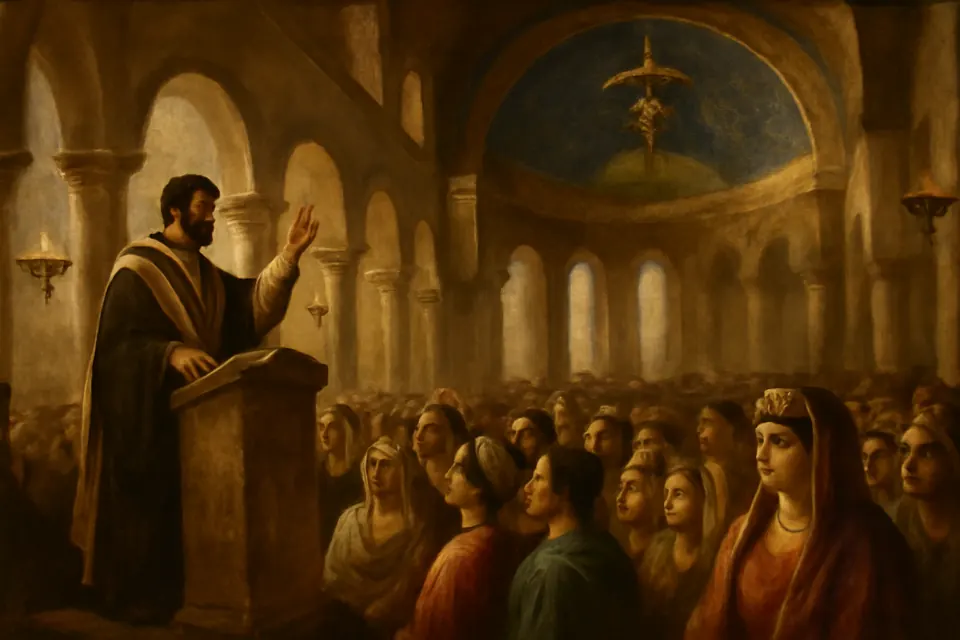
In his sermons, Catholic Culture notes, he "strongly urged frequent Communion."
Miracles and legends of St. Peter Chrysologus
Peter's reputation rests on his preaching and his orthodoxy, not on wonders. No miracle of his has been formally investigated, since his cult is older than the canonization process.
- The vision of Pope Sixtus III: traditional, from Agnellus's ninth-century life.
- Cures invoked against fever and the bite of rabid dogs: traditional. These old patronages are well attested in later calendars, but no early story explains them.
Why St. Peter Chrysologus is the patron of Imola
Imola is his birthplace and his burial place. The city honors him together with its martyr St. Cassian, and his remains rest in the cathedral dedicated to Cassian. For the patronages against fever and rabies, see our list of patron saints.
Symbols of St. Peter Chrysologus in art
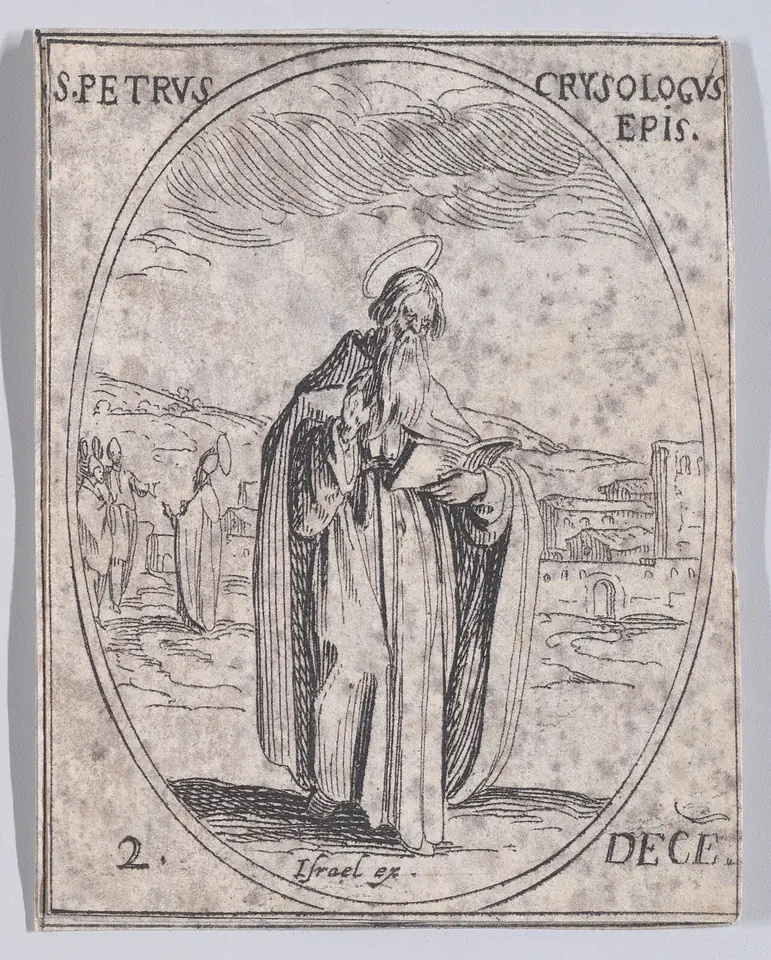
Chrysologus has no single, famous emblem the way St. Blaise has his candles. Painters show him as a bishop and add one or more of these:
- Bishop's miter, crozier and pallium: the white wool band around the shoulders marks him as a metropolitan archbishop.
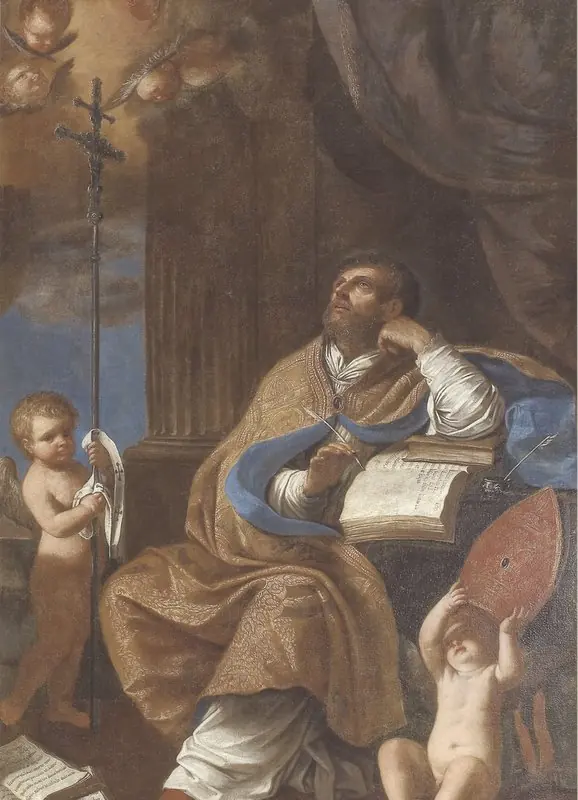
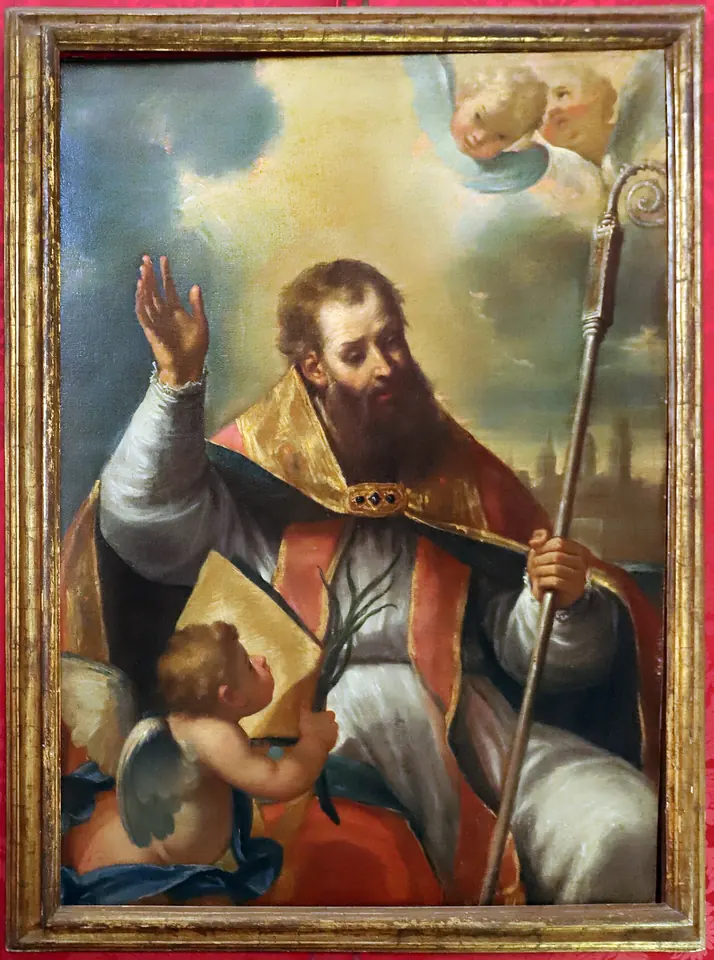
- A book or pen: for his sermons; Baroque artists liked to show him writing or looking up from his desk for inspiration, as in the Guercino-school painting above.
- A chalice or dish: an old attribute listed by Catholic Culture, perhaps for his preaching on the Eucharist.
- St. Peter and St. Apollinaris presenting him to the pope: the vision of Sixtus III, which Catholic Culture lists among his usual portrayals.
- Angels with his miter and crozier: a common Baroque touch for a bishop-saint in glory.
In Imola he often appears alongside St. Cassian, two bishops kneeling together. Lavinia Fontana, the Bolognese painter, set the pair beneath the Virgin rising into heaven, with a little view of Imola between them, in an altarpiece commissioned by the city for its town hall chapel.

In Ravenna Cathedral, an altarpiece by Giuseppe Milani gathers three saints of the city: Chrysologus in his miter pointing upward, the hermit-abbot St. Romuald in white, and St. Peter Damian in cardinal's red.

Feast day and where he is honored
We keep the memorial of St. Peter Chrysologus on July 30, an optional memorial in the General Roman Calendar since 1969. Before then his feast fell in December. The Mass of the day prays that, through his intercession, we may "constantly ponder in our hearts the mysteries of your salvation and faithfully express them in what we do." You can find his neighbors on our feast days calendar.
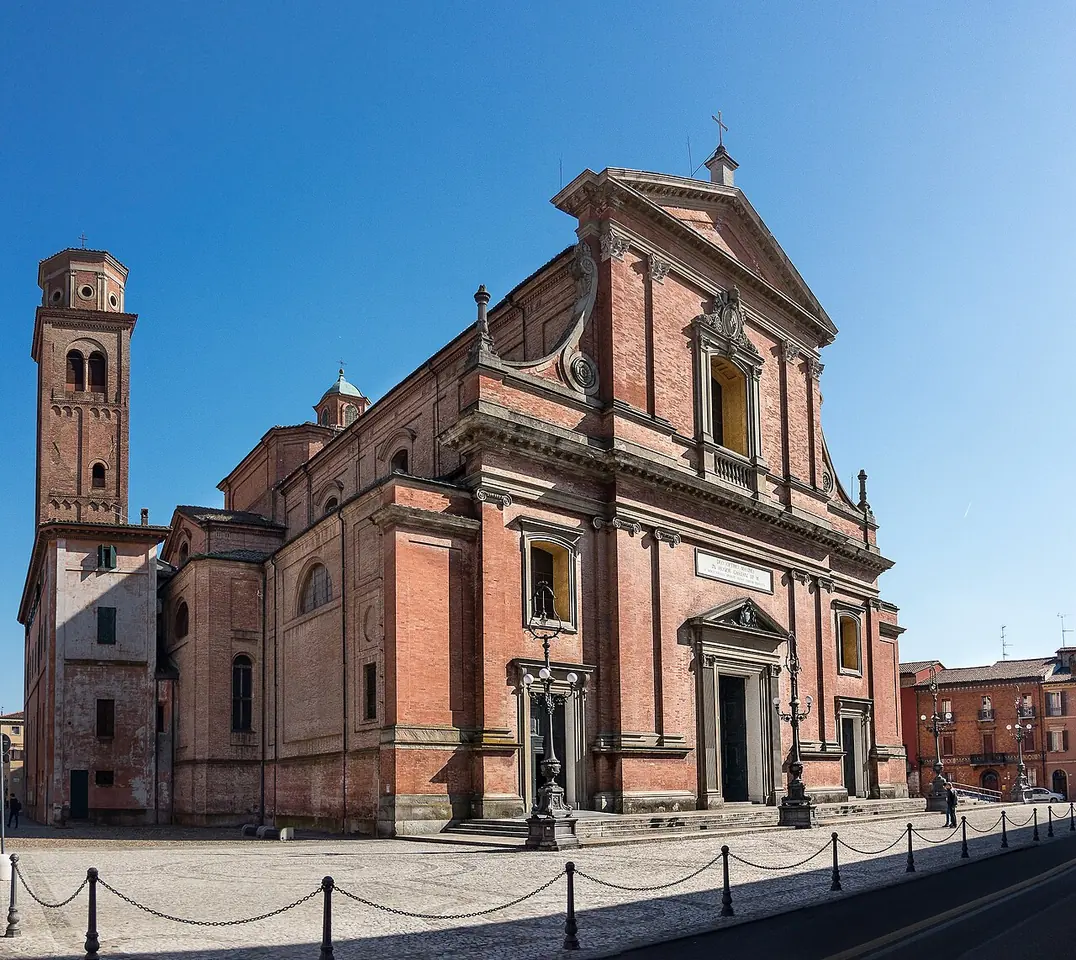
His tomb is in the Cathedral of San Cassiano in Imola, which keeps the remains of four of the city's saints: Cassian, Peter Chrysologus, Proiectus and Maurelius. The present building is mostly an eighteenth-century rebuilding. In Ravenna, the city's archbishops still count him as their most famous predecessor.
Prayer to St. Peter Chrysologus
The Church's own prayer for his feast is the collect of the Mass, from the Roman Missal:
O God, who made the Bishop Saint Peter Chrysologus an outstanding preacher of your incarnate Word, grant, through his intercession, that we may constantly ponder in our hearts the mysteries of your salvation and faithfully express them in what we do. Through our Lord Jesus Christ, your Son, who lives and reigns with you in the unity of the Holy Spirit, God, for ever and ever.
There is no other traditional prayer to him in common use. Let us ask St. Peter Chrysologus to pray for preachers and for all who listen to God's word, that our prayer, our fasting and our mercy may become one offering to God.
Frequently asked questions
Why is he called Chrysologus?
The name comes from Greek and means "golden-worded" or "golden speech," a tribute to the beauty and force of his preaching. It is the Latin West's counterpart to the Greek title of St. John Chrysostom, the "golden-mouthed."
When is the feast of St. Peter Chrysologus?
July 30, an optional memorial in the General Roman Calendar. Before the 1969 calendar reform his feast fell in December.
Why is St. Peter Chrysologus a Doctor of the Church?
For his sermons, which explain the Incarnation, the Creed, the Lord's Prayer and the Gospels in short, clear and vivid language, and which defended the faith against the errors of Arius and Eutyches. Pope Benedict XIII declared him a Doctor of the Church in 1729.
What is St. Peter Chrysologus the patron saint of?
He is a patron of his hometown, Imola, in northern Italy, where his body rests in the cathedral. Older lists of patronages also invoke him against fever and against rabies, though the origin of those patronages is not recorded.
What did St. Peter Chrysologus say about prayer, fasting and mercy?
In a Lenten sermon the Church reads in the Liturgy of the Hours, he teaches that the three belong together: "Prayer knocks at the door, fasting obtains, mercy receives." If we pray, we should fast; if we fast, we should show mercy.
Keep exploring
- Appears in
- Doctors of the Church
- Feast-day calendar
- Saints remembered in JulySaint of the day
- More
- Saints A to ZPatron saints A to ZExplore every section
Sources
- Catholic Encyclopedia (1911): St. Peter Chrysologus. Agnellus's 9th-century biography, the collection of 176 homilies made by Bishop Felix
- Catholic Encyclopedia (1911): Ravenna. His years as bishop (433 to 449) and his consecration by the pope
- Catholic Culture: St. Peter Chrysologus, July 30 (liturgical year). The choice of Pope Sixtus III, his burial in St. Cassian's at Imola, Doctor of the Church in 1729, patronages and the collect
- Letter XXV: From Peter Chrysologus, Bishop of Ravenna, to Eutyches (Nicene and Post-Nicene Fathers, series II, vol. 12)
- Office of Readings: Each One of Us Is Called To Be Both a Sacrifice To God and His Priest (Sermon 108)
- Office of Readings, Tuesday of the Third Week of Lent: Prayer, Fasting and Mercy (Sermon 43)