St. Hilarius, Pope (St. Hilarus, Pope 461–468)
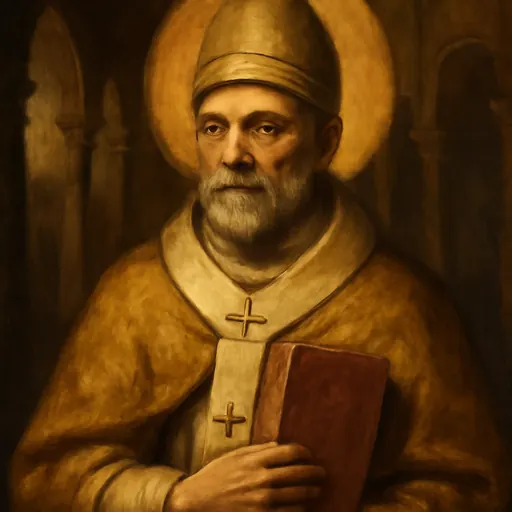
St. Hilarius (also spelled Hilarus) was the pope from 461 to 468, a native of Sardinia who succeeded St. Leo the Great. As Leo's legate at the 'Robber Council' of Ephesus in 449, he protested the condemnation of St. Flavian and barely escaped with his life. As pope he strengthened church order in Gaul and Spain and built oratories at the Lateran Baptistery. His feast day is February 28 (February 29 in leap years). He is not the same saint as St. Hilary of Poitiers.
Who was St. Hilarius?
St. Hilarius, also spelled Hilarus, was the pope who followed St. Leo the Great, from 461 to 468. The Book of the Popes (the Liber Pontificalis) calls him "by nationality a Sardinian, son of Crispinus." Before he was pope he was Leo's deacon and archdeacon, and Leo trusted him with one of the most dangerous errands of the century: to speak for Rome at the synod of Ephesus in 449, the gathering Leo himself named the "Robber Council."
He should not be confused with St. Hilary of Poitiers, the bishop and Doctor of the Church who died about a century earlier. When people search for "St. Hilarius," they often mean one or the other; this page is about the pope.
The life of St. Hilarius
Leo's legate at the Robber Council
In 449 the emperor Theodosius II called a council at Ephesus to judge St. Flavian, the patriarch of Constantinople, who had condemned the monk Eutyches for denying that Christ has two natures. Leo agreed and sent three envoys: Bishop Julius, a priest named Renatus, who died on the way, and the deacon Hilarus with his notary Dulcitius. They carried Leo's letter to Flavian, his great statement of the faith, which he meant the council to read and accept.
It was never read. Dioscorus of Alexandria presided and kept it off the floor. The council restored Eutyches and deposed Flavian. The Catholic Encyclopedia (1909), working from the Acts read aloud two years later at Chalcedon, describes soldiers brought into the church and bishops signing out of fear, some on blank paper. In the middle of it Hilarus, the pope's deacon, said one Latin word: Contradicitur, "it is opposed," annulling the sentence in Leo's name. Flavian was sent into exile and died a few days later.
Escape and thanksgiving
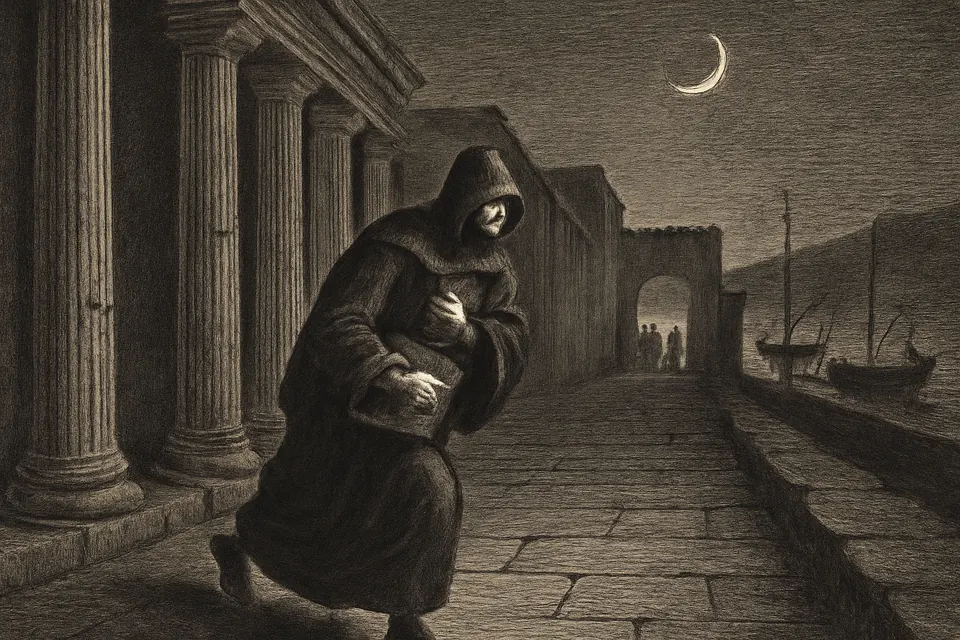
Hilarus himself had to run. In a letter to the empress Pulcheria, kept among Leo's letters, he apologizes for not delivering the pope's message to her: Dioscorus had tried to stop him from reaching either Rome or Constantinople, and he got away only with great difficulty. He hid, according to the Catholic Encyclopedia, in the crypt of St. John the Apostle, and he always believed St. John had saved him.
Years later, as pope, he built an oratory to St. John the Evangelist off the Lateran Baptistery. Its inscription is still over the doors: "To St. John the Evangelist, the liberator of Bishop Hilarus, a Servant of Christ."
Pope of order
After Leo died in November 461, Hilarus was chosen to succeed him, most likely consecrated on November 19. His pontificate, the Catholic Encyclopedia says, was "marked by the same vigorous policy as that of his great predecessor." With the Western empire breaking apart, he worked to keep the Church's government steady in Gaul and Spain. He settled a dispute over the see of Narbonne, upheld the rights of the bishop of Arles, warned Mamertus of Vienne against irregular ordinations, and told the bishops of Tarragona that no bishop could be moved from one diocese to another at will.
His Roman synod of November 19, 465, met in the basilica of Santa Maria Maggiore. It is the oldest Roman synod whose original records survive.
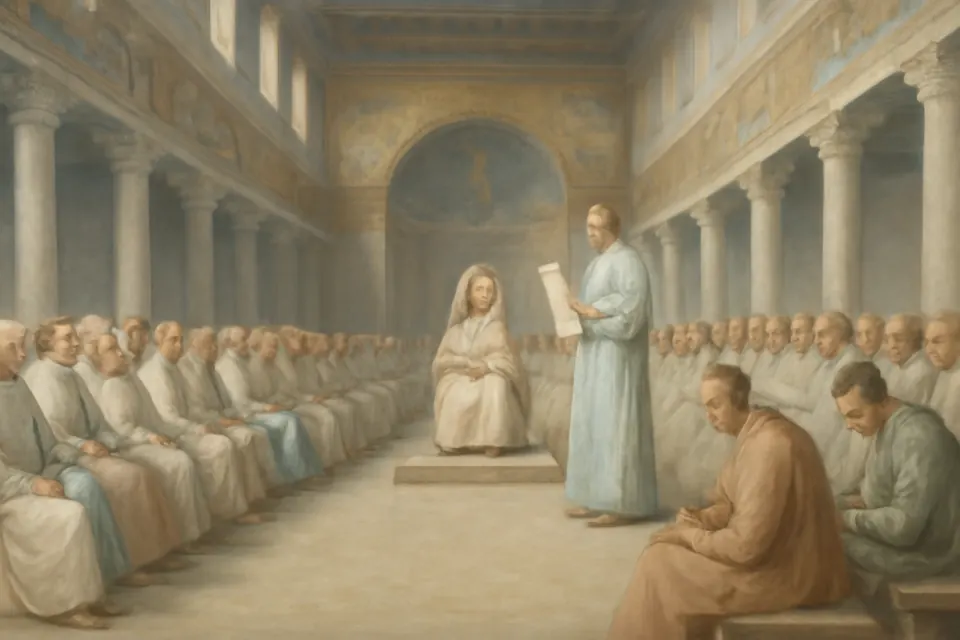
The Book of the Popes adds that he sent letters to the East confirming the councils of Nicaea, Ephesus and Chalcedon and Leo's letter to Flavian. When the emperor Anthemius came to St. Peter's, Hilarus publicly took him to task for favoring Philotheus, a follower of the Macedonian heresy, and made him promise at the grave of St. Peter to stop the heretics' meetings in Rome.
Builder of the Lateran oratories
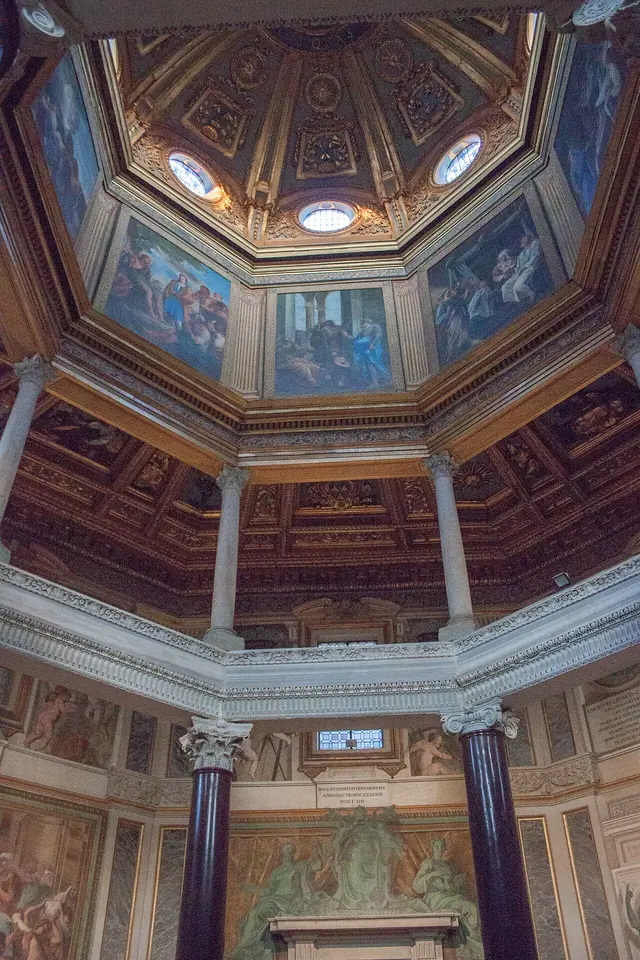
Hilarus built three oratories at the baptistery of the Lateran: to St. John the Baptist, to St. John the Evangelist and to the Holy Cross. The Book of the Popes says they were "decked with silver and precious stones." The first two still open off the baptistery. The Chapel of the Holy Cross was torn down in the seventeenth century.
He also gave Rome a set of silver vessels, 25 beakers and 25 pitchers among them, for the stational Masses, when the clergy of the whole city gathered at one church with the pope. Near the basilica of St. Lawrence he built a monastery, two baths and two libraries. He died on February 29, 468, after six years, three months and ten days as pope.
Miracles and legends of St. Hilarius
No healing miracles are recorded for him, and no early life of him survives beyond the short notice in the Book of the Popes.
- Deliverance at Ephesus: traditional. Hilarus himself credited St. John with saving him from Dioscorus in 449, and the inscription at the Lateran says so in his own words. It is his personal thanksgiving, not a formally examined miracle.
Is St. Hilarius a patron saint?
No decree gives Hilarius a patronage. He is honored as one of the early saint-popes. Those who pray for the Holy Father, or for courage to speak the truth when it is unpopular, can ask his help. See our patron saints page for others.
Symbols of St. Hilarius in art
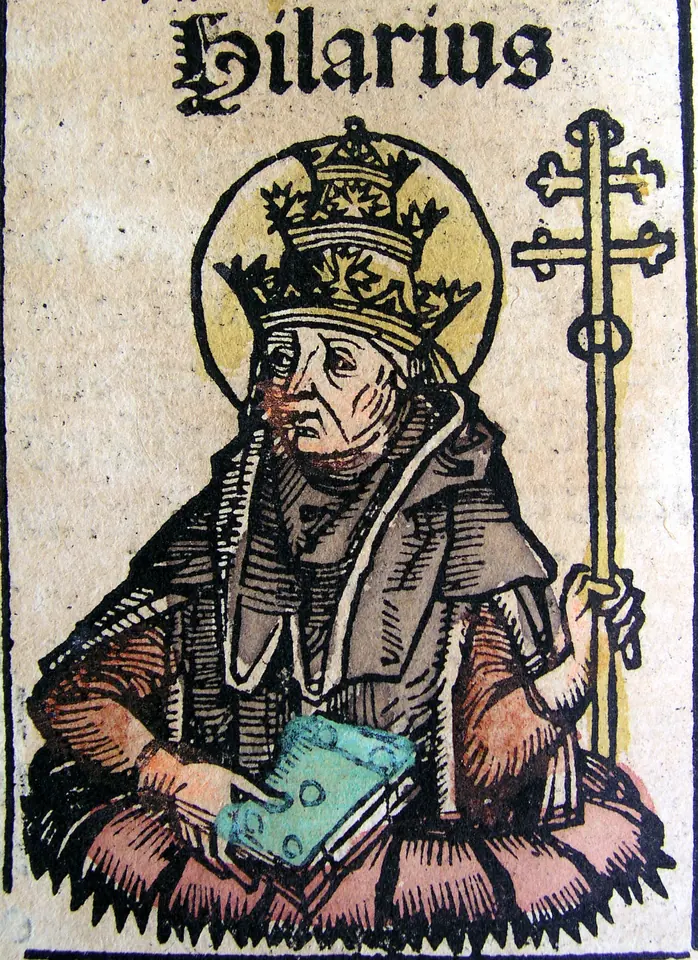
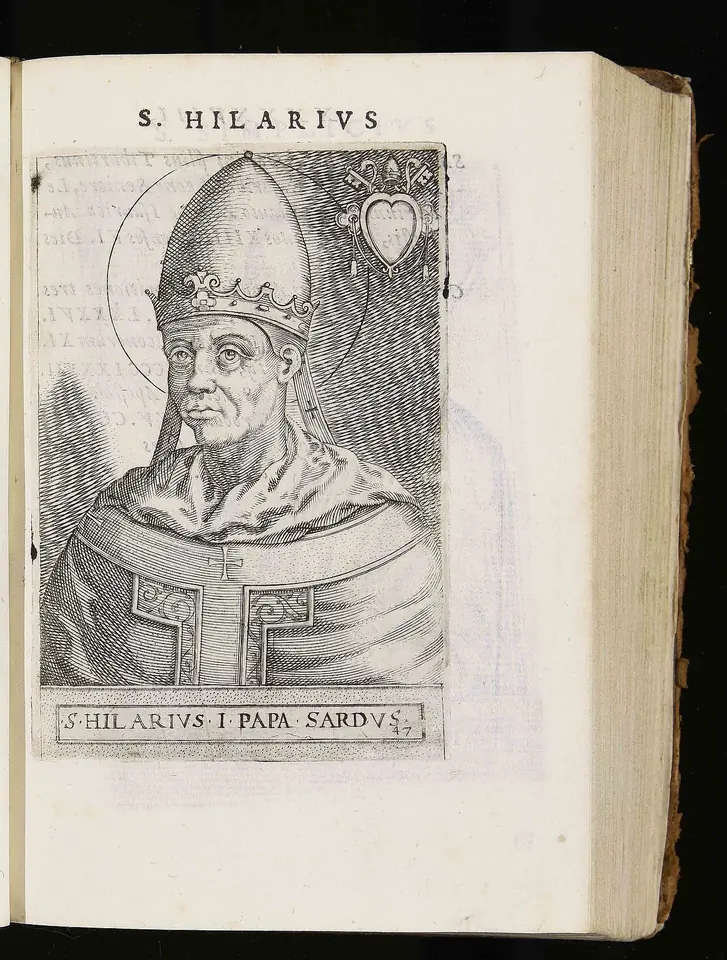
Hilarius has no attribute of his own, so artists show him simply as a pope. Look for the papal tiara (anachronistic for the fifth century, but standard in later art), the pallium, a book for his letters on the faith, and sometimes a papal cross with two or three bars. Without a label he is hard to tell apart from other early popes, which is why series of papal portraits, like the Nuremberg Chronicle, Cavalieri's engravings and the medallions in Roman basilicas, always write his name.

Feast day and where he is honored
The Roman Martyrology keeps him on February 29, or February 28 in ordinary years: "At Rome on the Via Tiburtina, the burial of St. Hilarus, pope," it begins. Older calendars kept him on September 10. The Book of the Popes says he was buried "near the holy Lawrence in a crypt near the body of the blessed bishop Xystus" at San Lorenzo fuori le Mura. Find other saints of late February on our feast days page.

Prayer to St. Hilarius
No traditional prayer to St. Hilarius has come down in the standard Catholic prayer books. On his feast we can pray for the pope and the bishops in union with him, and ask St. Hilarius to intercede for all who must stand firm for the faith.
Frequently asked questions
Is St. Hilarius the same as St. Hilary of Poitiers?
No. St. Hilarius (Hilarus) was a pope, born in Sardinia, who reigned from 461 to 468. St. Hilary of Poitiers was a bishop in Gaul and Doctor of the Church who died about 367; his feast is January 13. Other saints named Hilarius include Hilarius of Aquileia, a third-century bishop and martyr.
When is the feast day of Pope St. Hilarius?
The Roman Martyrology keeps him on February 29, the day of his burial in 468, and on February 28 in other years. Older calendars kept him on September 10, and the 1910 Catholic Encyclopedia gives November 17.
What happened to St. Hilarius at the Robber Council?
In 449 Pope Leo the Great sent the deacon Hilarus to the synod of Ephesus. When the synod, under Dioscorus of Alexandria, deposed St. Flavian of Constantinople by force, Hilarus spoke one Latin word, Contradicitur ("it is opposed"), to annul the sentence in the pope's name. He then escaped with difficulty and carried the news back to Rome.
Where is St. Hilarius buried?
The Book of the Popes says he was buried near St. Lawrence, in a crypt near the body of Pope Sixtus III, at the Basilica of San Lorenzo fuori le Mura in Rome.