St. Romuald of Ravenna
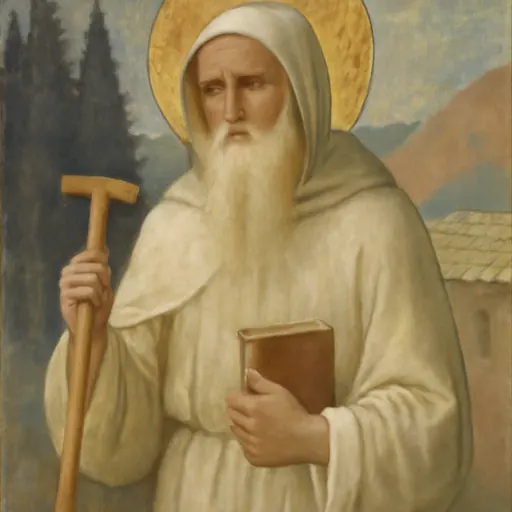
St. Romuald of Ravenna (about 950 to 1027) was an Italian monk and hermit who founded the Sacred Hermitage of Camaldoli in Tuscany and with it the Camaldolese branch of the Benedictine family, joining the life of hermits to life in community. His three-sentence Brief Rule begins, "Sit in your cell as in paradise." We keep his feast on June 19.
Who was St. Romuald?
St. Romuald of Ravenna was a monk of the late tenth and early eleventh centuries who spent his life in search of solitude with God, and who kept being followed into the wilderness by disciples. He founded or reformed dozens of hermitages and monasteries across Italy, and around 1012 he built five small cells on a mountainside in the Casentino, in Tuscany. That place, Camaldoli, became the mother house of the Camaldolese monks, a family within the Benedictine order that still lives his way today: hermits in their cells and monks in community, side by side.
He is not to be confused with the many places and people called Romuald or Romualdo. This is the Romuald of Camaldoli, the saint we honor on June 19.
Almost everything we know comes from one book, the Life of Blessed Romuald written about 1042 by St. Peter Damian, who never met him but gathered the memories of his disciples about fifteen years after his death. A second, earlier witness is St. Bruno of Querfurt, Romuald's own disciple, who wrote around 1006. Peter Damian is vivid and devout, and sometimes careless with numbers: he says Romuald died at 120, which the Catholic Encyclopedia calls irreconcilable with known dates.
The life of St. Romuald
A nobleman of Ravenna
Romuald was born at Ravenna around 950 into a noble family, the Onesti. Alban Butler, following Peter Damian, says he was raised for pleasure and hunting, yet when he came upon a quiet place in the woods he would stop and pray and say, "How happy were the ancient hermits, who had such habitations!"
When he was twenty, his father, Sergius, settled a quarrel over property by fighting a duel and killed his kinsman. Romuald had been made to watch. Horrified, he went to do forty days of penance at the Benedictine abbey of Sant'Apollinare in Classe, just outside Ravenna, and there he asked to stay as a monk.
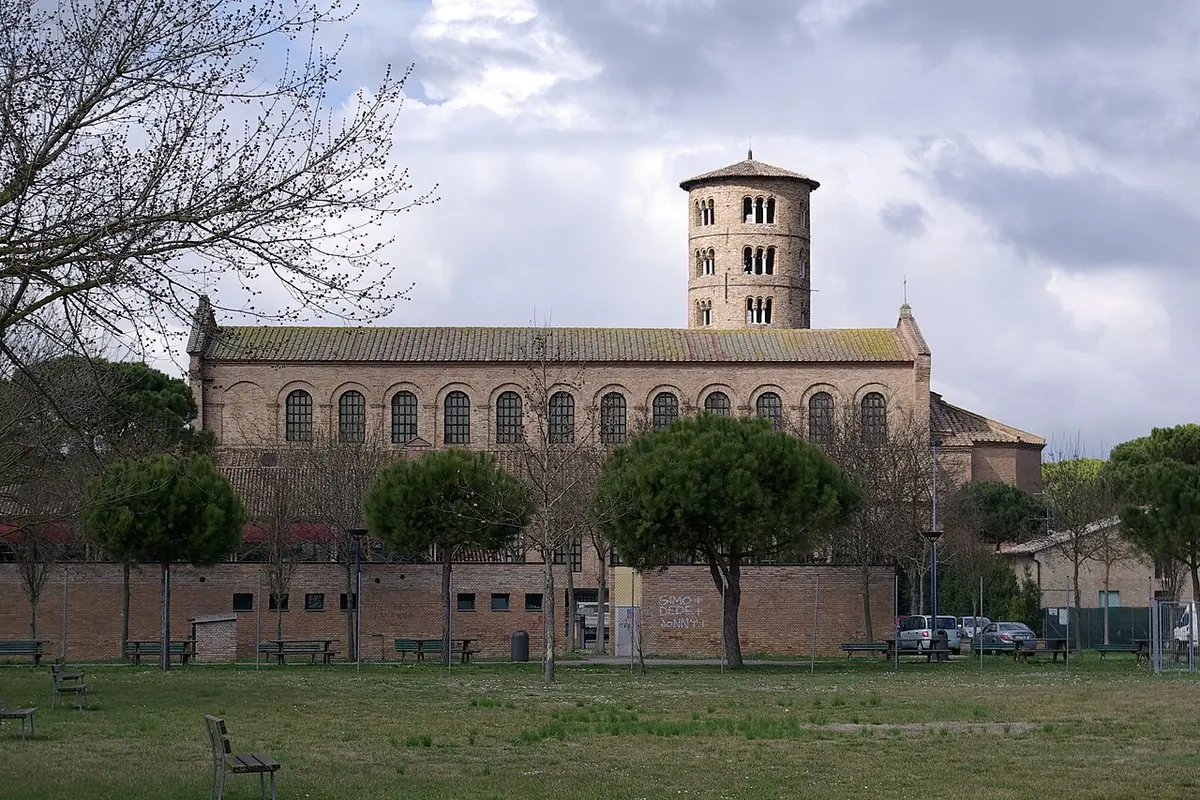
The community was not strict enough for him, and his corrections of the slacker monks made him enemies. With his abbot's leave he went to the marshes near Venice and put himself under an old hermit named Marinus, living, as the Catholic Encyclopedia puts it, "a life of extraordinary severity."
The doge who fled to a monastery
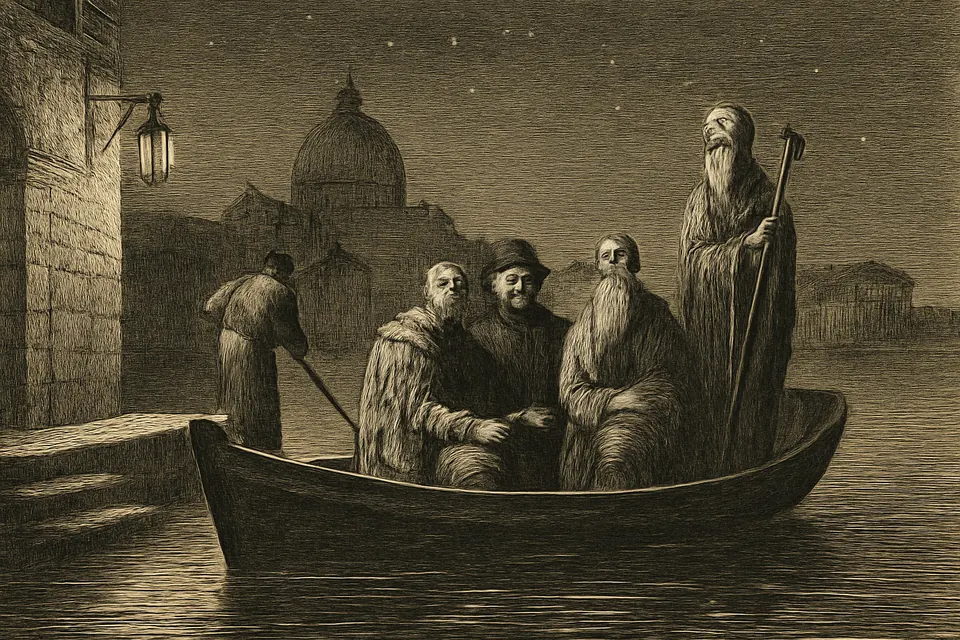
Around 978 Romuald and Marinus became part of one of the strangest conversions of the age. Pietro Orseolo I, Doge of Venice, had come to power after the murder of his predecessor, and his conscience gave him no rest. On the advice of Guarinus, abbot of Sant Miquel de Cuixà in Catalonia, and of the two hermits, he left his office secretly by night and went with them to Cuixà, where he became a monk. Romuald and Marinus built a hermitage close by. The doge, too, is honored today as St. Peter Orseolo.
Romuald spent about five years there. Peter Damian tells a story that sounds like a joke and isn't one: when Romuald planned to leave for Italy, the local people decided to kill him so that at least his body, as a relic, would stay with them. He escaped by pretending to be mad. He went home because his father, now a monk himself at St. Severus near Ravenna, wanted to return to the world. Romuald talked him out of it, and Sergius died in the monastery.
Abbot, emperor and penitent
The young emperor Otto III admired Romuald, visited him in his cell and pressed him to become abbot of Classe around the year 999. It went badly. The monks resented his strictness, and within about a year Romuald went to the emperor, who was then besieging Tivoli, and threw down his abbot's staff at his feet. Butler adds that the meeting saved Tivoli from being sacked, and that Otto, who had broken his oath to the Roman rebel Crescentius and put him to death, did public penance at Romuald's direction.
Several of the emperor's own circle took the habit under Romuald. One of them, Bruno of Querfurt, went as a missionary bishop to the pagans of the east and was martyred in 1009. Five more of Romuald's disciples, sent to Poland, were murdered in 1003 and are remembered as the Five Martyred Brothers. Romuald himself set out to preach in Hungary, hoping for martyrdom, but a severe illness came back every time he tried to go on, and he took it as a sign and turned home.
Camaldoli
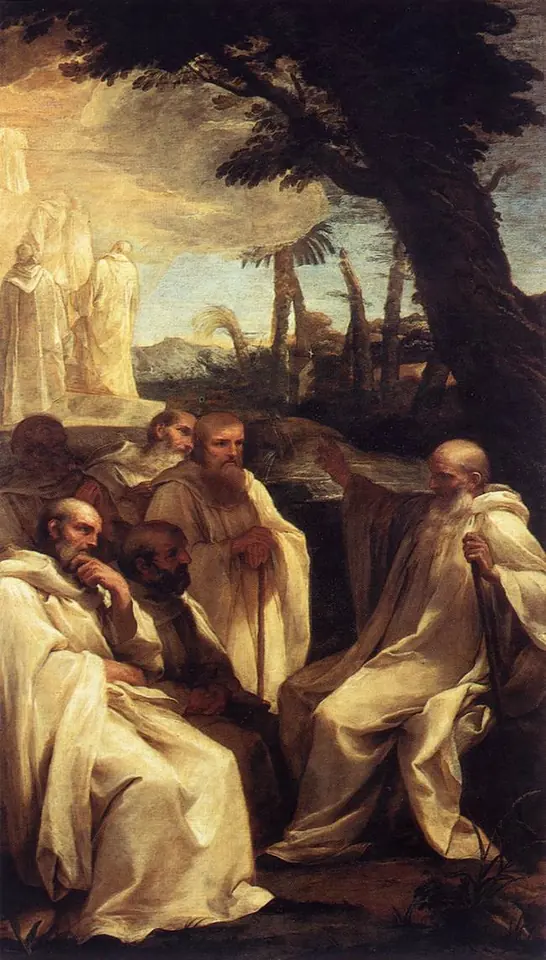
For thirty years Romuald moved through central Italy founding hermitages and monasteries: Pereum near Ravenna, Val di Castro in the Marche, Sitria at the foot of Monte Cucco, and many more. Around 1012 he came to the diocese of Arezzo. There, the legend says, a man named Maldolus had dreamed of monks in white climbing a ladder to heaven from one of his mountain fields, and he gave Romuald the land. The place became the Campus Maldoli, Camaldoli.
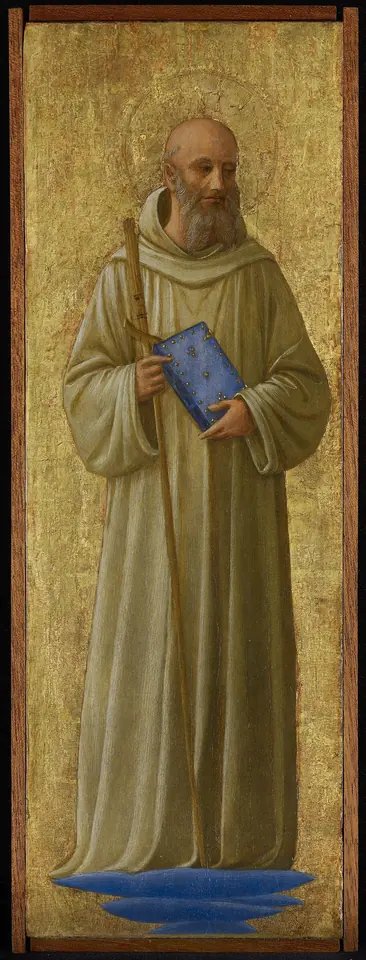
Romuald built five cells for hermits on the mountain, and a little lower down, at Fonte Buono, a house to look after guests, the sick and the business of the place, so that the hermits would not be distracted. The Catholic Encyclopedia points out that here, for the first time, all the marks of the later order appear together: the white habit, the rule and the pairing of hermitage and monastery. Pope Alexander II formally approved the congregation in 1072.
The last years
At Sitria a young nobleman whom Romuald had rebuked for his impurity accused him of a shameful crime. Astonishingly, his monks believed it, gave him a harsh penance and forbade him to say Mass. Butler says he accepted it in silence for six months, until God told him to stop obeying an unjust sentence; when he next offered Mass he was taken up in ecstasy. When the emperor St. Henry II received him, he rose from his throne and said, "I wish my soul was like yours."
Around 1005 Romuald had left Val di Castro saying he would come back to die there alone. About twenty years later he went back. He died there in his cell on June 19, 1027, alone, as he had foretold.
St. Romuald's Brief Rule
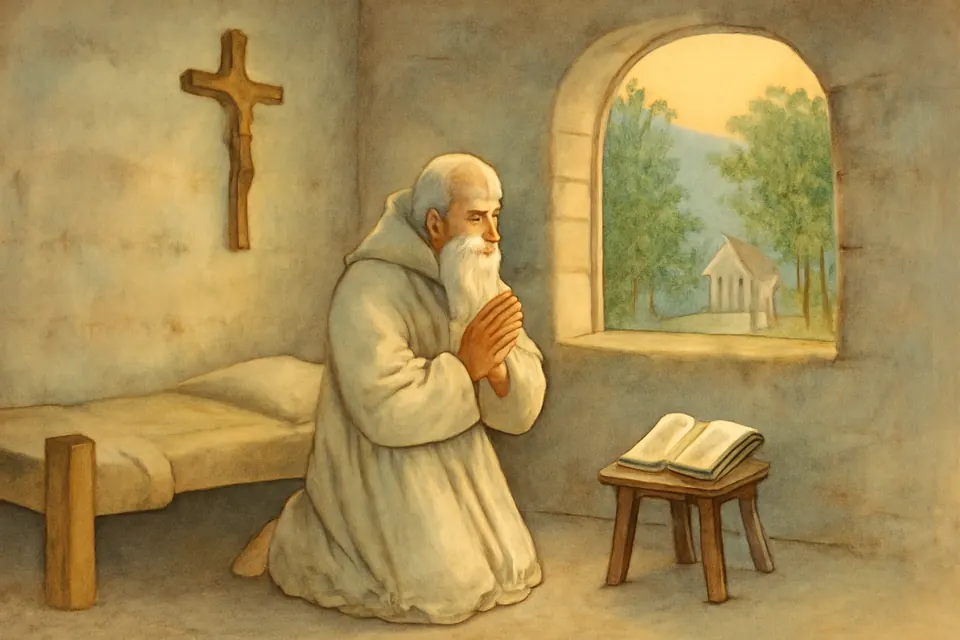
Romuald wrote no long rule. What he taught his hermits survives in a few lines that Bruno of Querfurt set down around 1006, in his Life of the Five Brothers, while Romuald was still alive. The Camaldolese call it the Brief Rule. It begins:
Sit in your cell as in paradise;
put the whole world behind you and forget it;
like a skilled angler on the lookout for a catch, keep a careful eye on your thoughts.
It goes on to say that the path to follow is in the psalms: when the mind wanders during the reading, don't give up but hurry back and try again. And it ends with an image of utter trust, that above all we should know we are in God's presence like a little chick that tastes nothing but what its mother brings it.
Peter Damian adds that Romuald told his monks it was better to sing one psalm with devotion than a hundred without it. Let us learn from him to come back, patiently and without discouragement, every time our thoughts wander away from God.

The miracles of St. Romuald
Peter Damian's Life is full of wonders, and they are all traditional: recorded by a devout biographer from the memories of disciples, never examined in a canonization process (Romuald was honored as a saint before such processes existed).
- The calmed storm. Crossing the Adriatic from Istria, he is said to have calmed a storm at sea.
- Cures at Sitria. Butler, following Peter Damian, says he worked many cures of the sick there.
- Prophecy of his death. He foretold years ahead that he would die at Val di Castro, alone and with no one to help him, and it happened so.
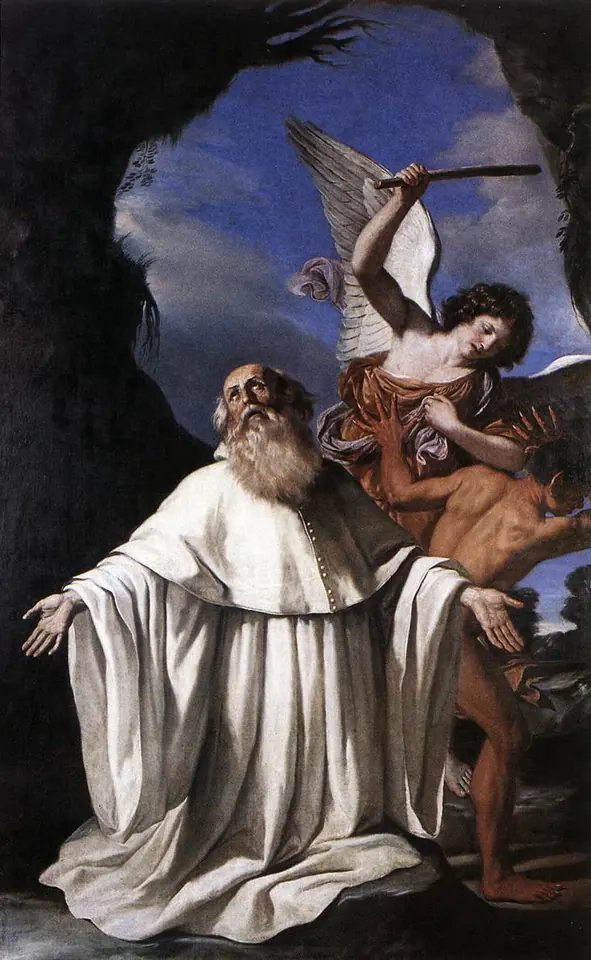
- Battles with the devil. Peter Damian describes long assaults by evil spirits in his cell. In one, he cried out the name of Jesus and they fled.
- Miracles at his tomb. The Catholic Encyclopedia reports that many miracles were worked at his tomb, which is why an altar was allowed over it in 1032, five years after his death.
His body was found whole and incorrupt in 1466, according to the Catholic Encyclopedia. Butler says it was stolen from its tomb in 1480 and fell to dust, and that what remained was brought to Fabriano in 1481.
Why St. Romuald is the patron of the Camaldolese and of hermits
The Camaldolese monks and nuns call him their father, and the Brief Rule is still read to novices. Hermits in many traditions look to him because he, more than anyone in the Western Church of his time, brought the life of the desert fathers like St. Anthony the Great back into the world of the Rule of St. Benedict, and showed how a hermit and a community can belong to one family. His influence reached far beyond his own houses: Peter Damian's hermitage of Fonte Avellana grew from his inspiration, and St. John Gualbert stayed with the hermits of Camaldoli before founding Vallombrosa.
Pope Benedict XVI kept the thousandth anniversary of Camaldoli in 2012 with Vespers at San Gregorio al Celio in Rome, a Camaldolese monastery, giving thanks "for the thousand years that have passed since the foundation of the Sacred Hermitage of Camaldoli by Saint Romuald."

Symbols of St. Romuald in art
Romuald is easy to spot once you know what to look for.
- The white habit. Camaldolese monks wear white, and Romuald nearly always does. Butler says he changed their habit from black to white after his own vision of white-robed monks on a ladder.
- The long white beard. Painters show him as very old, a reminder of Peter Damian's claim that he lived to 120.
- The ladder. His best-known image is the dream of monks in white climbing a ladder to heaven, as in Andrea Sacchi's great canvas. The Catholic Encyclopedia notes that he is shown "pointing to a ladder on which are monks ascending to Heaven."
- The staff and book. Florentine painters like Fra Angelico and Bicci di Lorenzo give him a crutch-shaped staff, the walking stick of an old hermit, and a book, his rule.
- The skull and the demon. Baroque painters add a skull for meditation on death, or an angel driving off a demon, recalling his battles in prayer.
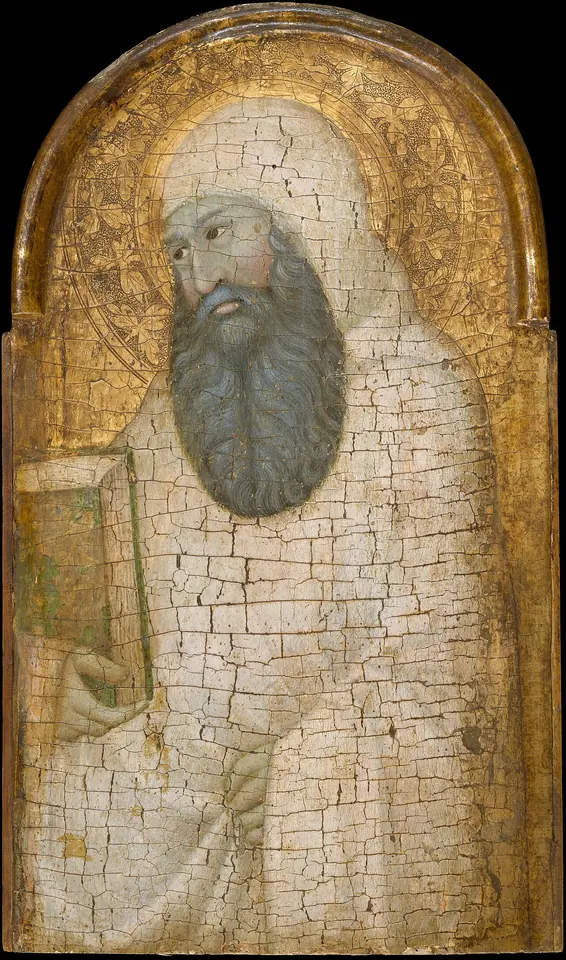
If you see an old monk in white with a staff in an Italian church, especially in Tuscany or the Marche, it is very likely Romuald.
Feast day, tomb and places to visit
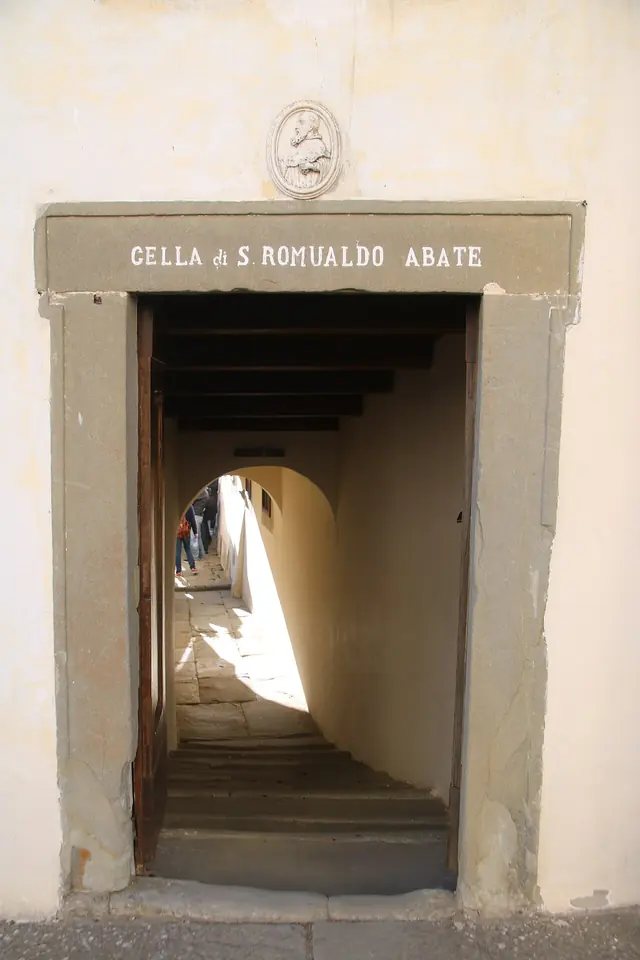
We keep his feast on June 19. The Sacred Hermitage of Camaldoli and the monastery below it still welcome pilgrims, and visitors can see the cell where tradition says Romuald lived. His remains rest in Fabriano in the church of Santi Biagio e Romualdo, a few miles from Val di Castro, where he died.

Praying with St. Romuald
There is no widely known traditional prayer composed to St. Romuald. Peter Damian preserved Romuald's own prayer, though, the cry that broke from him in contemplation. In Butler's English it runs:
Dear Jesus! my dear Jesus! my unspeakable desire! my joy! joy of the angels! sweetness of the saints!
Let us pray it slowly, and then sit for a few minutes in silence, as he taught, keeping a careful eye on our thoughts and bringing them gently back to God. And let us ask him: St. Romuald, father of hermits, pray for us, that we may find the peace of God in the cell of our own hearts.
Frequently asked questions
When is the feast of St. Romuald?
June 19, the day he died in 1027, as an optional memorial in the General Roman Calendar. Before the 1969 reform the universal Church kept it on February 7, the day his relics were moved, a date Pope Clement VIII set in 1595.
What is St. Romuald's Brief Rule?
A short summary of his teaching for hermits, preserved by his disciple St. Bruno of Querfurt in the Life of the Five Brothers, written around 1006. It begins, "Sit in your cell as in paradise; put the whole world behind you and forget it; like a skilled angler on the lookout for a catch, keep a careful eye on your thoughts." It goes on to the psalms and ends with the soul before God like a little chick fed by its mother.
What is St. Romuald the patron saint of?
He is the father and patron of the Camaldolese monks and nuns, and hermits look to him as a master of the solitary life.
Did St. Romuald really live to 120?
That is what St. Peter Damian wrote, but historians don't accept it. The Catholic Encyclopedia judges it a mistaken inference, and Alban Butler already worked out that Romuald was about seventy when he died. He was most likely born around 950 to 956.
Where is St. Romuald buried?
In the church of Santi Biagio e Romualdo in Fabriano, in the Marche region of Italy, where his remains were brought in 1481 from the monastery of Val di Castro, a few miles away, where he died.
Keep exploring
Sources
- Catholic Encyclopedia (1912): St. Romuald. Disputed birth date, the incorrupt body found in 1466, translation to Fabriano in 1481, the 1032 altar and Clement VIII's feast
- Catholic Encyclopedia (1908): Camaldolese. The legend of Maldolus, Fonte Buono, and the order's approval by Alexander II in 1072
- Alban Butler, The Lives of the Fathers, Martyrs and Other Principal Saints, vol. 2 (1812), February 7, Internet Archive. Drawn from St. Peter Damian's Life; source of Romuald's prayer, the Sitria accusation, Henry II's words and the 1480 theft
- Camaldolese Downunder: St Romuald's Brief Rule. English text of the Brief Rule and its source in Bruno of Querfurt
- Pope Benedict XVI, Vespers on the occasion of the visit of the Archbishop of Canterbury (March 10, 2012). The thousandth anniversary of Camaldoli and the Camaldolese saints
- St. Peter Damian, Vita beati Romualdi (about 1042)