Blessed Fra Angelico
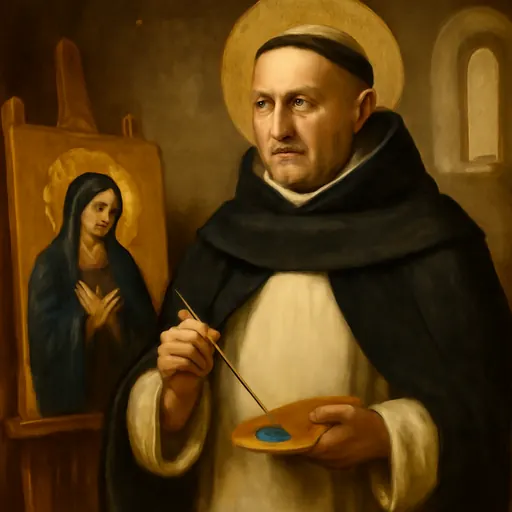
Blessed Fra Angelico (about 1395–1455), born Guido di Pietro, was a Dominican friar of Fiesole and one of the great painters of the early Renaissance. He painted the frescoes in the cells of San Marco in Florence so his brother friars could pray before them, and later decorated the Niccoline Chapel in the Vatican. Pope John Paul II confirmed his cult in 1982 and named him patron of artists in 1984; his feast day is February 18.
Who was Blessed Fra Angelico?
Fra Angelico was a Dominican friar and priest who painted the faith so that others could pray it. Born Guido di Pietro in the Mugello valley north of Florence around 1395, he took the name Fra Giovanni when he entered the Dominican priory of San Domenico at Fiesole. History remembers him by a nickname: Angelico, "the angelic one," for the gentleness of his life and the beauty of his angels. In Italy he is simply Beato Angelico.
His greatest work fills the priory of San Marco in Florence: dozens of frescoes painted on the walls of the friars' cells, corridors and chapter room, each one meant to be looked at in silence and prayed over. Later the popes called him to Rome, where he decorated a private chapel for Pope Nicholas V that still survives in the Vatican. He died in Rome on February 18, 1455, and lies in the Dominican church of Santa Maria sopra Minerva.
Pope St. John Paul II confirmed the friar's cult in 1982 and, two years later, named him the patron of artists. The Pope summed him up in one line of his 1984 homily at the tomb: "In lui l'arte diventa preghiera," in him art becomes prayer. His beatification rested on centuries of veneration and the witness of his life, so no approved miracle was required; none of the stories told about him is a miracle in the usual sense.
The life of Fra Angelico
A young painter becomes a friar
We know little of his childhood. He was already working as a painter in Florence when he joined the Observant Dominicans at Fiesole, a community that kept the rule of St. Dominic in its full strictness. The date of his entry is uncertain: the 1982 papal letter, following the old Dominican chronicles, places his novitiate at Cortona in 1408, while John Paul II's 1984 homily gives 1420, and modern art historians favor the early 1420s. His brother Benedetto, a manuscript illuminator, became a friar with him.
The young friar was ordained a priest and served his community in ordinary ways. The 1982 letter records that he was elected vicar and later prior at Fiesole, and that at San Marco he worked as the house's bursar. Painting was never separate from that life of obedience. Vasari, writing a century later, says that when anyone asked him for a picture, he answered that they need only get the prior's permission, and then he would not fail them.
San Marco and the frescoes for prayer
In the 1430s the Fiesole friars were given the convent of San Marco in Florence, and Cosimo de' Medici paid to rebuild it. Between about 1438 and 1445 Fra Angelico and his assistants painted its walls. The prior during those years was Antoninus Pierozzi, the future saint and archbishop of Florence, who lived under the same roof.
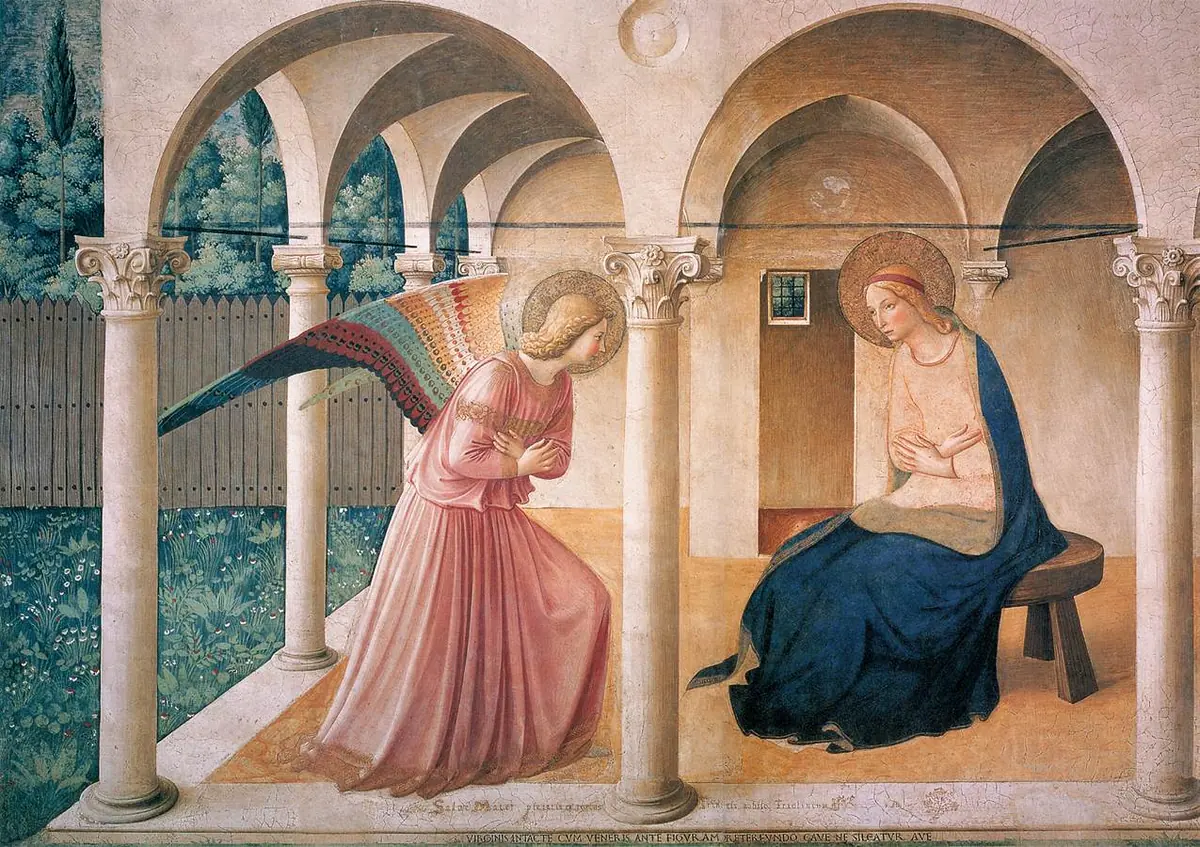
These are not grand public paintings. Most are in the friars' small cells, one fresco to a room, at eye level beside the window. Each shows a mystery of Christ's life: the Annunciation, the Nativity, the Transfiguration, the Passion, the Resurrection. Very often a Dominican saint kneels inside the scene, usually St. Dominic himself, sometimes St. Thomas Aquinas or St. Peter Martyr, showing the friar how to look at it.

Called to Rome
Pope Eugenius IV saw the finished San Marco when he came for the dedication of its church in 1443 and summoned the painter to Rome in 1445. Under Eugenius and his successor, Nicholas V, he worked in St. Peter's and in the Apostolic Palace, and in 1447 he began the ceiling of the San Brizio Chapel in Orvieto Cathedral, later finished by Luca Signorelli.
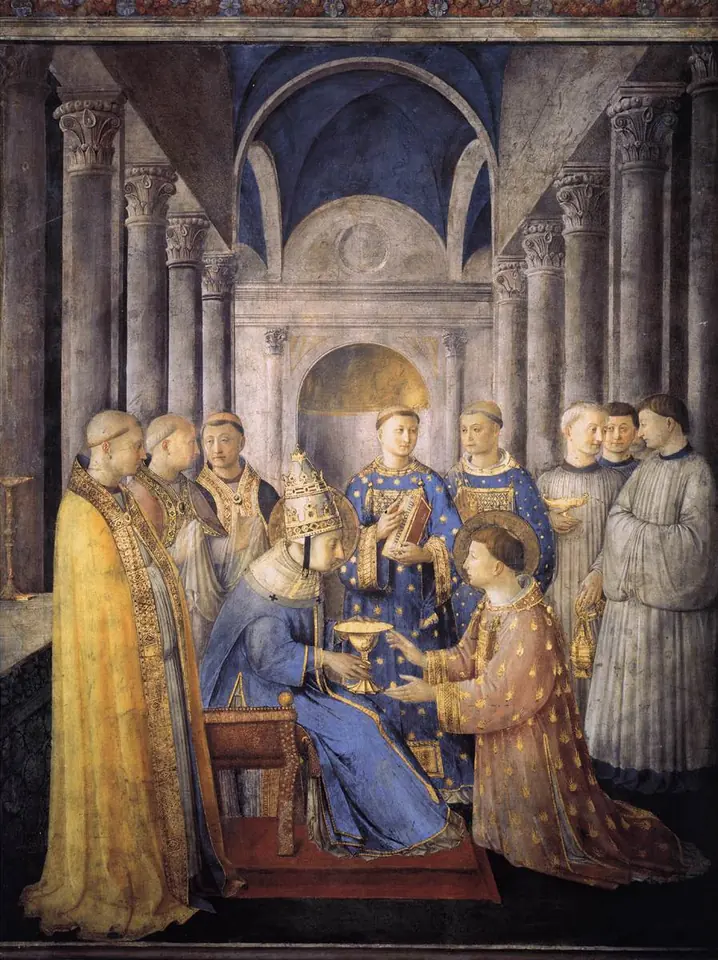
His one surviving Roman cycle is the small private chapel of Nicholas V, now called the Niccoline Chapel. On its walls he told the stories of two deacon-martyrs, St. Stephen and St. Lawrence: their ordination, their care for the poor, their preaching and their deaths. The 1982 papal letter says his art there "seemed pure prayer in paint."
The archbishopric he refused
Both Vasari and the 1982 letter tell how a pope offered Fra Angelico the archbishopric of Florence and how he begged to be excused, recommending his old prior Antoninus instead. Antoninus became archbishop in 1446. The letter names Eugenius IV as the pope; Vasari says Nicholas V. Either way, the story fits what everyone said of him. Vasari wrote that he "would never paint anything save Saints," that he cared nothing for riches, "saying that true riches consist only in being content with little," and that he was never seen angry among his brethren.
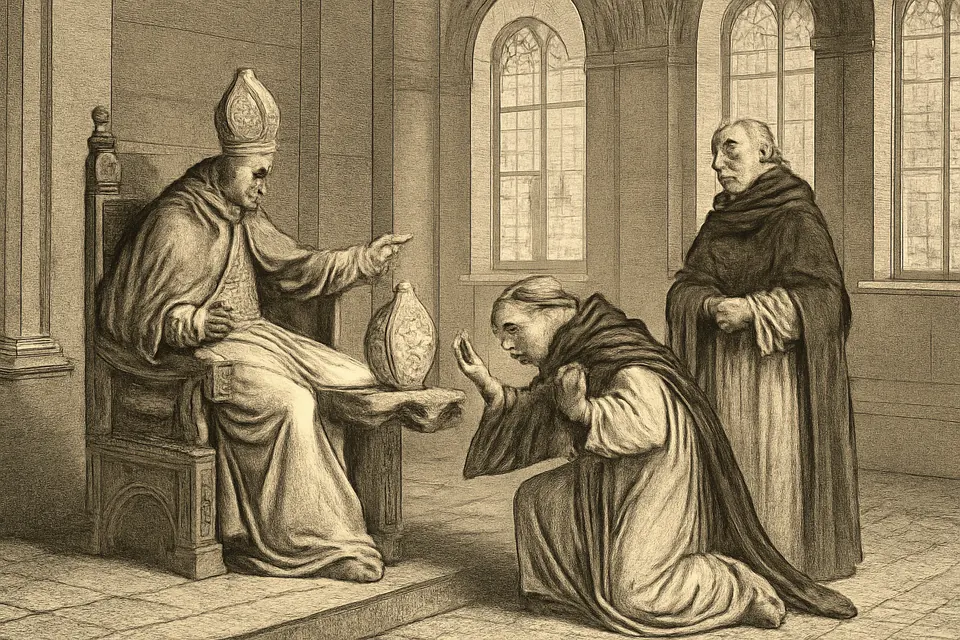
He died at the Minerva priory in Rome on February 18, 1455, and was buried in its church under a marble slab carved with his likeness.
How his art serves prayer
Fra Angelico painted as a preacher. The Dominicans are the Order of Preachers, and their motto is to contemplate and to hand on to others what has been contemplated. A San Marco friar woke, prayed the Office and studied in a cell where one mystery of Christ waited on the wall. The fresco was a companion to the Rosary and to the Gospel of the day, not a decoration.
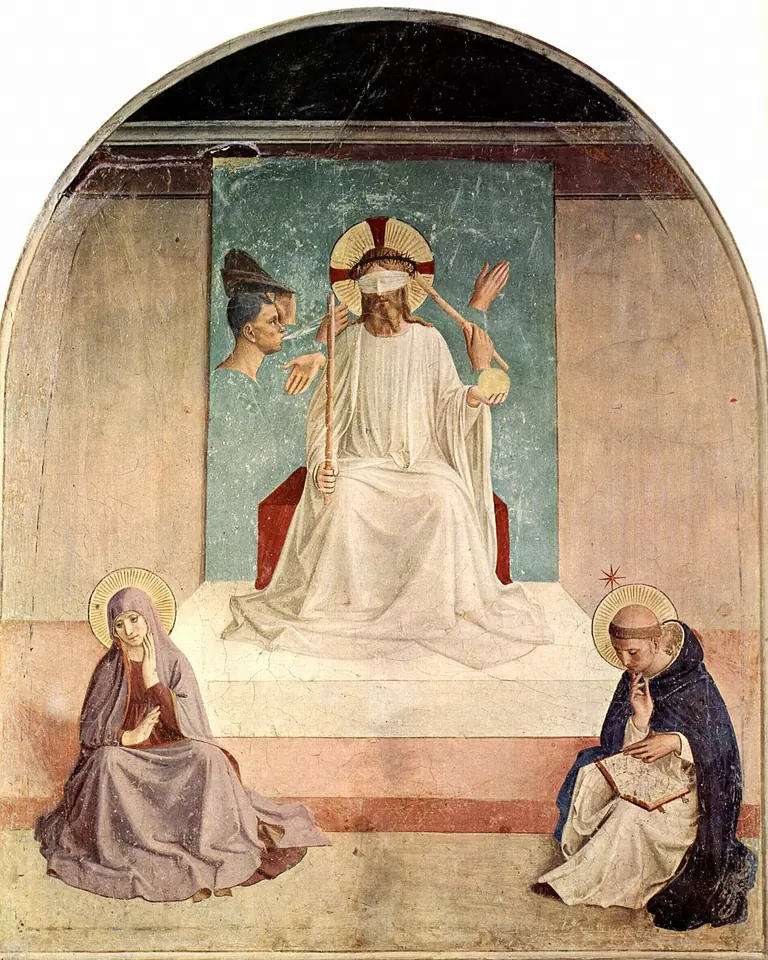
Look at how the cell frescoes are made and the purpose becomes clear. Backgrounds are bare, colors are soft, and almost nothing distracts from the mystery. In Cell 7, Christ sits blindfolded while hands strike at him and a head spits, all floating against a plain green panel with no bodies attached. Below, the Virgin and St. Dominic do not look at the scene at all. Mary sits in sorrow; Dominic reads, meditating on the Passion in Scripture. The friar in the cell was meant to do the same: to pray the Passion, not to watch a spectacle.
Vasari records the two habits behind this work that are still told of him: "Some say that Fra Giovanni would never have taken his brushes in his hand without first offering a prayer. He never painted a Crucifix without the tears streaming down his cheeks." He also says the friar never retouched a finished picture, believing that it was the will of God, and that he often said "he whose work is connected with Christ must ever live with Christ." John Paul II opened the 1982 decree with that saying in Latin: Qui res Christi gerit, oportet Christo semper adhaereat.

The same purpose runs through his altarpieces for churches. His Coronations of the Virgin and his Last Judgment gather the whole Church of saints together. In the Last Judgment, now in the San Marco museum, the blessed join hands with angels and dance into a flowering garden toward the gate of heaven.

Why Blessed Fra Angelico is the patron of artists
On February 18, 1984, the anniversary of his death, John Paul II celebrated a Mass at Santa Maria sopra Minerva for the Jubilee of Artists in the Holy Year of the Redemption. At that Mass he proclaimed Fra Angelico patron of artists, and three days later he confirmed the patronage in the apostolic letter Tribus adhinc diebus, naming him heavenly patron of all who practice the fine arts, and painting above all. In the homily he called the friar a "prophet" of the sacred image and said that in him faith became culture, and culture became lived faith.
He shares the care of painters with St. Luke, whom tradition calls the first painter of the Virgin. See more on our patron saints page.
Symbols of Blessed Fra Angelico in art
Fra Angelico is usually shown as a friar in the Dominican habit: a white tunic and scapular under a black cloak and hood. What sets him apart from other Dominicans is his work. Look for:
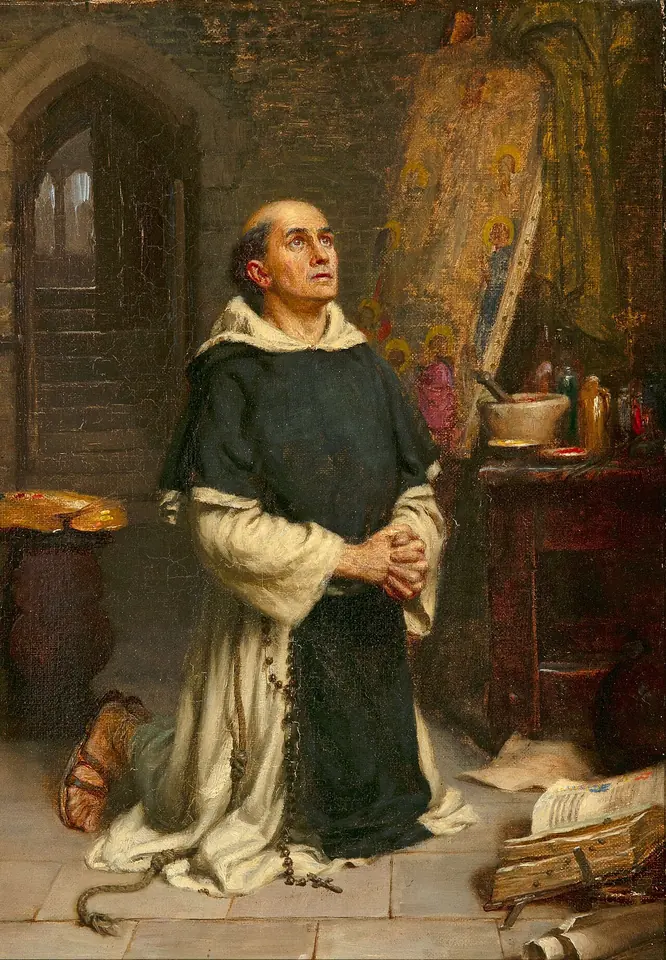
- A paintbrush, palette or pots of paint: his craft, offered to God.
- A panel or wall painting in progress: often a Madonna or a Crucifixion.
- Hands joined in prayer before the easel: the tradition that he prayed before every picture.
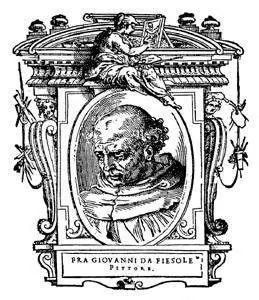
- A tonsured, round, clean-shaven face: this comes from Vasari's woodcut portrait, the image most later artists copied.
His own paintings speak their own language, and it helps to know it. Gold backgrounds and gold halos stand for the light of heaven. The Virgin's deep blue mantle was made from lapis lazuli, the costliest pigment, a way of giving the best to the Mother of God. Angels have wings striped like rainbows. Dominican saints step inside biblical scenes as witnesses who model prayer. In the cells, white and pale colors leave space for meditation; in altarpieces, crowded ranks of saints show the communion of saints all looking toward Christ.

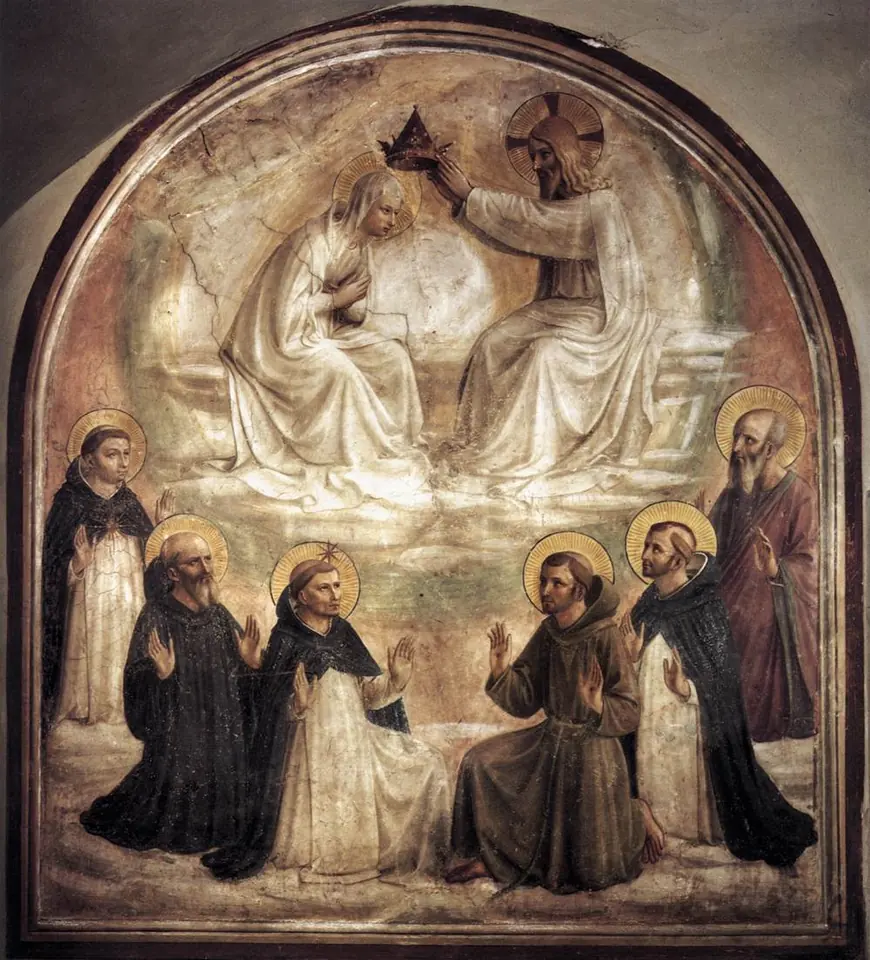
The Coronation of the Virgin is a favorite subject. In Cell 9 it is almost all white, the crowning of the Blessed Virgin Mary watched by six kneeling saints, among them Dominic and Francis.
In the Louvre altarpiece the same mystery blazes with color and gold, with the steps of the throne crowded by angels and saints.

Feast day and where he is honored
We keep his feast on February 18. It is an obligatory memorial at his tomb in Santa Maria sopra Minerva, near the Pantheon in Rome, and an optional memorial throughout the Dominican Order. Find his calendar neighbors on our feast days page.
Vasari places his tomb "near the lateral door beside the sacristy." The slab shows him lying in his habit with hands crossed. Vasari copied the Latin epitaph, which has the friar say that he wants no praise for being "a second Apelles" (the great painter of ancient Greece), but only because he gave all his earnings to Christ's own.
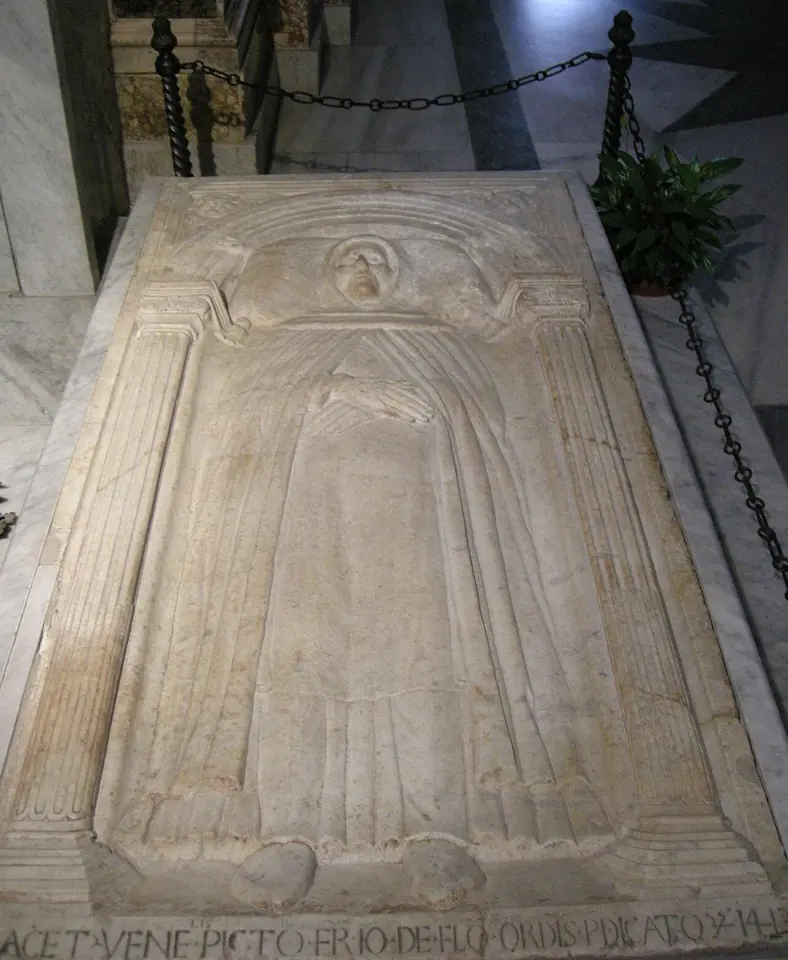
Pilgrims who want to pray with his art go to the Museo di San Marco in Florence, where the cells can still be visited one by one, and to the Vatican Museums, which include the Niccoline Chapel.
Prayer to Blessed Fra Angelico
The Missionary Society of St. Columban published this prayer for his feast on February 18, 2024:
O God, in Your providence You inspired blessed John of Fiesole to portray the beauty and sweetness of heaven. By his prayers and the example of his virtues, grant that we may manifest this splendor to our brothers and sisters. Amen.
Let us ask Blessed Fra Angelico to pray for all artists, and for every one of us who wants our work, whatever it is, to lead others to God.
Frequently asked questions
Is Fra Angelico a saint?
He is a Blessed. Pope John Paul II confirmed his cult on October 3, 1982, with the letter Qui res Christi gerit, which allowed him to be honored with the title "Blessed" in the liturgy. This was an equivalent beatification, recognizing a long-standing reputation for holiness, so no new miracle was required. He has not been canonized.
Why is Fra Angelico the patron saint of artists?
John Paul II proclaimed him patron of artists on February 18, 1984, at a Mass for the Jubilee of Artists at his tomb in Santa Maria sopra Minerva, and confirmed it three days later in the apostolic letter Tribus adhinc diebus, which names him patron of all who practice the arts, and painters above all. The Pope praised him as a friar in whom "art becomes prayer."
When is Fra Angelico's feast day?
February 18, the anniversary of his death in Rome in 1455. It is kept as a memorial in the Dominican Order and at his tomb in Santa Maria sopra Minerva, but it is not on the General Roman Calendar.
What was Fra Angelico's real name?
He was baptized Guido, the son of Pietro, so he was known as Guido di Pietro. As a Dominican he took the name Fra Giovanni (Brother John) da Fiesole. "Angelico," the angelic one, is a nickname that grew out of his reputation and the beauty of his angels; Italians call him Beato Angelico.
Where can I see Fra Angelico's paintings?
The largest group is in the former priory of San Marco in Florence, now the Museo di San Marco, with the cell frescoes and many altarpieces. Others are in the Vatican's Niccoline Chapel, the Diocesan Museum in Cortona, the Prado in Madrid, the Louvre in Paris and the National Gallery in London.
Keep exploring
- Patron saint pages
- Artists
- Feast-day calendar
- Saints remembered in FebruarySaint of the day
- More
- Saints A to ZPatron saints A to ZExplore every section
Sources
- John Paul II, Qui res Christi gerit (motu proprio confirming the cult of Fra Giovanni da Fiesole), October 3, 1982
- John Paul II, Homily for the Jubilee of Artists, Santa Maria sopra Minerva, February 18, 1984
- John Paul II, Tribus adhinc diebus (apostolic letter confirming Blessed Angelico as patron of artists), February 21, 1984
- Giorgio Vasari, Lives of the Most Eminent Painters, Sculptors and Architects, vol. 3: Fra Giovanni da Fiesole (trans. Gaston du C. de Vere)
- Catholic Encyclopedia (1907): Fra Angelico
- National Gallery of Art: Fra Angelico (artist record, c. 1395–1455)
- Missionary Society of St. Columban: The Sweetness of Heaven (prayer for February 18)