St. Jacinta Marto
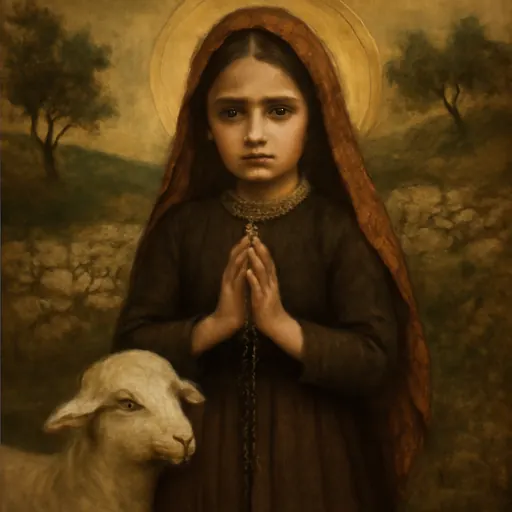
St. Jacinta Marto (1910 to 1920) was the youngest of the three shepherd children of Fátima, Portugal, who saw Our Lady six times in 1917, when she was seven. She offered her sacrifices and a long, painful illness for the conversion of sinners and died alone in a Lisbon hospital at nine. Pope Francis canonized her with her brother Francisco on May 13, 2017, and her feast day is February 20.
Who was St. Jacinta Marto?
St. Jacinta Marto was the youngest of the three shepherd children who saw Our Lady at Fátima, Portugal, in 1917. She was seven years old. With her brother Francisco and their cousin Lúcia dos Santos, she watched the family sheep on the stony hills around Aljustrel, a hamlet of a few houses in the parish of Fátima, and there the Angel of Peace came to them in 1916 and a Lady "more brilliant than the sun" six times the next year. The story of those apparitions is told on our page on Our Lady of Fátima. This page is about the little girl herself.
Jacinta lived less than three years after the last apparition. She caught the influenza that swept Europe in 1918, suffered for more than a year, and died alone in a Lisbon hospital on February 20, 1920, before her tenth birthday. In that short time she gave herself, with a child's whole heart, to what she believed the Lady had asked: prayer and sacrifice for sinners, love for the Holy Father, and devotion to the Immaculate Heart of Mary. In 1989 the Church declared that she and Francisco had practiced the virtues to a heroic degree, the first time it had said so of children who were not martyrs. Pope Francis canonized them both at Fátima on May 13, 2017.
Almost everything we know of her inner life comes from Lúcia. In December 1935, at her bishop's request, Lúcia sat down and wrote her first memoir, and it is nearly all about Jacinta. Later writers, above all Father John De Marchi, who interviewed Jacinta's parents in the 1940s, added what the family and the people of Lisbon remembered.
The life of St. Jacinta Marto
A child of Aljustrel
Jacinta was the last of the children of Manuel Pedro Marto, known to everyone as Ti Marto, and Olímpia de Jesus. Her official birthday is March 11, 1910, but the shrine at Fátima notes that the parents probably changed the date, as Lúcia's did; a note by the priest-investigator Manuel Nunes Formigão gives March 5. She was baptized in the parish church of Fátima on March 19, 1910. Her brother Francisco was two years older.

She was pretty, quick and full of life. "She was a darling," her father told De Marchi decades later, "and none of the others could compare with her." Lúcia remembered that Jacinta loved to dance, liked to climb a hilltop and call out names so the valley would echo them back ("the name which echoed best," Lúcia wrote, "was Maria"), and called the moon "the candle of Our Lady" because it didn't hurt the eyes. Lúcia was honest about her faults too. Jacinta sulked when she lost a game, kept the buttons she won from her cousin, and, like the other two, rushed through the Rosary by saying only "Hail Mary" on each bead.
She loved the lambs most of all. The shrine's account, drawing on Lúcia, says she hugged them, called them by name, and carried the smallest ones in her arms "to do as our Lord," like the Good Shepherd in the holy pictures.

1916 and 1917: the angel and the Lady
In 1916 the Angel of Peace appeared three times to the three children and taught them to pray with their foreheads to the ground. On May 13, 1917, the Lady appeared at the Cova da Iria. The children agreed to say nothing. Jacinta couldn't keep it in. That evening, as Pope Francis recalled at her canonization, she told her mother: "Today I saw Our Lady." Later she said, in words Lúcia preserved, "I had inside me something that would not let me be silent."

The Lady asked for the Rosary and for sacrifices offered for sinners. In July she showed the children a vision of hell. It marked Jacinta for the rest of her life. Lúcia found her one day sitting alone on a rock, very sad. "I'm thinking of hell and of the poor sinners who go there," Jacinta said. "Oh, Lucia, how sorry I am for all those souls." Then she knelt and repeated the prayer the Lady had taught them: "O my Jesus, forgive us and deliver us from the fire of hell. Take all souls to heaven, especially those who are most in need."
Sacrifices for sinners
From then on the three children looked for small sacrifices the way other children look for games. They gave their lunch to the sheep, or to poor children they met on the road, and ate acorns instead; Jacinta insisted on the bitter ones from the cork oak because they made the greater sacrifice. Through the summer heat of the serra they went without water for long stretches. Each wore a rough piece of rope knotted around the waist, until the Lady told them in September not to wear it at night.
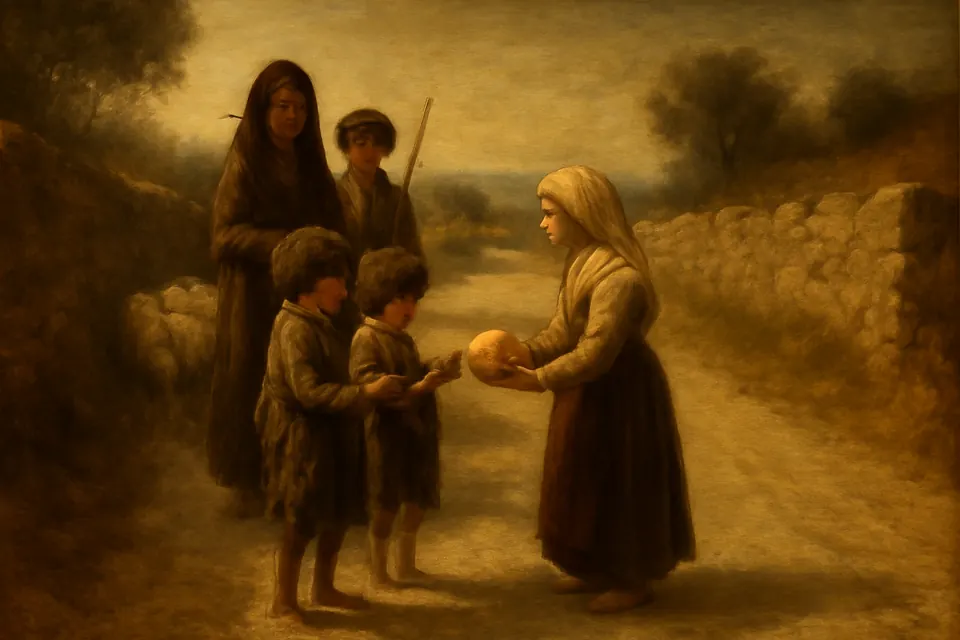
Lúcia did not hide that Jacinta sometimes forgot. Once, sick in bed, she refused a milk pudding her mother brought. When Lúcia reminded her that she had disobeyed her mother and missed a chance to offer something to God, Jacinta burst into tears, called her mother back, asked her pardon and ate the pudding. "Lucia, you don't know how hard that was to take!"
The jail at Ourém
On August 13, 1917, the administrator of the district, Artur de Oliveira Santos, took the three children to Vila Nova de Ourém to make them reveal the secret the Lady had confided in July. They were questioned, offered gold, and finally put in the town jail among the prisoners, with the threat that they would be boiled in oil. Jacinta cried, not from fear of death but because she missed her parents: "Because we'll die without even seeing our parents." Francisco comforted her, and the three of them offered it up: "O my Jesus, this is for love of You, for the conversion of sinners."
When one of the prisoners told them to give up the secret and go home, Jacinta looked at him and said, "But we'd much rather die than tell the secret." The prisoners got out a concertina, and one of them danced with her, holding her in his arms. Then she remembered why she was there, asked to be put down, and hung a holy medal on a nail in the wall and knelt with Lúcia and Francisco to say the Rosary aloud. The prisoners knelt with them. The children were returned home on August 15.
The Holy Father
Jacinta had a particular love for the Pope, whom she had never seen and knew only as "the Holy Father." Twice she had visions of him that the others did not share. In one she saw him "in a very big house," kneeling at a table with his face in his hands, weeping, while people outside threw stones and cursed him. In the other, Pope Francis quoted at her canonization, she cried out to the others: "Do you not see all those streets, all those paths and fields full of people crying out for food, yet have nothing to eat? And the Holy Father in a church, praying before the Immaculate Heart of Mary? And all those people praying with him?" After that she added a prayer for the Pope to every sacrifice.
Illness
In the autumn of 1918 the influenza reached Aljustrel. Francisco and Jacinta both fell ill. Francisco died at home on April 4, 1919. Jacinta's illness turned into bronchial pneumonia and then purulent pleurisy, an abscess in the lining of the chest. "I keep thinking of Francisco," she told Lúcia, "and of how much I would like to be with him."
She told Lúcia the Lady had come again and told her she would go to two hospitals, not to be cured, but to suffer more for sinners. From July 1 to August 31, 1919, she lay in the hospital at Vila Nova de Ourém. The treatment did nothing, the family couldn't afford more, and she came home with an open wound in her side that had to be dressed every day. When she could no longer bow her head to the floor to say the angel's prayer, she said it on her knees, until the parish priest told her to pray lying down.

In December 1919 she told Lúcia that the Lady had appeared again: she would go to a hospital in Lisbon, would never see her family again, and would die alone. This frightened her more than any pain. Lúcia found her kissing a picture of Our Lady and saying, "Darling Mother in heaven, must I die alone?" The shrine quotes what she said when she accepted it: "O Jesus! Now You can convert many sinners, because this is really a big sacrifice!"
Lisbon
In January 1920 a Lisbon physician, Dr. Eurico Lisboa, visited Fátima with Canon Formigão, saw Jacinta and urged the family to send her to the capital. Her father agreed. "Papa, dear," she told him, "if I should recover from this illness, you may be sure I would get another. When I go to Lisbon, Papa, it means goodbye." Before leaving she was taken on a donkey to the Cova da Iria one last time to pray. Her parting from Lúcia was the hardest: "We shall never see each other again! Pray for me, Lucia; pray for me very much, until I can go to heaven, and then I will pray and pray for you."
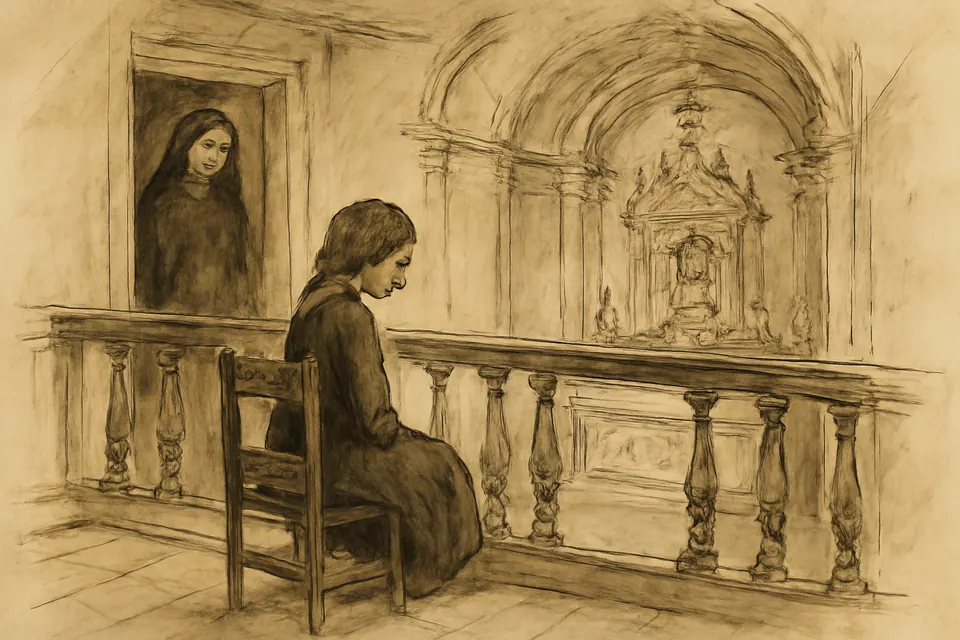
In Lisbon, with her mother and her brother António, she was turned away by one institution after another, until Mother Godinho took her into a small orphanage on the Rua da Estrela beside a chapel. Jacinta called her "Madrinha," godmother. From the chapel's choir loft she could see the tabernacle, and she sat there on a little chair for as long as they let her. Mother Godinho wrote down many of her sayings. "Who taught you these things?" the nun asked her. "Our Lady, but some of them I thought out myself. I love to think."
On February 2, 1920, she was admitted to the Hospital Dona Estefânia. On February 10 the surgeon Dr. Castro Freire removed two ribs from her left side under local anesthesia, because she was too weak for anything stronger. The wound was dressed every day, and De Marchi was told her only cries were the name of Our Lady. A few days before the end she told Mother Godinho that Our Lady had come to her, and her pain left her.
On the evening of February 20 she said she felt worse and asked for the sacraments. Dr. Lisboa's account, which the shrine quotes, says the parish priest of Anjos, Father Pereira dos Reis, heard her confession about 8 p.m. but would not bring Viaticum that night because she seemed fairly well. She insisted that she would die soon. About 10:30 that night she died "with great serenity," with only a nurse beside her, without having received Communion.

Burial and the opening of her coffin
Ladies of Lisbon dressed her body in a white First Communion dress with a blue sash, Our Lady's colors, as she had wished. People came to the sacristy of the Church of the Holy Angels to touch their rosaries to her, and the undertaker later told De Marchi of the pleasant scent of the body, though she had died of a purulent illness and lay unburied for days. She was buried on February 24 in the vault of the Baron of Alvaiázere at Vila Nova de Ourém. On September 12, 1935, the coffin was opened to move her to the Fátima cemetery beside Francisco, and her face was found intact. On May 1, 1951, her remains were carried into the new Basilica of Our Lady of the Rosary.

The miracles of St. Jacinta Marto
- The cure of Maria Emília Santos (approved). A woman of Leiria, paralyzed and bedridden for many years, recovered after praying to Francisco and Jacinta. John Paul II promulgated the decree recognizing the miracle on June 28, 1999, which opened the way to their beatification. Accounts of the date of the cure itself differ.
- The recovery of Lucas Baptista (approved). In 2013 a five-year-old Brazilian boy fell about 21 feet from a window while playing with his little sister. He suffered a severe brain injury and two cardiac arrests, and doctors gave him little chance of surviving. His parents and a community of Carmelite nuns prayed to the shepherd children. Six days later his breathing tubes came out, and he went home with no lasting harm. The Holy See announced on March 23, 2017, that Pope Francis had approved the cure for their canonization.
- Prophecies in Lisbon (reported). Mother Godinho testified that Jacinta foretold the deaths of her two older sisters, Florinda and Teresa, who died soon after her, and that she predicted that two doctors would die soon, and they did. These were recorded by witnesses but never examined by the Church.
- Her intact face in 1935 (reported). Witnesses and a photograph attest it. The Church has not ruled on it.
The Church approved the apparitions of Fátima in 1930; on what the Lady said to Jacinta privately in her illness, it has made no judgment.
Why St. Jacinta is invoked for the sick
No pope or bishop has named Jacinta a patron saint of anything, but the faithful have chosen for her. She knew sickness from the inside: pneumonia, pleurisy, an open wound, a hospital far from home, and the fear of dying alone. So we ask her prayers for the sick, and above all for sick children in hospitals, and for parents who sit beside their beds.
She and her brother and cousin were mocked, interrogated by priests and officials, called liars by neighbors and even doubted by their own families, and that is why people ridiculed for their faith turn to her. Because she was locked in the jail at Ourém, and kept praying there with the prisoners, she is also remembered by prisoners. You'll find more causes on our patron saints page.
Symbols of St. Jacinta Marto in art
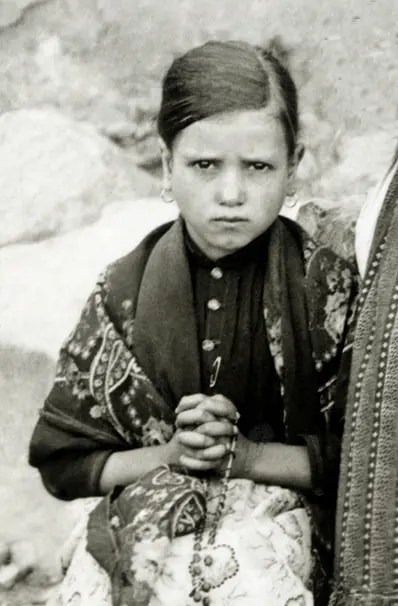
Most images of Jacinta are based on photographs taken in 1917, so she is easy to recognize. Look for these:
- A small girl in a head scarf and patterned shawl, with a long, full peasant skirt: the dress she wore in the photographs.
- A rosary in her joined hands, the prayer the Lady asked for in every apparition.
- A lamb or sheep, for her work as a shepherd girl and her love of the lambs. In some statues she carries one in her arms.
- Francisco and Lúcia beside her, often kneeling before Our Lady above a small holm oak.
- A halo in images made since her beatification in 2000; before that, holy cards show her without one.
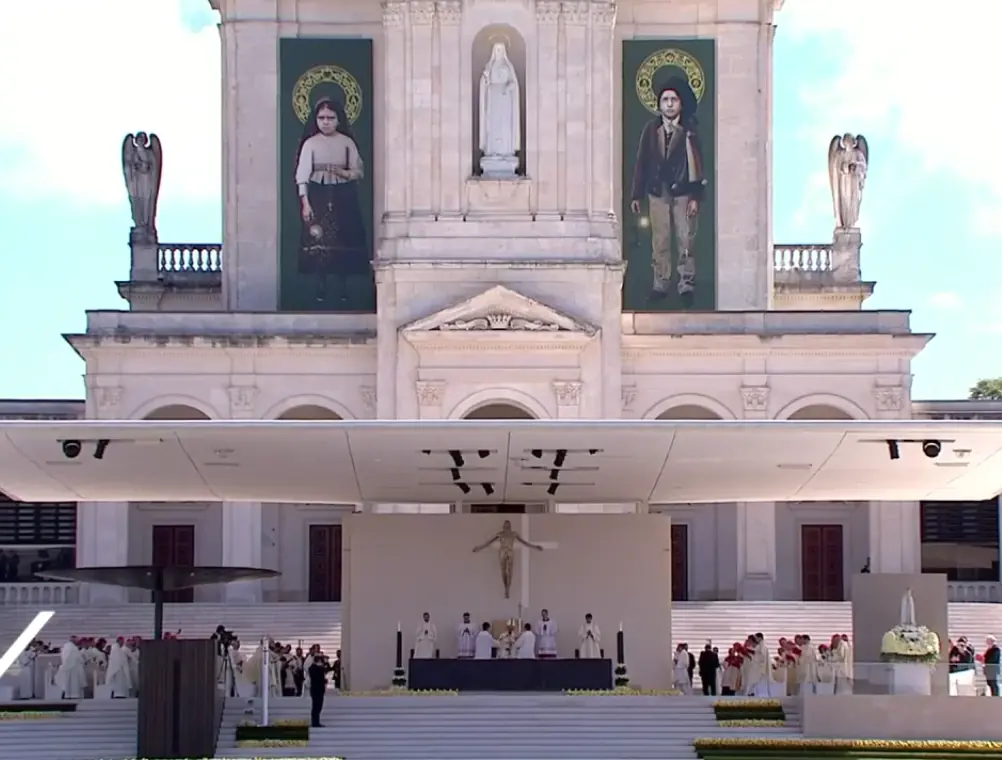
At her canonization in 2017, two great banners of the children hung from the front of the basilica, showing them in the peasant clothes of their photographs.
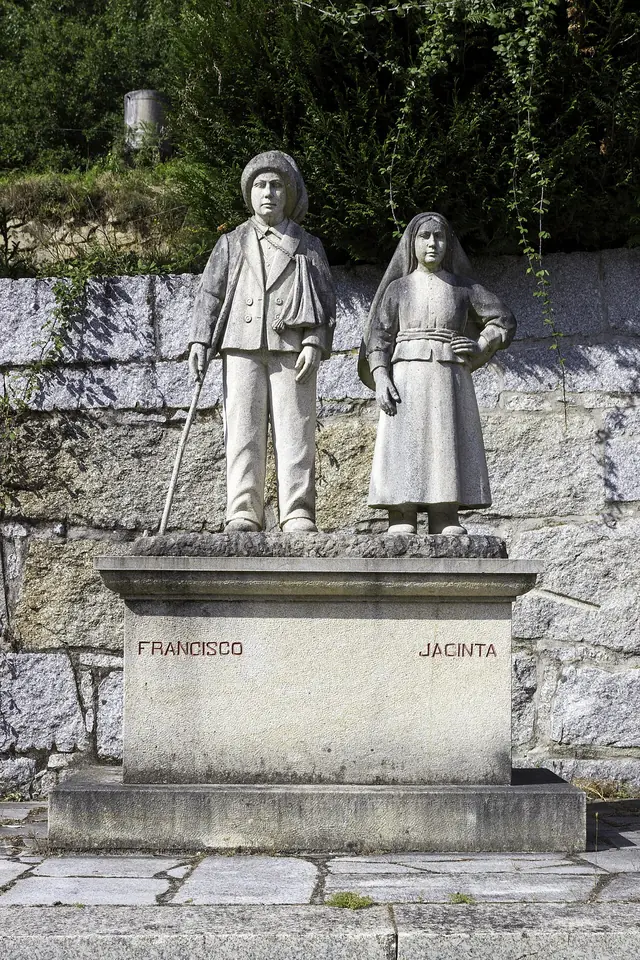
Statues of the two Marto children stand far beyond Fátima. The one below, at Ponte Barxas in Galicia, shows Francisco with his shepherd's crook and Jacinta in a long dress and veil.
Feast day and her tomb at Fátima
We keep the feast of St. Jacinta and St. Francisco on February 20, the day of her death. John Paul II set it when he beatified them at Fátima on May 13, 2000, and called them "two candles which God lit to illuminate mankind in its dark and anxious hours." Their cause had been long. The diocese of Leiria opened the inquiry into Jacinta's life in 1952; it held 77 sessions and heard 27 witnesses before it closed in 1979. Pope Francis canonized the two at Fátima on May 13, 2017, the hundredth anniversary of the first apparition. You can find their neighbors on the calendar on our feast days page.
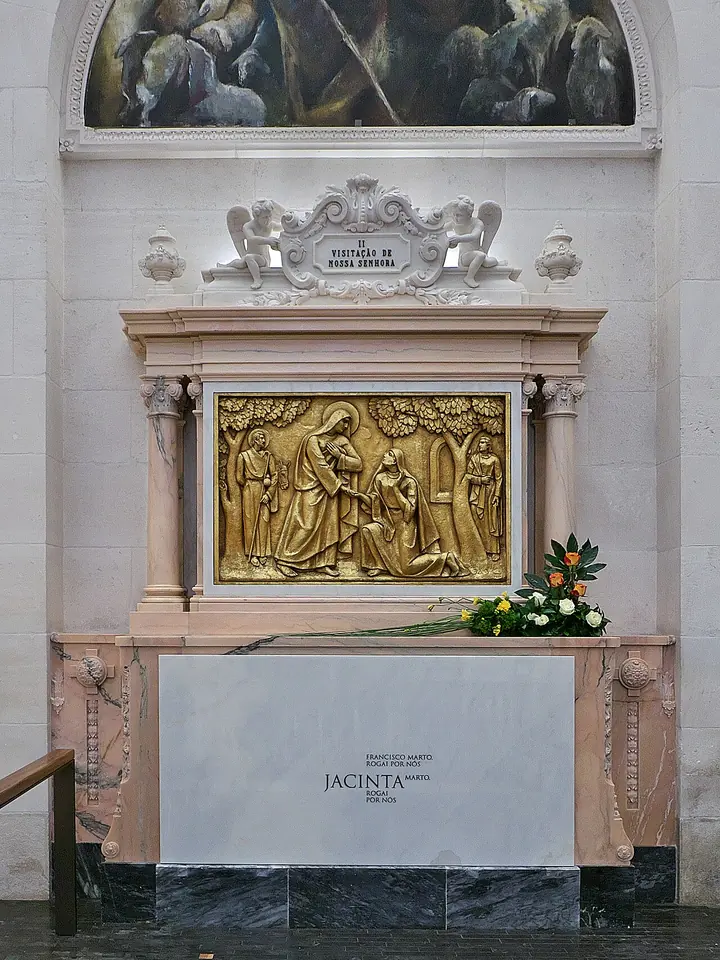
Jacinta's tomb is in a side chapel of the Basilica of Our Lady of the Rosary, at the head of the great esplanade of the sanctuary. Her cousin Lúcia, who became a Carmelite and died in 2005, was laid beside her in 2006; Francisco rests across the nave. Pilgrims to Fátima also visit the Marto house in Aljustrel, a short walk away, and Valinhos, where the Lady appeared in August 1917. For more on incorrupt saints and how the Church views them, see our page on relics and incorruptible saints.
Prayer to St. Jacinta Marto
The Sanctuary of Fátima prays a litany to the two saints, with invocations such as "Saint Jacinta Marto, pray for us!" and "Untiring examples of sacrifice for the conversion of sinners, pray for us!" It ends with this prayer:
God of infinite goodness, You love the innocent and exalt the humble; please grant, through the intercession of the Immaculate Mother of Your Son, that, in imitation of Saints Francisco and Jacinta, we may serve You in simplicity of heart and thus may enter the Kingdom of Heaven. Through Our Lord Jesus Christ, Your Son, Who lives and reigns with you in the unity of the Holy Spirit. Amen.
Jacinta's own prayers were the ones the Angel and the Lady taught her. She prayed the Rosary, and between the decades the prayer the Lady gave in July 1917, which we still say today:
O my Jesus, forgive us and deliver us from the fire of hell. Take all souls to heaven, especially those who are most in need.
When she offered a sacrifice, she used the words the Lady taught: "O my Jesus, this is for love of You, for the conversion of sinners." The full set of Fátima prayers, including the Pardon Prayer of the Angel, is on our page on the Fátima prayer. Let us ask St. Jacinta to pray for the sick children we love, for the Holy Father, and for sinners. St. Jacinta Marto, pray for us.
Frequently asked questions
Who was St. Jacinta Marto?
Jacinta Marto was a shepherd girl from Aljustrel, a hamlet in the parish of Fátima, Portugal. With her brother Francisco and their cousin Lúcia dos Santos she saw the Angel of Peace in 1916 and Our Lady six times in 1917. She caught the influenza of 1918, suffered for more than a year and died in Lisbon on February 20, 1920, at nine. She is the youngest saint the Church has ever canonized who was not a martyr.
When is the feast day of St. Jacinta Marto?
February 20, the day she died. She shares the feast with her brother St. Francisco, who died on April 4, 1919. John Paul II fixed the date when he beatified them at Fátima on May 13, 2000.
How old was Jacinta when she saw Our Lady of Fátima?
She was seven. Her official birthday was March 11, 1910, so she had turned seven two months before the first apparition on May 13, 1917. Francisco was nine and Lúcia ten.
How did St. Jacinta Marto die?
She fell ill in the influenza epidemic in late 1918. Bronchial pneumonia turned into purulent pleurisy, and later tuberculosis was suspected. After two months in the hospital at Vila Nova de Ourém in 1919, she was taken to Lisbon in January 1920. A surgeon removed two ribs from her left side on February 10, and she died in the Hospital Dona Estefânia about 10:30 on the night of February 20, 1920, with only a nurse present.
Is St. Jacinta's body incorrupt?
When her coffin was opened on September 12, 1935, to move her to the Fátima cemetery, her face was found intact, and a photograph was sent to Lúcia. Her remains were identified again in 1951 when they were moved to the basilica. The Church has never made a formal statement about her body, and it isn't displayed.
What miracles were approved for Jacinta and Francisco?
Two. For their beatification, John Paul II approved on June 28, 1999, the cure of Maria Emília Santos of Leiria, who had been paralyzed and bedridden for many years. For their canonization, Pope Francis approved in March 2017 the recovery of Lucas Baptista, a five-year-old Brazilian boy who had survived a 21-foot fall with a severe brain injury.
What is St. Jacinta Marto the patron saint of?
The Church has not assigned her an official patronage. Because of her own long illness, she is often invoked for the sick and especially for sick children. Because she was mocked, questioned and jailed for what she said she saw, she is also asked to pray for people ridiculed for their faith and for prisoners.
Where is St. Jacinta Marto buried?
In the Basilica of Our Lady of the Rosary at the Sanctuary of Fátima. Her remains were moved there on May 1, 1951. Her cousin Lúcia, who died in 2005, was laid beside her in 2006, and Francisco lies on the opposite side of the basilica.
Keep exploring
- Patron saint pages
- Healing
- Feast-day calendar
- Saints remembered in FebruarySaint of the day
- More
- Saints A to ZPatron saints A to ZExplore every section
Sources
- Shrine of Fatima: Chronology of the seers
- Shrine of Fatima: Life and spirituality of the seers. Jacinta's love of the lambs and her words when told she would die alone, quoted from Lúcia's memoirs
- Shrine of Fatima: Litany of Saints Francisco and Jacinta
- Pope John Paul II, Homily at the Beatification of Francisco and Jacinta Marto, Fátima, May 13, 2000
- Pope Francis, Homily at the Canonization of Francisco and Jacinta Marto, Fátima, May 13, 2017
- John De Marchi, The True Story of Fatima (1956), EWTN Library (archived copy). Interviews with her parents, Mother Godinho's notes and Dr. Eurico Lisboa's account of her last weeks
- CBS News (AP): Brazilian boy's survival after brain injury is Fatima "miracle," parents say (May 11, 2017)
- Observador: Canonização de Francisco e Jacinta: um processo com 67 anos (April 18, 2017)