St. Maria of Gatchina
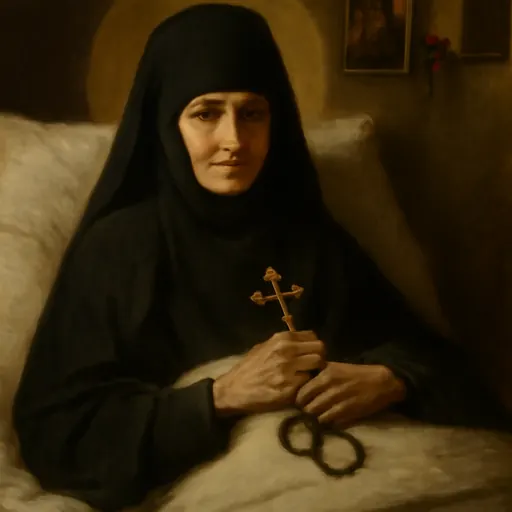
St. Maria of Gatchina (Lydia Lelyanova, 1874–1932) was a St. Petersburg merchant's daughter who lay paralyzed for some twenty years in Gatchina and became a nun in 1922. Arrested by the Soviet police in 1932, she died a prisoner. The Russian Orthodox Church honors her as a venerable martyr on April 17 (April 4, Julian calendar).
Who was St. Maria of Gatchina?
St. Maria of Gatchina was a Russian Orthodox nun who could not move from her bed for some twenty years, and who became, from that bed, a consoler to thousands. Born Lydia Lelyanova in St. Petersburg in 1874, she lived most of her adult life in Gatchina, a town south of the capital. Priests, bishops, professors and factory workers came to her room for prayer and counsel. In 1932 the Soviet police arrested her, and she died a prisoner in a prison hospital. The Russian Orthodox Church honors her as a venerable martyr, one of the New Martyrs and Confessors of Russia.
The Orthodox keep her memory on April 17, which is April 4 in the Julian calendar.
Her life
A merchant's daughter
Lydia was born in 1874 into a well-known merchant family of St. Petersburg. Her father, Alexander Lelyanov, owned a sealing-wax factory; the family lived near the Novodevichy Convent. He died when she was three and a half, and her mother and older brothers raised her and her younger sister Julia.
Shortly before she finished at the girls' gymnasium, she fell ill with encephalitis. Parkinson's disease followed, and later rheumatism and gout. She was brought to her final examinations in a wheelchair. The family took her to the best doctors in Russia and abroad, and none could help. In 1909, on the doctors' advice, the family moved to Gatchina.
Twenty years on her back
For about twenty years she lay motionless on her back, and every movement or touch caused her pain. According to her Life in Abbot Damaskin's collection of the New Martyrs, she did not complain. She accepted her illness as the will of God, and through it she learned to pray without ceasing. She could still speak, slowly and through half-closed lips, taking care to be understood.
After her mother and brothers died, she lived with her sister, and devout women came to live with them and care for her. Clergy visited often and served prayers at her bedside. A circle of friends gathered around her, named for St. John of Kronstadt.
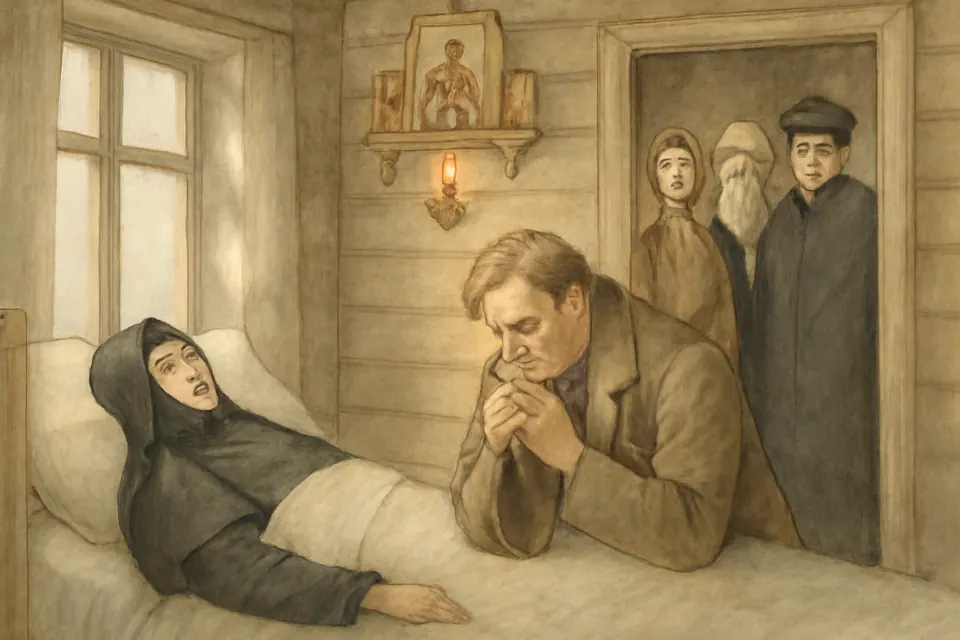
The nun Maria
With the blessing of Metropolitan Benjamin of Petrograd, she was tonsured a nun in 1922 in the Church of the Protection of the Mother of God in Gatchina, before a great crowd, by Archimandrite Makary (Voskresensky) of the Alexander Nevsky Lavra. She took the name Maria.
Visitors now came every day and waited their turn in the hallway. Many brought food and money, which she gave away to people in need. Professor Ivan Andreyev, who visited her in March 1927, later remembered the people he saw leave her room: a young man downcast over his priest-father's arrest and exile who came out smiling; a grieving father who came out standing straight again; a weeping old woman who left calm and steady. Metropolitan Benjamin himself gave her his photograph inscribed, in our translation, "To the deeply revered sufferer Mother Maria, who consoled, among many sorrowing, me a sinner too."

Her arrest and death
When Metropolitan Sergius issued his declaration of loyalty to the Soviet state in 1927, Mother Maria did not accept it. Questioned after her arrest, she said she was a supporter of Metropolitan Joseph (Petrovykh), who had refused it.
Early in 1932 the police began arresting the monks and nuns of the closed monasteries. Mother Maria was arrested on February 19, 1932. Her Life records that two agents seized her by her twisted arms, dragged her across the floor and the ground, and threw her into the back of a truck. Because she could not be held in an ordinary cell, she was put in the prison hospital, and she was questioned there. Witnesses called by the investigators all said the same thing: in Gatchina and around it, she was regarded as a holy woman with a God-given gift of insight.
On March 22, 1932, she was sentenced to three years of exile. She did not live to begin it. She died in the prison hospital on April 17, 1932, and was buried in the Smolensky Cemetery.
Glorification and miracles
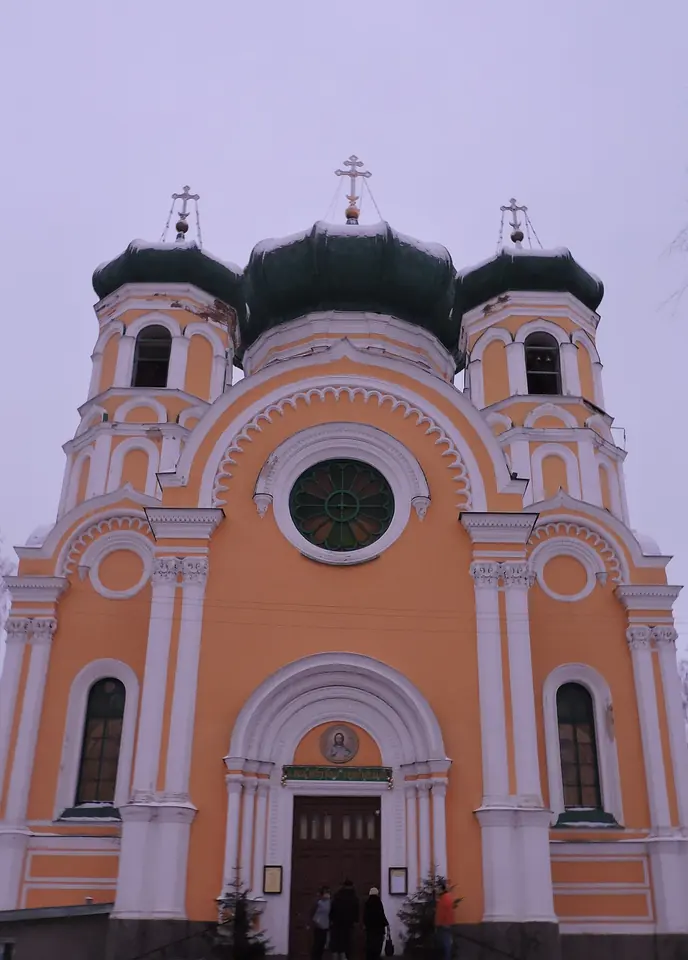
The Russian Orthodox Church Outside Russia numbered her among the New Martyrs in 1981. On July 17, 2006, the Russian Orthodox Church added her name to the Synaxis of the New Martyrs and Confessors of Russia, at the request of the Diocese of St. Petersburg. On March 26, 2007, her relics were uncovered in the Smolensky Cemetery and brought to the Cathedral of St. Paul in Gatchina.
- Reported: her gift of insight (in Russian, prozorlivost) and of consoling the sorrowful, attested by visitors and even by the witnesses the police questioned in 1932.
The Orthodox Church glorifies martyrs for their witness unto death, not for formally examined miracles, and we know of no investigated miracle in her cause.
Symbols of St. Maria of Gatchina in icons
- Black monastic habit and veil: she was a professed nun from 1922.
- Cross in her hand: the sign of a martyr.
- Bed of suffering: some icons and pictures show her lying in bed, as she lived for twenty years.
- Prayer rope: for the unceasing prayer she learned in her illness.
Icons call her a prepodobnomuchenitsa, a "venerable martyr," the title the Orthodox Church gives to monks and nuns who died as martyrs.
Feast day and prayer
Her memory is kept on April 17 (April 4, Julian calendar), and with the New Martyrs and Confessors of Russia on the Sunday nearest February 7. See the feast day calendar for other saints of April.
The Russian Orthodox Church sings this troparion (Tone 4) for her, given here in our translation from the Church Slavonic text:
Thy ewe-lamb Maria, O Jesus, / appeared as a consolation to Thy servants in a cruel time, / showing the strength of faith and piety, / and endured torments from those who fought against God. / By her prayers, as Thou art merciful, save our souls.
Let us remember before God all who are bedridden and in pain, all who sit at their bedsides, and every Christian who suffers for the faith.
Frequently asked questions
Who was St. Maria of Gatchina?
Lydia Lelyanova, born in St. Petersburg in 1874, was struck by encephalitis as a schoolgirl and later lay motionless for about twenty years. In Gatchina she became known for her gift of consoling the sorrowful, was tonsured a nun with the name Maria in 1922, and died in custody after her arrest in 1932.
Why is she called a martyr?
She was arrested in February 1932 in the Soviet campaign against monks and nuns, roughly handled though she could not move, and died in the prison hospital on April 17, 1932, after being sentenced to exile. The Orthodox Church counts her among the New Martyrs and Confessors of Russia.
When is the feast of St. Maria of Gatchina?
April 17 in the civil calendar (April 4 in the Julian calendar used by the Russian Orthodox Church), the day she died.
Where are her relics?
In the Cathedral of St. Paul the Apostle in Gatchina, near St. Petersburg. They were uncovered at the Smolensky Cemetery in 2007.
Keep exploring
Sources
- Azbyka.ru: Venerable Martyr Maria (Lelyanova) of Gatchina, nun (from Abbot Damaskin (Orlovsky), Lives of the New Martyrs and Confessors of Russia, April, 2006). Her life, her arrest and death, her glorification, the 2007 uncovering of her relics, and the troparion translated on this page