St. Benedict Joseph Labre, the Holy Beggar of Rome
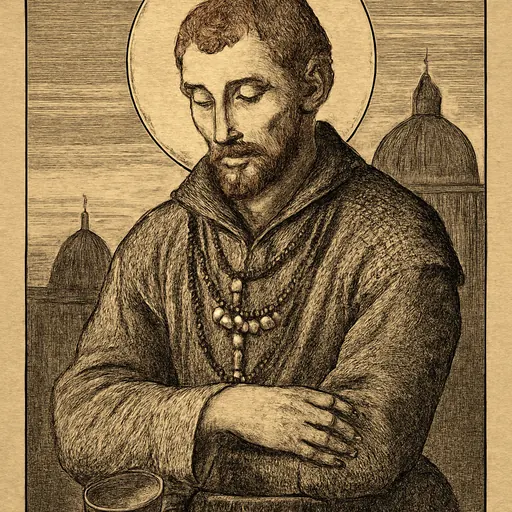
St. Benedict Joseph Labre (1748 to 1783) was a Frenchman who, turned away by several monasteries, became a homeless pilgrim, walking to the great shrines of Europe and spending his last years praying in the churches of Rome. He died on the steps of Santa Maria ai Monti and was canonized in 1881. He is the patron saint of the homeless, beggars and pilgrims, and his feast day is April 16.
Who was St. Benedict Joseph Labre?
St. Benedict Joseph Labre was a Frenchman from the farm country of Artois who wanted to be a monk, could not become one, and instead spent the last thirteen years of his life as a homeless pilgrim. He walked to the great shrines of Europe with nothing but the clothes on his back and a few books, then settled in Rome, where he prayed all day in its churches and slept wherever he could. He died there in 1783, at thirty-five, and the city cried out that a saint had died.
He never asked for alms. Whatever people gave him beyond a little bread, he passed on to other beggars. Pope Benedict XVI, whose birthday falls on Labre's feast, called him "one of the most unusual Saints in the Church's history" in a homily on April 16, 2012, and said his life points like a finger to the one thing that matters: "He shows us that God alone suffices."

The life of St. Benedict Joseph Labre
A serious boy from Amettes
Benedict was born on March 26, 1748, at Amettes, near Boulogne, the eldest of fifteen children of Jean-Baptiste Labre and Anne-Barbe Grandsire. His parents kept a shop and could afford schooling. At twelve he went to live with his uncle François-Joseph Labre, the parish priest of Erin, who taught him Latin. The Catholic Encyclopedia says the boy found he could not care for any learning that did not lead straight to God.
When an epidemic struck Erin in 1766, Benedict nursed the sick beside his uncle, and the priest died serving them. Benedict went home in November of that year still set on becoming a monk.

Every door closed
What followed was years of refusals. The Carthusians at Val-Sainte-Aldegonde would not take him. At Neuville he was told he was too young and should first learn plainchant and logic. He applied twice to La Trappe and was turned down, lived six weeks as a Carthusian postulant at Neuville, and was sent away. In November 1769 the Cistercian abbey of Sept-Fonts finally received him, and the monks grew fond of him, but his health collapsed and the community decided his vocation lay elsewhere.
On the road to Rome in 1770, at Chieri in Piedmont, he wrote his parents the last letter they would ever receive from him. Soon after, he became certain of his call. In the words of the Catholic Encyclopedia, he understood that God wanted him, like the ancient St. Alexis, to leave country and family "to lead a new sort of life, a life most painful, most penitential, not in a wilderness nor in a cloister, but in the midst of the world, devoutly visiting as a pilgrim the famous places of Christian devotion." He put this to experienced confessors more than once, and they told him he could safely follow it.
Pilgrim of Europe
For seven years he walked. He prayed at Loreto, Assisi, Naples, Bari and Fabriano in Italy, at Einsiedeln in Switzerland, at Compostela in Spain and at Paray-le-Monial in France. He wore an old coat, one rosary around his neck and another in his fingers, and kept his arms folded over a crucifix on his breast. In a small wallet he carried a New Testament, a breviary he prayed daily, The Imitation of Christ and a few other devout books. He slept on the ground, usually outdoors, and ate a little bread or herbs, often once a day, sometimes picked from a refuse heap.
The poor man of the Forty Hours
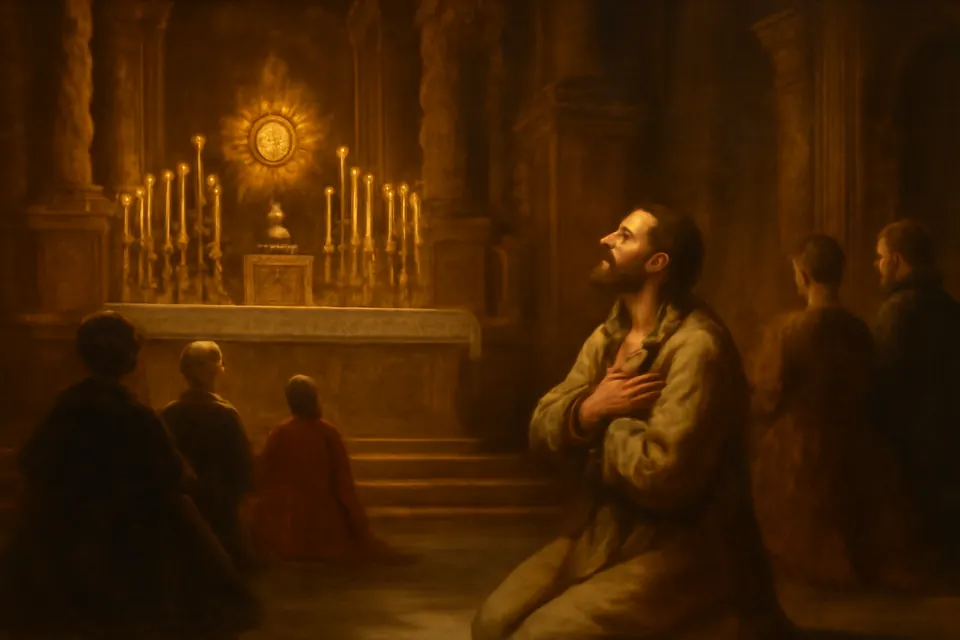
From 1777 he stayed in Rome, leaving once a year to walk to the Holy House of Loreto. The Romans called him "the poor man of the Forty Hours," because he followed the devotion of the Forty Hours from church to church, kneeling for hours before the Blessed Sacrament wherever it was exposed. A biography published for his canonization lists the churches he loved: St. Ignatius, the Minerva, the Holy Apostles, the Chiesa Nuova, the Ara Coeli and others. First among them was Santa Maria dei Monti (today Santa Maria ai Monti), with its miraculous image of Our Lady over the high altar.
At night he slept in a hole in a wall near the Quirinal, in a nook of the Colosseum, or in a hostel for the poor run by the Abbé Mancini.

He was dirty, lice-ridden and silent, and some people found him repellent. His humility, obedience and constant prayer slowly won over those who watched him. The same 1882 life notes that his confessor, at his last confession, could hardly find matter for absolution, yet Labre wept as if he were the worst of sinners.
Holy Week, 1783
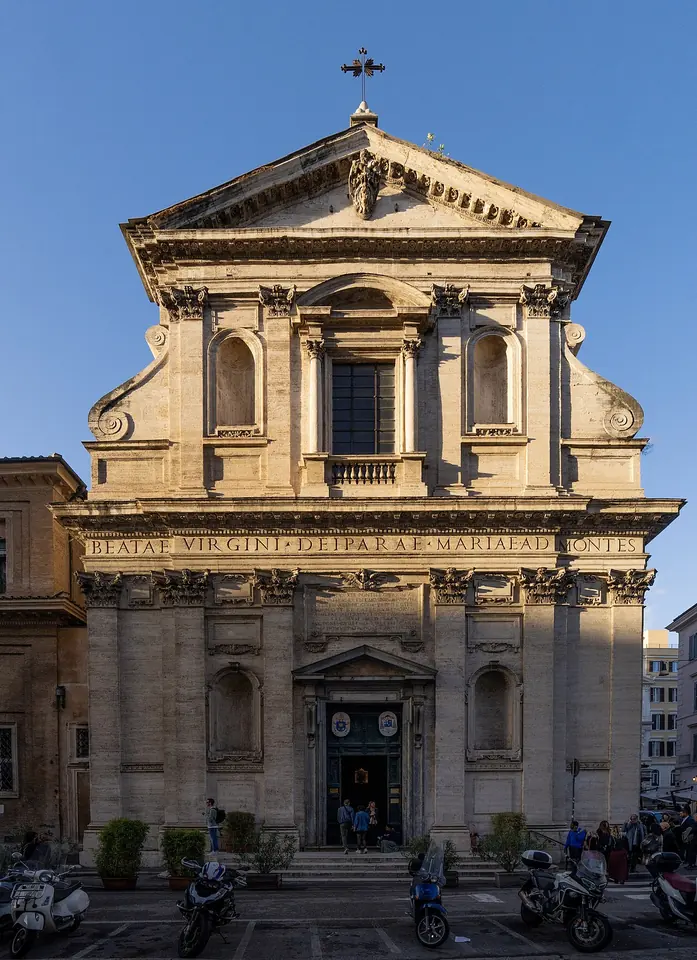
On Monday of Holy Week, April 14, 1783, he received Communion at the altar of St. Aloysius in the Church of St. Ignatius. On Wednesday, April 16, the warden of the hostel begged him not to go out. He went anyway, leaning on a stick, to Santa Maria dei Monti, heard Mass and stayed kneeling. Later that morning he collapsed on the church steps. A local butcher named Zaccarelli, who had always been kind to him, had him carried to his house nearby.
He received the anointing of the sick. That evening, as the people at his bedside prayed the Litany of Loreto and reached the words Sancta Maria, ora pro nobis, the bells of St. Mary Major rang eight o'clock and Benedict died. That night the cry went through Rome: "The saint is dead!" He was buried on Easter Sunday before the altar he had loved.
The miracles of St. Benedict Joseph Labre
The cures began at once. Father Marconi, his confessor and first biographer, recorded 136 miraculous cures certified by July 6, 1783, less than three months after his death. These are reported miracles: sworn accounts collected in good faith, not all of them later examined by the Church.
The miracles accepted in his cause are approved. Pope Pius IX beatified him in 1860, and Pope Leo XIII canonized him on December 8, 1881, after the Church had investigated miracles attributed to his intercession.
One conversion became famous. John Thayer, a Congregationalist minister from Boston, was in Rome when Labre died. The Catholic Encyclopedia says the evidence for some of the cures helped decide his conversion. Thayer became a Catholic and later a priest.
Why St. Benedict Joseph Labre is the patron saint of the homeless
He chose to own nothing and to sleep in the open, so the homeless, beggars and pilgrims see in him one of their own. Parishes and shelters named for him, from Queens in New York to Gozo in Malta, often serve the poor directly. The faithful also ask his prayers for people with mental illness, since many who met him thought his way of life was madness. When we pass someone sleeping in a doorway, we can ask St. Benedict Joseph to pray for that person, and for us, that we might see Christ there.
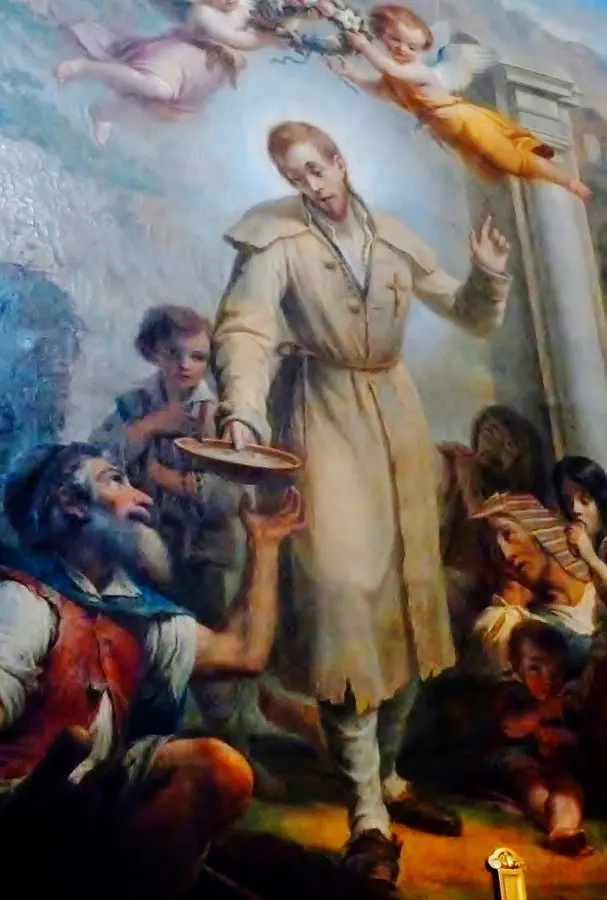
Symbols of St. Benedict Joseph Labre in art
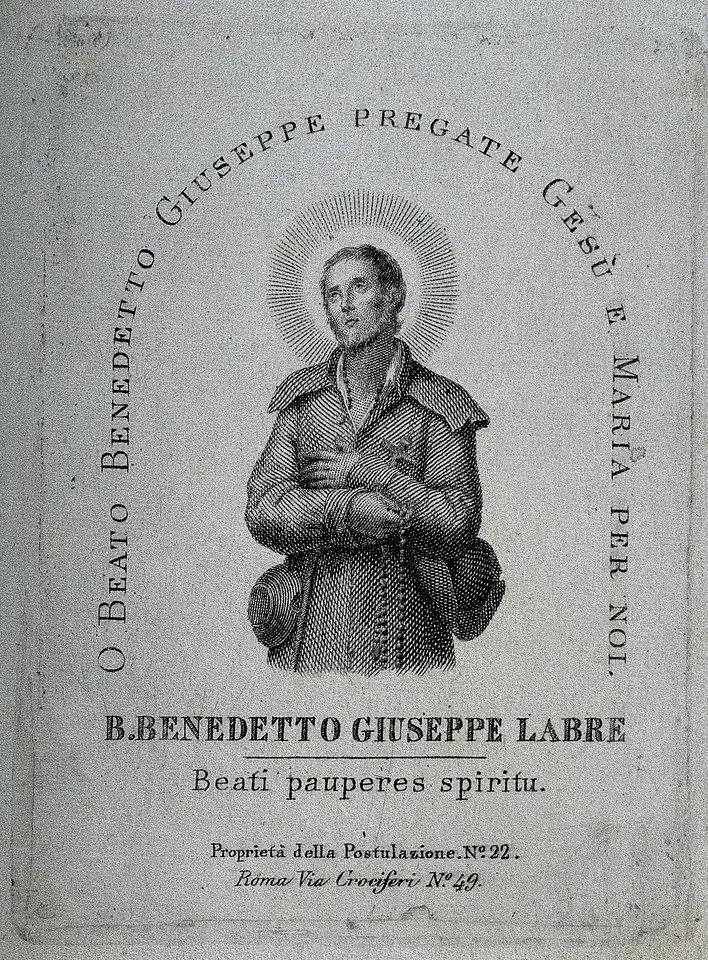
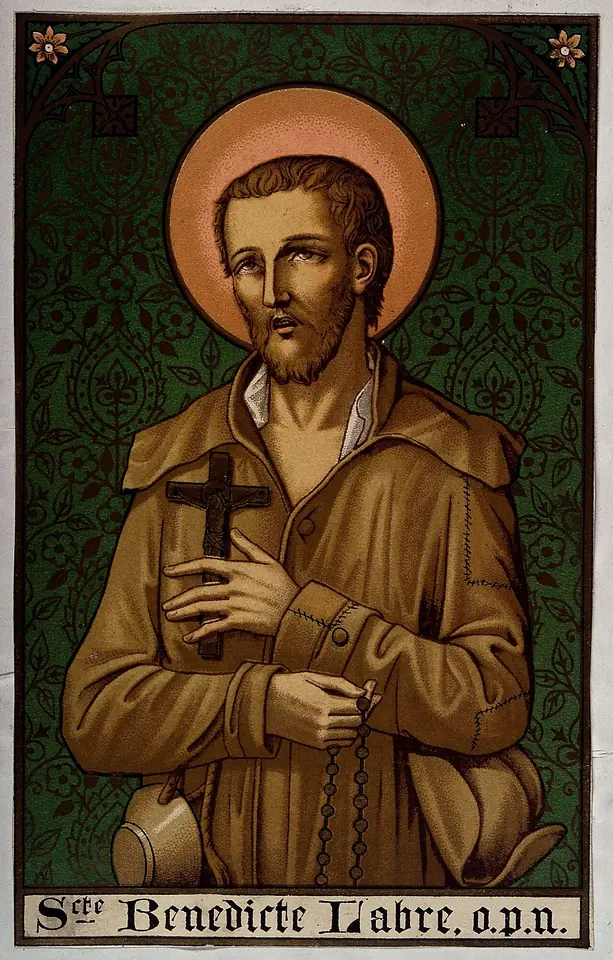
Labre died in 1783, so painters had eyewitnesses to follow, and his image is unusually consistent. Look for these signs:
- A ragged coat, often tied at the waist with a cord. It is the uniform of the poor, and painters show the patches and tears plainly.
- Rosaries around the neck, sometimes two or three. He prayed the rosary constantly, and the beads are the quickest way to recognize him.
- Arms folded over a crucifix. This was his habit on the road, and portraits from Cavallucci on keep the pose: eyes lowered, arms crossed on the breast.
- A small wooden bowl, the beggar's bowl, and sometimes a pilgrim's staff and wallet for his thousands of miles of walking.
- A thin bearded face, young, with reddish-brown hair, following Cavallucci's portrait, painted from eyewitness memory twelve years after his death.
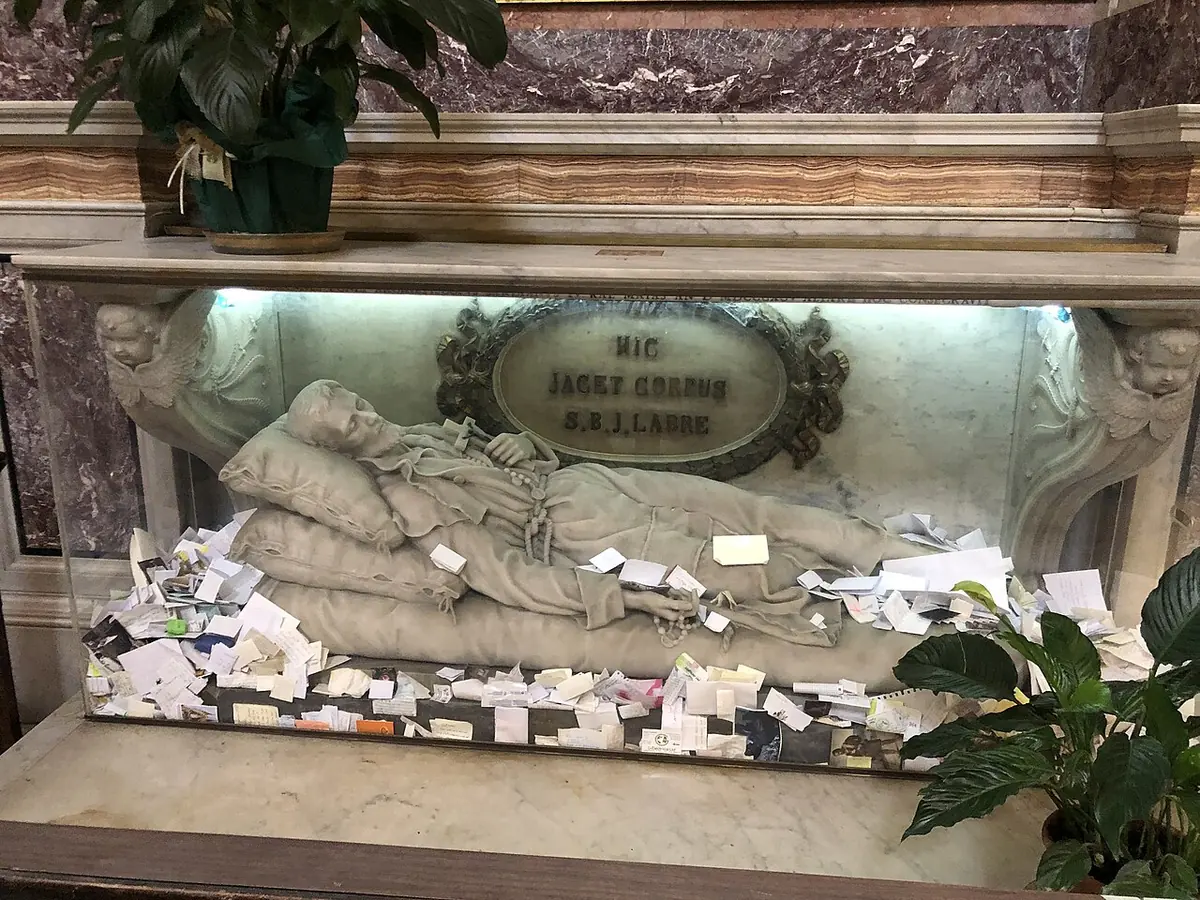
Nineteenth-century holy cards, like the colored lithograph below, add a halo and sometimes the battered hat he carried. In Rome his tomb effigy shows him lying in death, his rosary and crucifix in his hands.
Feast day and where St. Benedict Joseph Labre is honored
His feast is April 16. The Roman Martyrology for that day remembers him as one "renowned for his contempt of self and his great voluntary poverty." Because he is not on the General Roman Calendar, the feast is kept locally, especially at Santa Maria ai Monti in Rome, in the Diocese of Arras, and in churches and shelters that bear his name. You can find more saints for the season on our feast days calendar.
At his tomb, pilgrims still leave folded notes of petition around the marble figure, as people once pressed around him in the streets of Rome.
Prayer to St. Benedict Joseph Labre
We have found no prayer of his own that can be traced to a reliable source, and we won't put words in his mouth. Labre left no writings beyond a few letters to his family. The surest way to pray with him is to pray as he did: before the Blessed Sacrament, with the rosary, and with the Litany of Loreto, which the people at his deathbed were praying when he died.
Let us ask him simply: St. Benedict Joseph Labre, poor pilgrim of Christ, pray for the homeless, for all who have nowhere to sleep tonight, and for us, that we may learn that God alone is enough.
See also our page on the patron saints of the poor and of pilgrims.
Frequently asked questions
What is St. Benedict Joseph Labre the patron saint of?
The homeless, beggars and pilgrims, because he lived as all three. He is also asked to pray for people with mental illness, since many who met him took his strange, ragged life for madness. Shelters, soup kitchens and street ministries often carry his name.
When is the feast day of St. Benedict Joseph Labre?
April 16, the day he died in Rome in 1783. The Roman Martyrology lists him that day. He is not on the General Roman Calendar, so his feast is kept locally, above all at his tomb in Santa Maria ai Monti in Rome and in his home diocese of Arras in France.
Why didn't St. Benedict Joseph Labre become a monk?
He tried for years. The Trappists turned him down, the Carthusians took him for six weeks and sent him away, and the Cistercians of Sept-Fonts received him in 1769 until his health broke. On the road to Rome he came to believe God wanted him to be a pilgrim in the world instead, and his confessors agreed.
Where is St. Benedict Joseph Labre buried?
In the Church of Santa Maria ai Monti in Rome, near the Colosseum, where he collapsed on the morning of his death. A white marble effigy lies over his tomb, and visitors still leave handwritten prayers around it.
What miracles are attributed to St. Benedict Joseph Labre?
Many cures were reported right after his death; his confessor, Father Marconi, recorded 136 certified by July 6, 1783. Some were investigated for his beatification in 1860 and canonization in 1881. One famous fruit of those reports was the conversion of John Thayer, a Protestant minister from Boston who was in Rome when Labre died and later became a Catholic priest.
Sources
- Catholic Encyclopedia (1907): St. Benedict Joseph Labre. His failed attempts at monastic life, the 136 cures recorded by July 6, 1783, John Thayer, and the canonization of December 8, 1881
- Saints of 1881; or, Sketches of Lives of St. Clare of Montefalco, St. Laurence of Brindisi, St. Benedict Joseph Labre, St. John Baptist de Rossi (London, 1882). The "poor man of the Forty Hours," his nights in the Colosseum, his last days, death and Easter Sunday burial
- Pope Benedict XVI, Homily on his 85th birthday (April 16, 2012)
- The Roman Martyrology (English translation, 1916), April 16
- Enciclopedia Treccani: Benedetto Giuseppe Labre, santo. Beatified in 1860, canonized by Leo XIII in 1881