St. Theodore of Sykeon, Wonderworker of Galatia
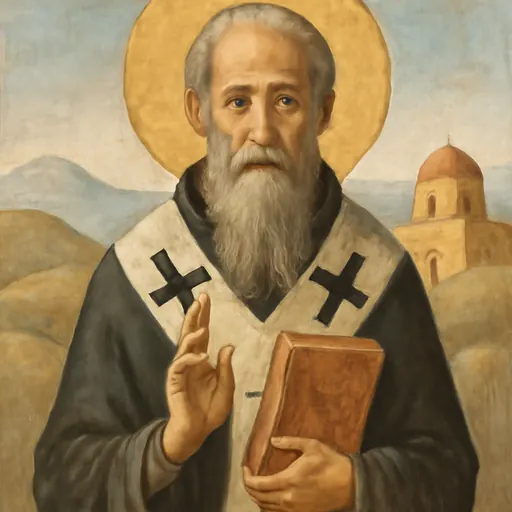
St. Theodore of Sykeon (Theodore the Sykeote) was a monk, wonderworker and bishop of Anastasiopolis in Galatia, in what is now central Turkey, in the late sixth and early seventh centuries. Raised in a roadside inn, guided from boyhood by St. George, he became famous for healings and for driving out demons, and his disciple George wrote his Life. His feast is April 22.
Who was St. Theodore of Sykeon?
St. Theodore of Sykeon, also called Theodore the Sykeote, was a monk, wonderworker and bishop in Galatia, in central Anatolia, in the decades around the year 600. He grew up in a roadside inn, spent his youth in caves and chapels praying to God, and became the holy man whole villages ran to when sickness, demons or locusts struck. The Church keeps his feast on April 22.
We know him unusually well. His disciple George wrote his Life soon after his death, gathering most of the stories of Theodore's youth "from the lips of the holy and saintly man himself." The historian Norman Baynes chose it for translation because it gives "the best picture known to us of life in Asia Minor in the Byzantine period before the Arab invasions."

The life of St. Theodore
Born at a roadside inn
Sykeon was a village on the imperial post road, twelve miles from the town of Anastasiopolis. George's Life is frank about the saint's beginnings: his mother Mary, his grandmother Elpidia and his aunt Despoinia kept the inn there, and they did not live chastely. His father was Cosmas, a performer of acrobatic feats on camels in the Hippodrome at Constantinople who became an imperial messenger in the reign of Justinian. Before the birth Mary dreamed of a brilliant star descending into her womb, and a holy man nearby told her the child would be "well-pleasing to God."
We can take heart from this. God called a saint out of a house that most people would have passed by on the road.
A boy guided by St. George
When Theodore was about six, his mother wanted to send him into the emperor's service and had a gold belt made for him. St. George appeared to her in a dream and told her not to, because the boy belonged to God. From then on George was Theodore's guide. The child slipped away at night to pray in the little chapel of St. George near the village. When his mother tied him to his bed to keep him home, George appeared to her again, and she and the other women of the inn gave up resisting. In time they too turned to God, and the Orthodox account says his grandmother, mother and sister all entered a convent.
At ten he fell gravely ill and was laid before the altar of a church of St. John the Baptist. The Orthodox account says two drops of water fell on him from the face of Christ painted in the dome, and he was healed.
Hermit, priest and monk
As a teenager he dug himself a cave under a boulder near St. George's chapel and had a deacon seal it, leaving a small hole for air. He stayed there two years, until the frightened deacon gave him away and he was brought out barely alive. The local bishop ordained him a priest at eighteen. He went on pilgrimage to Jerusalem and took the monastic habit at the monastery of Choziba near the Jordan.
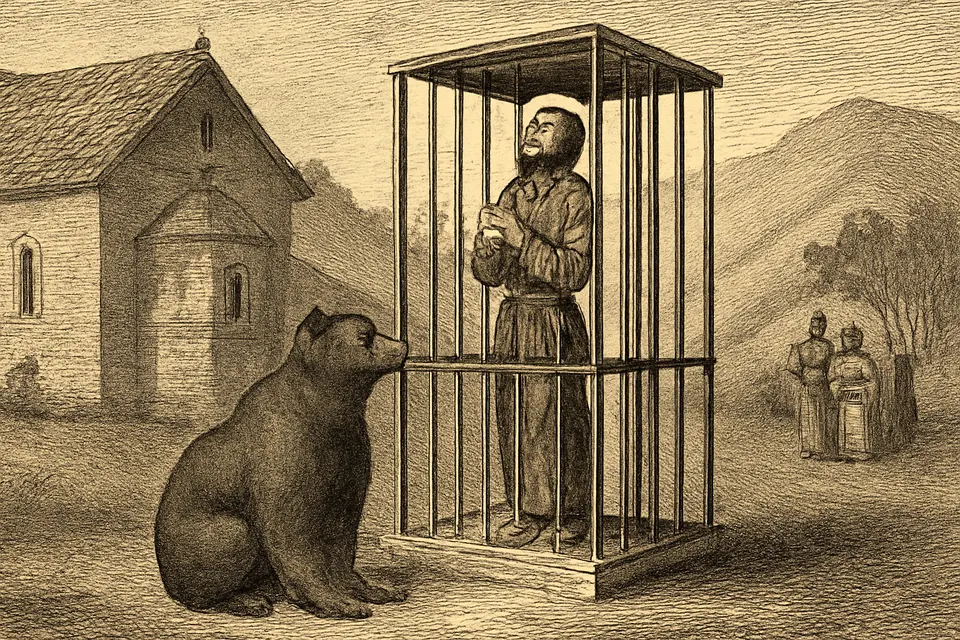
Back home, he had a blacksmith make him a narrow iron cage without a roof. He stood in it in chains from Easter to Christmas and spent the rest of the year in his cave. A community of monks grew up around him.
Bishop against his will
When the bishop of Anastasiopolis died, the people wanted Theodore. The Orthodox account says the metropolitan's messengers dragged him from his cell and carried him into the city. He served as bishop for years, but he longed for his monastery, and at last he resigned and went home. He died at Sykeon in the early seventh century; the Orthodox Church in America gives the year 610.
The miracles of St. Theodore
George's Life is crowded with wonders, and we label them traditional: they come from a disciple who knew him, but they were never formally examined.
- The bear and the wolf (traditional). A huge bear came to his cage for three years to take bread from his hand and went away without harming anyone. When a wolf waited at his cave, Theodore told his frightened servant, "Do not be afraid, you coward, where is your manhood?" and had him feed it.
- The locusts (traditional). When locusts threatened the crops of a nearby village, he prayed, and the Orthodox account says the locusts died while he celebrated the Liturgy.
- Demons driven out (traditional). Whole villages sent for him when they believed digging had loosed evil spirits. He led processions, prayed and set up a cross over the spot.
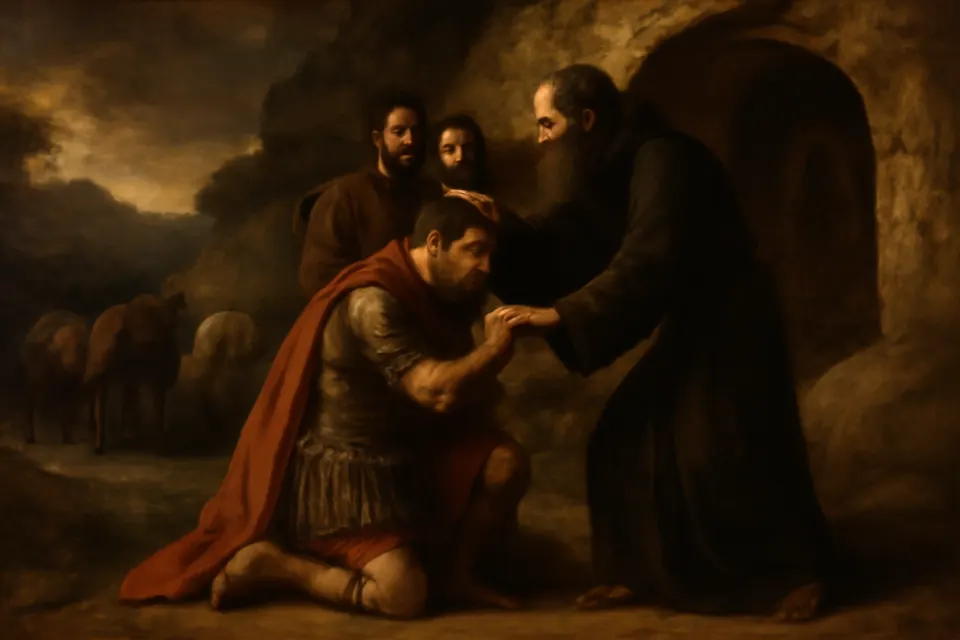
- The prophecy to Maurice (traditional). When the general Maurice passed by on his way back from the Persian war, Theodore took him aside and told him he would become emperor, adding, "only, when you reach those heights be sure to remember the needs of the poor." Maurice did become emperor in 582 and, the Orthodox account says, sent bread each year to Theodore's monastery for the crowds it fed.
Symbols of St. Theodore of Sykeon in art
- Bishop's omophorion and Gospel book: the bishop of Anastasiopolis.
- Gray beard and thin face: the long fasts of a monk.
- Scenes with St. George: the martyr who guided him from boyhood.
- The cage or cave: his years of seclusion.
The seventeenth-century Russian icon on this page is a "life icon": Theodore stands in the center, and small panels around him tell his story. The 1547 fresco earlier on this page shows him as a venerable old man with a long gray beard, his hand raised in blessing.

Feast day and relics
We keep his feast on April 22, and the Orthodox Church keeps the transfer of his relics on June 15. In his introduction to the Life, Norman Baynes notes that the Emperor Heraclius later moved Theodore's body to Constantinople, hoping it would protect the city from the Persian attack. Where it rests today is not known. See more saints of April on our feast days page.
Prayer to St. Theodore of Sykeon
The Orthodox Church sings this troparion on his feast (Tone 2, in the Orthodox Church in America's translation):
You were sanctified from your earliest childhood / and were shown to be filled with grace. / You illumined the world with miracles / and drove away a multitude of demons, O Holy Hierarch Theodore. / Therefore, entreat the Lord on our behalf.
And this kontakion (Tone 3):
As upon a fiery chariot, you ascended on the virtues to the heavenly mansions, O God-bearer Theodore. / You were an Angel living on earth with men; / and a man dancing with joy with the holy Angels. / Therefore, O Theodore, / you proved to be a divine vessel of miracles.
Let us ask St. Theodore to pray for children born in hard places, for farmers whose crops are threatened, and for all who are troubled by evil.
Frequently asked questions
Who was St. Theodore of Sykeon?
A holy man of Byzantine Asia Minor, born in the village of Sykeon in Galatia in the reign of Justinian. He became a hermit, a priest at eighteen, a monk, the founder of a monastery and, unwillingly, bishop of Anastasiopolis. Crowds came to him for healing, and he foretold that the general Maurice would become emperor.
When is the feast of St. Theodore of Sykeon?
April 22. The Orthodox Church also remembers the transfer of his relics on June 15.
Who wrote the Life of St. Theodore of Sykeon?
His disciple George, a monk of his monastery, who says he learned most of the stories of Theodore's youth from the saint himself and from people who knew him. Elizabeth Dawes translated it into English in Three Byzantine Saints (1948).
Where are the relics of St. Theodore of Sykeon?
Norman Baynes notes that the Emperor Heraclius later carried his body to Constantinople, hoping its presence would protect the capital from the Persians. Where it rests today is not known.
Keep exploring
Sources
- The Life of St. Theodore of Sykeon, from Three Byzantine Saints (trans. Elizabeth Dawes, 1948), Internet Medieval Sourcebook, Fordham University. The inn at Sykeon and his parents, George the disciple as author, the iron cage, the bear and the wolf, the prophecy to Maurice, the locust miracle and Heraclius's transfer of his body
- Saint Theodore the Sykeote, Bishop of Anastasiopolis, Orthodox Church in America. The Eastern account, including the drops of water from the image of Christ, the purple light over the Gifts, the clashing crosses, the year 610, and the June 15 translation feast
- Saint Theodore the Sykeote: Troparion and Kontakion, Orthodox Church in America. Texts of the troparion and kontakion quoted on this page