St. Fidelis of Sigmaringen

St. Fidelis of Sigmaringen (1577–1622) was a German lawyer, known as the poor man's advocate, who became a Capuchin friar and preached the Catholic faith in the Swiss Alps. He was killed near Seewis in the Grisons on April 24, 1622, the first martyr of the Church's new missionary congregation, Propaganda Fide. His feast day is April 24.
Who was St. Fidelis of Sigmaringen?
St. Fidelis of Sigmaringen was a Capuchin friar and priest who gave his life for the Catholic faith in the mountains of eastern Switzerland in 1622. He was born Mark Rey (the name is also spelled Roy) in 1577 in Sigmaringen, a small town on the upper Danube in Swabia. His father, Johannes Rey, was the town's burgomaster, and the family was of Flemish descent.
Before he was a friar he was a lawyer, and a good one. In his thirties he left the courts, was ordained a priest and entered the Capuchins, the poor and austere reform of the Franciscans. Ten years later he was dead, cut down on a mountain road in the Prättigau valley by men who demanded that he renounce his faith. The Church honors him as the first martyr of the Congregation for the Propagation of the Faith, the missionary office Pope Gregory XV had founded in Rome that same year.
We keep his feast on April 24, the day he died.
The life of St. Fidelis
Student, tutor and pilgrim
Mark Rey studied philosophy and law at the University of Freiburg im Breisgau. Butler's Lives of the Saints says that even as a student he drank no wine and wore a hair shirt, and that his friends knew him for his meekness and modesty.
In 1604 he became the tutor of young Wilhelm von Stotzingen and of other young Swabian noblemen, and he traveled with them for six years through France and Italy. According to Butler, he went to Communion often on the journey, and in every town they reached he visited the hospitals and churches, knelt for hours before the Blessed Sacrament and gave to the poor, sometimes the very clothes off his back. Wilhelm von Stotzingen later testified in the canonization process about the penances his tutor practiced on those journeys.
The poor man's lawyer
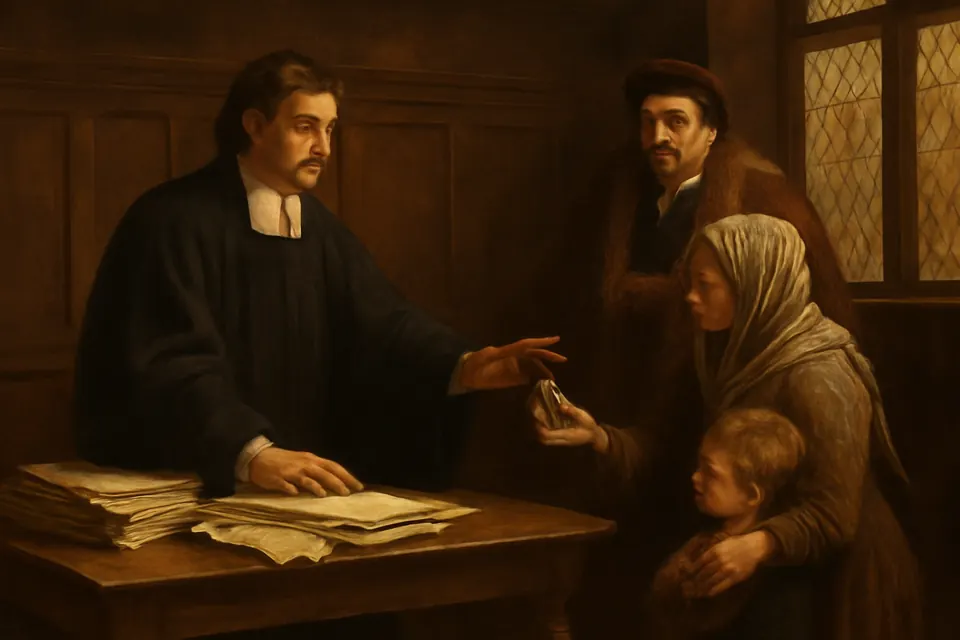
He returned to Freiburg in 1611, took his doctorate in civil and canon law and began to practice as an advocate at Colmar in Alsace. Butler records that he never used insults or attacked the reputation of an opponent, and that his charity earned him the nickname "counselor and advocate for the poor."
It didn't last. A colleague scolded him for laying out all of his evidence at the start of a case, which settled lawsuits quickly when lawyers could earn more by dragging them out. The Catholic Encyclopedia puts it plainly: "the open corruption which found place in the law courts" made him leave the profession.
Brother Fidelis, Capuchin
He was ordained a priest in 1612 and said his first Mass on October 4, the feast of St. Francis of Assisi, at the Capuchin friary in Freiburg. He then asked for the habit. His brother George was already a Capuchin.
The guardian of the friary gave him the name Fidelis, "faithful," thinking of the words of Christ in the Book of Revelation: "Be thou faithful until death: and I will give thee the crown of life." Before he entered he left his inheritance to the bishop's seminary for poor students, gave them his library and gave the rest of his goods to the poor.
As a novice he wrote out a book of spiritual exercises for himself, which survived and was printed in 1893 as S. Fidelis a Sigmaringen exercitia seraphicae devotionis. He studied theology at Constance and then served as guardian, or superior, of the friaries at Rheinfelden, Freiburg and Feldkirch. Butler says he fasted on bread, water and dried fruit through Advent and Lent, and that his preaching at Feldkirch brought many in the town back to the sacraments.
He told a fellow friar that since entering the order he had prayed every day for two graces: never to fall into mortal sin, and to die for the faith.
The mission to the Grisons
In the early 1600s most of the Grisons, the mountain league that is now the Swiss canton of Graubünden, had become Reformed. The Catholic Encyclopedia blames this partly on the ignorance and lack of zeal of the local clergy. The Bishop of Chur had asked the Capuchins for missionaries in 1614, and in 1621 Fidelis was sent, still guardian of Feldkirch, with a band of friars. Before he set out, the papal nuncio also charged him with reforming the Benedictine abbey of Pfäfers.
He went in complete poverty, carrying only his crucifix, his Bible, his breviary and the Rule of St. Francis. He reached Maienfeld in time for Advent and preached, sometimes in several villages a day, in Catholic churches, in the streets and occasionally in the Reformed meeting houses. At Zizers he talked with the magistrates late into the night, and Rudolf von Salis, the most powerful man in the town, became a Catholic. Many followed him.
Opponents began to say that his mission was political, that the friar was preparing the valley for the Austrian troops then occupying it. That charge would cost him his life. In early 1622 the new Congregation for the Propagation of the Faith made him superior of the whole mission, and on January 6 of that year he entered the Prättigau. He sensed what was coming. Butler says he began signing his letters "Brother Fidelis, who will be shortly the food of worms."

The martyrdom of St. Fidelis
On the morning of April 24, 1622, Fidelis made his confession, said Mass and preached at Grüsch. Butler reports that at the end of the sermon he stopped speaking and stood for some time with his eyes fixed on heaven. Then he set out for Seewis, a village higher up the valley. His companions noticed how cheerful he was.
At Seewis he went into the church and began to preach. A shot was fired at him inside the church, and an uprising against the Austrian garrison broke out the same day; several of the soldiers guarding the church doors were killed. The Catholics begged him to leave. A Reformed man offered to lead him to safety, and Fidelis thanked him but said his life was in God's hands.
The two old accounts place the end slightly differently. The Catholic Encyclopedia says he was surrounded just outside the church; Butler says he was met on the road back toward Grüsch by about twenty armed men with a preacher at their head. They promised to spare him if he would give up the Catholic faith. His answer, as Butler records it, was: "I am sent to you to confute, not to embrace your heresy. The Catholic religion is the faith of all ages, I fear not death."
A sword blow struck him to the ground. He rose to his knees, stretched out his arms in the form of a cross and prayed:
Pardon my enemies, O Lord: blinded by passion they know not what they do. Lord Jesus, have pity on me. Mary, mother of Jesus, assist me.
A second blow killed him. He was about forty-five years old and had been a Capuchin for ten years. Catholics buried him at Seewis the next day.

Miracles, beatification and canonization
- The beatification miracles: approved. Butler's Lives says that 305 miracles attributed to his relics and intercession were presented in his cause, and three of them were named in the decree of beatification issued by Pope Benedict XIII in 1729. Further miracles were proven for his canonization by Pope Benedict XIV in 1746. (The Catholic Encyclopedia gives the canonization year as 1745.) The old accounts do not describe the individual cures.
- His body found incorrupt: reported. Butler says that when the grave was opened six months after his death, the body was found incorrupt.
- The conversion of the preacher: reported. Butler writes that the Reformed minister who led the men who killed him later became a Catholic and made a public profession of faith.
- The ecstasy at Grüsch and his foreknowledge of his death: traditional, told in the early lives.
Benedict XIV canonized him in the same ceremony as St. Camillus de Lellis, St. Joseph of Leonessa, St. Peter Regalado and St. Catherine de' Ricci. His earliest biographer was Placidus, abbot of Weissenau, and a popular German life by the Capuchin Lucianus Montifontanus was reprinted for his beatification in 1729.

Why St. Fidelis is a patron of lawyers
Catholic patron lists name Fidelis as a patron of lawyers, beside the older patron, St. Ivo of Kermartin, and St. Thomas More. It is a popular patronage rather than a decreed one, and it comes straight from his life. He was an honest advocate who took the cases of the poor, refused to drag out lawsuits for fees, and finally left the law because he would not make his peace with corruption in the courts. A lawyer who wonders whether his work can be holy has a friend in him. You'll find the other patrons of the profession on our page on patron saints of lawyers.
The Capuchins also honor him as the protomartyr, the first martyr, of the Congregation for the Propagation of the Faith (today the Dicastery for Evangelization), which sent him to the Grisons.
Symbols of St. Fidelis of Sigmaringen in art
Fidelis is always a bearded Capuchin friar in a brown or dark hooded habit with a white cord. To tell him from other Capuchins, look for:
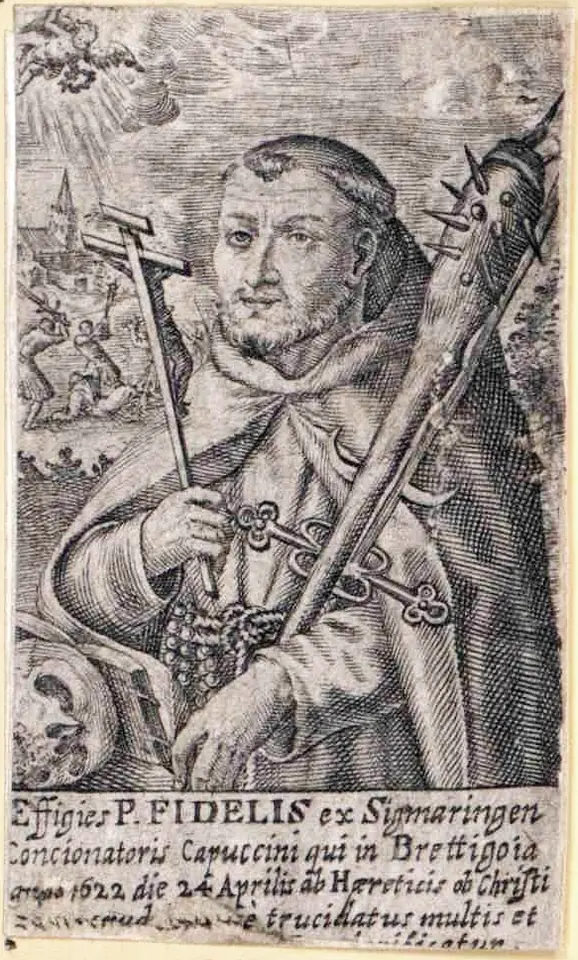
- A spiked club or "morning star": the weapon of his martyrdom and his most distinctive attribute. The Catholic Encyclopedia calls it his emblem.
- A sword: for the sword blows that killed him. German churches often show him holding a long sword upright, as in the wall painting at Pfärrenbach below.
- A wound in the head: a red gash on the forehead or crown.
- A palm branch: the sign of every martyr.
- A crucifix: the one he carried on his mission.
- A crown held by angels, often with the words of Revelation 2:10, Esto fidelis usque ad mortem, "Be faithful until death," a play on his name.
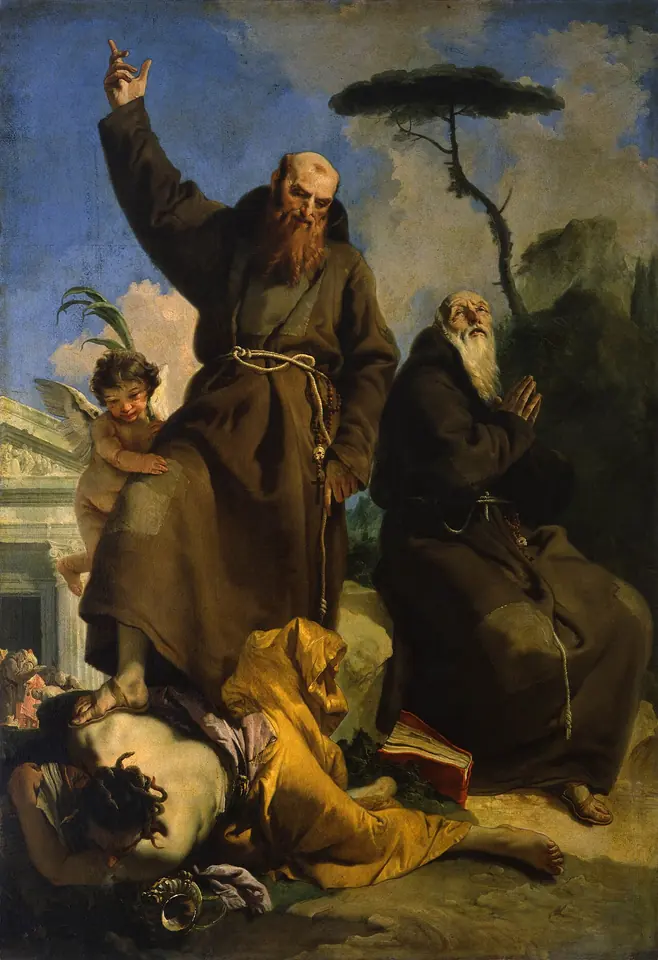
- A figure trampled underfoot: in Baroque altarpieces such as Tiepolo's, a fallen figure stands for the heresy he preached against.
Tiepolo often paired him with another Capuchin, St. Joseph of Leonessa, because the two were canonized on the same day.


Feast day, relics and shrines
His feast is April 24, an optional memorial in the General Roman Calendar. See the other saints of the season on our feast days page.
When his body was translated, the head and left arm were separated and taken, at the bishop's request, to the cathedral at Chur, where they were laid under the high altar. The rest of the body went to the church of the Capuchin friary at Feldkirch in Vorarlberg, the community he had led. The Capuchins are still there.

Across the Atlantic, German Capuchins carried his name to the American Midwest, where the great limestone church of St. Fidelis in Victoria, Kansas, is known as the Cathedral of the Plains.

Prayer to St. Fidelis of Sigmaringen
The traditional prayer for his feast is the collect of the Mass of April 24 in the Roman Missal of 1962. In Latin it reads:
Deus, qui beátum Fidélem, seráphico spíritus ardóre succénsum, in veræ fídei propagatióne martýrii palma et gloriósis miráculis decoráre dignátus es: ejus, quǽsumus, méritis et intercessióne, ita nos per grátiam tuam in fide et caritáte confírma; ut in servítio tuo fidéles usque ad mortem inveníri mereámur. Per Dóminum nostrum.
The English translation in the Divinum Officium edition of the old Missal reads:
God, Who didst vouchsafe to enkindle in blessed Fidelis the fire of thy Seraphim, and to glorify his toil to give men a true knowledge of thee by the palm-branch of martyrdom and by great signs and wonders, be entreated, we beseech thee, for his sake and by his prayers, and so establish us in the knowledge and love of thee, that we also, like him, may be found faithful even unto death in serving of thee. Through our Lord.
Let us ask St. Fidelis to pray for us when honesty costs us something at work, for lawyers and judges who serve the poor, and for missionaries who carry the Gospel where it is not welcome. St. Fidelis of Sigmaringen, pray for us.
Frequently asked questions
When is the feast day of St. Fidelis of Sigmaringen?
April 24, the day he died in 1622. It is an optional memorial in the General Roman Calendar, and the Capuchin Franciscans keep it as a feast.
What is St. Fidelis of Sigmaringen the patron saint of?
He is popularly invoked as a patron of lawyers, because before he became a friar he practiced law in Alsace and was known as the counselor and advocate of the poor. The Capuchins also honor him as the first martyr of the Congregation for the Propagation of the Faith.
Why did he take the name Fidelis?
Fidelis is Latin for "faithful." His superior gave him the name when he received the Capuchin habit, thinking of the promise in Revelation 2:10, "Be thou faithful until death: and I will give thee the crown of life."
How did St. Fidelis die?
On April 24, 1622, after preaching at Seewis in the Prättigau valley, he was surrounded by armed men who demanded that he give up the Catholic faith. When he refused, they struck him down with swords and clubs. Butler's Lives of the Saints says his last words were a prayer for his killers.
Where are the relics of St. Fidelis?
His body rests in the Capuchin church in Feldkirch, Austria, where he had been superior of the friary. His head and left arm were taken to the cathedral of Chur in Switzerland.
Keep exploring
- Patron saint pages
- Lawyers
- Feast-day calendar
- Saints remembered in AprilSaint of the day
- More
- Saints A to ZPatron saints A to ZExplore every section
Sources
- Catholic Encyclopedia (1909): St. Fidelis of Sigmaringen
- Butler's Lives of the Saints: St. Fidelis of Sigmaringen, Martyr (EWTN). Source of his last words, the beatification miracles and the details of his burial
- Divinum Officium: Roman Missal (1962), Mass of St. Fidelis, April 24 (Latin collect)
- Divinum Officium: Roman Missal, Mass of St. Fidelis, April 24 (English collect)
- Roman Martyrology, April 24