Pope St. Agapetus I, the Pope Who Faced Down Justinian

Pope St. Agapetus I reigned for less than a year, 535 to 536. Sent to Constantinople by the Gothic king, he refused to be cowed by Emperor Justinian, deposed the patriarch Anthimus as unsound in faith, and consecrated his successor Mennas himself. He died there on April 22, 536, the day we keep his feast.
Who was Pope St. Agapetus I?
Pope St. Agapetus I was the bishop of Rome from 535 to 536, an old Roman priest whose short reign ended with one of the boldest acts of any pope in the East. He went to Constantinople on a diplomatic errand that failed, and while he was there he stood up to the Emperor Justinian, removed a patriarch the empress had installed, and consecrated the new one with his own hands. He died in the imperial city on April 22, 536. We keep his feast on April 22.
He was a Roman, the son of Gordianus, a priest who had been killed in the riots of the time of Pope Symmachus. His name is also spelled Agapitus.

A short, busy reign in Rome
Agapetus began by healing an old wound. His predecessor Boniface II had pronounced an anathema against his rival Dioscurus and stored it in the Roman archives. Agapetus brought out the document and burned it in front of the assembled clergy.
He confirmed the decrees of a council at Carthage held after the Vandals were driven out of Africa, which barred former Arian clergy from holy orders. He also accepted an appeal from Contumeliosus, bishop of Riez, whom a council at Marseilles had condemned, and ordered St. Caesarius of Arles to give the accused bishop a new trial before papal delegates.
The journey to Constantinople
Meanwhile Justinian's general Belisarius had taken Sicily and was preparing to invade Italy. The Gothic king Theodahad, desperate, begged the aged pope to go to Constantinople and persuade the emperor to call off the war. To pay for the journey, the Catholic Encyclopedia says, Agapetus had to pledge the sacred vessels of the Roman Church. He set out in the middle of winter with five bishops.
A healing on the road
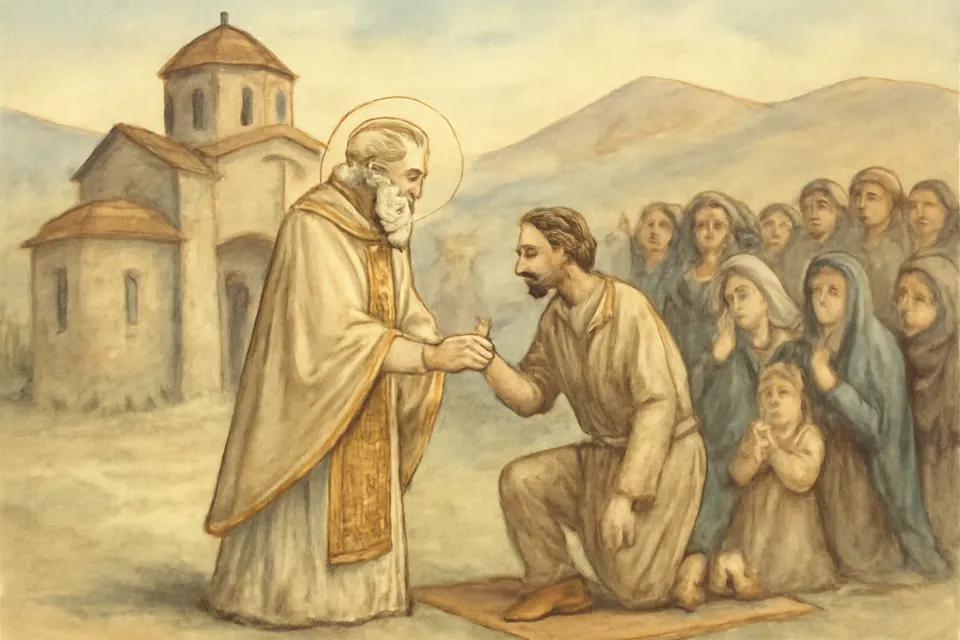
- Traditional: St. Gregory the Great, pope himself fifty years later, tells in his Dialogues that as Agapetus traveled through Greece a man who was lame and mute was brought to him. The pope asked the man's weeping relatives whether they believed he could cure him, and they answered that they hoped he could, "in the virtue of God by the authority of St. Peter." Agapetus celebrated Mass, then came from the altar, "took the lame man by the hand, and straightways, in the presence and sight of all the people, he restored him to the use of his legs." When the pope gave him Holy Communion, the man's tongue was loosed.
Gregory wrote about fifty years after the event, and the miracle was never formally examined, so we hold it as tradition. The Roman Martyrology remembers Agapetus as a pope "whose sanctity is attested by blessed Gregory the Great."
"In his place I find a Diocletian"
Agapetus reached Constantinople in February 536 and was received with great honor. As he had probably foreseen, Justinian would not give up the war. But the visit brought a victory for the faith.
The patriarch of Constantinople was then Anthimus, who had left his own see of Trebizond against the canons. He was close to the Empress Theodora and to those who were quietly working against the Council of Chalcedon and its teaching that Christ is one person in two natures. The orthodox clergy of the city brought charges against him. Agapetus told Anthimus to make a written profession of faith and go back to his own diocese. When he refused, the pope would not be in communion with him.
Justinian, misled by his wife about Anthimus, threatened the pope with exile. According to the Catholic Encyclopedia, Agapetus answered: "With eager longing have I come to gaze upon the Most Christian Emperor Justinian. In his place I find a Diocletian, whose threats, however, terrify me not."
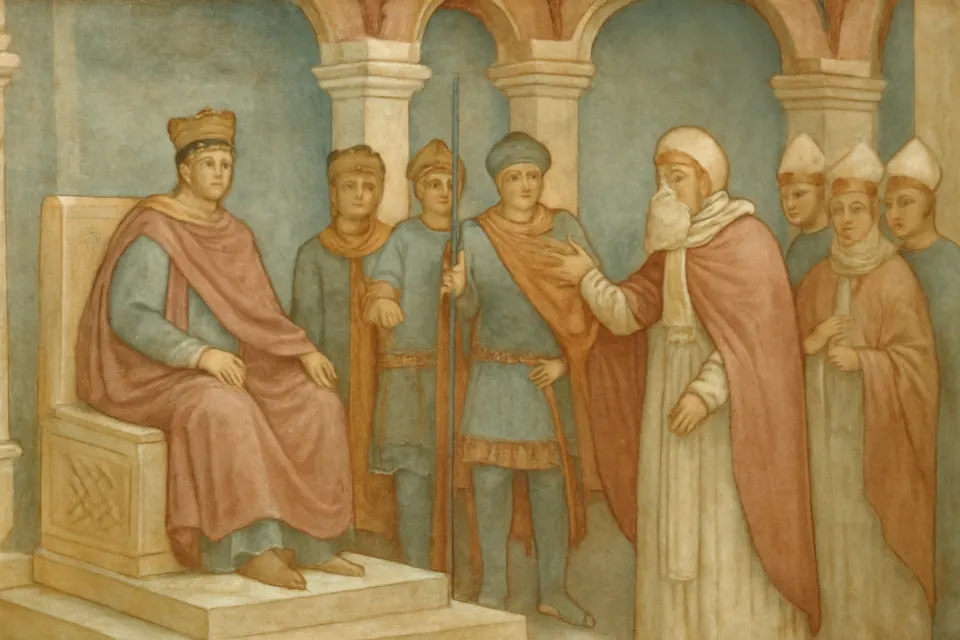
The emperor paused and was convinced that Anthimus was not sound in faith. Agapetus deposed him and, for the first time in the history of the Church, personally consecrated the lawfully elected successor, Mennas. Justinian handed the pope his own written confession of faith.
His death and burial
Soon afterward Agapetus fell ill. He died in Constantinople on April 22, 536, after about ten months as pope. His body was brought to Rome in a lead coffin and buried in St. Peter's on September 20. The Catholic Encyclopedia notes that the people of the East, who had watched him act, honored him as a saint along with the Latins.
Symbols of St. Agapetus I in art
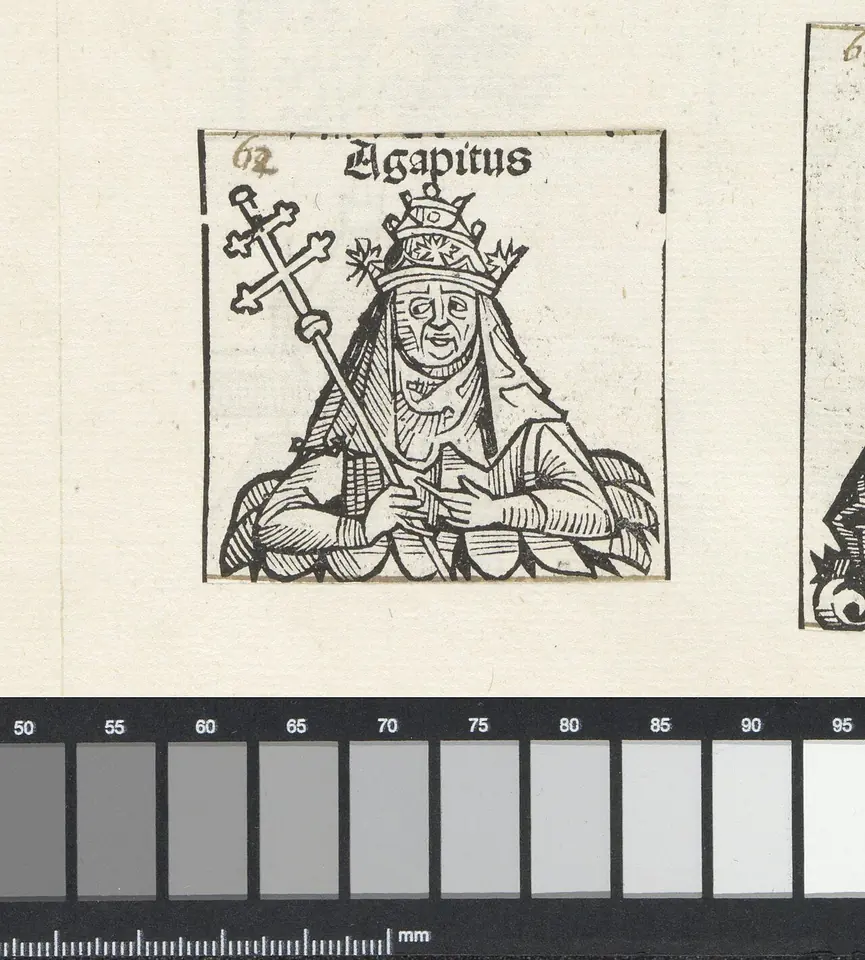
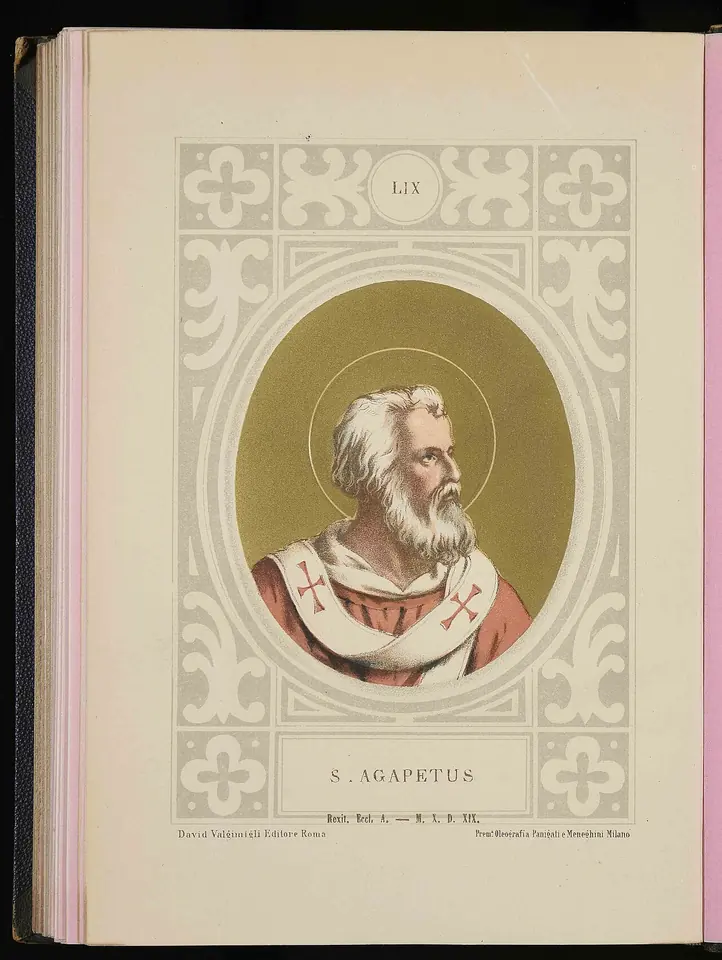
Agapetus appears mostly in the long series of papal portraits. The Nuremberg Chronicle of 1493 gives him a tiara and a staff with a double-barred cross, the conventional signs of a pope. Cavalieri's 1580 engraving shows him in profile in a richly embroidered cope, and the 1879 Milan print gives him a halo and pallium. To pick him out in a series of popes, look for the inscription, spelled either Agapetus or Agapitus.
Feast day and prayer
We keep the memory of Pope St. Agapetus I on April 22, the day of his death. There is no traditional prayer to him in common use. Let us ask St. Agapetus, who spoke the truth to an emperor without fear, to pray for the pope and for all who must defend the faith before the powerful. Pope St. Agapetus, pray for us.
Frequently asked questions
Who was Pope St. Agapetus I?
A Roman, son of a priest named Gordianus, who was pope from 535 until his death in Constantinople on April 22, 536. He is honored in both East and West for defending the Council of Chalcedon against Monophysite intrigue at the imperial court.
What did Pope Agapetus say to Justinian?
When Justinian threatened him with exile, Agapetus answered, according to the Catholic Encyclopedia, "With eager longing have I come to gaze upon the Most Christian Emperor Justinian. In his place I find a Diocletian, whose threats, however, terrify me not."
What miracle is Pope Agapetus known for?
St. Gregory the Great tells in his Dialogues that on the way to Constantinople, in Greece, Agapetus celebrated Mass for a man who was lame and mute, then took him by the hand so that he walked, and gave him Holy Communion so that he spoke.
When is the feast of St. Agapetus I?
April 22, the day of his death. Older Roman calendars kept September 20, the day of his burial in St. Peter's, and the Orthodox Church keeps April 17.
Keep exploring
Sources
- Catholic Encyclopedia (1907): Pope St. Agapetus I. His father Gordianus, the burning of the anathema against Dioscurus, the case of Contumeliosus, the journey to Constantinople, his words to Justinian, the deposition of Anthimus, the consecration of Mennas, his burial and his feast days
- St. Gregory the Great, Dialogues, Book III, chapter 3 (1911 translation). The healing of the lame and mute man in Greece
- The Roman Martyrology (1916 English edition), September 20. Pope St. Agapitus, whose sanctity is attested by blessed Gregory the Great
- Orthodox Church in America: Saint Agapitus, Pope of Rome. His feast in the Orthodox calendar on April 17