St. Lidwina of Schiedam
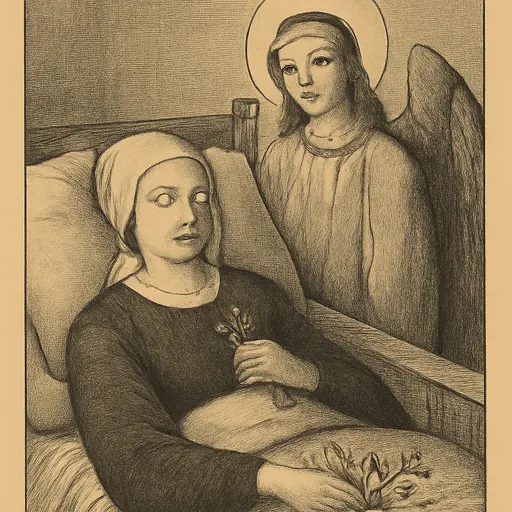
St. Lidwina of Schiedam (1380 to 1433) was a Dutch girl who fell while ice skating at fifteen, broke a rib, and never recovered. For 38 years she lay sick in her family's house, offering her pain for others, praying, counseling visitors and receiving visions. She is the patron saint of ice skaters and of the sick and chronically ill, and her feast day is April 14.
Who was St. Lidwina?
St. Lidwina of Schiedam was a Dutch laywoman of the early 1400s who spent 38 years in illness after a fall on the ice, 33 of them without leaving her bed, and who turned that long suffering into prayer for others. She was born in Schiedam, a small town near Rotterdam in the County of Holland, on April 18, 1380, the only daughter of a poor family. The Catholic Encyclopedia says her father, Peter, came of a noble line, while her mother, Petronella, was a country girl from nearby Kethel. She died there on April 14, 1433. The Dutch call her Liedewij or Liduina; older English books spell her name Lydwine.
She never entered a convent and never left her parents' house once she took to her bed. Yet people came from all over the Low Countries to see her: the poor for alms, the troubled for advice, priests and religious for her prayers. Thomas à Kempis, the author of The Imitation of Christ, edited her life within a generation of her death. We ask her prayers today for the sick, especially those whose illness has no end in sight, and for ice skaters, because her suffering began on a frozen canal.
The life of St. Lidwina
Our knowledge of her comes from close to the source. Her confessor of nearly eight years, John Walters of Leiden, and a relative, John Gerlac, supplied most of what the Franciscan preacher Johannes Brugman put into her life soon after she died. Thomas à Kempis then reworked Brugman's text for the Canons Regular of Brielle. Their accounts are devout and detailed, and they were written by men who knew her or knew those who did.
A girl of Schiedam
Lidwina grew up poor in a devout household. The Catholic Encyclopedia notes that as a child she prayed often before the image of Our Lady of Schiedam, a statue honored in the town's parish church. Kempis says she was so lovely and quick-witted that by the age of twelve she was sought in marriage by many, and that her father urged her to accept. She refused, resolved to belong to God alone.
The fall on the ice
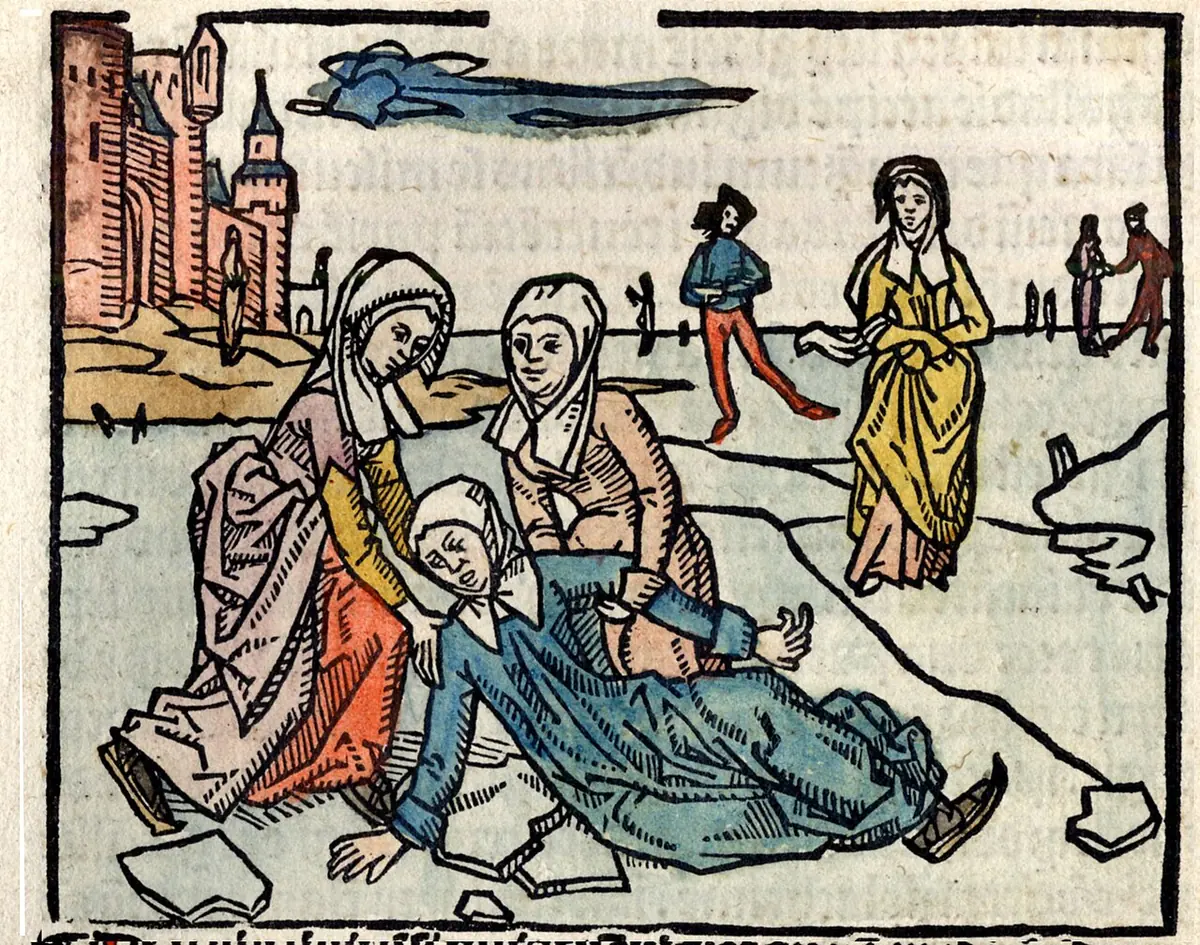
In the winter of her fifteenth year, around the feast of Candlemas, her friends invited her skating. Thomas à Kempis tells it plainly. She was asked "to go with them upon the ice shod with skates," when a companion racing over the ice and "unable to stop herself, caught Lydia by the hand; and before long she suddenly fell upon some fragments of ice, and, seriously hurt, broke a small rib in her right side."
The old life counts this as early 1395; the Schiedam tourist office gives 1396 or 1397, and Dom Vincent Scully's chronology says 1394. Whatever the year, the result is not in doubt. An abscess formed at the break, physicians could do nothing, and from about 1400 she never left her bed again.

Learning to suffer with Christ
The first years were bitter. Kempis admits that she wept and fretted and could not accept her illness. Her confessor, John Pot, taught her to meditate on the Passion of Christ, a little at a time. Slowly, the old life says, she came to see her pain as a share in the Cross and to offer it for sinners and for the souls in purgatory. From then on her biographers describe a woman at peace in agony.
Her body kept failing. Her lives describe open wounds, recurring fevers, the loss of sight in her right eye and finally paralysis of all but her head and one arm. From about 1413, they say, she took almost no food at all except Holy Communion. In 1421 the magistrates of Schiedam, after an inquiry of their own, issued a sealed certificate describing her condition and her fast, and Scully printed it in full in his 1912 translation. It is one of the most unusual civic documents in the history of the saints.
Mother to the poor
Lying in one room, Lidwina became a center of charity. Money and food sent to her were passed on to poor families, and Kempis gives whole chapters to her alms: meat, peas, bread and coins given to the poor. Visitors came for counsel, and she gave it with a directness that sometimes stung. She also suffered outrage. In October 1425, when Philip, Duke of Burgundy, came to Schiedam with his army, a band of his retainers forced their way into her room, threw off her coverings and mocked her, while her young niece Petronilla tried to shield her.

The roses of Paradise
Scully's notes preserve a story from John Gerlac's early German life. Years before she died, Lidwina told her friends that her angel had shown her a rose tree in Paradise covered with buds, and that when every rose had opened her exile would be over. Friends would ask how her rose tree was coming along. In the spring of 1433 she answered with joy: "Behold, all the roses are opened; it will not now be long before I die."
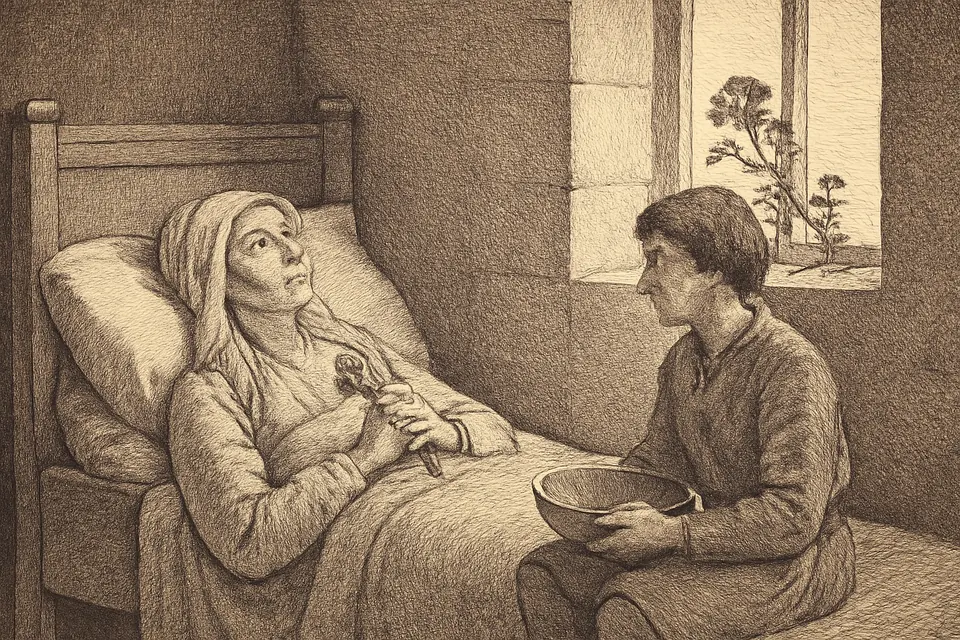
She died on the Tuesday of Easter week, April 14, 1433, alone except for a boy named Baldwin who looked after her, as she had asked God to let her die "forsaken of men" with Him as her only witness. A chapel was built over her grave in 1434, and her house was turned into a hospice for the aged poor, as she had wished.
The miracles of St. Lidwina
Lidwina was never put through the modern canonization process; her cult was confirmed on the strength of its antiquity. Her miracles are sorted by this encyclopedia's labels:
- The unconsecrated host: reported. The Catholic Encyclopedia tells how her parish priest, Andries, doubting her, brought her an unconsecrated host, and she recognized at once that it was not the Sacrament.
- Healings and favors at her bedside: reported. Her early biographers record many, and her grave was a place of pilgrimage within a year of her death.
- Visions and ecstasies: reported. From about 1405 her lives describe ecstasies in which her guardian angel led her to the Holy Land, to Rome, to purgatory and to Paradise. A Eucharistic vision she had in 1412 is one of the scenes Dunselman later painted for Schiedam.
- Food and money multiplied for the poor: traditional. Kempis tells of a ham given away and replaced, and of meat, peas and coins that multiplied as she gave them out.
- The rose tree and the foretelling of her death: traditional, preserved in Gerlac's German life.
- Her long fast on the Eucharist alone: reported, and attested by the town magistrates in 1421.
Why St. Lidwina is the patron saint of ice skaters and the sick
Lidwina is the patron of ice skaters for a simple reason: her lifelong illness began with a fall on the ice. In the Netherlands, where skating on frozen canals is a national pastime, she is the skaters' own saint.
She is also a patron of the sick and above all of the chronically ill. She wasn't healed. She lived 38 years with pain that got worse rather than better, and she found holiness there. Those who live with long illness, disability or pain that won't go away can see their own lives in hers. In 1979 the neurologist R. Medaer suggested in Acta Neurologica Scandinavica that her symptoms fit multiple sclerosis, and she is sometimes called a patron of people with MS; that diagnosis is a modern theory, not a certainty. She is also the patron of her town, Schiedam. Our patron saints page lists other saints for the sick.
Symbols of St. Lidwina in art
Artists usually show Lidwina in one of two ways: lying in her sickbed, or standing, young and crowned with flowers, receiving a branch from her guardian angel. Look for:
- A rose branch or flowering branch held out by an angel: the rose tree of Paradise that foretold her death. Some images show her holding a bouquet of roses.
- A fall on the ice, with skates: the accident that began her illness, often the first scene in a cycle of her life.
- A sickbed, crutch or rough wooden room: her 33 years of confinement.
- A crucifix: her meditation on the Passion.
- A crown of flowers: her virginity, in late 16th-century prints.
The 1498 woodcut near the top of this page comes from the edition of Brugman's life printed in Schiedam itself in 1498. Hieronymus Wierix's engraving, below, gives her the crucifix and the crown of flowers, with the angel handing her the branch "from Paradise," as its Latin caption says. Ludwig Seitz's drawing of 1890, made the year of her papal confirmation, puts the angel at her bedside with the roses.


St. Lidwina's feast day and shrine in Schiedam
We keep her feast on April 14, the day of her death and her date in the Roman Martyrology. She is not on the General Roman Calendar, but Pope Leo XIII approved an Office and Mass in her honor for the Diocese of Haarlem in 1890, and she is honored throughout the Netherlands. Schiedam holds its own yearly Lidwina celebration on a Sunday in the Easter season, with a procession carrying her relic through the town. See her neighbors on the calendar on our feast days page.
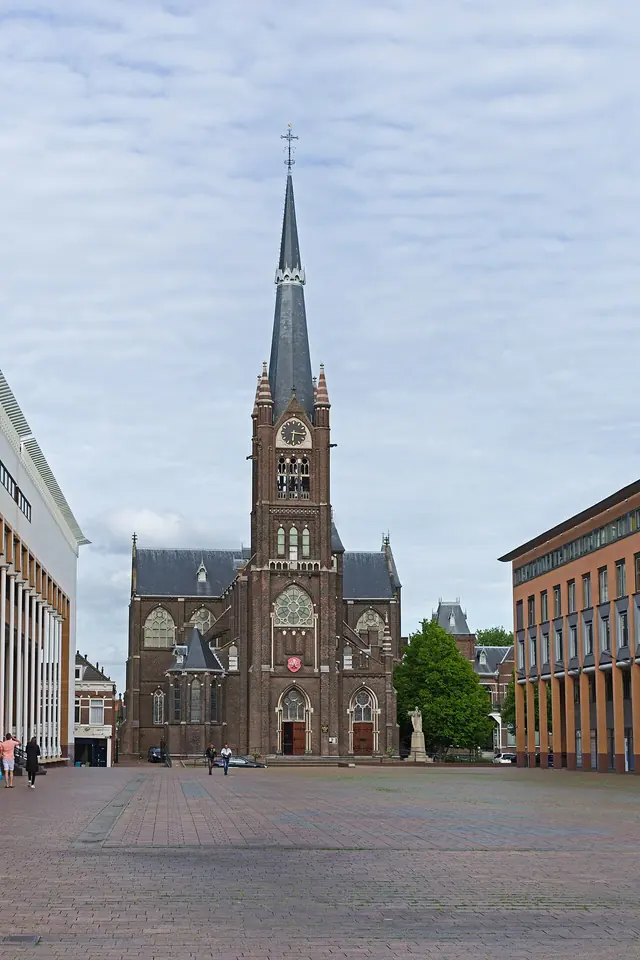
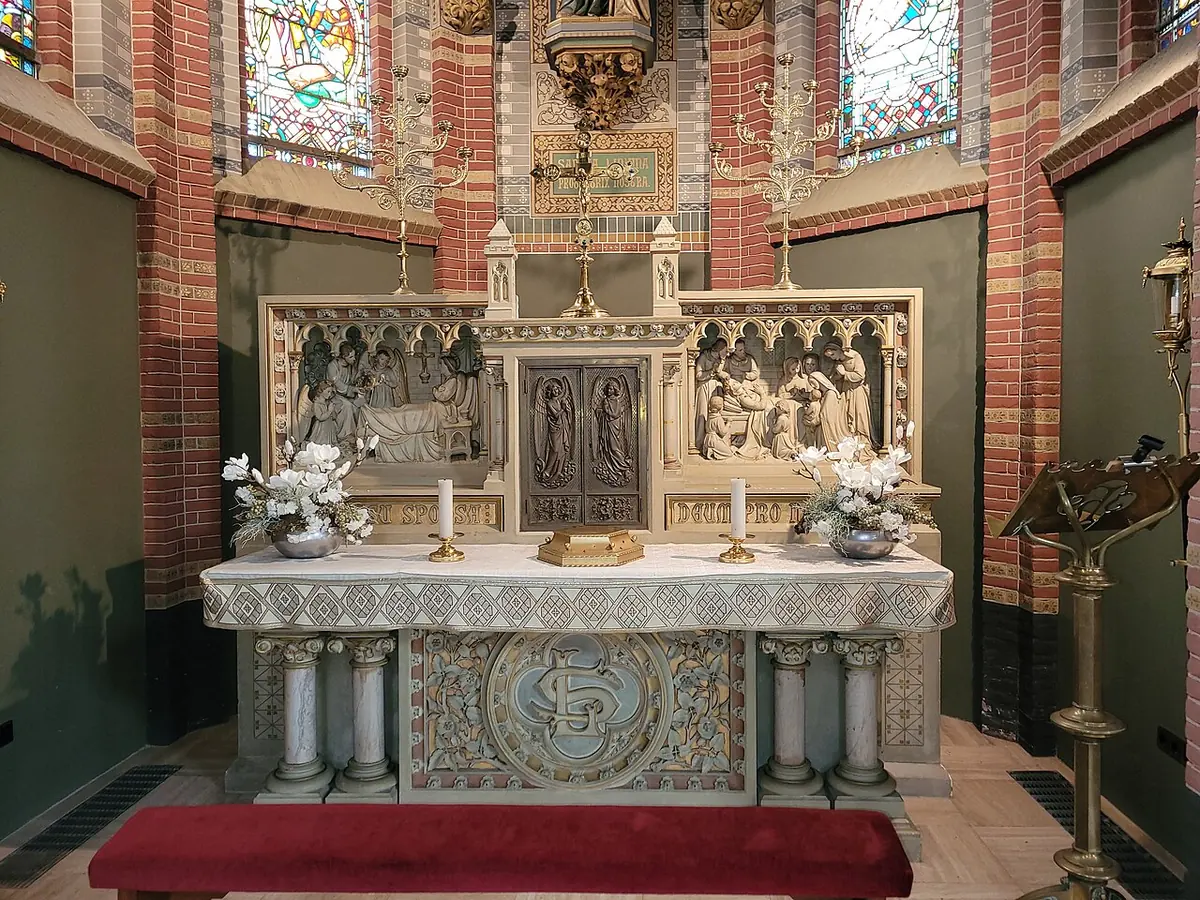
Her story after death is a story of exile and return. After the Reformation, Catholic worship was forbidden in Schiedam's parish church of St. John the Baptist, where she was buried. In 1615 her bones were secretly dug up and carried to Brussels, where the Carmelite nuns and the collegiate church of St. Gudula kept them. They came home to Schiedam in the 19th century (1871, according to the Catholic Encyclopedia). Today they rest in a gilded neo-Gothic shrine in the Basilica of St. Liduina and Our Lady of the Rosary, a red-brick church built from 1878 to 1881. The church keeps a Lidwina chapel, the eight panels of her life by Jan Dunselman, and a silver statue of the saint made in 1950.
Prayer to St. Lidwina
No single traditional prayer to St. Lidwina is in wide use in English, and we won't put words in her mouth. When Leo XIII confirmed her cult in 1890, the Church approved a proper Office and Mass for her in the Netherlands, and Dutch parishes have long kept their own devotional booklets. A priest visiting Schiedam in 1906 found a weekly Thursday-evening service in her honor there.
We can ask her intercession simply: St. Lidwina, pray for us. Let us bring to her the people we know who live with long illness, chronic pain or a body that will not heal, and ask her to obtain for them the patience and peace she found at the foot of the Cross. Skaters can ask her protection on the ice, and all of us can ask her to teach us, as she learned, to unite our sufferings with Christ's.
Frequently asked questions
Why is St. Lidwina the patron saint of ice skaters?
Because her long illness began with a skating accident. In the winter of her fifteenth year, around Candlemas, friends took her skating on the frozen canals of Schiedam. A skater who couldn't stop grabbed her hand, and Lidwina fell onto broken ice and cracked a rib on her right side. The injury never healed, and she spent the rest of her life in bed.
When is St. Lidwina's feast day?
April 14, the day she died in 1433, which fell on the Tuesday of Easter week that year. It is her date in the Roman Martyrology. In her hometown of Schiedam the people also hold a yearly Lidwina celebration on a Sunday in the Easter season.
Is St. Lidwina an official saint?
Yes. People venerated her from the day of her death, and a chapel was built over her grave in 1434. On March 14, 1890, Pope Leo XIII confirmed that centuries-old cult by decree, and an Office and Mass in her honor were approved for the Diocese of Haarlem. This kind of confirmation, called equipollent canonization, is used for saints whose cult predates the modern process.
What illness did St. Lidwina have?
Her biographers describe an abscess at the broken rib, then spreading wounds, fevers, paralysis and blindness in one eye. No one can diagnose her from a distance of six centuries. In 1979 the neurologist R. Medaer argued in Acta Neurologica Scandinavica that she may be the earliest well-documented case of multiple sclerosis, a theory still discussed but not proven.
Where are St. Lidwina's relics?
In the Basilica of St. Liduina and Our Lady of the Rosary in Schiedam, the Netherlands. Her bones were taken to Brussels in 1615, during the years when Catholic worship was suppressed in Holland, and were brought back to Schiedam in the 19th century.
Sources
- Catholic Encyclopedia (1910): St. Lidwina
- Thomas à Kempis, St. Lydwine of Schiedam, Virgin, translated by Dom Vincent Scully (London: Burns & Oates, 1912)
- Medaer R. Does the history of multiple sclerosis go back as far as the 14th century? Acta Neurologica Scandinavica, 1979
- Schiedam tourist office (sdam.nl): Lidwina
- Meertens Institute, Pilgrimage in the Netherlands database: St. Liduina, Schiedam (image gallery)