St. César de Bus
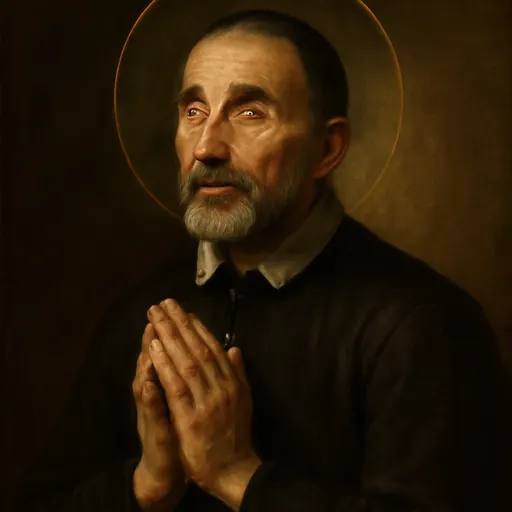
St. César de Bus (1544–1607) was a French soldier and worldly young poet from Cavaillon who was converted, became a priest, and in 1592 founded the Fathers of Christian Doctrine, priests devoted to teaching the faith to ordinary people. Pope Francis canonized him on May 15, 2022. His feast is April 15.
Who was St. César de Bus?
St. César de Bus was a French priest of the late sixteenth century who gave his life to one plain task: teaching the faith to people who did not know it. Born at Cavaillon, in the papal territory of the Comtat Venaissin, on February 3, 1544, he founded the Fathers of Christian Doctrine in 1592 and died at Avignon on April 15, 1607. Pope Francis canonized him on May 15, 2022. We keep his feast on April 15.
His story is a conversion story. Before he was a catechist, he was a soldier, a poet and, for a time, a young man who lived for pleasure.
Soldier, poet, man of the world
At eighteen César joined the king's army and fought in the wars against the Huguenots. Afterward, the Catholic Encyclopedia tells us, he spent some time on poetry and painting, then decided to join the fleet besieging La Rochelle, until a serious illness stopped him.
Up to then he had lived a decent and pious life. Three years in Paris changed that. He came home to Cavaillon a man of the world, and when his brother, a canon of Salon, died, César obtained the vacant church post for the income and standing it gave him.
Pope Paul VI, at his beatification in 1975, described those years frankly: a light, carefree life, a gifted young man who shone in society, "a poet in his hours, more sensitive to the enjoyment of everything than to the demands of the Gospel." (Our translation from the French.)
Three unlikely guides
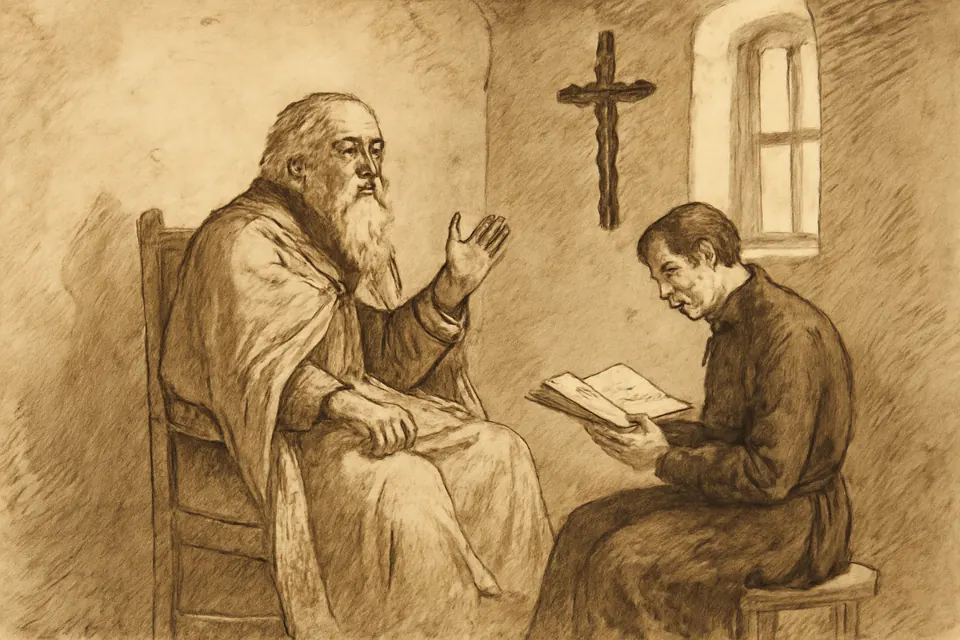
God used three very different people to bring him back. Paul VI named them: Louis Guyot, a tailor who served as the humble sacristan of Cavaillon Cathedral; Antoinette Réveillade, a devout woman who seems not to have been able to read and who kept asking César to read the lives of the saints aloud to her, so that he had to listen to them himself; and the Jesuit Pierre Péquet, whose wisdom and firmness guided him through the years that followed.
Under their influence César broke with his old life, took up his studies again and was ordained a priest in 1582. Paul VI saw a thread running through all his later life: a spirit of penance. He had come back from far away, and he knew it.
The Fathers of Christian Doctrine
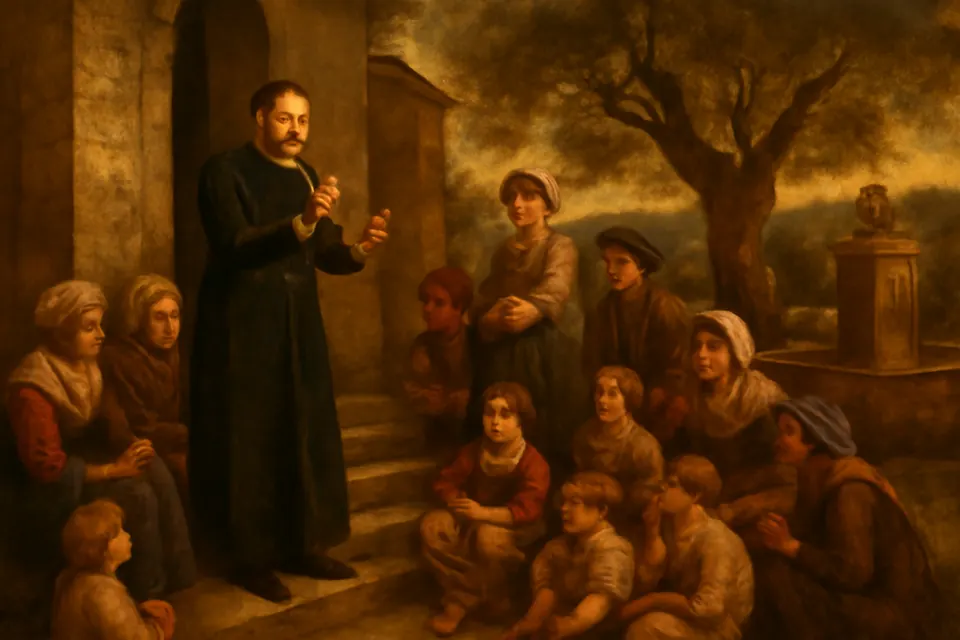
The new priest became known for charity, preaching and above all catechizing. With his cousin Jean-Baptiste Romillon he went through the towns and countryside of Provence teaching the faith to everyone: children, parents, servants and the old. Paul VI described his method: simple words, a few formulas that were easy to remember, and preaching full of Scripture, so that what people learned would change how they lived.
His model was St. Charles Borromeo, the archbishop of Milan who had organized schools of Christian doctrine in every parish. When the archbishop of Avignon gave César a life of St. Charles, he wrote that he was "set on fire with so great a desire to do something in imitation of him that I will give no sleep to my eyes nor rest to my days until I have given some satisfaction to my resolution" (our translation of the words quoted by Paul VI).
In 1592 he founded the secular priests of Christian Doctrine, the Doctrinaires, in the town of L'Isle-sur-la-Sorgue; the next year they moved to Avignon. Pope Clement VIII approved the congregation on December 23, 1597. César also founded a community of women, the Daughters of Christian Doctrine, and helped establish the Ursulines, the teaching sisters of St. Angela Merici, in Provence.
Blind at the end
His last years were hard. Paul VI says that at the end of his life he was "crippled with ailments and afflicted with blindness" (our translation). He kept guiding his priests and offered his sufferings to God. He died at Avignon on April 15, 1607. His Familiar Instructions on the Four Parts of the Roman Catechism were published in five volumes in Paris in 1666, nearly sixty years after his death.
The road to sainthood
Pope Pius VII declared him Venerable in 1821. Pope Paul VI beatified him on April 27, 1975, praising him as a model for catechists and for the young volunteers who give their free time to teach the faith. Paul VI noted that his body then rested in Rome, in the church of Santa Maria in Monticelli.
After a further miracle attributed to his intercession was approved, Pope Francis canonized him in St. Peter's Square on May 15, 2022, together with Charles de Foucauld, Titus Brandsma, Devasahayam Pillai and six others.

Symbols of St. César de Bus in art
He was painted from life or soon after, so he has no legendary emblems. Look for:
- A black cassock with a small white collar: the dress of a French secular priest around 1600.
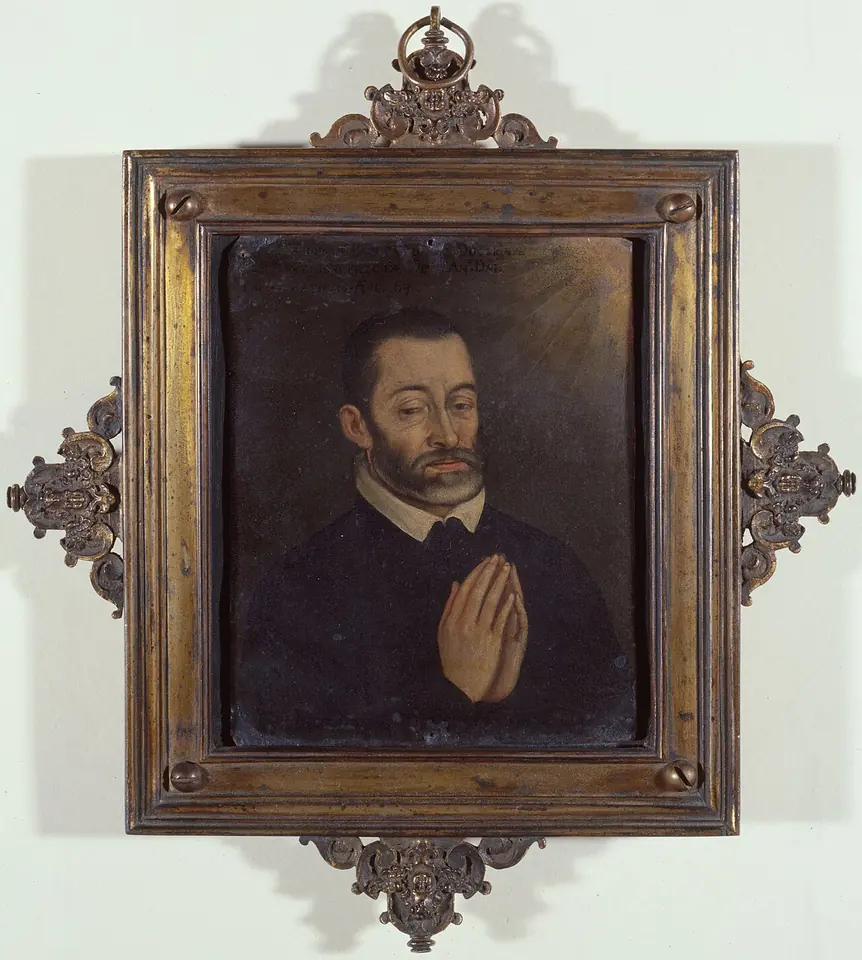
- Hands joined in prayer: as in the Carnavalet portrait and later engraved portraits.
- A book or catechism: his life's work of teaching.
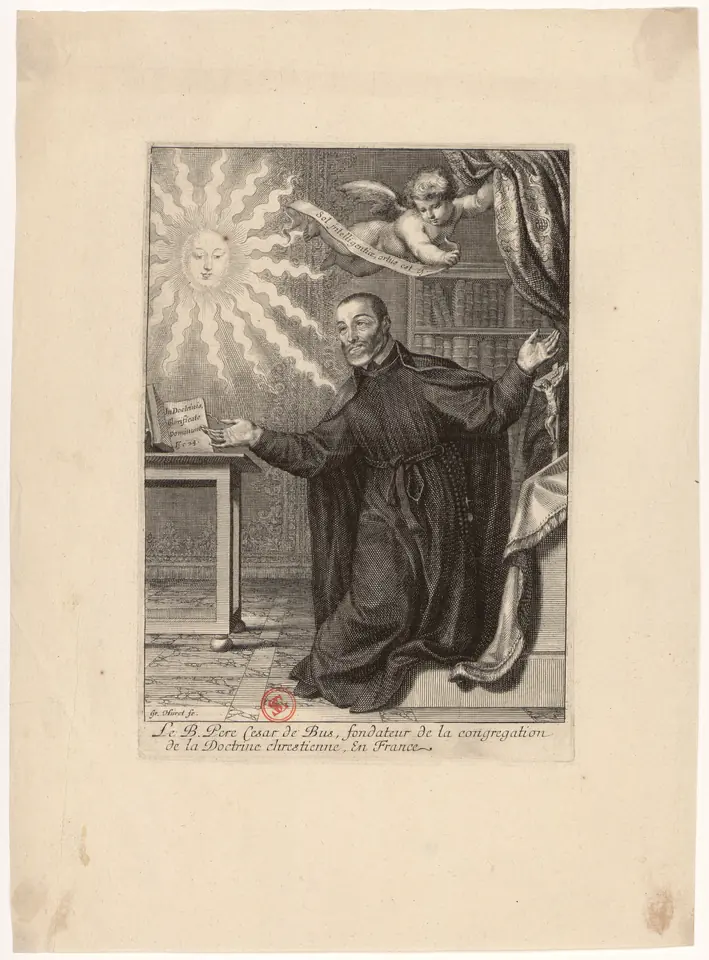
- Light from heaven: in Huret's engraving, the grace that turned his life around.
Feast day and prayer
We keep his feast on April 15; see our feast day calendar. There is no traditional English prayer to him, so let us ask his help in our own words. St. César de Bus, who came back to God and spent your life teaching his truth, pray for catechists and teachers, for parents who hand on the faith, and for everyone still searching their way home.
Frequently asked questions
Who was St. César de Bus?
A priest of Provence who, after a youth of soldiering, poetry and pleasure, was converted and gave his life to teaching the catechism. He founded the Fathers of Christian Doctrine (the Doctrinaires) in 1592 and a congregation of women, the Daughters of Christian Doctrine. He died blind at Avignon in 1607.
When was César de Bus canonized?
Pope Francis canonized him in St. Peter's Square on May 15, 2022, together with Charles de Foucauld, Titus Brandsma and seven others. Pope Paul VI had beatified him on April 27, 1975.
When is the feast of St. César de Bus?
April 15, the day he died at Avignon in 1607.
Keep exploring
Sources
- Catholic Encyclopedia (1908): Venerable César de Bus. His birth and death, the war, Paris, ordination in 1582, the founding of 1592 and Clement VIII's approval of 1597
- Pope Paul VI, homily for the beatification of César de Bus, April 27, 1975 (Vatican, in French). The three who guided his conversion, his blindness, his debt to St. Charles Borromeo, his quotation, and his tomb in Rome
- Pope Francis, homily at the Mass of canonization, May 15, 2022 (Vatican)