St. Michael de Sanctis
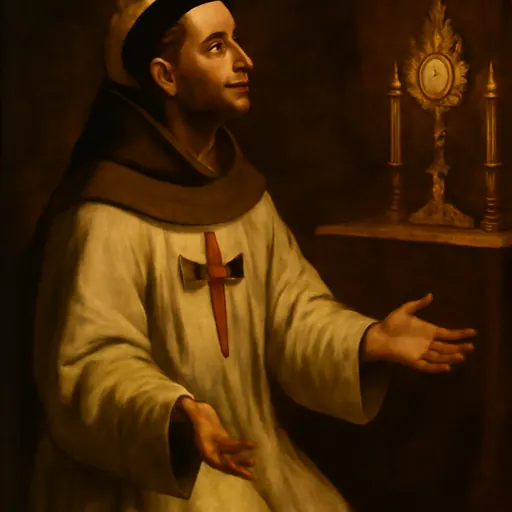
St. Michael de Sanctis (1591–1625), also called Michael of the Saints, was a Discalced Trinitarian priest from Vic in Catalonia, famous for his ecstasies before the Blessed Sacrament. He died at thirty-three as superior of the Trinitarian house in Valladolid and was canonized in 1862. His feast is April 10, and he is patron of his hometown, Vic.
Who was St. Michael de Sanctis?
St. Michael de Sanctis, known in Spain as San Miguel de los Santos and in Catalonia as Sant Miquel dels Sants, was a Discalced Trinitarian friar and priest whose whole life turned on the Eucharist. He was born in Vic, Catalonia, on September 29, 1591, the feast of St. Michael the Archangel, and died in Valladolid on April 10, 1625, at thirty-three. His brothers called him "the Ecstatic," because he was so often caught up in prayer at the altar. Pope Pius IX canonized him in 1862.
We keep his feast on April 10. His hometown of Vic, where he is patron, celebrates him on July 5.
His life
A boy who wanted to be a hermit
The Trinitarian Order still keeps the note his father, Enric Argemir, a notary and town official of Vic, wrote in the family book: on the feast of St. Michael in 1591 his wife Montserrat gave birth to a son, baptized Miguel, José, Jerónimo. "May God make him a good Christian, to His honor and glory."
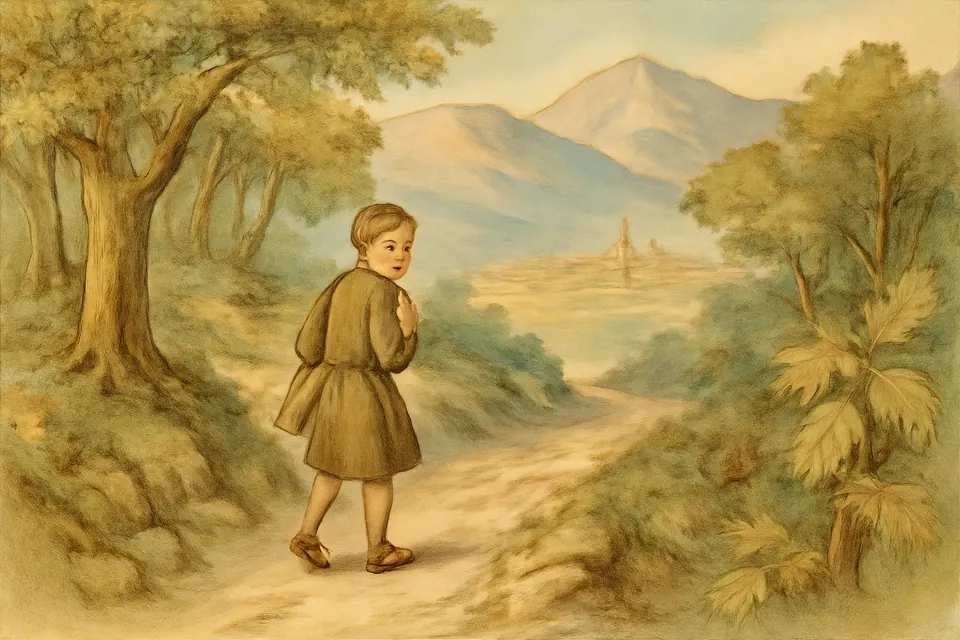
He lost his mother at four and his father at eleven. A childhood friend remembered that at eight he fired up the other boys with his plan to go and live as a hermit on the Montseny. Catalan tradition says he set off for the mountains more than once and was brought home.
From the Trinitarians to the Discalced reform
His guardians would not hear of the religious life, so in August 1603 he ran away to Barcelona and presented himself at the church of the Trinitarians, the order founded by St. John of Matha and St. Felix of Valois to ransom Christian captives. The Catholic Encyclopedia says he made his vows at the monastery of St. Lambert in Zaragoza on September 5, 1607.
That same year a Discalced Trinitarian came to Zaragoza to be ordained, and Michael was drawn to the stricter reform. With his superior's permission he entered its novitiate at Madrid and professed at Alcalá. He studied philosophy at Baeza and theology at Salamanca, where a fellow friar wrote that he was "a prodigy of holiness, wisely combining the active and the contemplative life."
Carnival in Salamanca
The Trinitarian Order tells a story from his student years. During carnival he led a small procession of penitent friars behind a large crucifix into the Plaza de San Juan, where another friar began to preach to the crowd of revelers. Michael gave a great cry, went toward the crucifix and stood suspended in ecstasy. The crowd was shaken, and the carnival turned into a procession of penance to the Trinitarian church. After that, the students called him "the hunter of souls."

Falsely accused
At Baeza he was falsely accused (the Order's account says we don't know of what) and held for months in the convent prison. A friend who visited daily found him cheerful: "Here I can give all my time to prayer." When the matter was investigated his innocence came out, and his accusers changed their lives.
Superior at Valladolid
After his ordination he was twice elected superior of the Discalced Trinitarian house in Valladolid. Witnesses at his canonization process remembered how he sought out the poor and lonely and brought them food hidden under his cloak. He told his brothers, "We must serve God with joy. Sadness does great harm to body and soul." He died in Valladolid on April 10, 1625, and the Trinitarians say he was consumed more by love than by illness. He left mystical writings, including a Treatise on the Tranquility of the Soul.
The miracles of St. Michael de Sanctis
- Ecstasies at Mass: reported. His brothers and many witnesses described him rapt in ecstasy at the consecration, and the Trinitarians tell of a mystical exchange of hearts with the Heart of Jesus, as in the life of St. Catherine of Siena, whom he loved.
- The miracle for his canonization: approved. The Trinitarians record that it was granted to a young Trinitarian of Santa Maria alle Fornaci in Rome, Fr. Antonio della Madre di Dio, who then worked tirelessly for the cause. Pius VI had beatified Michael on May 24, 1779; Pius IX canonized him on June 8, 1862, the same day as the martyrs of Japan.
Why St. Michael de Sanctis is a patron saint
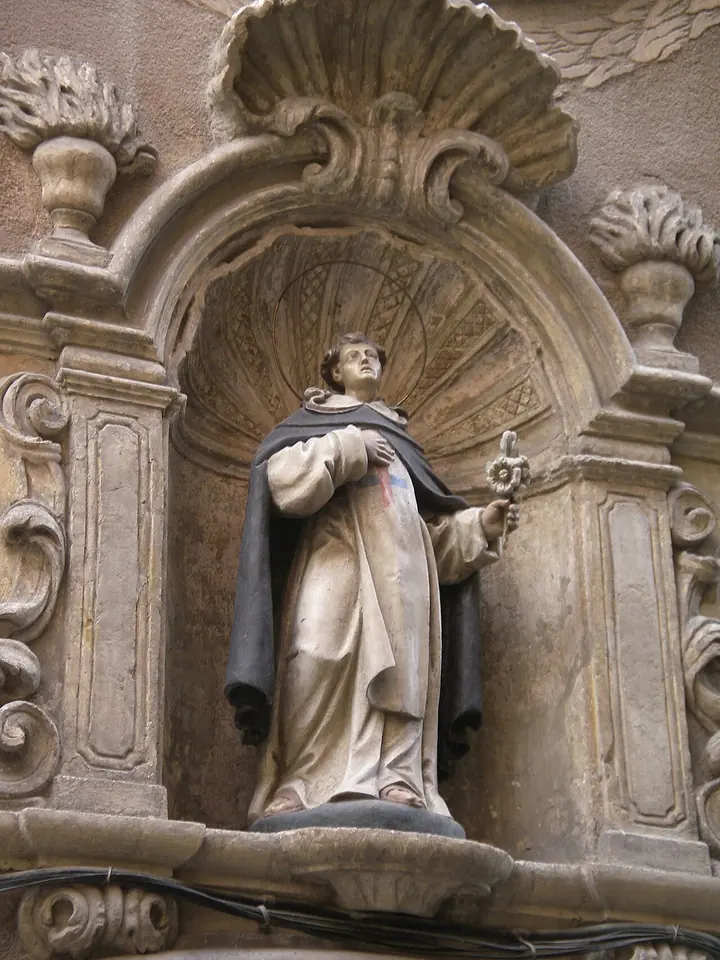
Vic honors him as its patron, and the Trinitarian Order names him patron of its youth, because he gave himself to God so young and served Him so gladly. Some devotional writers also call him a patron of people with cancer; we found no older source for that. You can find saints for every cause on our patron saints page.
Symbols of St. Michael de Sanctis in art
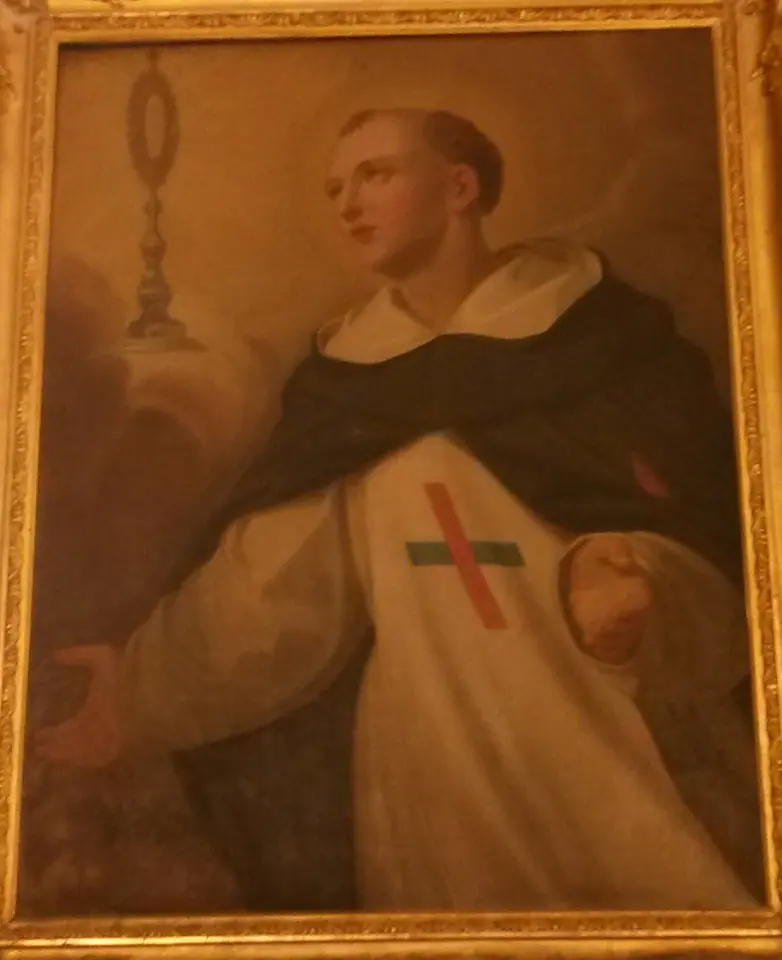
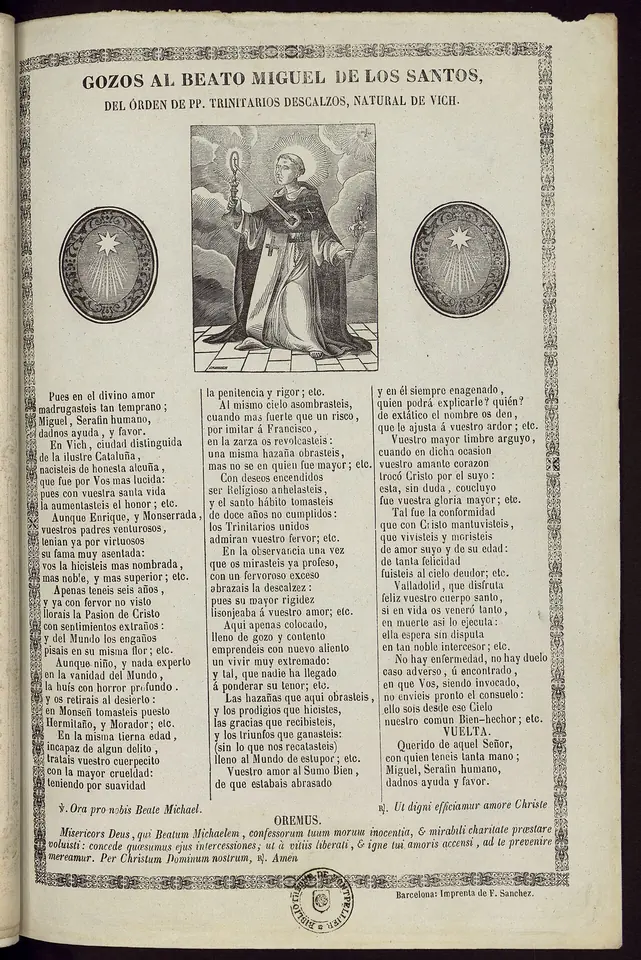
- The Trinitarian habit: a white habit with a cross of red upright and blue crossbar on the chest, and for the Discalced reform a dark cape.
- The monstrance or the Blessed Sacrament: his chief sign. The Catholic Encyclopedia says he is "generally represented kneeling before an altar where the Blessed Sacrament is exposed."
- Ecstasy: eyes raised, arms open, sometimes lifted from the ground.
Look for a young friar with that red and blue cross and a monstrance in hand: that is almost always Michael.
Feast day and relics
The Roman Martyrology keeps his memory on April 10, calling him remarkable for innocence of life, wonderful penitence and love for God. In the Archdiocese of Valladolid and in Vic his day is July 5, the old date. His relics rest in a casket on the high altar of the Church of San Nicolás in Valladolid, once the Discalced Trinitarians' church. In Vic, the house where he was born is now a chapel. See other saints of April on our feast days page.
Where the relics of St. Michael de Sanctis are kept: see them on the relics map →
Prayer to St. Michael de Sanctis
This traditional prayer is printed by the Columban Fathers:
O glorious Saint Michael, inflamed with the most ardent love of Jesus in the Blessed Sacrament, who spent your nights and days in His Real Presence and found your dearest joys, so that you swooned away for very love: grant, I pray to you, to obtain for me a lively faith, a firm hope and an ardent love toward this inestimable Treasure, this precious Pledge of glory everlasting; so that I may be able to be a fervent worshiper of Jesus in the Blessed Sacrament, and thereby rejoice with you to behold Him face to face in an eternity of bliss. Amen.
When we kneel before the tabernacle and our hearts are cold, let us ask St. Michael of the Saints to lend us a little of his fire.
Frequently asked questions
When is the feast day of St. Michael de Sanctis?
April 10, the day he died in 1625, in the Roman Martyrology. His older feast was July 5, and his hometown of Vic and the Archdiocese of Valladolid still celebrate him on July 5.
Why is St. Michael de Sanctis shown with a monstrance?
Because of his love of the Eucharist. He spent long hours before the Blessed Sacrament and was often seen rapt in ecstasy at the consecration of the Mass. When asked why he stayed so long before the tabernacle, he answered that Christ had chained him there.
Where are the relics of St. Michael de Sanctis?
In Valladolid, Spain, in a casket on the high altar of the Church of San Nicolás, the former church of the Discalced Trinitarian convent where he died.
Is there a prayer to St. Michael de Sanctis?
Yes. A traditional prayer asks him, who was 'inflamed with the most ardent love of Jesus in the Blessed Sacrament,' to obtain for us a lively faith and an ardent love of the Eucharist. The full text is on this page.
Keep exploring
Sources
- Catholic Encyclopedia (1911): St. Michael de Sanctis. His birth, vows of 1607, beatification on May 24, 1779, and canonization on June 8, 1862
- Ordine della SS.ma Trinità (Trinitarian General Curia): Santi trinitari, San Michele dei Santi. His father's baptismal note, the carnival procession in Salamanca, the false accusation at Baeza, his sayings and the canonization miracle
- Ökumenisches Heiligenlexikon: Michael von den Heiligen. The July 5 memorial in Vic and Valladolid
- Archdiocese of Valladolid (Iglesia en Valladolid): Fiesta San Miguel de los Santos 2018. Relics in a casket on the high altar of San Nicolás; obligatory memorial on July 5 in the archdiocese
- Columban Fathers: Prayer to St. Michael De Sanctis