Blessed Giles of Assisi, Companion of St. Francis
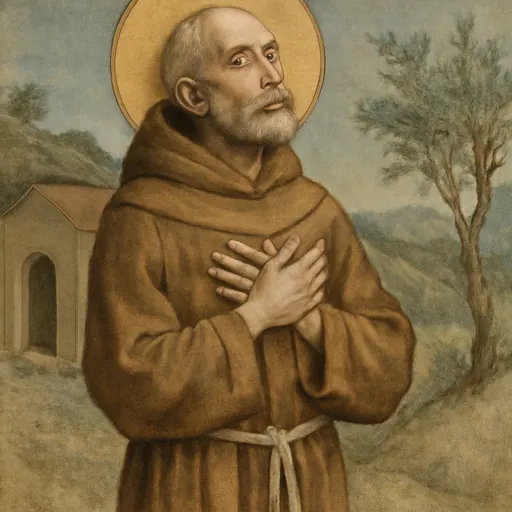
Blessed Giles of Assisi (about 1190–1262) was the third companion of St. Francis, received into the brotherhood in April 1209. He went on pilgrimage to Compostela and Jerusalem, worked with his hands wherever he went, and spent his last decades in prayer near Perugia, where popes and kings came to hear him. His Golden Sayings are still read. His feast is April 23.
Who was Blessed Giles of Assisi?
Blessed Giles of Assisi was the third man to follow St. Francis, a pilgrim, a laborer and, for the last decades of his life, one of the great contemplatives of the Franciscan family. St. Francis called him "the Knight of our Round Table." He never studied theology, yet popes, cardinals and, by tradition, a king climbed the hill outside Perugia to hear a few words from him. We keep his feast on April 23.
Brother Giles is not to be confused with St. Giles, the hermit of Provence with the hind, whose feast falls on September 1.
The life of Blessed Giles of Assisi
The third companion
Nothing certain is known of his early life. In April 1209, moved by the example of two Assisi men who had already joined Francis, Giles begged to be allowed into the little band. On the feast of St. George, April 23, he was clothed in a poor habit that Francis had begged for him. Almost at once the two set out to preach in the Marches of Ancona.
Pilgrim and laborer
Giles was a born traveler. About 1212 he walked to the tomb of St. James at Compostela. Soon after, he went to Jerusalem, stopping on the way home at the shrines of St. Michael on Monte Gargano and St. Nicholas at Bari. He never begged when he could work. The Catholic Encyclopedia lists his jobs: at Ancona he made reed baskets; at Brindisi he carried water and helped bury the dead; at Rome he cut wood, trod grapes and gathered nuts; and as a cardinal's guest at Rieti he insisted on sweeping the house and cleaning the knives.

In 1219 Francis sent him to preach in North Africa. He landed at Tunis, but a crowd rose against the friars and the Christian merchants there, afraid of a massacre, forced them back onto the ship. Giles long regretted that he had not won a martyr's crown. In old age he said, "I do not desire to die a better death than that of contemplation."
The contemplative of Perugia
Francis assigned him to the hermitage of Fabriano, and there, as Fr. Paschal Robinson writes, began "that long series of ecstasies" that lasted to his death. People learned not to say the word "Paradise" near him, because it was enough to carry him away. If anyone spoke to him of God, he would kiss the flowers, trees and stones.
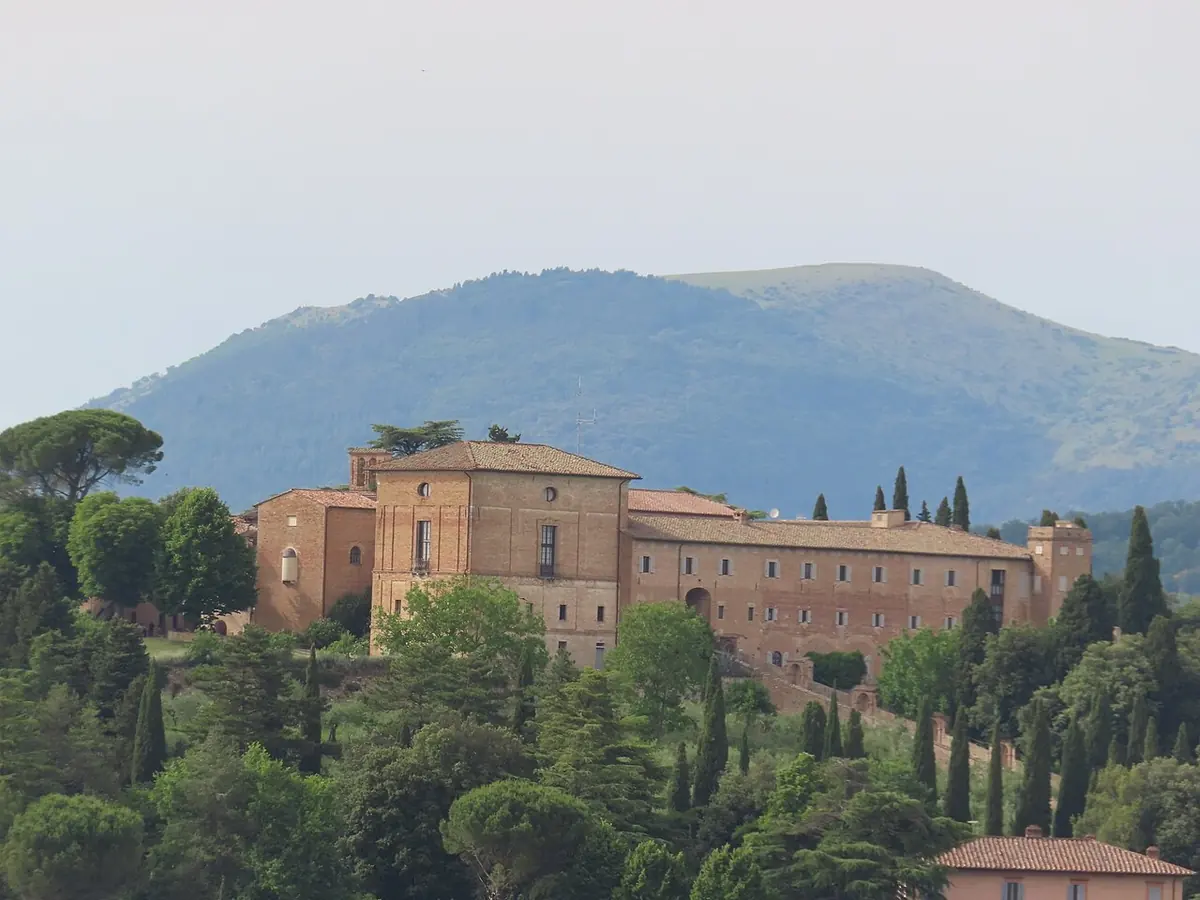
His later years were spent at Monteripido, on the hill outside Perugia's Porta Sant'Angelo. About 1235, Pope Gregory IX visited the friary and watched him lost in prayer. "Verily," said the Pope, "if thou die before me I will ask no other miracle to canonize thee." When the Pope asked for a word of advice, Giles answered, "Keep thy spiritual eyes pure: the right one for contemplating heavenly things, the left for judging rightly the world that you have to govern."

The meeting with St. Louis
The best-loved story of Brother Giles comes from the Little Flowers of St. Francis, and we hold it as traditional. King Louis IX of France, it says, came to Perugia dressed as a poor pilgrim and asked for Brother Giles at the friary door. Giles knew in his heart who it was, ran out, and the two knelt and embraced "with such signs of tender love as though for long time they had been close, familiar friends." Neither said a word. When the friars scolded Giles for his silence, he told them that "the light of heavenly wisdom revealed and showed to me his heart, and mine to him."

The Golden Sayings
The counsel Giles gave his visitors was remembered and written down, and these Dicta, or Golden Sayings, became a small classic. St. Bonaventure prized them. They are blunt and homely. He warned learned friars, "Paris, Paris, thou destroyest the Order of St. Francis." He taught a preacher in the piazza of Perugia to say of himself, "I say much and do little." And on the mystery of God he said that all the saints who have ever spoken of Him have said no more, compared with what He is, than "the prick of a needle" compared with heaven and earth.
His death and tomb
Giles died at Monteripido on Saturday, April 22, 1262, by Robinson's reckoning (some historians prefer 1261). He had asked to be buried at the Porziuncula, so the people of Perugia put soldiers around the friary to keep his body. He sent them word that no bells would ring for his canonization and no sign would be given them "except that of Jonas." They buried him in San Francesco al Prato, and the stone coffin they found for him was an old sarcophagus carved with the story of Jonah.
- Reported: miracles at his tomb, which the Bollandists recorded, although the chronicler Salimbene says Giles had prayed to work none after death.
The church of San Francesco later collapsed. In 1880 his remains were placed under the altar of the Chapel of Sant'Onofrio in Perugia's cathedral of San Lorenzo, beside Blessed Conrad of Offida, where Robinson found them in 1907. Pope Pius VI confirmed his age-old cult in 1777.
Symbols of Blessed Giles of Assisi in art
Brother Giles wears the patched brown Franciscan habit and knotted cord. He is most often painted in ecstasy, lifted from the ground or standing rapt, as in Murillo's canvas on this page. A book recalls his Golden Sayings, and a pilgrim's staff his journeys. The silent embrace with a crowned king is the scene that identifies him at once.
Feast day and prayer
We keep his feast on April 23, the day he put on the habit. See the feast day calendar.
We know of no traditional prayer to Blessed Giles that we can quote. Let us take one of his own sayings as our prayer for today, and ask him to teach us to keep the eyes of the heart pure, one fixed on heaven and one on the work God gives us. Blessed Giles of Assisi, pray for us.
Frequently asked questions
Who was Blessed Giles of Assisi?
Brother Giles was one of the very first followers of St. Francis of Assisi, received in April 1209. He traveled as a pilgrim and preacher, then lived for many years as a contemplative near Perugia, where he died in 1262. Francis called him "the Knight of our Round Table."
What are the Golden Sayings of Brother Giles?
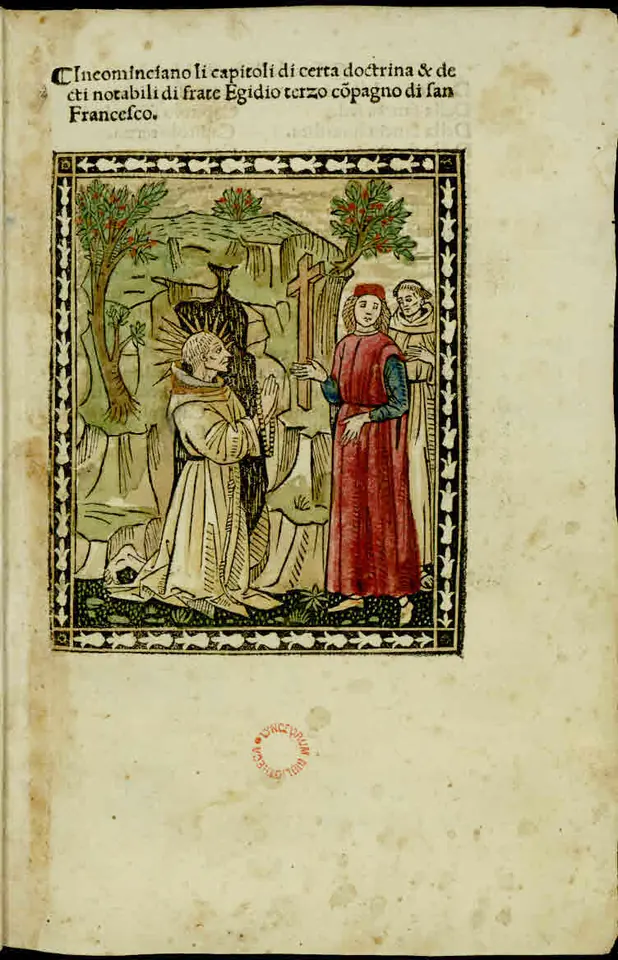
Short, practical counsels on the Christian life that his visitors remembered and wrote down. St. Bonaventure valued them, and they have been printed many times, including an edition of 1493 and an English translation by Fr. Paschal Robinson in 1907.
When is the feast of Blessed Giles of Assisi?
April 23, the feast of St. George, the day he received the Franciscan habit in 1209. Pope Pius VI confirmed his cult in 1777.
Did St. Louis of France visit Brother Giles?
The Little Flowers of St. Francis tells that King Louis IX came to Perugia as a pilgrim and the two embraced without a word. Fr. Paschal Robinson notes that the chronicler Salimbene, who wrote much about Louis, is silent about it, so we hold it as a cherished tradition.
Keep exploring
Sources
- Catholic Encyclopedia (1907): Bl. Aegidius of Assisi, by Paschal Robinson. The name "Knight of our Round Table," the habit on the feast of St. George 1209, the pilgrimages, the manual labor in Ancona, Brindisi, Rome and Rieti, Fabriano, cult confirmed by Pius VI, feast April 23
- The Golden Sayings of the Blessed Brother Giles of Assisi, trans. Paschal Robinson (Philadelphia: Dolphin Press, 1907). Tunis, the Gregory IX episode and his words to the Pope, Cetona, the death on April 22, 1262, the Perugians' guard, the Jonah sarcophagus, the move of his remains to the cathedral in 1880, the cult confirmed in 1777, and the quoted sayings
- The Little Flowers of St. Francis, trans. T. W. Arnold (Temple Classics, 1907), chapter 34. The visit of St. Louis of France to Brother Giles at Perugia, quoted