Blessed Marie of the Incarnation (Madame Acarie)

Blessed Marie of the Incarnation (1566–1618), better known as Madame Acarie, was a Paris wife and mother of six who brought the Discalced Carmelite nuns to France in 1604. Widowed, she entered the Carmel as a humble lay sister. She was beatified in 1791; her feast is April 18. She is not St. Marie of the Incarnation of Quebec.
Who was Blessed Marie of the Incarnation?
Blessed Marie of the Incarnation, known in her lifetime as Madame Acarie, was a Paris wife and mother who brought the Discalced Carmelite nuns of St. Teresa of Ávila into France. She was born Barbe Avrillot on February 1, 1566, ran a large household through civil war, debt and illness, and made her home a meeting place for the holiest people of her day. When her husband died, she gave up everything and entered one of the convents she had founded as a lay sister, the lowest place in the house.
She died at the Carmel of Pontoise on April 18, 1618. By then the French Carmel she started had fourteen houses. Pope Pius VI beatified her in 1791, and we keep her feast on April 18.
One note before we go on. Two holy Frenchwomen took the religious name Marie of the Incarnation. This page is about the Paris Carmelite. The other, St. Marie of the Incarnation (Marie Guyart), was an Ursuline who sailed to Quebec in 1639 and was canonized in 2014.
The life of Madame Acarie
A Paris girlhood and an early marriage
Her father, Nicholas Avrillot, was an accountant general in the Chamber of Paris, and her mother, Marie Lhuillier, came from an old Paris family. Barbe was educated by the Poor Clares at Longchamp and wanted to stay in the cloister. Her parents had other plans. In 1584, at eighteen, she married Pierre Acarie, a wealthy and devout young man. Paris called her "la belle Acarie," the beautiful Acarie. They had six children, and the Catholic Encyclopedia calls her "an exemplary wife and mother."
War, debt and a broken body
Pierre Acarie was a leader of the Catholic League, which fought the succession of the Protestant Henry of Navarre. During the siege of Paris in 1590, when famine struck the city, Barbe gave away food and money to the starving. After the League collapsed, Pierre was exiled and his property seized. She was left to face the creditors alone and to save what she could for her children. Around the same time a fall from a horse, and the rough treatment that followed it, left her an invalid for the rest of her life.

None of this closed her door. She visited the sick in the hospitals of Paris and gave to the poor, and her house filled with visitors who came for her advice: the Jesuit Pierre Coton, the young priest Pierre de Bérulle, St. Vincent de Paul, and St. Francis de Sales, who for six months was her spiritual director.
St. Teresa comes to call
In 1601 a French translation of the life of St. Teresa of Ávila reached her. A few days after reading it, she had a vision of Teresa, who told her that God wished to use her to found Carmelite convents in France. She was a laywoman with a sick body and a ruined husband. She went to work anyway.
On July 18, 1602, King Henry IV signed letters patent for a first monastery on the rue Saint-Jacques. Nine days later, on July 27, a meeting that included Bérulle and Francis de Sales decided to bring the reformed Carmel into France. Pope Clement VIII granted the bull of foundation on November 23, 1603, and in 1604 a small band of Spanish Carmelites arrived in Paris, among them Blessed Anne of St. Bartholomew, Teresa's own nurse and companion.

The new Carmel of Paris drew women from the greatest families of France. Madame Acarie stayed in the background, helping with the houses, with Bérulle's Oratory, and with bringing the Ursulines to Paris to teach girls.

The lay sister
Pierre Acarie died in 1613. The next year Barbe entered the Carmel of Amiens and took the name Marie of the Incarnation. She asked to be received as a lay sister, in the words of the Catholic Encyclopedia "as a lay sister in the poorest community." Three of her daughters were already Carmelites, and one of them was subprioress at Amiens, so the foundress of the French Carmel took her place below her own child. In 1616 she was sent under obedience to the Carmel of Pontoise, and she died there in April 1618, at fifty-two.
The miracles of Blessed Marie of the Incarnation
Her cause was introduced in Rome in 1627, less than ten years after her death, and she was beatified on April 24, 1791. The miracles accepted for her beatification are approved, but we have not found a reliable published account of what they were, so we do not describe them here.
The vision of St. Teresa in 1601 is reported: it comes from her early biographers and from those who knew her. Her contemporaries also wrote of ecstasies and of other mystical gifts, which the Catholic Encyclopedia sums up as her "supernatural gifts." The nuns of Pontoise say she is especially invoked for children yet to be born, and for the protection of life.
Symbols of Blessed Marie of the Incarnation in art
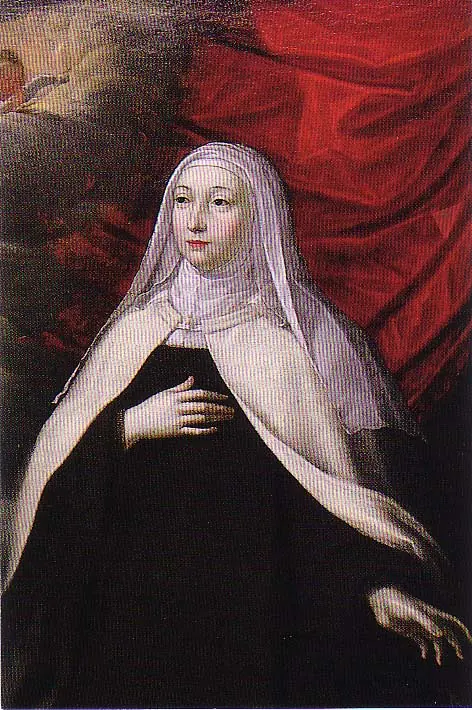
She is painted as a Discalced Carmelite lay sister, in the brown habit with a white mantle, a white veil or wimple framing a pale, gentle face. Her hands are often crossed on her breast or joined in prayer. In the older painting on this page, St. Teresa of Ávila appears in light above her, the sign of the vision that set her work in motion, with a crucifix and an open book on the desk beside her for her life of prayer. A halo marks her as blessed. In a church you will tell her apart from St. Teresa by the setting: Teresa usually holds a pen or has a dove at her ear, while Marie kneels below Teresa or has her standing in a vision.
Feast day and her relics at Pontoise
Her feast is April 18. The Carmel of Pontoise, founded in 1605, still keeps her relics in its chapel, and the small church where she prayed in her last years, built in 1610, still stands in the monastery courtyard.

Where the relics of Blessed Marie of the Incarnation are kept: see them on the relics map →
Praying with Blessed Marie of the Incarnation
We have not found a traditional prayer to her with a citable origin, so we do not print one here. Ask her help in your own words, especially for mothers, for children not yet born, for anyone carrying a household through money trouble or illness, and for vocations to the Carmel. Let us ask Blessed Marie of the Incarnation to pray for us, that we may serve God where we are, as she did, and give up our place gladly when He asks.
Frequently asked questions
Who was Blessed Marie of the Incarnation?
Barbe Avrillot, called Madame Acarie, was born in Paris in 1566, married Pierre Acarie at eighteen and raised six children. Moved by a vision of St. Teresa of Ávila in 1601, she led the effort that brought the Teresian Carmel to France in 1604. Widowed in 1613, she entered the Carmel of Amiens as a lay sister, taking the name Marie of the Incarnation, and died at Pontoise in 1618.
Is Madame Acarie the same as St. Marie of the Incarnation of Quebec?
No. Madame Acarie (1566–1618) was a Paris Carmelite, beatified in 1791, with her feast on April 18. St. Marie of the Incarnation (Marie Guyart, 1599–1672) was an Ursuline who founded the Ursulines of Quebec and was canonized in 2014; her feast is April 30. They took the same religious name.
When is the feast of Blessed Marie of the Incarnation?
April 18, the day she died at Pontoise in 1618. It is kept in Paris and by the Carmelite family.
Where are the relics of Madame Acarie?
In the chapel of the Carmel of Pontoise, northwest of Paris, the monastery where she spent her last two years and died. The nuns there say she is especially invoked for children yet to be born.
Keep exploring
Sources
- P. A. Fournet, "Bl. Marie de l'Incarnation," Catholic Encyclopedia, vol. 9 (1910). Her family, the letters patent of July 18, 1602, the meeting of July 27, 1602, the bull of 1603, her entry at Amiens and the beatification date
- Carmel de Pontoise: Nos grandes figures. Her death in the monastery and her invocation for future births