St. Drogo of Sebourg

St. Drogo (Druon in French), who died in 1186, was a shepherd, pilgrim and hermit from Flanders who spent his last decades walled into a tiny cell beside the church of Sebourg, near Valenciennes in northern France. He is the patron saint of shepherds and, by an old and unexplained custom first recorded in Ghent, of coffee and coffeehouse keepers. His feast day is April 16.
Who was St. Drogo?
Drogo, called Druon in French, was a shepherd who became a pilgrim and then a hermit. He was born in the early 1100s at Épinoy in Artois, then part of the County of Flanders and now a district of Carvin in northern France. He died on April 16, 1186, at Sebourg, a village near Valenciennes, after spending the last thirty or forty years of his life shut up in a small cell built against the wall of the village church.
What we know of him comes from late sources. Sabine Baring-Gould's Lives of the Saints names a life written in 1320, and the parish that keeps his relics says the oldest surviving text, by the chronicler Jacques de Guyse, is "already full of the marvelous." The outline of his story is simple and probably sound. Many details are traditional.
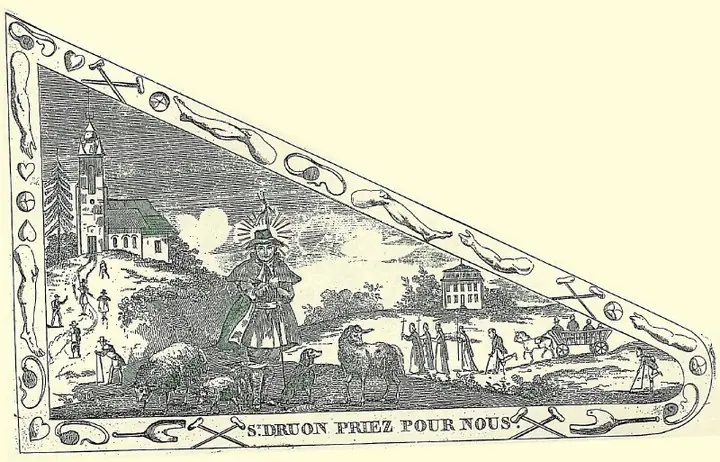
The life of St. Drogo
An orphan from birth
His father died before he was born, and his mother died bringing him into the world; Baring-Gould says by cesarean section. When Drogo was about ten, he learned that his mother had died giving him life, and he carried that grief all his life, taking on hard penances while still a boy.
As a young man he gave away his inheritance, came to Sebourg and hired himself out as a shepherd to a devout woman of the village, Elizabeth la Haire. He kept her sheep for about six years.
The shepherd who was in two places at once
The best-loved story about Drogo is that he could watch his sheep in the field and be at Mass in the church at the same time. The story is traditional, and it lasted for centuries in the speech of the villages. The parish of Sebourg records an old saying of local farmers, asked to do two jobs at once: "Je n'sus mie Saint Druon, je n'pus point sonner à l'messe et être à l'procession," meaning "I'm not St. Drogo, I can't ring the bell for Mass and walk in the procession too."
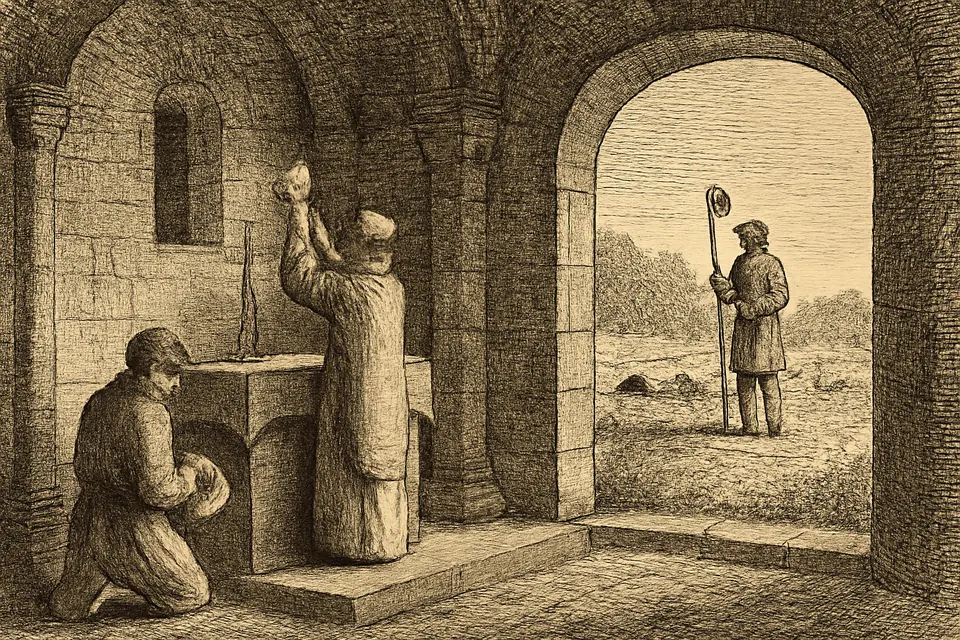
Nine times to Rome
Drogo then became a pilgrim. Nominis, the saints' calendar of the French bishops, says he walked to Rome nine years in a row, visiting the great shrines of France and Italy along the way. The parish adds that he taught the shepherds he met along the way how to keep their flocks healthy.
The hermit of Sebourg
A severe hernia ended his journeys and left him disfigured and nearly unable to move. Back at Sebourg, the parishioners built him a narrow cell against the church at his request. There he lived out his life in prayer and penance, seen by almost no one, with a little opening from which he could adore the Blessed Sacrament. Baring-Gould writes that "his patience and piety under this loathsome and hideous infliction were conspicuous."
Once the church caught fire. Drogo would not leave his cell, and although part of it burned, he survived unharmed. This is told as a miracle and is traditional.

He died on Easter Tuesday, April 16, 1186.
The miracles and legends of St. Drogo
- Bilocation, at Mass and in the field: traditional.
- Unharmed in the church fire: traditional.
- The cart that would not move: traditional. His relatives from Épinoy came to take his body home. The parish tells how the cart grew heavier and heavier, and at the edge of the village the horses refused to go on. The people of Sebourg took it as a sign that Drogo wanted to stay, and buried him in the middle of their church. A cross still marks the spot where the cart stopped.
- Cures at his shrine: reported. Pilgrims came for centuries asking for healing of hernias, kidney stones and intestinal illness. In one chapel at Cottenchy in the Somme, the parish notes, kidney stones hung beside his statue as thank offerings.
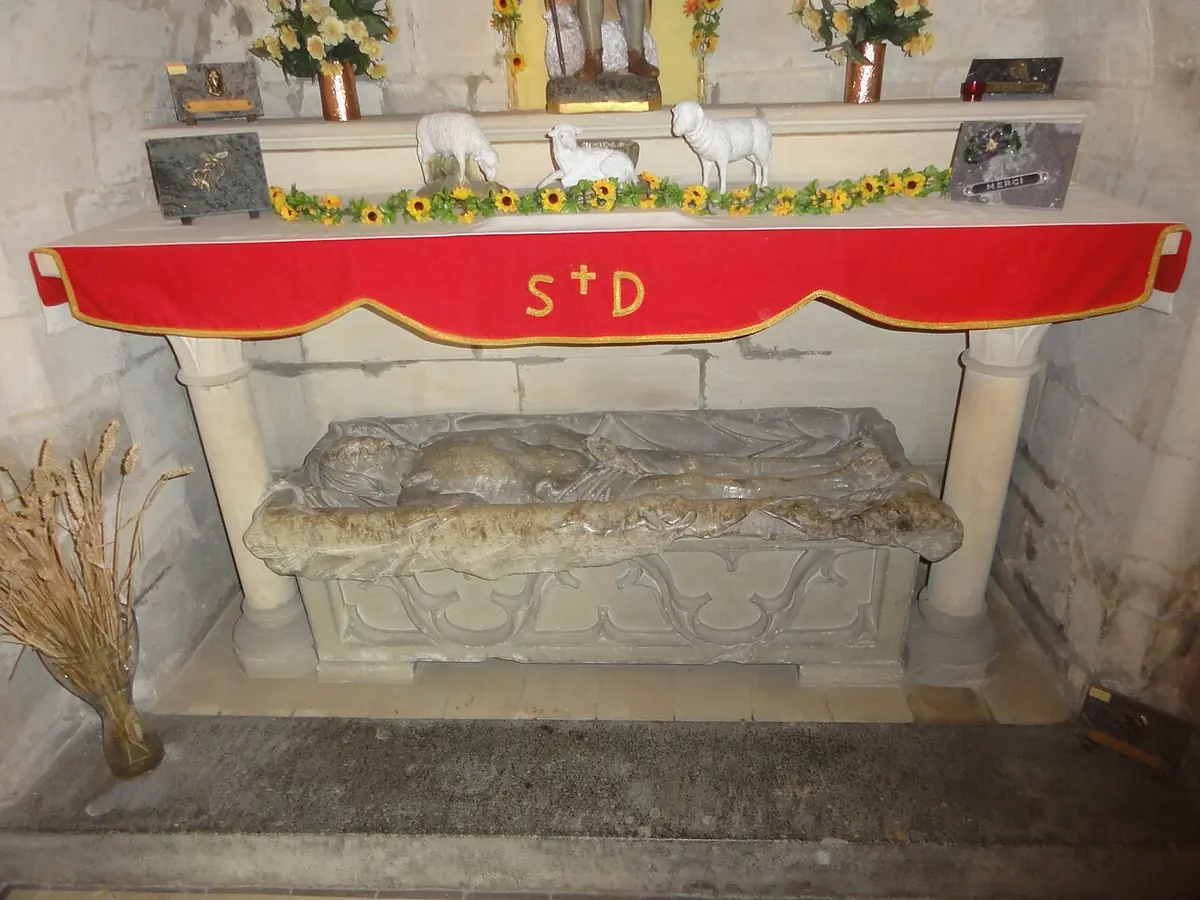
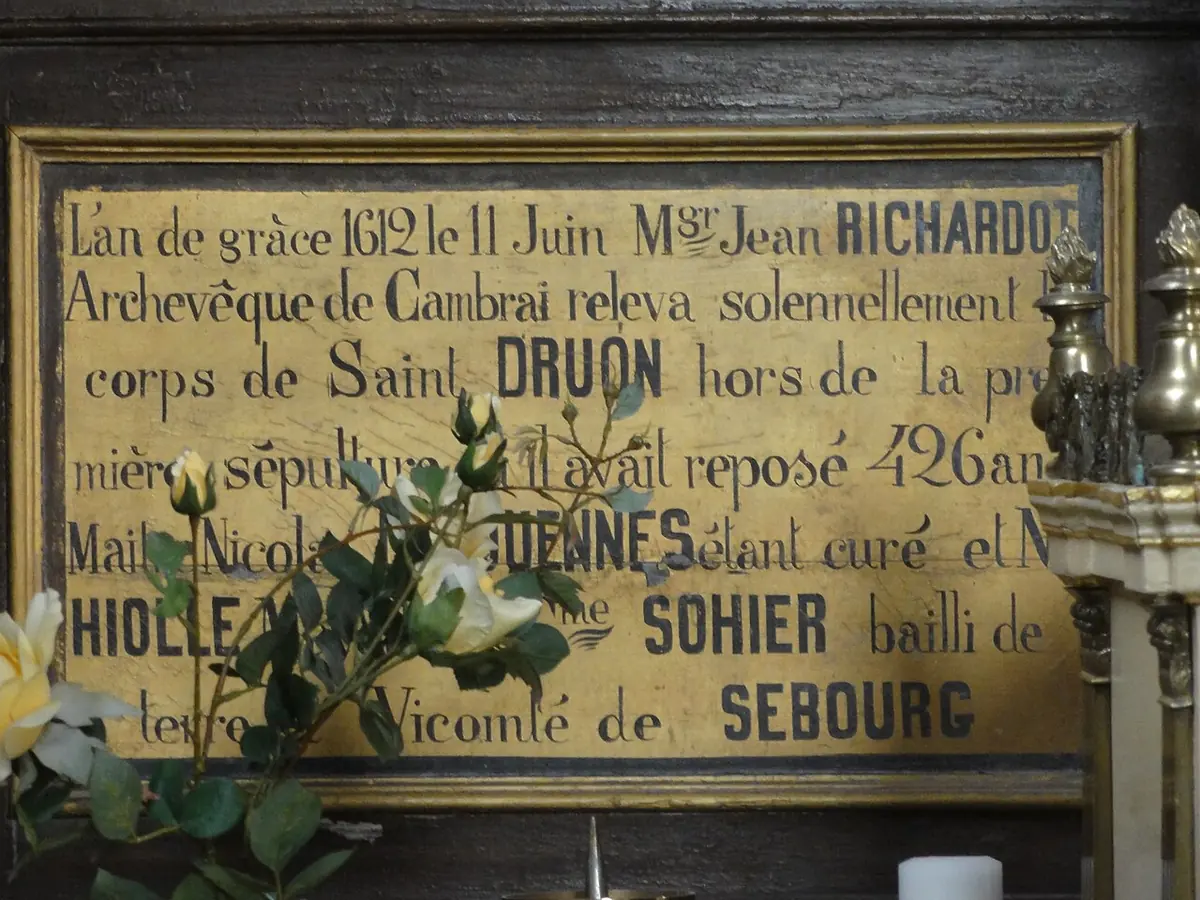
On June 11, 1612, the Archbishop of Cambrai, Jean Richardot, solemnly raised Drogo's body from its first grave, where a plaque in the church says it had lain for 426 years. That ceremony recognized his cult. He was never canonized by a formal process, which didn't exist in his day.
Why St. Drogo is the patron saint of coffee
Here we have to be honest: no one knows. Baring-Gould, writing in the 1870s, says Drogo was regarded around Valenciennes as the patron of shepherds, "but at Ghent, for what reason it is impossible to divine, of coffee-house keepers." So the link with coffee is at least 150 years old and goes back to the coffeehouses of Flanders, not to the internet.
One popular modern guess points to the bilocation story: only coffee lets a person be in two places at once. That is a joke, not history. Some modern lists also call him a patron of people others consider unattractive, because of his disfigurement; we haven't found an older source for that.
His older patronages are clearer: shepherds, because he was one; hernias, kidney stones and intestinal disorders, because of what he suffered; and expectant mothers, because of how he came into the world. See all the patronages on our patron saints page.
Symbols of St. Drogo in art
Drogo is shown as a young shepherd, not a monk or a bishop. Look for:
- Shepherd's clothes: a short tunic, a cloak and often a broad hat.
- A crook or a pilgrim's staff: his two callings.
- Sheep or a lamb: often carried in his arms, as in the statue at Sebourg.
- A book: his life of prayer.
- A small cell by a church: in story scenes of his life as a hermit.
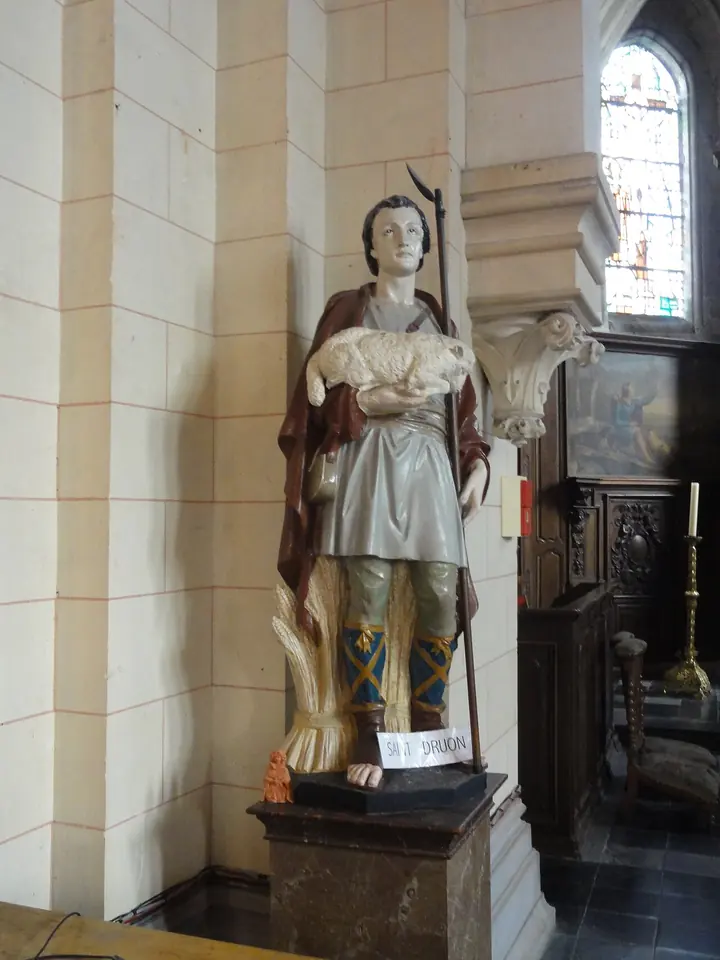
St. Drogo's feast day and Sebourg
We keep his feast on April 16, the day of his death, which is how the Roman Martyrology lists him. You can find his neighbors on our feast days page. Sebourg celebrates him on Trinity Sunday with a Mass and a procession. The confraternities of Carvin and Sebourg carry his banner and relics, with children dressed as little shepherds, to the chapel built where, the parish says, he grazed his sheep.
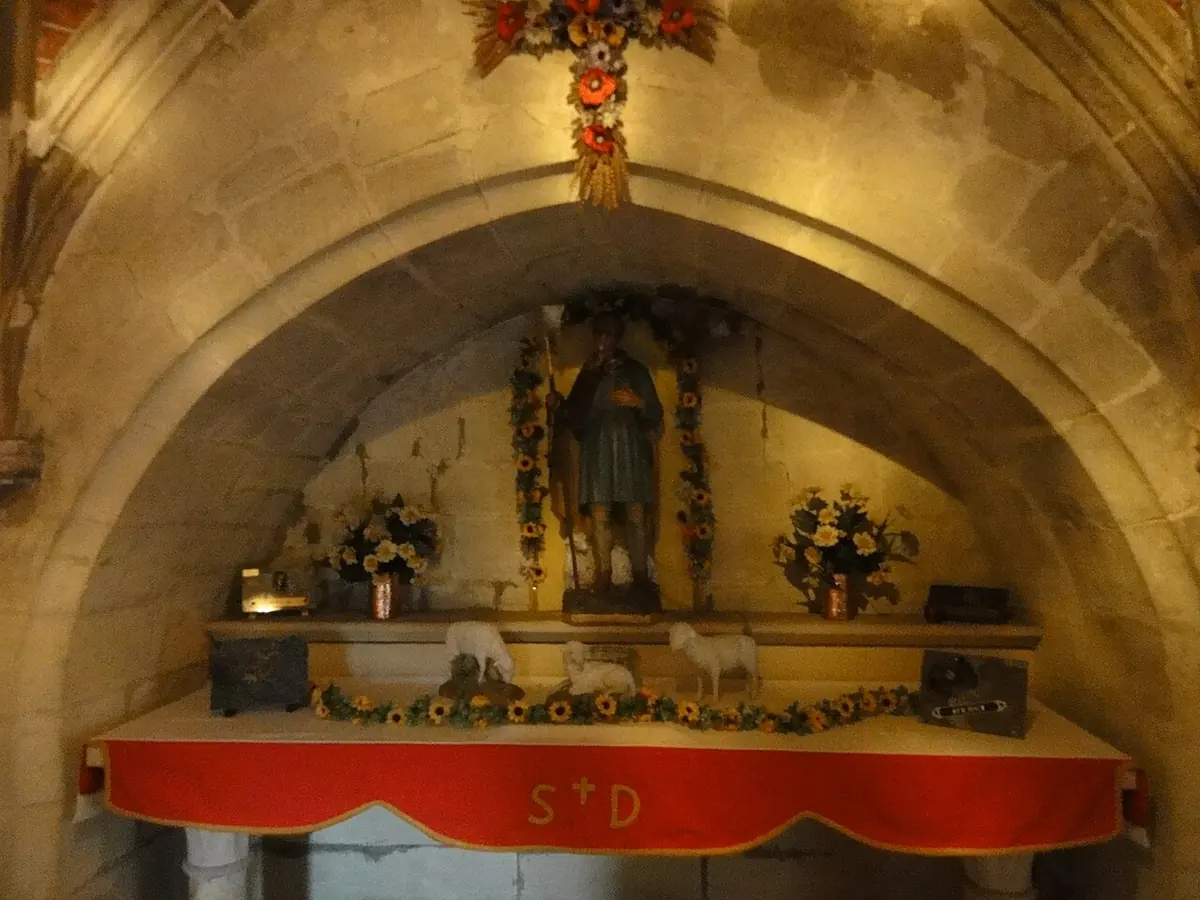
Prayer to St. Drogo
We have not found a traditional prayer to St. Drogo in the standard prayer books, and we won't invent one under his name. The simplest prayer is the one on the old banner from his cult, S. Druon, priez pour nous: St. Drogo, pray for us.
Let us ask him to pray for shepherds and all who care for animals, for the sick, for mothers waiting to give birth, and for those who carry a grief they cannot put down, as he did.
Frequently asked questions
Why is St. Drogo the patron saint of coffee?
Nobody knows for sure. The oldest record we found is in Sabine Baring-Gould's Lives of the Saints, first published in the 1870s, which says Drogo was the patron of coffeehouse keepers in Ghent, "for what reason it is impossible to divine." The popular modern explanations, such as the joke that it takes coffee to be in two places at once, came later.
What is St. Drogo the patron saint of?
Shepherds above all, in the north of France and Belgium. He is also invoked for hernias, kidney stones and illnesses of the intestines and kidneys, by expectant mothers, and by coffeehouse keepers and coffee lovers.
When is St. Drogo's feast day?
April 16, the day he died in 1186, in the Roman Martyrology. In Sebourg, where his relics are, the parish celebrates him with a Mass and procession on Trinity Sunday, the Sunday after Pentecost.
Was St. Drogo canonized?
Not by a formal process, which did not yet exist in his time. His cult was recognized when the Archbishop of Cambrai, Jean Richardot, solemnly raised his relics on June 11, 1612.
Sources
- S. Baring-Gould, The Lives of the Saints, vol. 4 (April), Edinburgh: J. Grant, 1914, April 16: S. Drogo. The life written in 1320; the hernia and the fire; patron of shepherds near Valenciennes and of coffee-house keepers at Ghent
- Paroisse Sainte Maria Goretti du Hainaut (Diocese of Cambrai): Tout savoir sur Saint Druon. Death on Easter Tuesday 1186, the cart that would not move, Jacques de Guyse as the oldest source, fourteen old lives, the bilocation proverb, his patronages, the Trinity Sunday procession
- Nominis (Conférence des évêques de France): Saint Druon. Nine pilgrimages to Rome; the reclusion of thirty or forty years; the Roman Martyrology entry
- Roman Martyrology, April 16