St. Agnes of Montepulciano
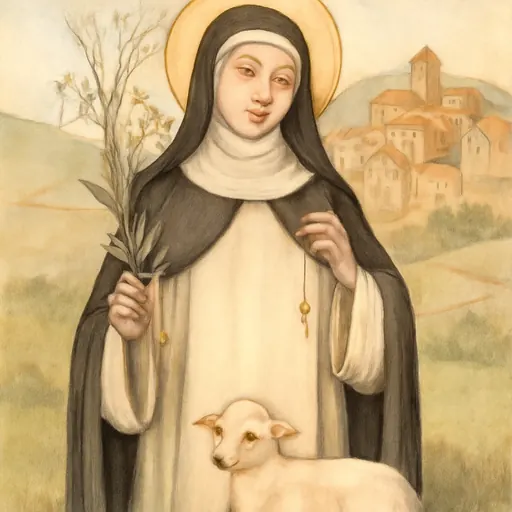
St. Agnes of Montepulciano (about 1268–1317) was a Tuscan nun who became an abbess at fifteen, founded the Dominican monastery of Montepulciano and was famous in her lifetime for prayer and wonders: manna falling like snow, a rose in winter, a little cross left by the Christ Child. Her feast day is April 20. Pope Benedict XIII canonized her in 1726.
Who was St. Agnes of Montepulciano?
St. Agnes of Montepulciano was a Tuscan nun of the late 1200s and early 1300s who founded the Dominican monastery of her hometown and governed it until her death in 1317. She was born Agnese Segni, about 1268, in Gracciano, a hamlet below the hill town of Montepulciano, between Siena and Lake Trasimeno. She entered a convent at nine, was made the superior of a new community at fifteen, and spent her life in prayer so constant that her sisters learned not to interrupt her.
Nearly everything we know comes from one book: the Legenda of her life written in 1366 by Blessed Raymond of Capua, the Dominican who later became the confessor of St. Catherine of Siena and master of the whole order. Raymond wrote about fifty years after her death, from the memories of her nuns, the friars who had known her and sworn records of miracles. He was a careful writer for his time, but his book is a medieval saint's life, full of wonders, and we read it that way.
The Church canonized her in 1726. Her feast is April 20, and her body is venerated in the church she built in Montepulciano.
The life of St. Agnes of Montepulciano
The Sisters of the Sack
At about nine, Agnes begged her parents to let her join a small community of women in Montepulciano known as the "Sisters of the Sack," from the rough cloth of their scapulars. Raymond describes the girl as obedient, "full of fervor in prayer," courteous in conversation and "always serene for the love of God." Around fourteen she was made the community's bursar.
Raymond places two of her best-known visions in these years. Once she was seen lifted up to the height of the crucifix over the altar, embracing it. In another, the Virgin Mary gave her three small stones and told her that before she died she would build a church in Mary's honor, founded on firm faith in the Holy Trinity. These accounts are traditional.
Abbess at fifteen in Proceno
In the early 1280s the people of Proceno, a village near Orvieto, asked the nuns of Montepulciano to found a convent among them. Sister Margherita was chosen to lead it, on condition that she could bring Agnes. The new community soon grew, and when it came time to elect a superior, the sisters chose Agnes, about fifteen years old. A papal dispensation confirmed the choice. The Catholic Encyclopedia names the pope as Nicholas IV; the Diocese of Arezzo's life names Martin IV.
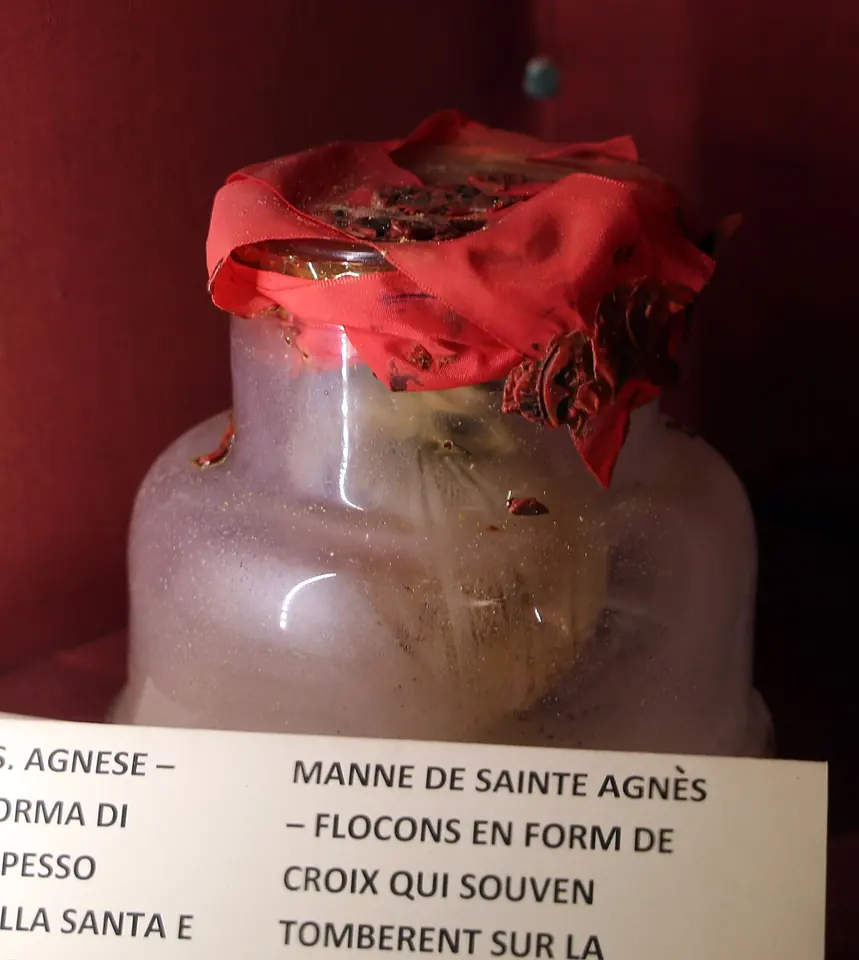
Raymond tells that on the day the bishop installed her, a very white manna fell on the altar and on the people, and every grain had the shape of a cross. He says the same wonder came again many times where she prayed. For fifteen years she lived on bread and water, slept on the ground and used a stone for a pillow, "just like the holy father Dominic."
The rose in winter and the bread at table
Two gentle stories from Proceno show the kind of holiness her sisters remembered. Two hermits visited her one winter, and as they ate and spoke of God, a fresh rose appeared on a plate. Agnes told them, in Raymond's telling, that the Lord had sent this summer flower to show how their words had warmed her spirit with the fire of charity.

On another day the convent had no bread at all. Agnes sat down with her sisters anyway, spoke to them about patience, lifted her hands to heaven in prayer and brought them down holding a fresh loaf, with the ash of the oven still on it. Both stories are traditional.
The Christ Child's little cross
Raymond's most loved story comes from a feast of the Assumption. Agnes had prayed to be allowed to hold the Child Jesus. Mary appeared to her and placed the Child in her arms, and Agnes did not want to give Him back. When Mary gently took her Son again, Agnes held on to a tiny cross that hung from His neck on a thin thread, and the cross stayed in her hand when the vision ended. Raymond says that little cross was kept among her relics and solemnly shown to the people every year. This is a traditional account, and it is the reason artists put a small cross on a thread in her hand.
Home to Montepulciano and the Dominican rule
The people of Montepulciano kept asking for her return. With the permission of the bishop of Arezzo, she came home and founded a new monastery outside the walls, near the Porta al Prato. She became its superior on September 23, 1306, according to the Diocese of Arezzo, and its church was dedicated to Our Lady as Santa Maria Novella, fulfilling the promise of the three stones. After a vision of St. Dominic, she placed the community under the Dominican rule.
She was often called on to make peace between the feuding families of her town. Raymond adds that she could read hearts, so her nuns were careful about their faults.
The baths of Chianciano and her death
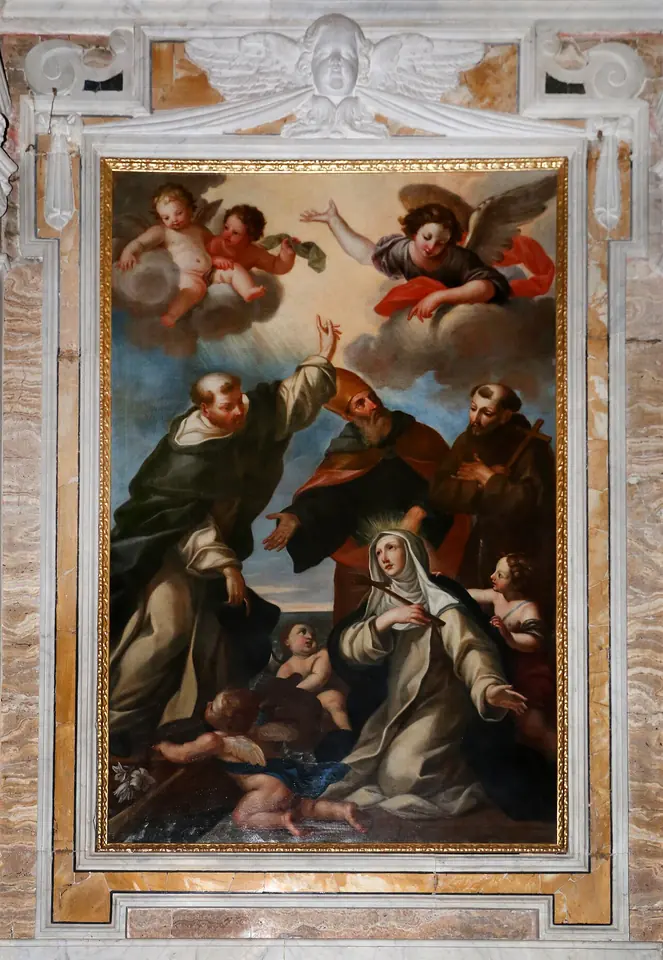
In her last years Agnes suffered constant pain. Her superiors sent her to the hot springs of Chianciano, a few miles away. Raymond fills the visit with wonders: manna falling on the baths, a new hot spring rising where she bathed (still called the Bagno di Sant'Agnese), a girl's deep knife wound healed, and a drowned child given back alive to his mother after Agnes prayed over him. Others were healed. Agnes was not, and she came home worse.

She died at midnight on April 20, 1317, at about forty-nine. According to the life on the Santi e Beati website, her last words were, "My beloved belongs to me; I will never leave Him again."
The miracles of St. Agnes of Montepulciano
Raymond gives a whole book of his Legenda to the wonders after her death, which he says he drew from eyewitnesses and notarized records.
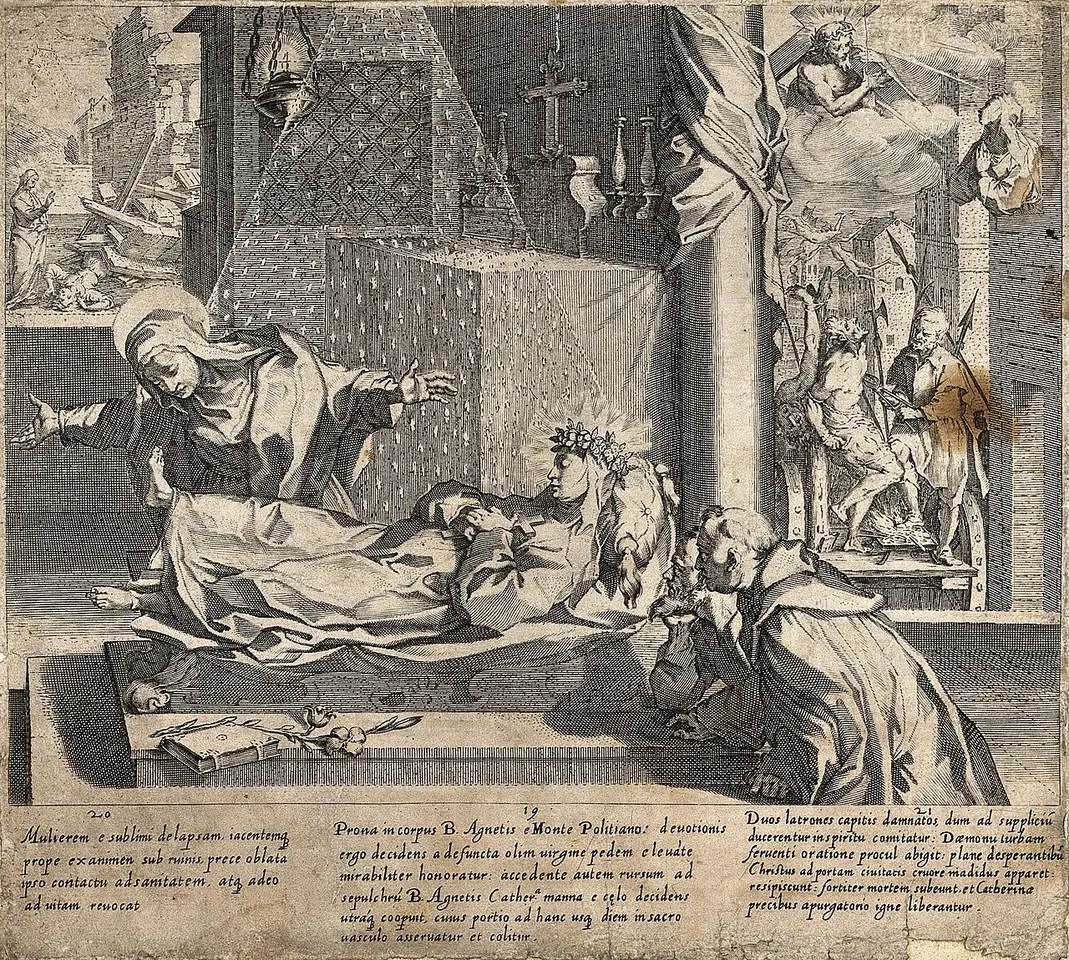
- Her body (reported). The people of Montepulciano sent to Genoa for balsam to embalm her, but before it arrived her fingers began to give off a fragrant liquid, and the blind, the lame and the crippled were healed by touching it. Her body stayed whole and supple.
- The woman with a withered arm (reported). A woman of Montepulciano saw Agnes in glory on the night she died and was told to visit her body. The nuns had not yet announced the death and turned her away, but when she described her vision they let her in, and her arm was healed as she touched the body.
- Healings from heaven (reported). Raymond lists the blind, the mute and the lame cured, a child of Chianciano raised, and a fire put out at Cigliano near Perugia, many of them by name and village.
- The miracles for her canonization (approved). The Church's judgment came in 1726, when Pope Benedict XIII canonized her. We have not found the specific miracles examined for that decree, so we don't list them here.
St. Catherine of Siena and St. Agnes
About thirty years after Agnes's death, Catherine of Siena was born, and she came to love Agnes as a spiritual mother. Raymond, who wrote the lives of both women, says an angel once showed Catherine a throne prepared for her in heaven and, beside it, another, where sat a young woman in a white habit and black mantle: "That is Agnes of Montepulciano, a daughter of St. Dominic too."
In the autumn of 1374 Catherine made a pilgrimage to Montepulciano with some of her companions. Kneeling at Agnes's body, she bent to kiss the feet, and the left foot lifted itself toward her lips, in front of everyone there. The Diocese of Arezzo notes that the foot is still in that raised position. On a later visit, when Catherine brought her niece Eugenia to enter the monastery, she kissed Agnes's head instead, and a fine white manna in the form of little crosses fell over those present. Both events come from Raymond and are traditional.
Catherine kept writing to the nuns. In a letter to Sister Cristofora, prioress of Sant'Agnese, she urged the sisters to "follow the footsteps of our glorious mother Agnese," whose chief virtue, she said, was true humility.
Symbols of St. Agnes of Montepulciano in art
You can usually recognize her by her Dominican habit and a small cluster of attributes.
- The habit. A white tunic, white veil and black cape and veil, the dress of Dominican nuns. Some images show her all in white.
- A lamb. A play on her name, agnus being Latin for "lamb," shared with the Roman martyr St. Agnes.
- Lilies. Her consecrated virginity.
- A tiny cross on a thread, or the Christ Child in her arms. Her vision on the Assumption, when the Child's little cross stayed in her hand.
- A crucifix. Her prayer before the crucifix and the time she was lifted up to embrace it.
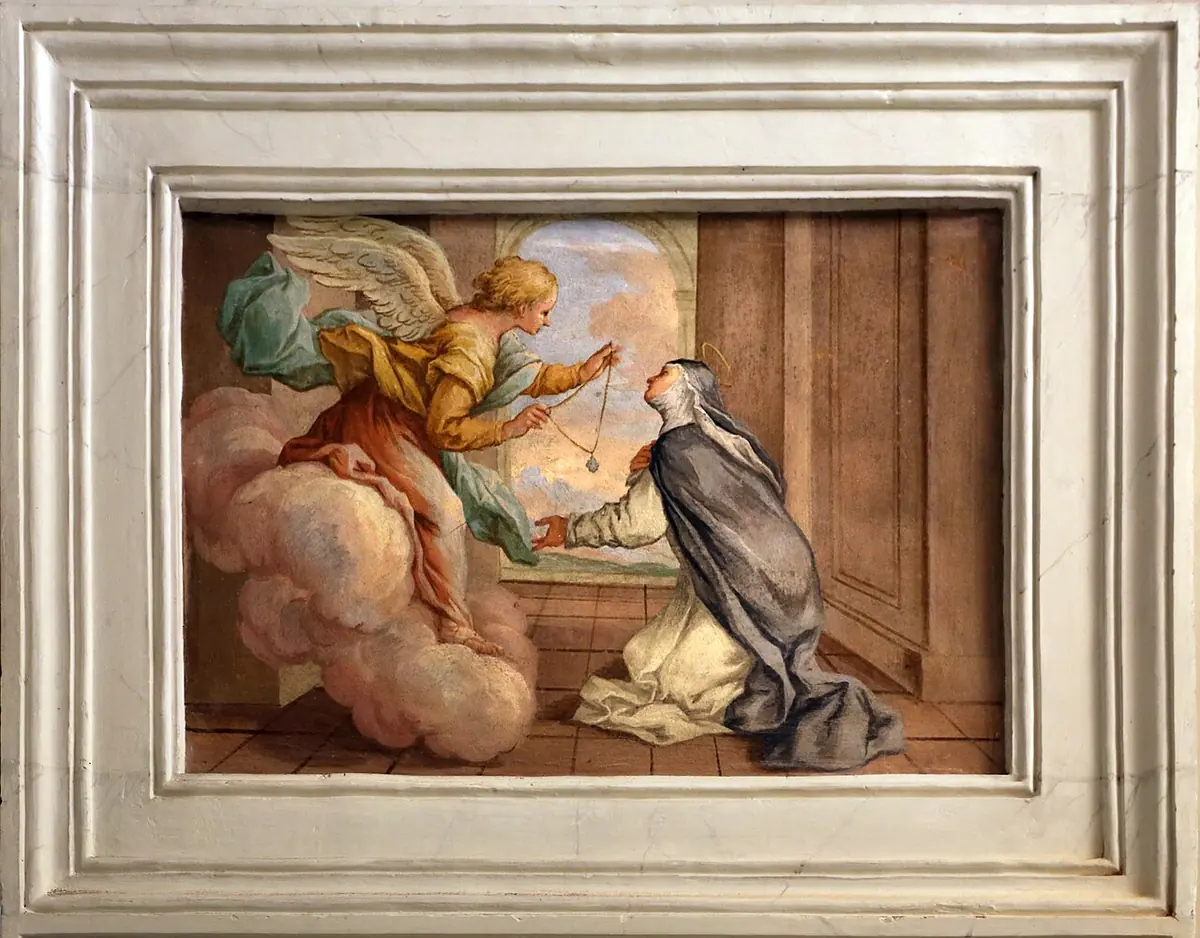
- An angel with a chalice or Host. Her legend tells of an angel bringing her Holy Communion, a scene painted in her cell in Montepulciano and carved on altars of the order.
- Manna falling like snow. Usually shown as white flakes or small crosses.
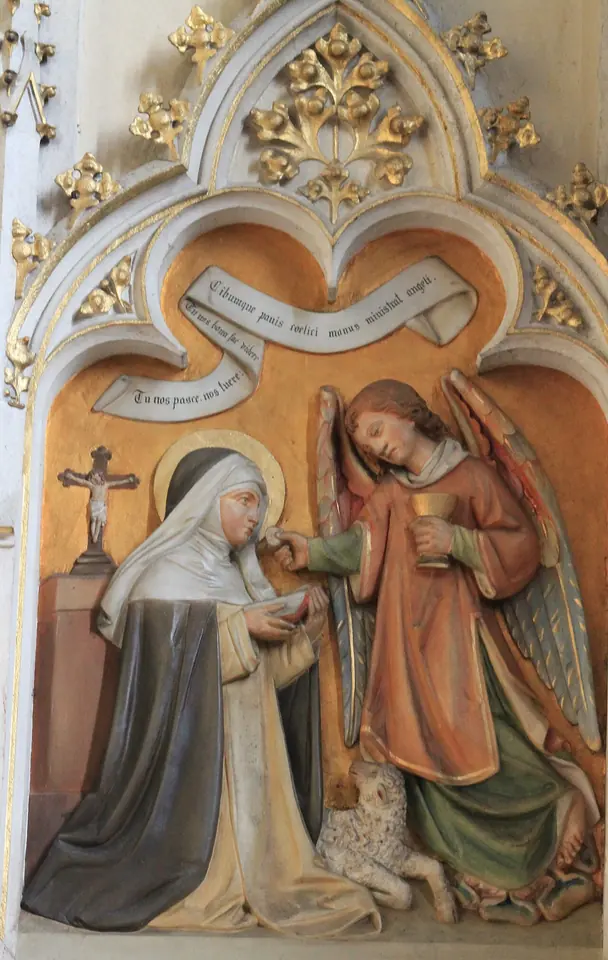
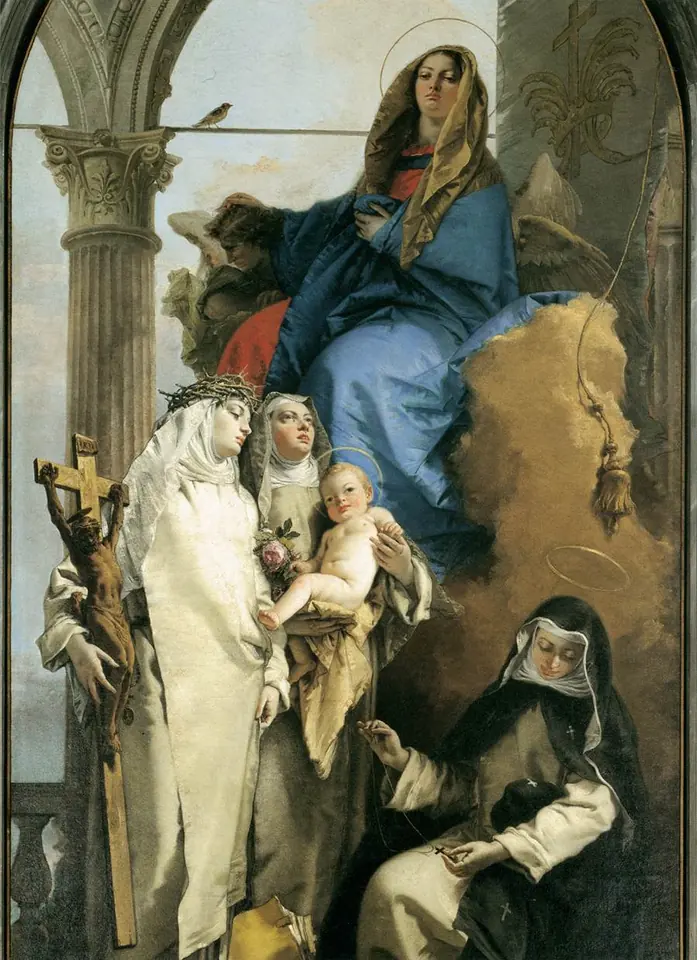
She often appears with other Dominican women. In Tiepolo's altarpiece in Venice she stands with St. Catherine of Siena and St. Rose of Lima. In Spain and its former empire, from Valencia to Quito and Manila, she is Santa Inés de Montepulciano and is usually shown holding the Christ Child.
Her feast day and shrine
We keep her feast on April 20. Montepulciano celebrated it from 1532, and the Dominican Order adopted it for all its houses in 1601. The faithful called her "Saint" long before any decree, and her church came to be known as Sant'Agnese rather than Santa Maria Novella. The Emperor Charles IV visited her tomb in the 14th century. On December 10, 1726, Pope Benedict XIII, a Dominican friar, canonized her.
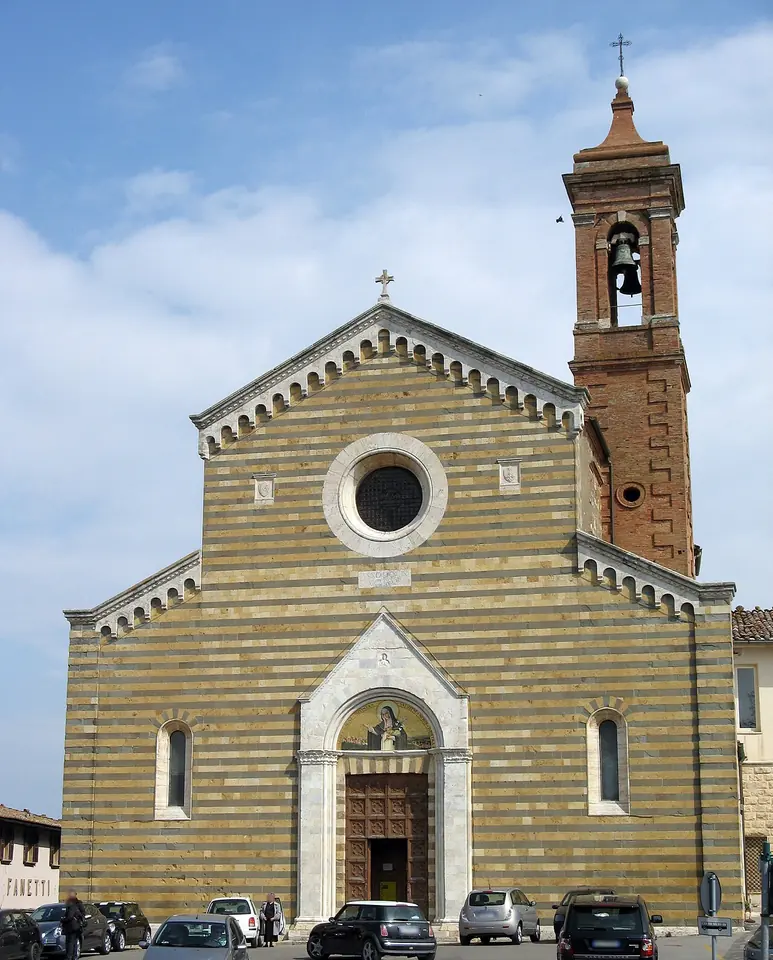
Her body is venerated in that church, now served by Dominican friars. Her cell in the convent holds her reliquaries, including the manna. Pilgrims coming to Montepulciano for its wine and its Renaissance streets can find her at the north end of town.
Prayer to St. Agnes of Montepulciano
The Church prays to God through St. Agnes in the collect of her feast-day Mass. This is the opening prayer from the proper Mass of the Diocese of Arezzo-Cortona-Sansepolcro, in our translation from the Italian:
O God, who adorned St. Agnes as a holy bride with an extraordinary fervor of prayer, keep our hearts always turned toward you, so that we may grow in the spirit of prayer. Through our Lord Jesus Christ, your Son, who lives and reigns with you in the unity of the Holy Spirit, God, for ever and ever. Amen.
The lunette over her church door carries an invocation that the Diocese of Arezzo gives as "Agnes, bride of the Lamb, obtain salvation for us." Let us ask St. Agnes to pray for us when prayer feels dry and our hearts wander, that like her we may hold on to Christ and not let Him go.
Frequently asked questions
When is the feast day of St. Agnes of Montepulciano?
April 20, the day she died in 1317. It is in the Roman Martyrology and the Dominican calendar, not the General Roman Calendar, so it is kept above all by Dominicans and in the Diocese of Montepulciano-Chiusi-Pienza.
Is the body of St. Agnes of Montepulciano incorrupt?
Her early biographer, Blessed Raymond of Capua, wrote that her body stayed whole and fragrant without embalming, and that a healing liquid flowed from her fingers. The body is venerated today in the Church of Sant'Agnese in Montepulciano. These are reported wonders, recorded with witnesses, not a modern scientific finding.
What happened when St. Catherine of Siena visited St. Agnes?
In 1374 Catherine made a pilgrimage to Montepulciano. As she bent to kiss the feet of Agnes's body, according to Raymond of Capua, one foot lifted itself toward her lips. On a later visit, white manna in the shape of tiny crosses fell on those present. Both are traditional accounts from Raymond, who knew Catherine personally.
Why is St. Agnes of Montepulciano shown with a lamb?
The lamb is a play on her name, since agnus is Latin for lamb, and it links her to the Roman martyr St. Agnes. Artists also give her lilies for purity, a crucifix, and a tiny cross on a thread, from the vision in which the Christ Child's cross stayed in her hand.
Who canonized St. Agnes of Montepulciano?
Pope Benedict XIII, himself a Dominican friar, canonized her on December 10, 1726, more than four hundred years after her death. The faithful of Montepulciano had called her "Saint" since the 1300s.
Keep exploring
Sources
- Diocese of Arezzo-Cortona-Sansepolcro: Santa Agnese da Montepulciano, vergine (proper Mass and Office, 2015). Her life from Raymond of Capua's Legenda, the collect of her Mass, the 1726 canonization date, Catherine of Siena's visits, Chianciano and the miracles after her death
- Catholic Encyclopedia (1907): St. Agnes of Montepulciano
- Richard Stracke, Saint Agnes of Montepulciano: The Iconography (Christian Iconography). Her attributes and the Acta Sanctorum text of Raymond's life
- Santi e Beati: Sant' Agnese Segni di Montepulciano. Her last words
- Raymond of Capua, Legenda of St. Agnes of Montepulciano (1366), in Acta Sanctorum, April, vol. 2
- Catherine of Siena, Letter to Sister Cristofora, prioress of the monastery of Sant'Agnese in Montepulciano