St. Peter the Athonite, First Hermit of Mount Athos
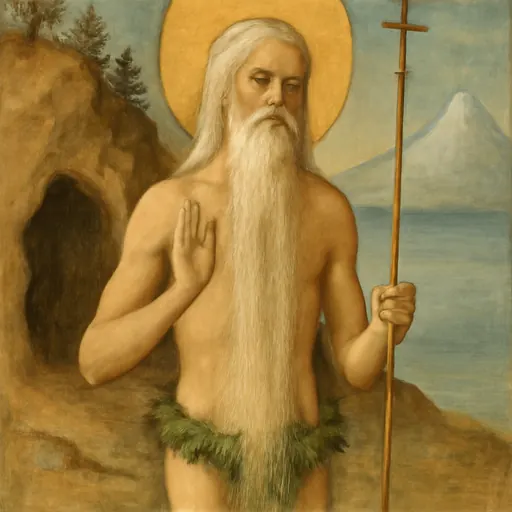
St. Peter the Athonite (Peter of Athos) was a Byzantine soldier who, after a miraculous release from captivity, became a monk and lived alone on Mount Athos for fifty-three years, from 681 until his death in 734. He is honored as the first known hermit of the Holy Mountain. His feast is June 12 in the Orthodox and Eastern Catholic churches.
Who was St. Peter the Athonite?
St. Peter the Athonite, also called Peter of Athos, was a soldier of the Byzantine army who became the first hermit of Mount Athos whose life we know. He reached the Holy Mountain in 681 and lived there alone for fifty-three years, until his death in 734. The Orthodox Church honors him on June 12, together with St. Onuphrius, another hermit of the desert.
Athos today is a peninsula of monasteries in northern Greece, home to monks for more than a thousand years. Peter came long before any of them. He found only forest, rock and sea, and the Mother of God, who in his story claims the mountain as her own garden.
His life is told in the Orthodox Church's lives of the saints. It reads like the old desert stories, full of visions and wonders, and we should receive it as the Church has handed it down: a portrait of holiness more than a chronicle.
The life of St. Peter
A soldier in chains
Peter was a Greek by birth and served in the imperial armies, living at Constantinople. In 667, during a war with the Syrians, he was taken captive and locked in a fortress at Samara on the Euphrates. In prison he asked himself which of his sins had brought this on him, and he remembered: he had once meant to leave the world for a monastery and never done it.
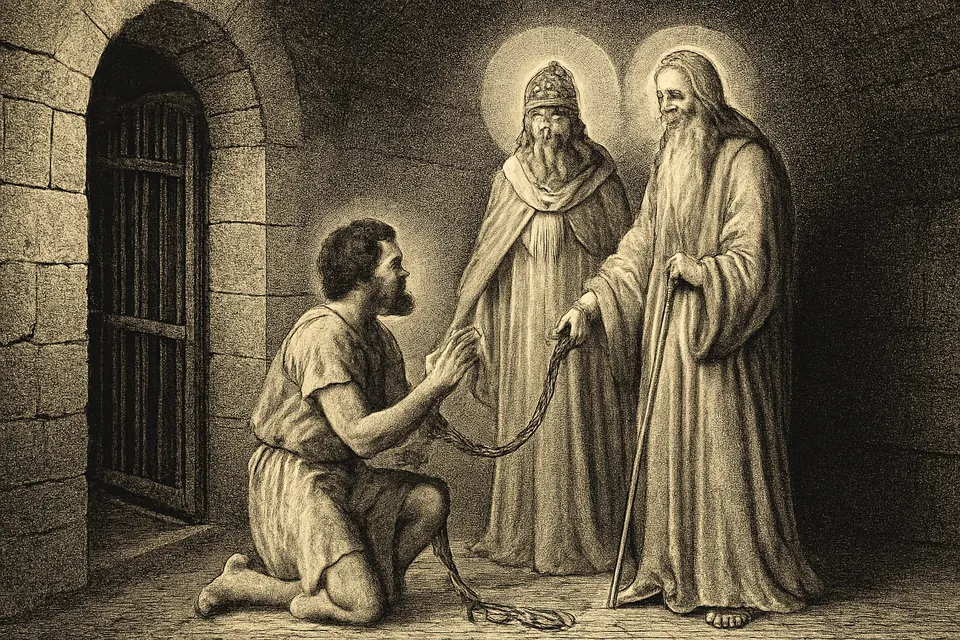
So he began to fast strictly and pray, and he asked St. Nicholas to intercede for him. According to the account, Nicholas appeared to him in a dream and told him to call on St. Simeon the God-Receiver, the old man who held the infant Jesus in the Temple. The third time, Nicholas came awake and in person, with Simeon beside him. Simeon touched his staff to Peter's chains, and they melted like wax. The prison doors opened.
Tonsured in Rome
Peter kept his vow this time. He went to Rome to receive the monastic habit at the tomb of the Apostle Peter. The Orthodox account says St. Nicholas appeared to the Pope in a dream and told him the whole story, so that the next day the Pope called out across the crowd for "Peter, you who are from the Greek lands," and tonsured him at the apostle's tomb.
Led to the Holy Mountain
Peter then sailed east. On the way he healed a whole household of sick people through his prayer. The Most Holy Theotokos showed him in a dream where he was to spend the rest of his days: Mount Athos. When the ship came alongside the mountain, it stopped of its own accord, and Peter understood and went ashore. That was in 681.

Fifty-three years alone
He lived in a cave in the wild places of the mountain and did not see another human being for fifty-three years. His clothes fell to rags, and his hair and beard grew long enough to cover him.
The struggle was hard at first. Demons came as soldiers, as wild beasts and as snakes. Then they tried tricks. One came in the form of a boy from his home village, begging him with tears to come back. Peter wept, but he answered:
Here have the Lord and the Most Holy Theotokos led me. I will not leave here without Her permission.
At the name of the Mother of God, the demon vanished. Seven years later the devil came again, this time as a shining angel, telling Peter that God wanted him out in the world to guide souls. Peter gave the same answer, and the devil did not come back. The Theotokos then appeared to him with St. Nicholas and promised that after a fast of forty days an angel would bring him heavenly manna, and so it happened.
The miracles of St. Peter the Athonite
All of these come to us through the Church's tradition of his life, and we label them traditional.
- The melted chains (traditional). St. Simeon's staff loosed his fetters at Samara.
- The sick household (traditional). On the voyage east, sailors asked him to pray in a house where everyone lay ill, and they were healed.
- The heavenly manna (traditional). After forty days of fasting, an angel fed him, as the Theotokos had promised.
- The hunter's brother (traditional). Near the end of his life a hunter chasing a stag came upon the hair-covered old man and was frightened. Peter calmed him, told him his story and sent him home for a year of self-examination, forbidding him to speak of the meeting. When the hunter returned with his brother, who was afflicted by a demon, Peter had already died. The brother was healed by touching the saint's body.

The Theotokos and the Holy Mountain
Peter's life holds one of the most loved sayings about Athos. In a vision, the Mother of God spoke to him of the mountain as her own domain. The Orthodox Church in America gives her words this way:
I have chosen this mountain... and have received it from My Son and God as an inheritance, for those who wish to forsake worldly cares and strife.... Exceedingly do I love this place. I will aid those who come to dwell here and who labor for God... and keep His commandments....
This is the root of the Athonite custom of calling the Theotokos the Abbess of the Holy Mountain, and of naming Athos the Garden of the Theotokos.
Symbols of St. Peter the Athonite in art
- Hair and beard covering the body: the long years alone, when his clothing wore away.
- A girdle of leaves: how the hunter found him, and how icons cover him.
- A staff with a cross: the hermit's staff, and also a reminder of St. Simeon's staff that broke his chains.
- Beside St. Onuphrius: because they share June 12, icons and prints often pair the two hermits. They look much alike, so read the inscription. Peter's usually says "Peter of Athos."
The gold-ground icon on this page shows him with St. Onuphrius and St. Macarius of Egypt, three desert fathers in one row.
Feast day and relics
We keep his feast on June 12. After his death his relics rested on Athos at the Monastery of St. Clement. During the time of Iconoclasm they were hidden, and in 969 they were carried to the village of Photokami in Thrace, the Orthodox Church in America records. Two centuries after Peter, St. Athanasius the Athonite founded the Great Lavra, and the Holy Mountain began to fill with the monks Peter had gone before. See more saints of June on our feast days page.
Prayer to St. Peter the Athonite
The Orthodox Church sings this kontakion on his feast (Tone 8, in the Orthodox Church in America's translation):
Planting the spiritual principles within your heart, O holy Peter, / you were made a vessel holy to the indivisible Trinity. / You obtained the grace of miracles and gave glory to God, singing: Alleluia!
The troparion of the day joins him with St. Onuphrius:
In the flesh you lived the life of the angels, / you were citizens of the desert and treasuries of grace, / O Onuphrius, adornment of Egypt, / and Peter the light of Athos. / Therefore we honor your struggles as we sing to you: / Glory to him who has strengthened you! / Glory to him who granted you a crown! / Glory to him who through you grants healing to all!
Let us ask St. Peter to pray for all who are held captive, for those who put off a promise they made to God, and for the monks of the Holy Mountain today.
Frequently asked questions
Who was St. Peter the Athonite?
A Greek soldier of the imperial army who was captured in a war with the Syrians in 667, freed through the prayers of St. Nicholas and St. Simeon the God-Receiver, tonsured a monk in Rome, and led by the Mother of God to Mount Athos, where he lived as a hermit for fifty-three years.
When is the feast of St. Peter the Athonite?
June 12. The Orthodox Church keeps it together with St. Onuphrius the Great, and the two hermits share one troparion.
Why is St. Peter of Athos shown covered in hair?
The Orthodox account says that during his long years alone his clothing wore away, and his hair and beard grew to cover his body in place of clothes. A hunter found him girded with leaves, which is how icons paint him.
Was St. Peter the first monk on Mount Athos?
He is the earliest hermit of Athos whose story has come down to us, which is why he is called the Athonite. The great monasteries came later, beginning with St. Athanasius the Athonite's Great Lavra in the tenth century.
Keep exploring
Sources
- Venerable Peter of Mount Athos, Orthodox Church in America. His capture in 667, the dates 681 and 734, the fifty-three years alone, the hunter, the relics at the Monastery of St. Clement and their move to Photokami in 969, and the Theotokos's words about Athos
- Venerable Peter of Mount Athos: Troparion and Kontakion, Orthodox Church in America. Texts of the troparion and kontakion quoted on this page
- Athos, Mount, Catholic Encyclopedia (1907), New Advent. Hermits on Athos before the monasteries, and St. Athanasius's founding of the Laura about 960