St. Euphrosyne of Polotsk, Abbess and Patron of Belarus
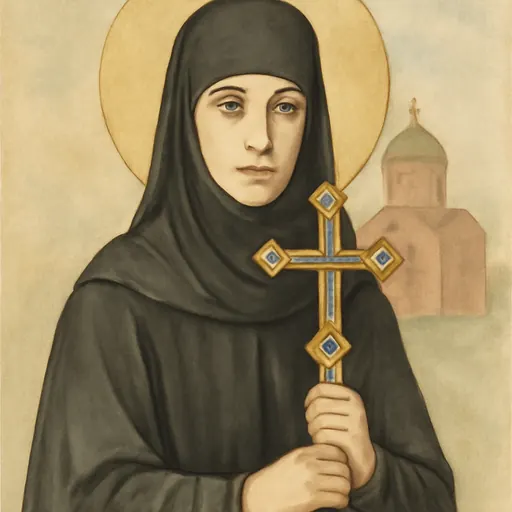
St. Euphrosyne of Polotsk (died about 1173) was a princess of Polotsk, in today's Belarus, who refused marriage, became a nun, copied books and founded the Savior convent at Polotsk. In 1161 she had a jeweled cross made for its church, the famous Cross of Euphrosyne, lost in 1941. She is honored as a patron of Belarus, and her feast is June 5 (May 23 on the Julian calendar).
Who was St. Euphrosyne of Polotsk?
St. Euphrosyne of Polotsk was a twelfth-century princess who gave up a royal marriage to become a nun, and then spent her life making books, building churches and teaching young women. She was born Predslava, a granddaughter of Prince Vseslav of Polotsk, in what is now Belarus. The convent she founded still stands, her church still stands, and her relics rest there today. The Orthodox Church honors her as a patron of women's monastic life, and Belarusians, Orthodox and Catholic alike, honor her as a heavenly patron of their land. We keep her feast on June 5, which is May 23 on the Julian calendar.

The life of St. Euphrosyne of Polotsk
The princess who chose the veil
Predslava was born between 1101 and 1104, the daughter of Prince Svyatoslav-Georgy, a son of Vseslav of Polotsk. The Orthodox life says she loved prayer and books from childhood. When she was offered in marriage, she refused and took monastic vows under the name Euphrosyne.
With the blessing of Bishop Elias of Polotsk, she lived in a small cell beside the Cathedral of St. Sophia. There she copied books by hand. Belarus's official portal adds that she helped with the work on the Polotsk chronicles.

Founder of convents
Around 1128 the bishop entrusted her with founding a women's monastery at Seltso, just outside the city, dedicated to the Transfiguration of the Savior. The Orthodox life says she took nothing with her but her holy books. There she taught girls to copy books, to sing, to sew and to do other handwork. She also founded a monastery for men dedicated to the Mother of God. Through her efforts the stone Church of the Savior was built, which still stands and is counted among the finest buildings of medieval Belarus.

At her request, the Orthodox life says, the patriarch of Constantinople sent a copy of the wonder-working Ephesus icon of the Mother of God. It became known as the Hodegetria of Polotsk.
The Cross of Euphrosyne
In 1161 Euphrosyne had a craftsman named Lazar Bogsha make a six-armed cross for her church. It was covered in gold and silver and set with gems and enamel images of saints, and Belarus's official portal calls it a unique masterpiece of early Belarusian art. It survived for nearly eight centuries, until it disappeared in 1941, during the evacuation of a museum in World War II. It has never been found.

Pilgrimage and death in Jerusalem
Near the end of her life she went on pilgrimage with her nephew David and her sister Eupraxia. After praying at the shrines of Constantinople she reached Jerusalem, where she fell ill. The Orthodox life says the Lord granted her a peaceful death at the Russian monastery of the Mother of God on May 24, 1173. Some sources give 1167.
Her relics and miracles
When Saladin took Jerusalem in 1187, her body was carried to the Caves Monastery in Kyiv. There it stayed for more than seven centuries. In 1910 her relics were brought home in procession to the convent she had founded at Polotsk, where they rest today.
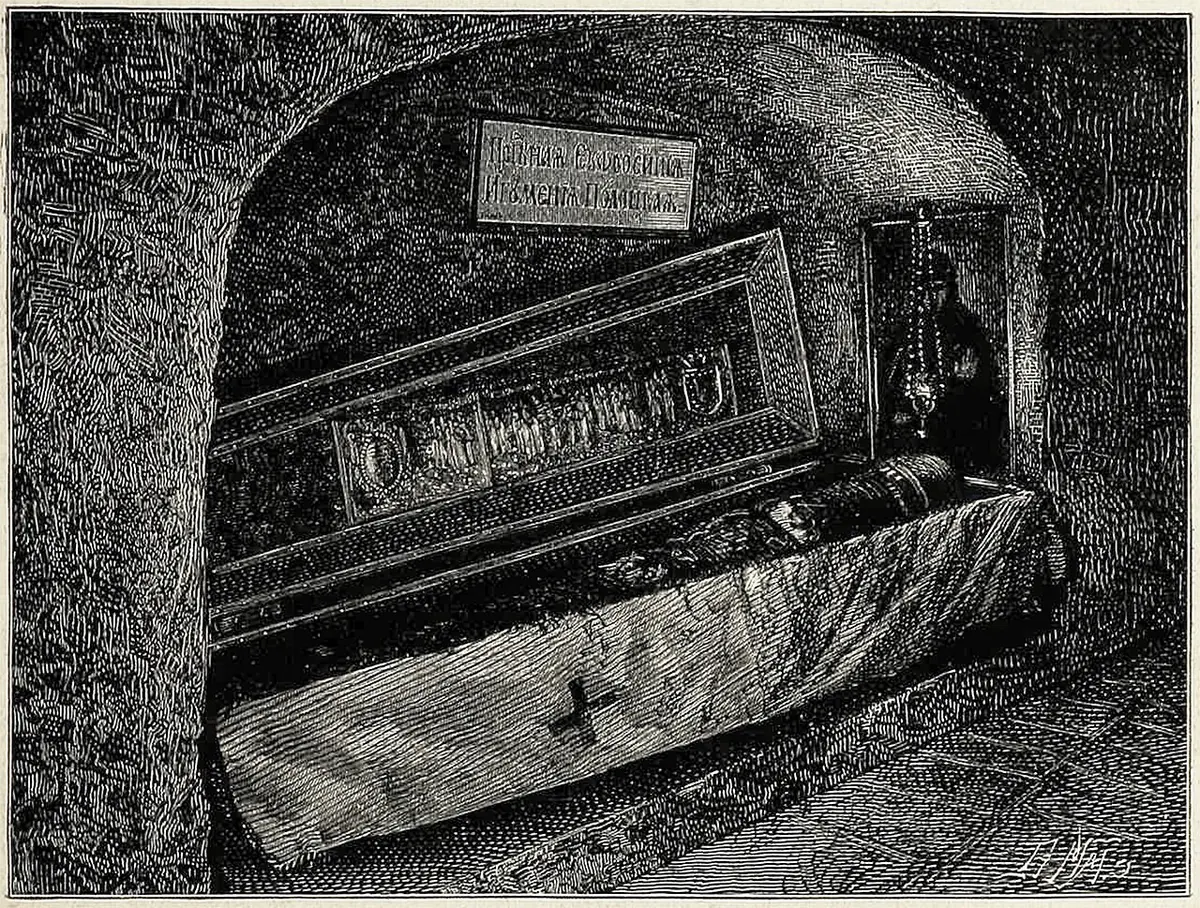
We know of no miracle of hers that the Church has formally examined. The faithful of Belarus have long asked her prayers at her shrine, and healings there are reported in Orthodox devotional tradition, not investigated by any formal process.
Why St. Euphrosyne is a patron of Belarus
Euphrosyne is among the earliest saints of the Belarusian land. She was a princess of Polotsk, the oldest town in Belarus, and she gave her life to its people: their books, their churches, their daughters' education and their peace. Belarus's official portal notes that she helped heal the old hostility between Polotsk and Kyiv.
Symbols of St. Euphrosyne of Polotsk in art
- A nun's black habit and veil, sometimes with the cap and mantle of an abbess.
- The six-armed Cross of Euphrosyne, held upright, her most recognizable sign.
- A book, for her copying and her love of learning.
- A small church in her hands, the Church of the Savior she built.
- White lilies, in some later icons, for her virginity.
The icon of about 1910 near the top of this page shows the cross and the lilies together. Belarusian coins and stamps show the cross on its own.
Where St. Euphrosyne is honored
The heart of her cult is the Savior and St. Euphrosyne Convent in Polotsk, where her relics lie and the twelfth-century Church of the Savior keeps rare frescoes from her time. On her feast, belarus.by notes, a festive service is held in St. Sophia Cathedral in Polotsk, the only one of the year, followed by a procession to her convent along the path she once walked. See our feast days calendar for other saints of June.
Prayer to St. Euphrosyne of Polotsk
The Orthodox Church sings hymns in her honor on her feast, but we know of no traditional English prayer to her that we can cite. Let us ask her, in our own words, to bless the people of Belarus, to keep young women close to God, and to make us love the Scriptures as she did. Holy Mother Euphrosyne, pray for us.
Frequently asked questions
When is the feast of St. Euphrosyne of Polotsk?
May 23 on the Julian calendar, which is June 5 on our civil calendar. On that day a festive service is held in St. Sophia Cathedral in Polotsk and a procession goes to her convent.
What is the Cross of St. Euphrosyne?
A six-armed cross of gold, silver, enamel and precious stones that Euphrosyne had made in 1161 by a craftsman named Lazar Bogsha for the Church of the Savior. It survived for nearly 800 years, but disappeared in 1941 during World War II and has never been found.
Where are the relics of St. Euphrosyne of Polotsk?
In the convent she founded at Polotsk. She died in Jerusalem, her body was taken to the Caves Monastery in Kyiv in 1187, and her relics came home to Polotsk in 1910.
Is St. Euphrosyne of Polotsk a Catholic saint?
She is honored above all in the Orthodox Church, which keeps her feast. Belarus's official portal notes that she is revered by Orthodox and Catholics alike in Belarus.
Keep exploring
Sources
- Orthodox Church in America: Venerable Euphrosyne, Abbess of Polotsk. Her baptismal name Predslava, the book copying, the convent founded around 1128, the cathedral of 1161, the Ephesus icon, her death in Jerusalem and the moves of her relics in 1187 and 1910
- Belarus.by (official portal of the Republic of Belarus): Euphrosyne of Polotsk. Her birth between 1101 and 1104, the June 5 feast and procession, and veneration by both Orthodox and Catholics