St. Nicholas the Pilgrim (San Nicola Pellegrino), the Greek Youth of Trani
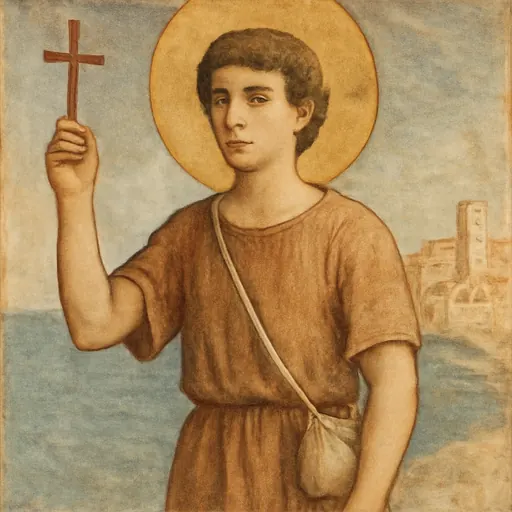
St. Nicholas the Pilgrim (San Nicola Pellegrino) was a young Greek from Steiri in Boeotia who wandered through southern Italy carrying a wooden cross and crying "Kyrie eleison" ("Lord, have mercy"). He reached Trani worn out and died there in 1094, still in his teens. Pope Urban II approved his cult, and the great cathedral of Trani was built over his tomb. He is the patron of Trani, and his feast is June 2.
Who was St. Nicholas the Pilgrim?
St. Nicholas the Pilgrim, San Nicola Pellegrino in Italian, was a Greek youth of the eleventh century who lived and died with one prayer on his lips: Kyrie eleison, "Lord, have mercy." He came from Steiri, a village in Boeotia below Mount Helicon, crossed the sea to southern Italy as a pilgrim bound for Rome, and died at Trani on the Adriatic coast on June 2, 1094. He was still in his teens.
Trani took him for its own. Within a few years Pope Urban II had approved his cult, and the city began the white Romanesque cathedral by the sea that still bears his name. Pope John Paul II described him in 1999 as "that Greek youth of 17 years named Nicholas, a pilgrim toward Rome," who "died of hardship" at Trani "while with the insistent cry of 'Kyrie eleison' he witnessed to everyone the need to return to God."
He is a different saint from St. Nicholas of Myra, the bishop whose relics had been carried to Bari, a few miles down the coast, only seven years before.

The life of St. Nicholas the Pilgrim
What we know of him comes from a Latin life written at Trani in the twelfth century, said to rest on the memories of a monk named Bartholomew who traveled with him. It is a holy story more than a chronicle, and much of what follows is tradition.
A shepherd boy who would not stop praying
Nicholas was born to poor farming parents at Steiri; later Greek writers give the year as 1075, which would make him nineteen at his death, though John Paul II, following Trani's tradition, called him seventeen. As a small boy he was sent out to keep sheep, and one day, the life says, he began to cry "Kyrie eleison" and never stopped. Neighbors and even his mother took it for madness. She punished him, and in time drove him from the house. He went up into the hills of Helicon, lived in a cave on wild plants, cut crosses from tree trunks and set them up at crossroads.

His family had him brought to the great monastery of Hosios Loukas, near his village, where the monks tried to drive out what they thought was a demon. Nothing changed. He kept praying the same three words, and they let him go.
Across the sea to Apulia
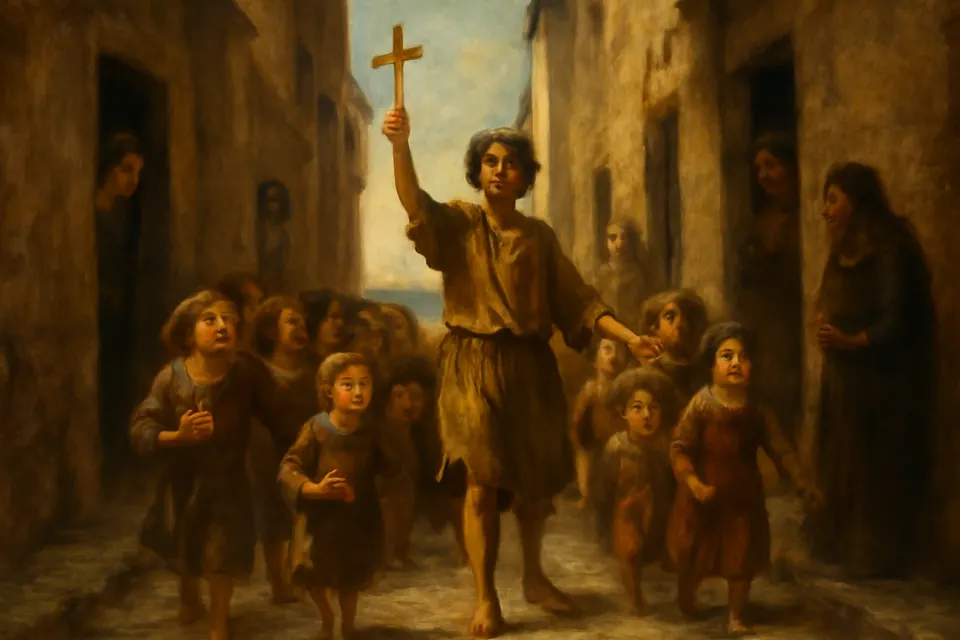
Around 1092, at Naupaktos on the Gulf of Corinth, he met the monk Bartholomew, and together they crossed to Otranto in the heel of Italy. From there Nicholas walked north through Apulia. He wore a short tunic and went barefoot, held a wooden cross in his hand, and called out "Kyrie eleison" in the streets. Children followed him, and he gave them fruit so that they would sing the words with him. Some towns laughed at him. The life says that at Taranto he was beaten and driven out.
Death at Trani
He reached Trani sick and exhausted at the end of May 1094. This time the town received him, and the archbishop gave him shelter. He died a few days later, on June 2, 1094. The diocese's own Mass text says simply that he "stopped at Trani, where he died a few days after his arrival, leaving a great fame of holiness."

The miracles of St. Nicholas the Pilgrim
Healings at his tomb began almost at once and are reported in the medieval life. The Roman Martyrology says his miracles were "related in the Roman Council, under Urban II," which is why the pope allowed him to be honored as a saint; that approval is historical, though the individual healings are not listed in any surviving papal document. Other wonders told of him, such as taming a bear in his mountain cave or calming the wind for a ship at Otranto, are traditional.
Why St. Nicholas the Pilgrim is the patron of Trani
The people of Trani took him as their patron from the start. His body was laid first in the old cathedral of Santa Maria della Scala. In 1099, after the papal approval, Trani began a new cathedral to hold his relics, and the church that stands on the sea front today grew from it. John Paul II wrote that the townspeople "wanted him as Patron of the City," and his feast is still Trani's great day.
Symbols of St. Nicholas the Pilgrim in art
He is easy to recognize once you know him:
- A wooden cross held high: the cross he carried through every town.
- A short pilgrim's tunic and bare feet: his poverty and his long walk from Greece.
- A young, beardless face: he died in his teens.
- Fruit or a small bag: the apples and figs he gave the children who sang with him.
- An open mouth or a scroll with "Kyrie eleison": his one prayer.
In the statues and paintings of Apulia he looks like a boy apostle with his cross raised over the crowd.
Feast day and his cathedral
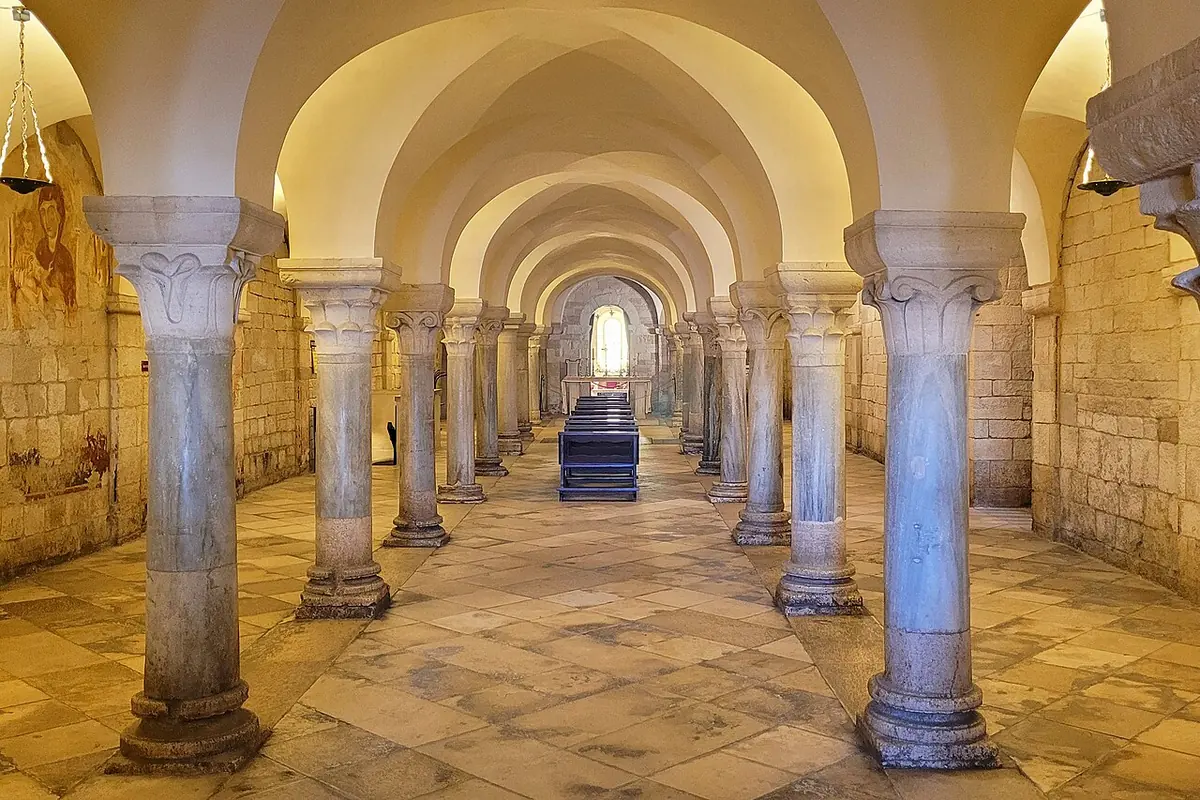
We keep his feast on June 2. Trani honors him with a pontifical Mass in the cathedral and, in summer, a great procession through the town and along the harbor. The cathedral, begun in 1099, is one of the finest Romanesque churches in southern Italy, and his relics rest in a reliquary in the crypt. See more saints of early June on our feast days page.

Praying with St. Nicholas the Pilgrim
The best prayer to learn from St. Nicholas is the one he prayed: Kyrie eleison, "Lord, have mercy." It is the oldest Greek cry of the liturgy, still sung at Mass, and the same plea that lies at the heart of the Jesus Prayer. We know of no traditional English prayer to him that we can cite. Let us ask his help in his own words: St. Nicholas the Pilgrim, you carried the cross and the cry for mercy from Greece to Trani; pray for all young people, for all who are laughed at for their faith, and teach us to say with our whole lives, Kyrie eleison.
Frequently asked questions
Who was St. Nicholas the Pilgrim?
A poor Greek youth from Steiri in Boeotia who, by tradition, spent his short life repeating "Kyrie eleison," crossed to Italy as a pilgrim and died at Trani in Apulia in 1094. Trani took him as its patron and dedicated its cathedral to him.
When is the feast of St. Nicholas the Pilgrim?
June 2, the day he died. Trani honors him again with a great procession in summer.
Is St. Nicholas the Pilgrim the same as St. Nicholas of Bari?
No. St. Nicholas of Bari is the fourth-century bishop of Myra, whose relics were brought to Bari in 1087. Nicholas the Pilgrim was a Greek youth who died at Trani, up the coast, seven years later.
Where is St. Nicholas the Pilgrim buried?
In Trani Cathedral, the Romanesque church by the sea begun in 1099 to hold his relics. His reliquary is in the crypt.
Keep exploring
Sources
- The Roman Martyrology (1916), June 2. "St. Nicholas Peregrinus, confessor, whose miracles were related in the Roman Council, under Urban II"
- John Paul II, Message to the Archbishop of Trani-Barletta-Bisceglie for the ninth centenary of the cathedral (October 4, 1999). His age, death in 1094, the cry of Kyrie eleison and the building of the cathedral from 1099 (in Italian)
- Omelia dell'Arcivescovo per il Pontificale di San Nicola il Pellegrino, 2 giugno 2025 (Archdiocese of Trani-Barletta-Bisceglie). The proper Mass text of the archdiocese and the Kyrie eleison from Steiri to Trani (in Italian)