St. Juliana Falconieri, Foundress of the Servite Sisters
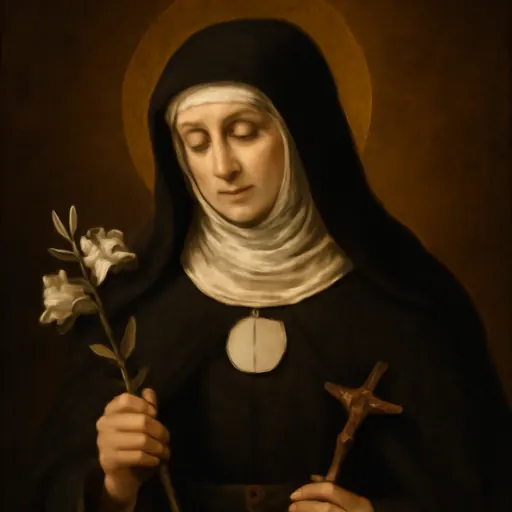
St. Juliana Falconieri (about 1270–1341) was one of the first women of the Servants of Mary and is honored as foundress of the Servite Sisters, the Mantellate. Tradition says as she lay dying, a Host was laid on her breast and vanished. Her feast is June 19, and she is invoked by the sick and for a holy death.
Who was St. Juliana Falconieri?
St. Juliana Falconieri was a holy woman of medieval Florence, born about 1270 into the Falconieri, a family of wealthy merchants, and the Church honors her as the foundress of the Servite Sisters. As a girl she turned down marriage, took the habit of the Servants of Mary, and spent her life in prayer, penance and the care of the sick. The women who gathered around her wore a black habit with a mantle, so Florence called them the Mantellate.
She died in 1341, by tradition on June 19. The story told of her death has made her one of the great Eucharistic saints: too ill to swallow, she asked that the Host be laid on her breast, and it vanished as she breathed her last. Pope Clement XII canonized her in 1737.
We keep her feast on June 19. Let us ask St. Juliana to pray for all who are sick, and for each of us, that we may receive our Lord worthily at the end of our lives.
The life of St. Juliana Falconieri
The story of Juliana's life as the Church has long told it comes from the Servite tradition, written down in its fullest form in the 1600s and 1700s for her beatification and canonization. The account below follows that tradition. A later section explains what historians can and cannot confirm.
A daughter of the Falconieri
Juliana's father, Chiarissimo Falconieri, was a rich Florentine merchant and a benefactor of the little church of the Servants of Mary at Cafaggio, just outside the old city walls. That chapel, with its miraculous fresco of the Annunciation, grew into the Basilica of the Santissima Annunziata, the mother church of the Servite Order. Her mother was named Riguardata.
The 1847 English life of the saint, translated from an Italian life written for her canonization, says her parents were old and had given up hope of children when she was born in 1270. It compares them to the parents of Samuel and of John the Baptist. Her father's brother, by the same tradition, was Alexis Falconieri, one of the seven Florentine merchants who left the world to found the Servants of Mary in 1233. He is honored today as St. Alexis Falconieri, one of the Seven Holy Founders.
Alexis, a lay brother who begged in the streets for his community, watched over his niece's upbringing. The old life says the first words the child spoke were the names of Jesus and Mary, and that her favorite game was building little altars to Our Lady and covering them with flowers.
No husband but Christ
When Juliana was fourteen, her mother set about arranging a marriage with a young nobleman of good family. Juliana would not hear of it. The 1847 life describes the mother moving from coaxing to tears to threats, and the girl standing firm.
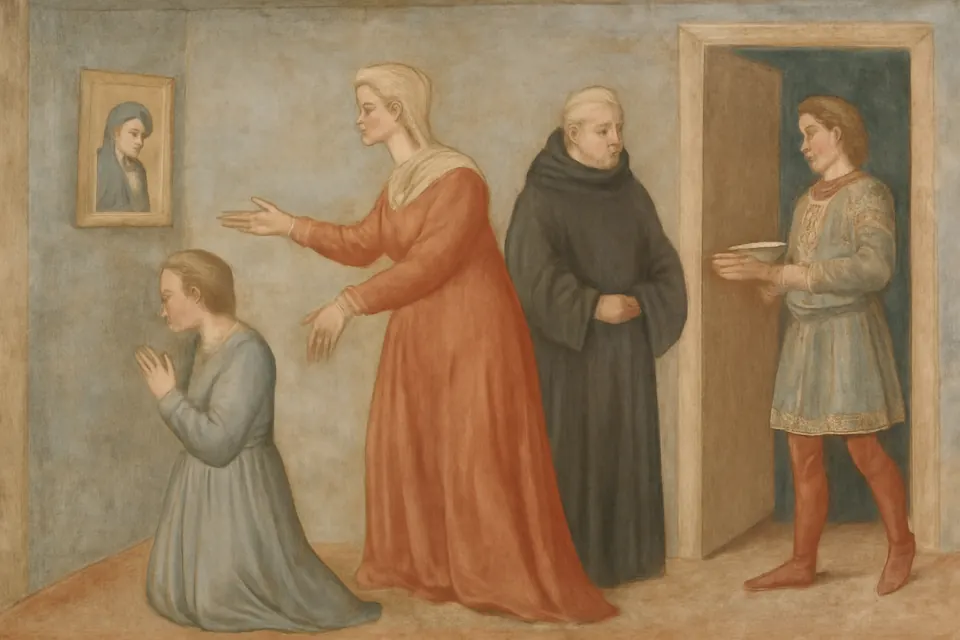
In the end Alexis persuaded Riguardata not to force her, and Juliana made a vow of virginity.
The habit of the Servants of Mary
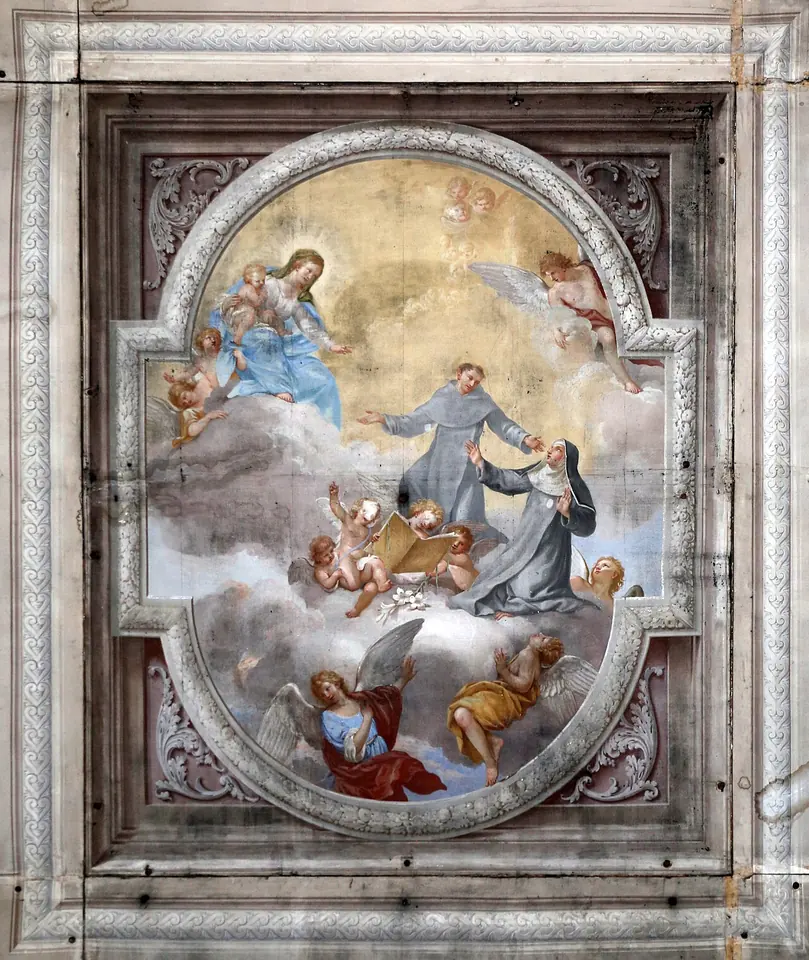
On her uncle's advice, Juliana asked to wear the habit of the Servites. No woman had yet received it. The tradition says Philip Benizi, the order's prior general and later a saint, clothed her in the habit of the Third Order at a chapter in Florence in 1284 or 1285, and that she made her profession in his hands a year later.

The old life adds that Philip, near his own death, entrusted to her prayers the whole Servite family, which was then in danger of being suppressed.
Juliana did not leave home at once. She lived in her parents' house under the rule Philip had given her, caring for her widowed mother. Other Florentine women began to follow her example, among them, the tradition says, her own mother.
The first Mantellate
After her mother's death, Juliana and several companions moved into a house of their own in 1305. The Catholic Encyclopedia calls it the first convent of the Sisters of the Third Order of Servites. The women chose her as their prioress, and she led them for some thirty-five years.
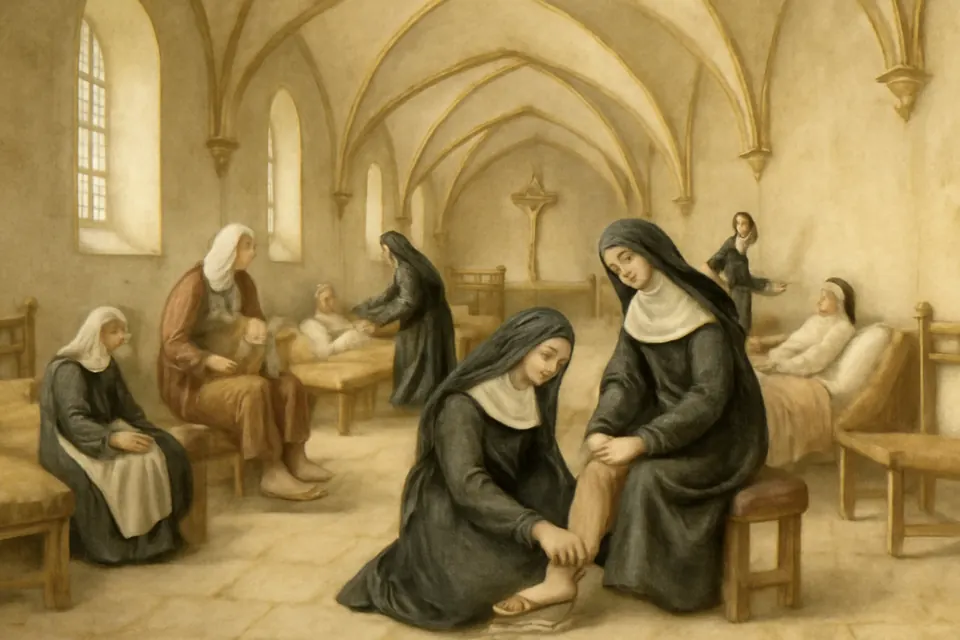
Their dress was a black gown with a leather belt and a white veil. The sleeves were short so they could work with their hands, and Florence called them the Mantellate after the mantle they wore over it. They prayed the Divine Office, looked after the sick in their homes and in the city's hospitals, and helped the poor. The 1847 life says Juliana gave away her own clothing to poor girls who were in danger of being drawn into sin, and that she refused her share of her father's inheritance, earning her bread by the work of her hands.
She is also said to have written the rule for her sisters, which Pope Martin V approved for the Servite tertiaries in the 1420s, long after her death.
Her prayer and her penances
The old life describes penances that are hard to read today: fasting on bread and water, iron chains and a hair shirt, sleeping on the floor. It also tells how a mention of sin could make her faint from grief, and how she often repeated a single prayer: "No one shall take from my heart my Crucified Love." Her devotion went above all to the Passion of Christ and to the sorrows of His Mother, the heart of Servite spirituality.
The same life says that on Wednesdays and Fridays she took no food but the Eucharist. The Dicastery for the Causes of Saints notes that she suffered for years from an illness of the stomach, with sharp pains, until in old age she could hardly keep any food down. That illness set the scene for her death.
The miracle of the Host at her death
This is the story that has made St. Juliana loved for seven centuries. We label it traditional: it has been told since the first accounts of her and is named in the prayer of her feast, but the documents once offered as eyewitness records of it were later judged unreliable.
In June 1341, Juliana was about seventy and dying. She could not keep anything in her stomach, so the priest could not give her Holy Communion as Viaticum, for fear she could not swallow the Host. Her greatest sorrow was to die without receiving her Lord. She asked at least to see the Blessed Sacrament, and when it was brought, the 1847 life says, she slipped from her bed to lie on the floor in the shape of a cross in adoration.
Then she asked for one more thing. Could the Host be laid on her breast, near her heart? The priest agreed. A veil was placed on her chest, a corporal over it, and the Host on the corporal. Juliana said, "O my sweet Jesus!" and died. When the bystanders looked, the Host was gone. As the sisters prepared her body, one of them, her disciple Giovanna Soderini, found over the heart a mark like a seal, bearing the image of Christ on the cross, like the image stamped on the Host.

The traditional collect of her feast, approved by Pope Benedict XIII in 1728, recalls how God wonderfully refreshed the dying Juliana with the precious Body of His Son, and asks Him to strengthen us in the same way in our last agony. Servite Sisters in several congregations still wear a badge on their habit in memory of the Host.
What history can tell us about St. Juliana
Love for a saint goes hand in hand with love for the truth, and the honest truth is that we know very little about Juliana's life for certain.
Franco Andrea Dal Pino, a Servite historian, wrote her entry in the Dizionario Biografico degli Italiani in 2001. He notes that the first written mention of her comes from a Servite friar, Paolo Attavanti, in a dialogue written in 1465–67, more than a century after 1341. Attavanti's first account speaks only of a holy virgin of Florence who wore the habit of the Servants of Mary. His second, printed in Siena in 1494, adds the Falconieri family, the uncle Alexis, the beauty, and the vanishing Host. The Servite chronicler Arcangelo Giani admitted in 1618 that he had found nothing about her in the convent registers of Florence before Attavanti.
Dal Pino reports more. The Bollandists, the Jesuit scholars who study the lives of the saints, raised doubts about several details, including whether Alexis belonged to the Falconieri family at all. The register of the Florentine friary for 1338 to 1342 records the burials of several Falconieri women but no Juliana. And two documents presented during the canonization process, an account of her death said to date from July 1341 and a life said to date from 1384, were later found to be forgeries. Dal Pino suggests that an earlier holy woman of the order, Blessed Giovanna of Florence, may have been merged with Juliana in the Servite memory.
None of this takes away what the Church has done. A canonization does not rest on every detail of a biography, and the Church canonized Juliana after examining her cult and the miracles worked at her intercession. It does mean we should hold the colorful details of her life lightly: the suitor, the pins hidden in her hair, the exact words at her death. What has been believed of her from the first is simple and enough: a woman of Florence who gave herself wholly to Christ and His sorrowful Mother, served the sick, and longed for the Eucharist at the end.
The miracles of St. Juliana Falconieri
The miracles approved for her canonization
The Servite friars opened her cause in the 1660s. In 1678 the Church confirmed the devotion long paid to her, which made her Blessed. The canonization process followed. According to the 1847 life, which quotes the papers of the Congregation of Rites, Pope Benedict XIII on September 8, 1729, approved four of the nine miracles proposed. Our sources don't say which four. Pope Clement XII, himself a Florentine, completed the canonization in June 1737.
Cures sworn to in Pisa and Rome
The 1847 life lists cures that witnesses described under oath in the canonization process. These are reported miracles: sworn and recorded, though we cannot tell from our sources which, if any, were among the four approved.
- At Pisa on the feast of St. Juliana in about 1716, Father Orazio Riminaldi, a Servite who had been paralyzed on his left side by a stroke for six months, said Mass at her altar with great difficulty. At the first memento he asked for help through her merits and felt his side "set at liberty."
- In 1711 a surgeon of Pisa, Francesco Parabosco, who had been unable to swallow for weeks because of a throat infection, drank water in which her relic had been placed and said at once, "I am cured!"
- In 1712 Sister Angela Gattai, a lay sister at Pisa ill with asthma, was touched on the head with the saint's veil and recovered, according to the physician's testimony.
- In Rome on August 6, 1692, a thirteen-year-old boy, Giuseppe Fornici, who had already received the Last Rites, opened his eyes and spoke after his mother prayed to Juliana. He relapsed twice, and twice recovered after her relics were applied. The attending physician swore the cure was miraculous.
- A Franciscan priest of Rome, Fra Tommaso of Spoleto, dying of consumption, drank water with a little of her relic grated into it and dreamed of a woman in a black habit who made the sign of the cross over his heart. He woke cured, and his doctor said he had expected to find him dead.
Many of these cures came to women in dangerous childbirth and to the very sick, which is part of why the faithful have turned to her when the body fails.
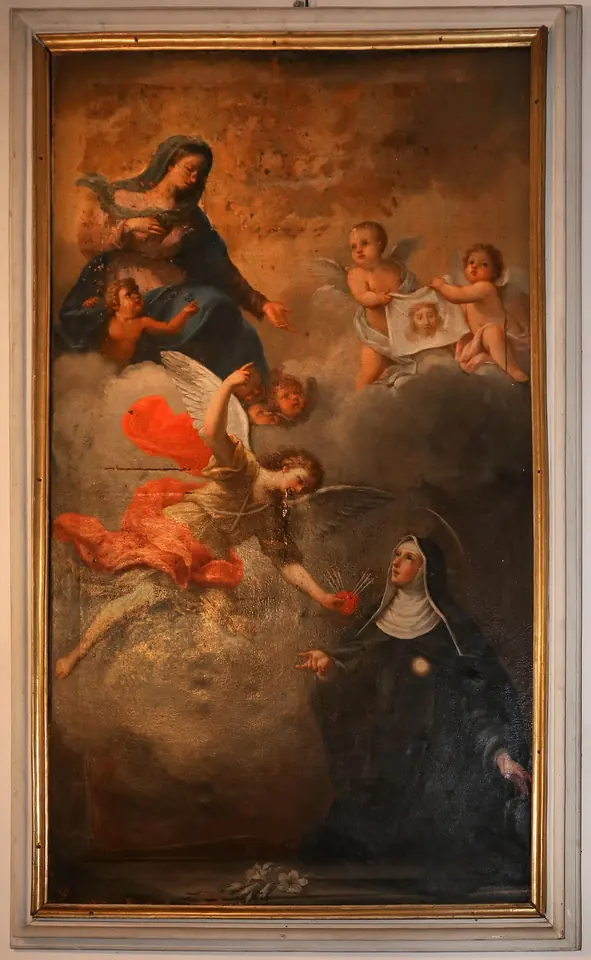
Why St. Juliana is the patron saint of the sick and of a holy death
St. Juliana was never named patron of anything by a decree. Her patronages grew from her life and from the prayers of the faithful.
- The sick and bodily ills. She spent her life nursing the sick of Florence, and she suffered herself from a long, painful illness that left her unable to eat. Many of the sworn cures at her intercession were healings of the body.
- A happy death. Her own death, longing for the Eucharist when she could not receive it, made her the saint Catholics ask for the grace to receive the sacraments before they die. The 1847 life ends with a prayer asking her to be the "protectress of the dying," so that no one sets out for eternity without the company of their Redeemer in the Blessed Sacrament.
- The Servite Sisters. She is honored as their foundress and mother. Pisa also chose her as one of its holy protectors, according to the same life.
Symbols of St. Juliana Falconieri in art
St. Juliana is one of the easiest saints to recognize, once you know to look for the Host.
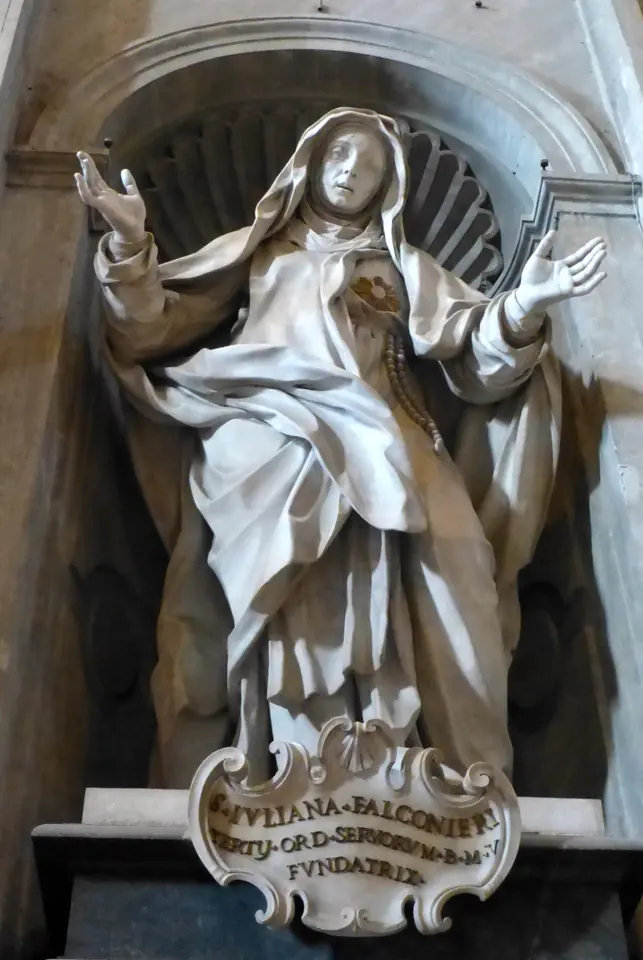
- A Host on her breast. Her chief attribute. Painters show a small round white Host shining over her heart, sometimes stamped with a cross or the crucified Christ, recalling the miracle at her death.
- The Servite habit. A black habit and black mantle with a white veil and wimple, sometimes with the leather belt. It marks her as a Mantellata, a sister of the Servants of Mary.
- A lily. The ordinary sign of virginity, for her vow as a girl.
- A crucifix. For her devotion to the Passion and the words "No one shall take from my heart my Crucified Love."
- Our Lady of Sorrows. She often appears with the Sorrowful Mother, or with the Virgin and Child, because the Servites are the order of Our Lady's sorrows.
- A book. The rule she gave her sisters, as foundress.
- A skull. Rarer, and found in older images. Dal Pino traces it to Attavanti's story that she gave herself to God after hearing a sermon on the Last Judgment.
Baroque artists liked two scenes above all: her clothing with the habit by St. Philip Benizi, and her death, with the sisters gathered around her and heaven opening. In churches she is often paired with Philip Benizi. Look for a nun in black with a white veil and a glowing Host on her breast, and you have found St. Juliana.
Her best-known statue is the one by Pietro Paolo Campi among the statues of founders of religious orders in St. Peter's Basilica. She stands with arms flung open, the Host on her breast, above a cartouche naming her foundress of the Servite Sisters.
Feast day and where St. Juliana is honored
June 19
Pope Innocent XII allowed the Servite Order and the city of Florence to celebrate her Mass and Office in 1698, and Pope Clement XI raised its rank in 1710. Pope Benedict XIII had her name placed in the Roman Martyrology in 1728, and her memorial entered the Roman calendar in 1738. The 1969 reform of the calendar left her feast to particular calendars, explaining that its importance was not truly universal. So today she is celebrated on June 19 above all by the Servite family and in Florence, while the faithful everywhere are free to honor her that day.
The 1847 life recommends a "devout exercise" of seven prayers in her honor, to be prayed every Thursday or for seven days before her feast, asking for the grace "always to receive Him worthily in the most august Sacrament, and especially in our last illness before we die."
The Santissima Annunziata in Florence
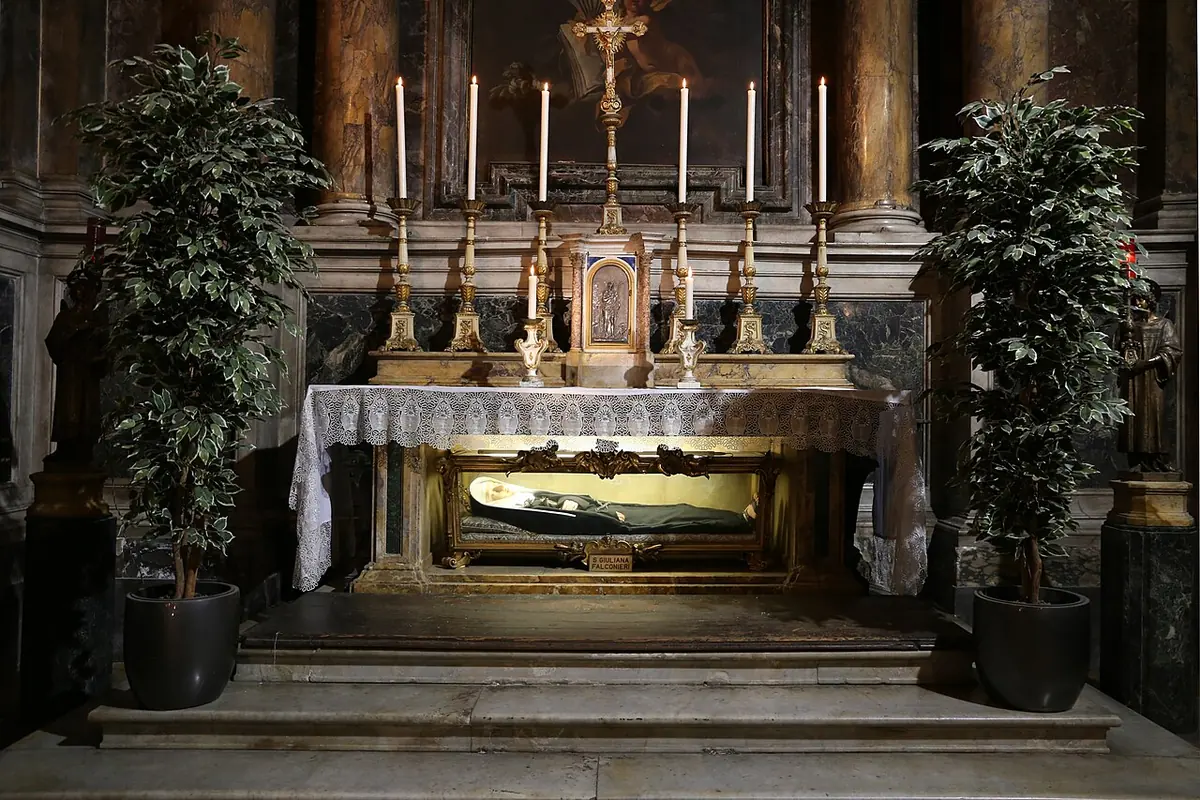
Juliana's body lies in the Basilica of the Santissima Annunziata, the church her father helped to build, under the altar of the Falconieri chapel, which is now the chapel of the Blessed Sacrament. The chapel also has a statue of her carved by Giovacchino Fortini in 1704. Pilgrims to Florence who come to pray before the miraculous Annunciation fresco can kneel a few steps away at her tomb.

When you visit, come in quiet. The chapel is now dedicated to the Blessed Sacrament, so the woman who longed for the Eucharist as she died rests beneath an altar of the Eucharist.
Beyond Florence
The church of the Mantellate in Florence keeps several paintings of her. In 1612 the widowed Archduchess Anna Caterina Gonzaga founded a Servite convent in Innsbruck, took the name Anna Juliana, and obtained a relic of the saint for its church. Churches in her name stand in Rome's Gianicolense quarter and in Red Cloud, Nebraska, among other places, and congregations of Servite Sisters around the world look to her as their mother.
Prayer to St. Juliana Falconieri
The collect of her feast
The oldest prayer in her honor is the collect of her Mass, approved in 1728 and printed in the 1847 life. In Latin it reads:
Deus qui Beatam Julianam Virginem tuam extremo morbo laborantem, pretioso Filii tui Corpore mirabiliter recreare dignatus es; concede quaesumus, ut ejus intercedentibus meritis, nos quoque eodem in mortis agone refecti ac roborati, ad caelestem Patriam perducamur. Per Dominum nostrum Jesum Christum Filium tuum, qui tecum vivit et regnat in unitate Spiritus Sancti Deus per omnia saecula saeculorum. Amen.
In our own plain English translation: O God, who were pleased to refresh wonderfully with the precious Body of your Son blessed Juliana, your virgin, as she labored in her last illness, grant, we pray, that through her merits and intercession we too may be refreshed and strengthened by the same in the agony of death and brought to our heavenly homeland. Through our Lord Jesus Christ, your Son, who lives and reigns with you in the unity of the Holy Spirit, God, for ever and ever. Amen.
From the Devout Exercise of 1847
The seventh of the prayers in the 1847 English life asks her help for a holy death. It is quoted here word for word:
O S. Juliana, how beautiful was the death that thou didst die! ... O great Saint, my special protectress, obtain for me, I beseech thee, the grace of a happy death. Assist me in life that I may not sin; and assist me in the hour of my death that I may end my days holily fortified by the blessed Sacraments of the Church, and so may die in the grace of God and be preserved from death eternal.
The prayer ends, as each prayer of the exercise does, with an Our Father, a Hail Mary and a Glory Be. Let us pray it for the sick we love, and for ourselves.
Frequently asked questions
Who was St. Juliana Falconieri?
A Florentine laywoman and religious of the late 1200s and early 1300s, traditionally the niece of St. Alexis Falconieri, one of the Seven Holy Founders of the Servite Order. She took the Servite habit as a girl, gathered women who cared for the sick and lived under a rule, and is honored as the foundress of the Servite Sisters, called the Mantellate.
What is the miracle of St. Juliana Falconieri?
Tradition holds that at her death in 1341 she could not receive Communion because she could not keep anything down. At her request a priest laid a corporal on her breast and placed the Host on it. The Host disappeared as she died, and the sisters later found the image of a cross over her heart. The old prayer of her feast thanks God for refreshing her wonderfully with the Body of his Son.
When is St. Juliana Falconieri's feast day?
June 19. Her feast entered the Roman calendar in 1738, and the 1969 reform left it to particular calendars. The Servite Order and Florence keep it on June 19.
What is St. Juliana Falconieri the patron saint of?
She is asked to pray for the sick and those with bodily illnesses, above all illnesses of the stomach like her own, and for the grace to receive the Eucharist before death. She is also the patron and mother of the Servite Sisters.
Why does St. Juliana have a Host on her chest in pictures?
The Host recalls the Eucharistic miracle told of her death. Painters and sculptors show it shining over her heart, often marked with a small cross, and Servite Sisters in some congregations wear a badge on their habit in memory of it.
Where is St. Juliana Falconieri buried?
Her body lies under the altar of the chapel named for her in the Basilica of the Santissima Annunziata in Florence, the mother church of the Servite Order, which her family helped to build.
Who are the Mantellate?
The name Florentines gave Juliana's sisters, from the mantle they wore over a black habit with short sleeves, made for working with the sick. Several congregations of Servite Sisters today trace their origins to her.
Keep exploring
- Patron saint pages
- Healing
- Feast-day calendar
- Saints remembered in JuneSaint of the dayWhat saint is my birthday?
- Relics
- Where the relics are kept (map)
- More
- Saints A to ZPatron saints A to ZExplore every section
Sources
- Catholic Encyclopedia (1910): St. Juliana Falconieri. The habit, the house of 1305, the Mantellate, the Host at her death, canonization and her feast
- Franco Andrea Dal Pino, "Giuliana Falconieri, santa," Dizionario Biografico degli Italiani, vol. 56 (2001). The late sources for her life (Paolo Attavanti, 1465–67 and 1494), the Bollandists' doubts, the canonization documents later judged false, and Blessed Giovanna of Florence
- The Lives of St. Rose of Lima, the Blessed Colomba of Rieti, and of S. Juliana Falconieri (Oratorian series, 1847). Her childhood, refusal of marriage, profession, penances, death, the cures sworn to at Pisa, the 1729 approval of four miracles, the Latin collect and the Devout Exercise, quoted
- Calendarium Romanum (1969), commentary on June 19. Her memorial, added to the Roman calendar in 1738, left to particular calendars
- Dicastery for the Causes of Saints: Giuliana Falconieri. Her fasting, her illness of the stomach, the Host at her death and the badge worn by the Mantellate