St. John Fisher
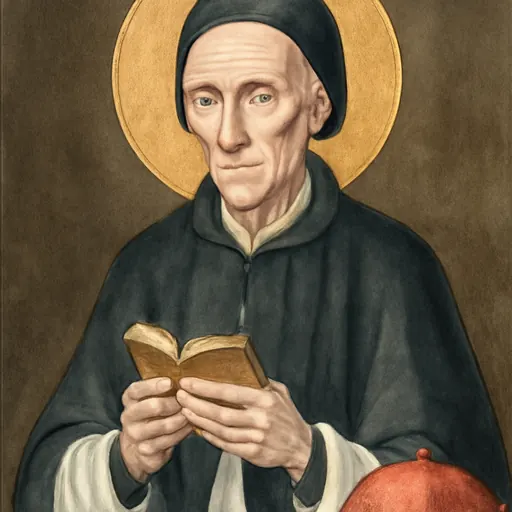
St. John Fisher (about 1469–1535) was the bishop of Rochester, chancellor of Cambridge University and a cardinal, beheaded on Tower Hill on June 22, 1535, for refusing to accept King Henry VIII as head of the Church in England. He was the only English bishop who would not give way. The Church honors him as a martyr, together with St. Thomas More, on June 22.
Who was St. John Fisher?
John Fisher was a Yorkshireman who spent most of his life at Cambridge and in the small diocese of Rochester in Kent. He was a scholar, a preacher, a reformer of his university and a bishop who lived like a poor man. In 1535, when he was about sixty-six and so thin that onlookers called him a living image of death, King Henry VIII had him beheaded for refusing to accept the king as Supreme Head of the Church in England.
Of all the bishops of England, Fisher was the only one who would not bend. The others took the oath, some of them sadly. He went to the Tower of London instead and stayed there for fourteen months. A month before he died, Pope Paul III made him a cardinal, which only hastened his end. He is counted as the only cardinal in the Church's history to die as a martyr.
We keep his feast on June 22, the day he died, together with his friend St. Thomas More, who followed him to the same scaffold two weeks later. The Church beatified Fisher in 1886 and canonized him in 1935.
Many people who search for "St. John Fisher" are looking for the university. St. John Fisher University in Rochester, New York, opened in 1951 as St. John Fisher College, and dozens of Catholic schools in England, Canada and Australia bear his name. All of them are named for the bishop on this page.
The life of St. John Fisher
A merchant's son at Cambridge
Fisher was born in Beverley, in the East Riding of Yorkshire, the eldest son of Robert Fisher, a merchant, and his wife Agnes. The Catholic Encyclopedia gives his birth year as 1459, with a question mark and 1469 as the alternative; most modern accounts accept 1469. He probably learned his letters at the school attached to Beverley's great collegiate church, the Minster.
In 1484 he went up to Michaelhouse, Cambridge. He took his bachelor's degree in 1487 and his master's in 1491, the year he became a fellow of his college and was made vicar of Northallerton. Three years later he gave up the parish to serve as proctor of the university, and in 1497 he became master of Michaelhouse.
Lady Margaret's confessor
Around 1497 Fisher became chaplain and confessor to Lady Margaret Beaufort, Countess of Richmond and Derby, the mother of King Henry VII. She was one of the richest and most devout women in England, and she trusted him completely. Under his guidance she founded Christ's College and St. John's College at Cambridge and endowed the Lady Margaret professorships of divinity at Oxford and Cambridge. Fisher was the first to hold the Cambridge chair.
In 1501 he became a doctor of divinity and vice-chancellor of the university. In 1504 he was elected chancellor, re-elected every year for ten years and then appointed for life. He brought the great Dutch scholar Erasmus to teach at Cambridge, and Erasmus later credited Fisher's protection for letting the study of Greek go forward there without the opposition it met at Oxford.

Erasmus called him "the one man at this time who is incomparable for uprightness of life, for learning, and for greatness of soul." Thomas More wrote that he knew no one in the realm "meet to be matched and compared with him" for wisdom, learning and long-proven virtue together.
When Henry VII and Lady Margaret both died in 1509, Fisher preached the funeral sermon for each of them. The sermons still survive.

Bishop of Rochester
A papal bull dated October 14, 1504, made Fisher bishop of Rochester, one of the smallest and poorest dioceses in England. Ambitious churchmen treated such sees as stepping stones. Fisher stayed there for thirty years and never moved to a richer one.
The life of Fisher on the website of St. John Fisher University describes his household: plain food at his table so that more could go to the hungry, blankets sent from his own bed to families suffering from the cold, and long nights sitting beside the sick and dying of his parishes. The early English life ascribed to Dr. Richard Hall, printed by the Redemptorist historian Thomas Bridgett in 1888, adds that he kept a skull on his altar to remind himself of death. He wore a hair shirt under his clothes until the morning of his execution.

Preacher against Luther
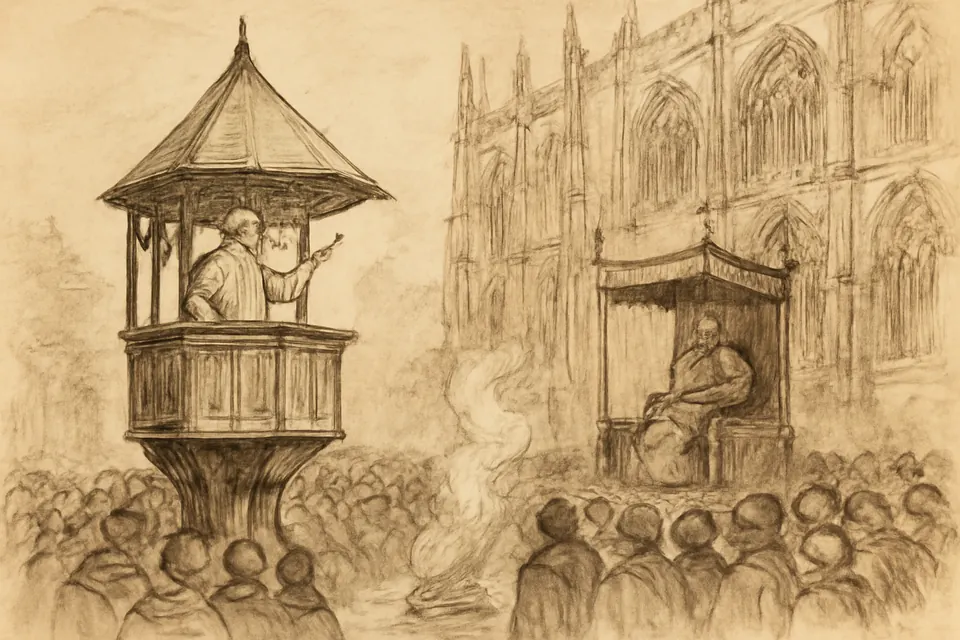
Fisher was the most respected preacher in England. When Martin Luther's books were publicly burned at St. Paul's Cross in London in 1521, Fisher preached the sermon, which was printed the same year. He then wrote long Latin works in defense of the Catholic faith: a reply to Luther in 1523, a defense of Henry VIII's own book against Luther, and in 1527 a treatise on the Real Presence of Christ in the Eucharist against the Swiss reformer Oecolampadius. The Catholic Encyclopedia counts twenty-six works by him, printed and in manuscript. Some writers have even claimed he was the true author of Henry's Assertio septem sacramentorum, the book that won the king the title Defender of the Faith, though the Catholic Encyclopedia says there is no real proof of it.
Counsel to Queen Catherine
When Henry VIII sought to annul his marriage to Catherine of Aragon, Fisher became the queen's chief defender. In 1529, before the two papal legates sitting in judgment at Blackfriars in London, he startled the court by declaring that, like St. John the Baptist, he was ready to die for the indissolubility of marriage. The comparison was pointed: the Baptist lost his head for telling King Herod he could not have his brother's wife. Henry was so angry that he wrote a long Latin reply himself. Fisher's copy survives, with his handwritten notes in the margins.
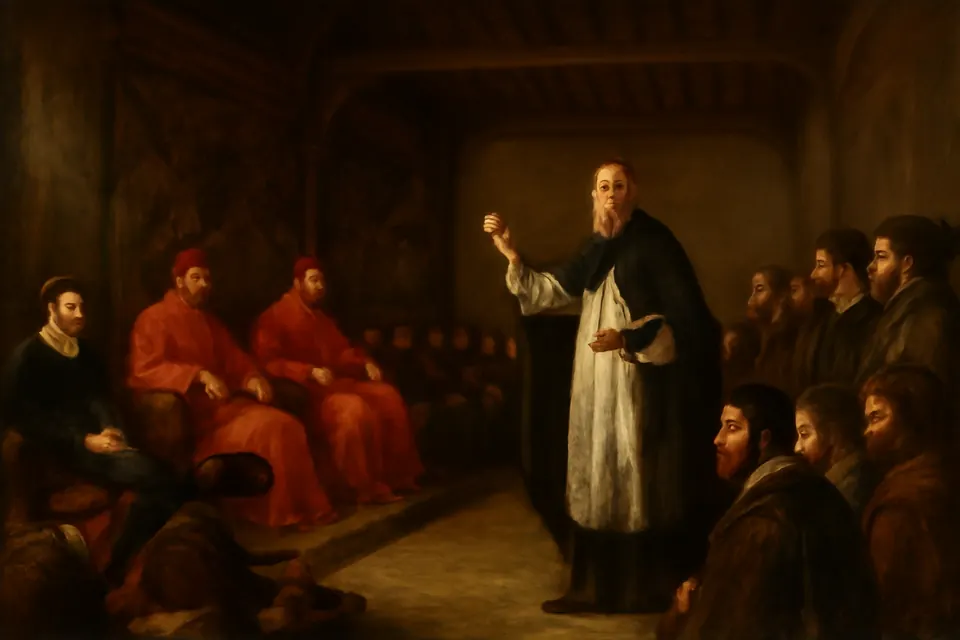
The king never forgave him. When Parliament began passing laws against the Church's rights in 1529, Fisher warned the House of Lords where they would lead. In 1531, when the clergy were forced to acknowledge Henry as Supreme Head of the Church in England, Fisher won the addition of the words "so far as God's law permits," as the Catholic Encyclopedia puts it. That same year several of his servants fell ill after eating porridge in his household, and two died. Many believed it was an attempt on his life.
Arrest and the Tower
In 1534 Parliament passed the Act of Succession, which required an oath accepting the children of Henry and Anne Boleyn as heirs and, with them, the break from Rome. In a letter to Thomas Cromwell he explained that he was "content to be sworn to that parcel concerning the succession," but refused "some other parcels" of the oath. He refused it and was sent to the Tower of London on April 26, 1534. Later that year he was attainted of misprision of treason, stripped of his goods, and his see of Rochester was declared vacant.
Bishops came to the Tower to talk him round. The early life gives his answer to one group of them, which ends with a sentence often quoted since:
The fort is betrayed even of them that should have defended it.
He told them that he was an old man and did not expect to live long, and that he would rather spend the rest of his days praying for the king than trouble his conscience by pleasing him.
The cardinal's hat
In May 1535 the new pope, Paul III, created Fisher cardinal priest of the title of St. Vitalis, apparently hoping the honor would move Henry to treat him more gently. It did the opposite. Fisher himself, questioned about it in the Tower, said that "if the cardinal's hat were laid at his feet, he would not stoop to pick it up, he did set so little by it." The early life reports Henry's own reply: "I will so provide that whensoever it cometh, he shall wear it on his shoulders, for head he shall have none to set it on." The imperial ambassador Eustace Chapuys wrote on June 16 that the king had said he would send the head to Rome for the hat.
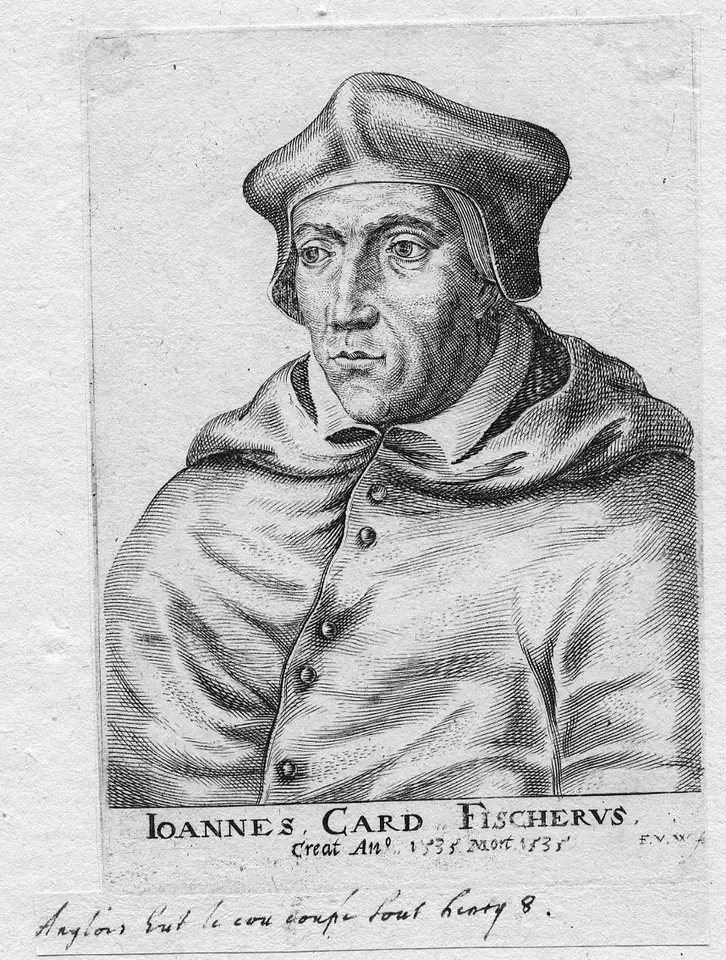
On June 17, 1535, Fisher was tried in Westminster Hall for denying that the king was Supreme Head of the Church. Bridgett shows that the key testimony came from Richard Rich, the solicitor general, who had drawn the bishop into a private conversation, claiming to come secretly from the king. Since his bishopric had been taken from him, he was tried by jury as a commoner, found guilty and sentenced to be hanged, drawn and quartered at Tyburn. The sentence was changed to beheading.
The martyrdom of St. John Fisher
The account of Fisher's last morning in the early life is one of the most moving passages in Tudor writing, and Bridgett checked its details against letters of the time.
The lieutenant of the Tower woke him at five o'clock on June 22 and told him he would die that morning. Fisher thanked him and asked when. At nine, he was told. "Well, then," he said, "let me by your patience sleep an hour or two, for I have slept very little this night." He slept soundly for two more hours.
When he woke, he told his servant to take away his hair shirt and bring out a clean white shirt and the best clothes he had. The servant asked why he took such care when he would have to take them off again within two hours. Fisher answered:
Dost thou not mark that this is our wedding-day, and that it behoveth us, therefore, to use more cleanliness for solemnity of the marriage?
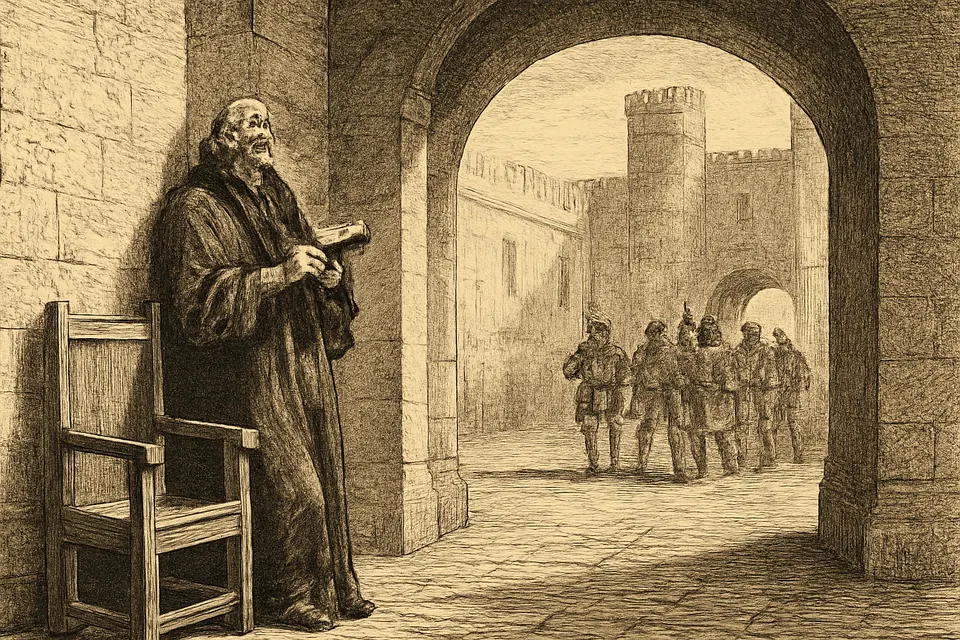
He was too weak to walk down the stairs and was carried in a chair to the Tower gate. While they waited there for the sheriffs, he stood, leaned his shoulder against the wall and opened the little New Testament he carried, praying, "O Lord, this is the last time that ever I shall open this book, let some comfortable place now chance unto me whereby I thy poor servant may glorify Thee in this my last hour." The page fell open at the seventeenth chapter of St. John: "This is life everlasting, that they may know Thee the only true God, and Jesus Christ whom Thou hast sent" (John 17:3, in the Douay version Bridgett quotes). He closed the book and said, "Here is even learning enough for me to my life's end." The same words are carved today on the front of Kearney Hall, the first building of St. John Fisher University.
At the foot of the scaffold on Tower Hill he waved away help and climbed the steps alone. The executioner knelt and asked his forgiveness, as was the custom. "I forgive thee with all my heart," Fisher told him, "and I trust thou shalt see me overcome this storm lustily." Then he spoke to the crowd:
Christian people, I am come hither to die for the faith of Christ's holy Catholic Church, and I thank God hitherto my stomach hath served me very well thereunto, so that yet I have not feared death; wherefore I do desire you all to help and assist me with your prayers, that at the very point and instant of death's stroke, I may in that very moment stand steadfast without fainting in any one point of the Catholic faith, free from any fear.
He prayed for the king and the realm, knelt, and, as some reported, recited the Te Deum and the psalm In te, Domine, speravi ("In you, O Lord, I have hoped"). He was beheaded with a single stroke at about ten in the morning. It was the feast of St. Alban, the first martyr of Britain, and two days before the feast of John the Baptist, his patron.

His body was stripped and left on the scaffold until evening, then buried without rites in the churchyard of All Hallows Barking. About two weeks later it was moved to the Chapel Royal of St. Peter ad Vincula inside the Tower and laid beside the body of Thomas More. His head was set on a pole on London Bridge.
The miracles of St. John Fisher
Fisher was canonized as a martyr. His holiness was proved by the manner of his death, not by a healing investigated in Rome. Sorted by the labels this encyclopedia uses:
- The head on London Bridge: reported. The early life says that for fourteen days the head did not decay in the hot summer weather but "grew daily fresher and fresher," with a ruddy color, so that crowds came to see it and blocked the bridge. The executioner was ordered to throw it into the Thames at night, and Thomas More's head took its place. The Catholic Encyclopedia repeats the account. A Latin letter printed at Antwerp in 1536 reports the same rumor from Flanders, while admitting, "I know not how truly."
- His clear voice on the scaffold: reported. The early life says the crowd took it as a marvel that so weak a body spoke so loudly and plainly.
- Approved miracles: none. Pope Leo XIII beatified him in 1886 among the English martyrs, and Pope Pius XI canonized him with Thomas More in 1935, the fourth centenary of their deaths.
Why St. John Fisher is a patron saint
No pope has named Fisher the patron of a profession, as John Paul II did for Thomas More and politicians. His patronages come from local devotion and from what he was in life.
- The Diocese of Rochester, New York: the young bishop James E. Kearney attended the canonization in Rome in 1935. Two years later he became bishop of Rochester, New York, a diocese with the same name as Fisher's English see, and chose St. John Fisher as its patron. He then invited the Basilian Fathers to found a college and gave it the name of the diocese's new patron. That college, opened in 1951, is now St. John Fisher University.
- Scholars, universities and Catholic schools: few bishops have done more for a university than Fisher did for Cambridge. The Catholic chaplaincy there is called Fisher House, and Catholic schools across England take his name.
- Bishops and priests under pressure: he is invoked as the shepherd who stood his ground when every other bishop gave way.
See more patrons on our patron saints page, and read what makes a martyr in the Church's eyes.
Symbols of St. John Fisher in art
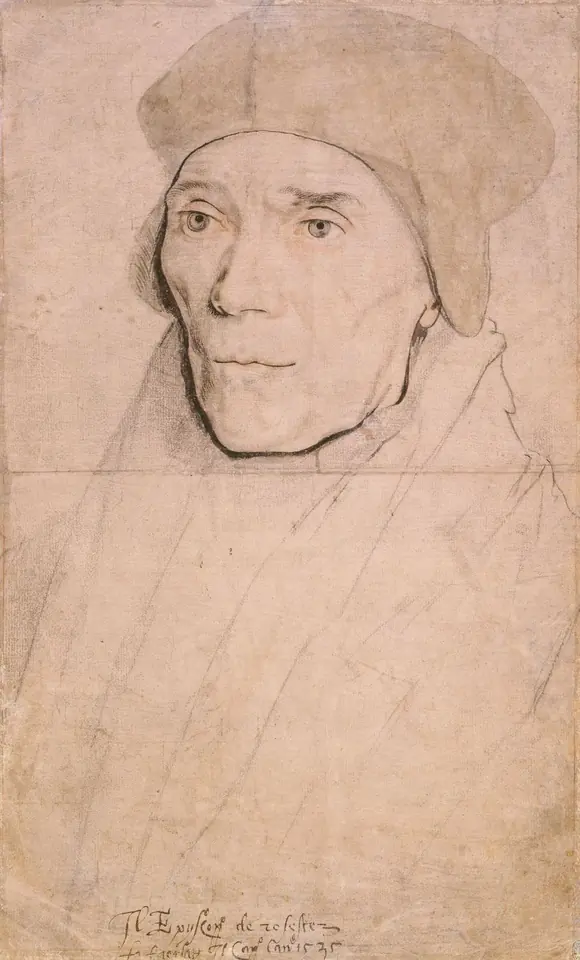
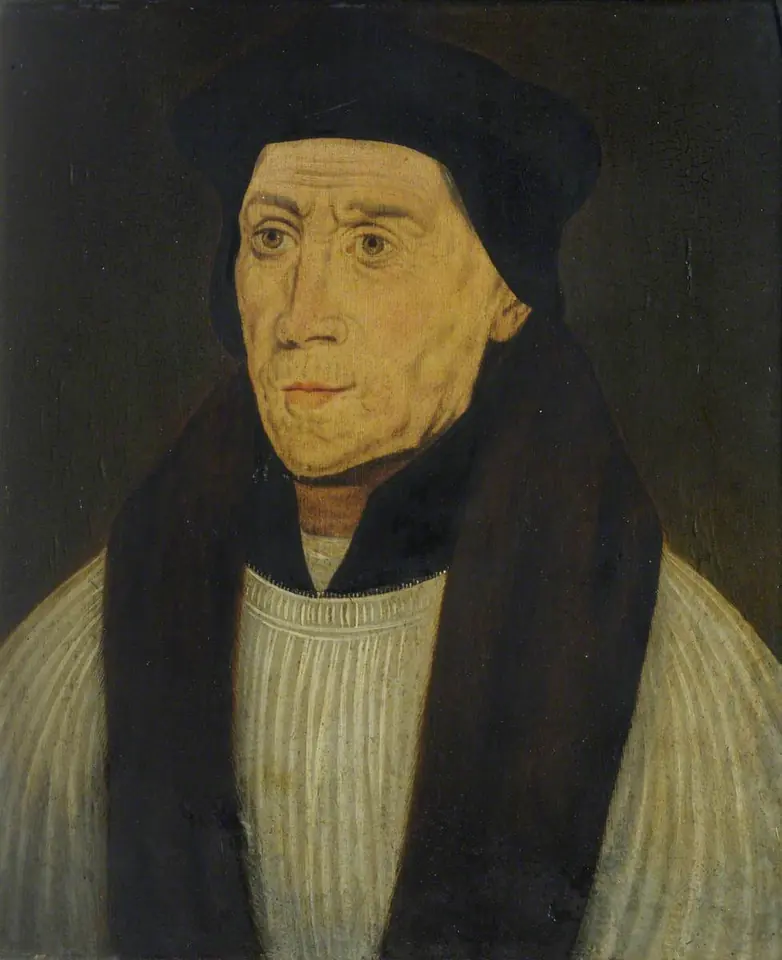
Every reliable likeness of Fisher goes back to one drawing: the chalk portrait Hans Holbein the Younger made in the early 1530s, now in the Royal Collection at Windsor. It shows a long, deeply lined face, heavy-lidded eyes and a soft cap pulled over the ears. Painted copies were made for Cambridge colleges, and engravers spread the face across Catholic Europe. When you see a gaunt, elderly, clean-shaven churchman with this face, it is almost always Fisher.
His usual attributes:
- A cardinal's red hat, or red robes: the honor Pope Paul III gave him a month before his death. Fisher never received the hat, but artists often dress him in scarlet as a sign of the blood he shed.
- A bishop's miter and crozier: for the see of Rochester.
- An axe: the instrument of his beheading.
- A book: for the scholar and preacher, and for the New Testament he opened at the Tower gate.
- A martyr's palm.
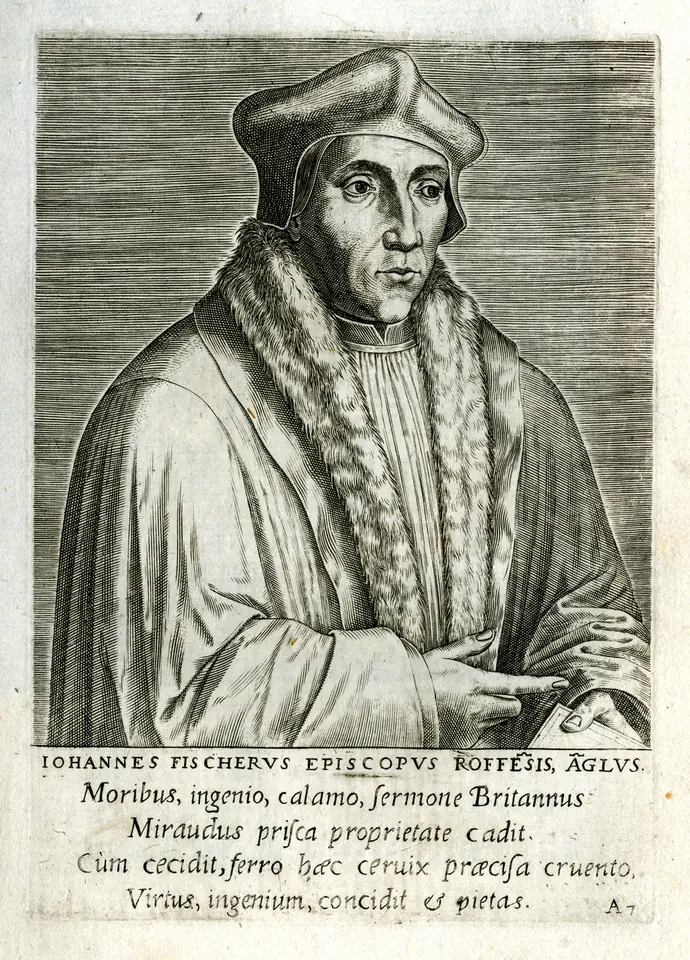
In English Catholic churches Fisher often stands beside Thomas More: a thin cleric in red or in episcopal dress next to a layman in the Lord Chancellor's chain. Rochester Cathedral, his own cathedral, includes a statue of him among the bishops of Rochester on its choir screen.
Feast day and where St. John Fisher is honored
The Church celebrates Sts. John Fisher and Thomas More on June 22, an optional memorial in the General Roman Calendar. The Church of England also keeps both men in its calendar, on July 6. Find the saints of the surrounding days on our feast days page.
Places to honor him:
- The Tower of London: his body lies, by tradition, in the Chapel Royal of St. Peter ad Vincula, near Thomas More, though the exact place is not known. The scaffold site on Tower Hill is marked in Trinity Square Gardens.
- Rochester Cathedral, Kent: the seat of his diocese for thirty years.
- Cambridge: St. John's College and Christ's College, the foundations of Lady Margaret that he guided, both keep portraits of him.
- Beverley, Yorkshire: his birthplace.
- Rochester, New York: the diocese he protects and the university that bears his name.
Prayer to St. John Fisher
The Church's own prayer for the feast is the collect of the Mass of Sts. John Fisher and Thomas More, from the Roman Missal (English translation, 2011):
O God, who in martyrdom have brought true faith to its highest expression, graciously grant that, strengthened through the intercession of Saints John Fisher and Thomas More, we may confirm by the witness of our life the faith we profess with our lips. Through our Lord Jesus Christ, your Son, who lives and reigns with you in the unity of the Holy Spirit, God, for ever and ever.
Fisher's own last prayer is the one he asked of the crowd on Tower Hill: that at the moment of death he might "stand steadfast without fainting in any one point of the Catholic faith, free from any fear." Let us ask St. John Fisher to pray for us in the same words when our own courage is tested, for bishops and priests who must speak hard truths, for marriages, and for students and teachers. As he did at the Tower gate, we can open the Gospel of John at chapter 17 and pray with the verse he found there.
St. John Fisher, pray for us.
Frequently asked questions
Who was St. John Fisher?
He was a Yorkshire merchant's son who became a Cambridge scholar, confessor to King Henry VII's mother, bishop of Rochester from 1504 and chancellor of Cambridge University for life. He defended Queen Catherine's marriage, refused the oath of the Act of Succession, and was beheaded on Tower Hill on June 22, 1535, a month after the pope made him a cardinal.
When is St. John Fisher's feast day?
June 22, the day he died, as an optional memorial in the General Roman Calendar, shared with St. Thomas More. The Church of England remembers the two men on July 6, the day More died.
Why was John Fisher executed?
He refused the oath that came with Henry VIII's Act of Succession and denied that the king was Supreme Head of the Church in England. He was tried for treason in Westminster Hall on June 17, 1535, convicted, and beheaded five days later. He was about 66 and so weak he had to be carried part of the way to the scaffold.
Was John Fisher a cardinal?
Yes. Pope Paul III created him a cardinal in May 1535, while he was a prisoner in the Tower. Henry VIII forbade the red hat to be brought into England and is said to have answered that Fisher would have no head to put it on. He is the only member of the College of Cardinals ever put to death as a martyr.
What were John Fisher's last words?
On the scaffold he told the crowd he had come to die for the faith of Christ's holy Catholic Church, asked their prayers that he would stand firm at the moment of death, and prayed for the king and the realm. Then he knelt and prayed, by some reports reciting the Te Deum and Psalm 31, "In te, Domine, speravi."
What is St. John Fisher the patron saint of?
He is the patron of the Diocese of Rochester, New York, chosen by Bishop James Kearney in 1937. He is also honored by Catholic schools, colleges and university chaplaincies, including Fisher House, the Catholic chaplaincy at Cambridge.
Is St. John Fisher University named after the saint?
Yes. St. John Fisher University in Rochester, New York, founded by the Basilian Fathers and opened in 1951 as St. John Fisher College, takes its name from the saint, the patron of the diocese that founded it.
Where is St. John Fisher buried?
His body was first thrown into a grave at All Hallows Barking, then moved two weeks later to the Chapel Royal of St. Peter ad Vincula inside the Tower of London, where it was laid beside Thomas More's. His head was set on London Bridge and, after two weeks, thrown into the Thames.
Keep exploring
Sources
- Catholic Encyclopedia (1910): St. John Fisher
- T. E. Bridgett, Life of Blessed John Fisher (1888), including the early life ascribed to Richard Hall (Internet Archive)
- John Paul II, Apostolic Letter E Sancti Thomae Mori (2000), on the beatification of 1886 and the canonization of 1935
- Catholic Culture: Optional Memorial of Sts. John Fisher and Thomas More, June 22 (collect from the Roman Missal)
- St. John Fisher University: The Life of Saint John Fisher
- Roman Martyrology, June 22