St. John of Sahagún, Augustinian Peacemaker and Patron of Salamanca
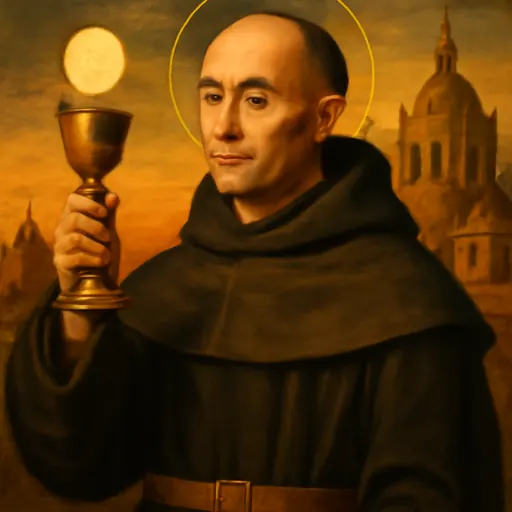
St. John of Sahagún (1419–1479) was a Spanish priest and Augustinian friar who preached so boldly against the vices of Salamanca's nobles that they hired assassins against him, and who made peace between the city's feuding families. Known for his love of the Eucharist, he is the patron saint of Salamanca. We keep his feast on June 11, and Salamanca and the Augustinians on June 12.
Who was St. John of Sahagún?
St. John of Sahagún was a Spanish priest of the fifteenth century, a canon who gave up comfortable benefices, a scholar of Salamanca and finally an Augustinian friar, who preached the Gospel there so plainly that the powerful wanted him dead. In a city torn by armed feuds between noble families, he made peace. In the confessional he could read hearts. At the altar, his brothers said, he saw the Host shine with glory. He is the patron saint of Salamanca, and we keep his feast on June 11, the day he died in 1479. Salamanca and the Augustinian Order celebrate him on June 12.

The life of St. John of Sahagún
Benefices he could not keep
John González de Castrillo was born in 1419 (the Augustinians give 1430) at Sahagún, in the old kingdom of León, the eldest of seven children of a respected family. The Benedictines of the town taught him his letters. As was common then, his father obtained for him the income of a nearby parish while he was still young, and it troubled John's conscience.
Alfonso de Cartagena, bishop of Burgos, took a liking to the bright, lively young man, educated him in his own household, gave him several church offices, ordained him a priest in 1445 and made him a canon of the cathedral. Out of respect for the Church's laws against holding many benefices, John resigned them all and kept only the chaplaincy of St. Agatha, where he worked for souls.
Salamanca
Wanting to know more theology, he went to the University of Salamanca, studied for four years and took his degree. For nine years he served as chaplain at the College of St. Bartholomew. Then he fell ill and needed surgery for a stone. He vowed that if he lived he would enter religious life. He recovered in 1463, asked to join the Hermits of St. Augustine at their convent of St. Peter in Salamanca, and made his profession on August 28, 1464.
He became master of novices and, in 1471, prior.

Preacher and peacemaker
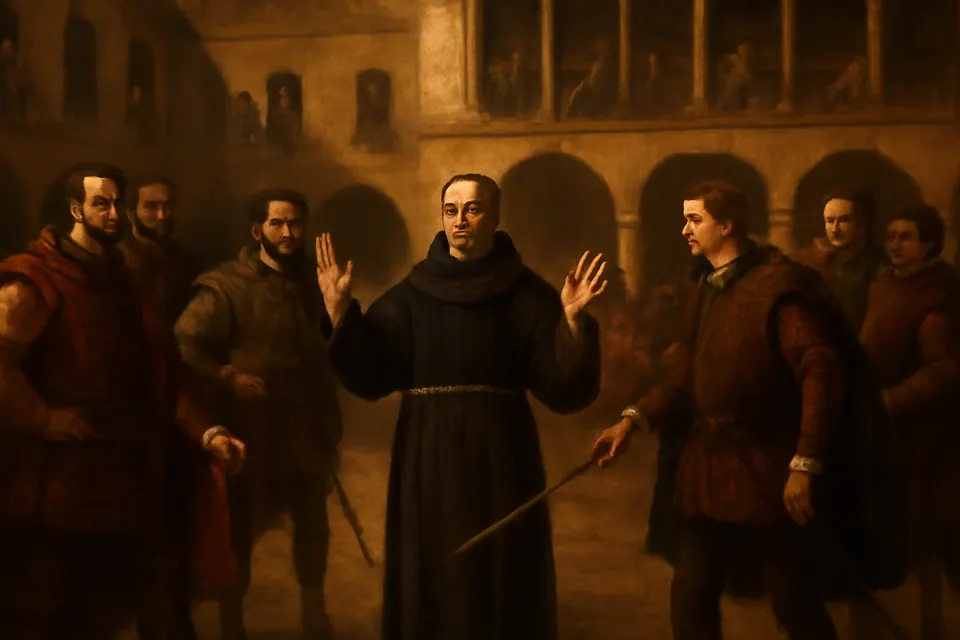
As a preacher he spared no one. The Catholic Encyclopedia compares him to St. John the Baptist: he denounced the crimes and vices of his day, and the rich and noble took offense. Enemies hired assassins, but the story goes that the men lost their nerve at the sight of his serene face. When he preached against extravagant dress, some women of Salamanca insulted him in the streets and threw stones at him until the city guard stopped them.
His great work was peace. Salamanca was divided by feuds, and the Catholic Encyclopedia says he "obtained wonderful results in doing away with enmities and feuds." The Augustinians also remember him as a defender of workers and the poor.
His death
He rebuked a nobleman who was living openly with a mistress. The man changed his life, and the woman swore revenge. People in Salamanca came to believe she poisoned the friar. He died on June 11, 1479. The Catholic Encyclopedia notes that the poisoning story is found only in later biographies.
The miracles of St. John of Sahagún
- The radiant Host: traditional. His brothers said that at Mass he often saw the Sacred Host shining in glory.
- Reading consciences: traditional. He was known for seeing into the hearts of penitents, so that it was hard to deceive him in confession.
- Miracles for his canonization: approved. His cause opened in 1525 and he was beatified in 1601. After further miracles at his intercession, Pope Alexander VIII entered his name among the saints on October 16, 1690. The individual cures examined are not described in the sources we consulted.
Why St. John of Sahagún is the patron saint of Salamanca
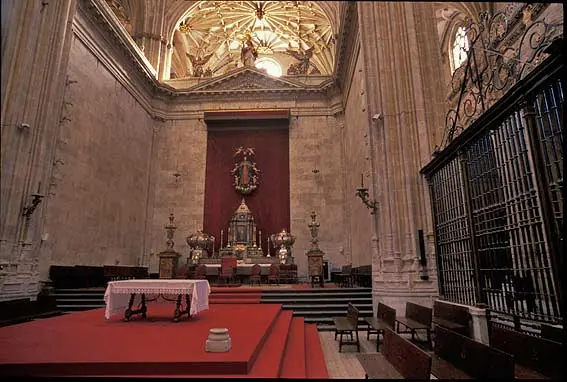
He spent most of his priestly life in the city, as student, chaplain, friar and prior. He preached in its streets, reconciled its families and died there. His veneration spread through Spain soon after his death, and Salamanca keeps his relics in its cathedral. See more causes on our patron saints page.
Symbols of St. John of Sahagún in art
He wears the black habit of the Augustinian friars with its leather belt. His sign, as the Catholic Encyclopedia notes, is a chalice with the Host above it, surrounded by rays of light, for his devotion to the Eucharist and the glory he saw at Mass. In Seville a 17th-century tile panel shows him this way, and Burgos Cathedral, where he served as a canon, has a chapel with his statue. Don't confuse him with St. Thomas Aquinas, who is also painted with a radiant sun-like emblem; the Augustinian habit and the chalice mark John.
Where St. John of Sahagún is honored
His relics rest in a silver urn in the main chapel of the New Cathedral of Salamanca, beside those of his fellow Augustinian St. Thomas of Villanova. The Catholic Encyclopedia adds that relics of him are also in Belgium and Peru. A neo-Gothic parish church in Salamanca bears his name, and his devotion traveled with the Augustinians to the Philippines and Latin America.

Prayer to St. John of Sahagún
No single traditional prayer to St. John of Sahagún is common in the standard Catholic prayer books; Salamanca and the Augustinians honor him at Mass on his feast. Let us ask St. John of Sahagún, who loved the Eucharist and would not keep silent before injustice, to pray for us, and to make peace where our families and cities are divided. Find other saints of June on our feast days page.
Frequently asked questions
Who was St. John of Sahagún?
A 15th-century Spanish priest from Sahagún in León who studied at Salamanca, joined the Augustinian friars there in 1463, and became famous as a preacher, confessor and peacemaker. He died in 1479 and was canonized by Pope Alexander VIII on October 16, 1690.
What is St. John of Sahagún the patron saint of?
He is the patron saint of the city and diocese of Salamanca, where he preached and where his relics rest in the New Cathedral.
Why is St. John of Sahagún shown with a chalice?
For his great devotion to the Blessed Sacrament. His brothers said that at Mass he often saw the Host shining in glory, so artists paint him holding a chalice with a radiant Host above it.
Was St. John of Sahagún poisoned?
Tradition says so. He rebuked a nobleman who was living with a mistress, the man reformed, and the woman was said to have poisoned the friar in revenge. The Catholic Encyclopedia notes that this story appears only in later biographies.
Keep exploring
Sources
- Catholic Encyclopedia (1910): St. John of Sahagun. His family and benefices, Bishop Alfonso de Cartagena, the vow during his illness, profession on August 28, 1464, prior in 1471, the stoning by the women of Salamanca, beatification in 1601 and canonization on October 16, 1690, the Life by John of Seville
- Augustinians of the Province of St. Thomas of Villanova: June 12, St. John of Sahagún. The Augustinian account, his relics in Salamanca cathedral and his patronage of the city and diocese