St. Athanasius the Athonite, Founder of the Great Lavra on Mount Athos
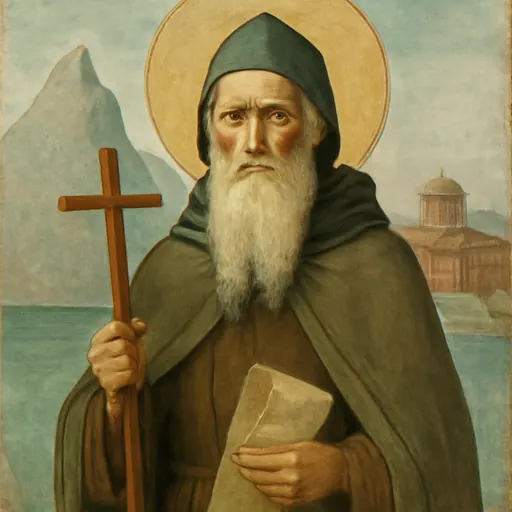
St. Athanasius the Athonite (about 920–1000) was a Byzantine monk who founded the Great Lavra in 963 and brought community monastic life to Mount Athos, the Holy Mountain. With the help of the emperor Nikephoros Phokas he built the first great monastery there and gave it a rule. We keep his feast on July 5, and Orthodox monks look to him as a father of the Athonite way of life.
Who was St. Athanasius the Athonite?
St. Athanasius the Athonite was the monk who turned Mount Athos from a scattering of hermits into the Holy Mountain we know. Around 963 he founded the Great Lavra, the first and still the largest of the great monasteries on the peninsula, and gave it a rule of common life. Every Athonite monastery since has followed in his footsteps, and Orthodox monks call him the father of their way of life on Athos.
His life comes to us in early Greek Lives written by monks who treasured his memory. The Orthodox Church in America's life of the saint follows the traditional account, which mixes the plain history of a founder with visions of the Mother of God. The Catholic Encyclopedia tells the historical side: "About 960 a far-reaching reform was introduced by the Anatolian monk Athanasius of Trebizond."
The life of St. Athanasius the Athonite
Abraham of Trebizond
He was born about 920 in Trebizond on the Black Sea and baptized Abraham. Orphaned young, he was raised by a devout nun and copied her habits of fasting and prayer. After her death he was taken to Constantinople, to the court of the emperor Romanos the Elder, and studied under a famous teacher of rhetoric named Athanasius. He soon matched his master and began teaching himself, while living like a monk: barley bread and water, little sleep, and that only sitting on a stool.
Kyminas and the call to Athos
In Constantinople he met St. Michael Maleinos, abbot of the monastery on Mount Kyminas in Asia Minor, and Michael's nephew, the general Nikephoros Phokas, who came to revere him. Abraham went to Kyminas and was tonsured with the name Athanasius. Later he left in search of deeper solitude and settled at a place called Melanos, at the very tip of Athos. For a year he was tempted to hate the place. On the last day of that year, the OCA's life says, a heavenly light shone on him, he wept for joy, and he received the gift of compunction, so that he came to love the spot he had wanted to leave.
Building the Lavra
Nikephoros Phokas, who had vowed to become a monk, asked Athanasius to build a monastery with his money. At first Athanasius refused the gold; then he saw God's will in it and began to build: a large church of St. John the Baptist, another of the Mother of God at the foot of a hill, cells, a refectory and a hospice for the sick and for pilgrims. Monks came from all over, among them hermits, abbots and even bishops who wished to live as simple monks. Athanasius gave them a rule of common life on the model of the old monasteries of Palestine, and he insisted on strict order in church: no talking, no coming late, no leaving without need.
Not everyone on Athos welcomed him. The hermits resented the new order. The Catholic Encyclopedia says that with the backing of the emperor John Tzimiskes (969–976) "all opposition was set aside," and Athanasius was made superior over the fifty-eight monastic communities then on the mountain.

His death under the dome
Late in life Athanasius foretold his death and told the brothers not to be troubled, "For Wisdom disposes otherwise than as people judge." One day, after long prayer, he put on the mantle and cowl he wore only on great feasts and climbed with six monks to inspect the top of a church under construction. It collapsed. Five monks died at once. Athanasius and the builder Daniel were thrown onto the stones, and the brothers heard him cry, "Glory to Thee, O God! Lord, Jesus Christ, help me!" When they dug him out, he was dead. This was around the year 1000.
The miracles of St. Athanasius the Athonite
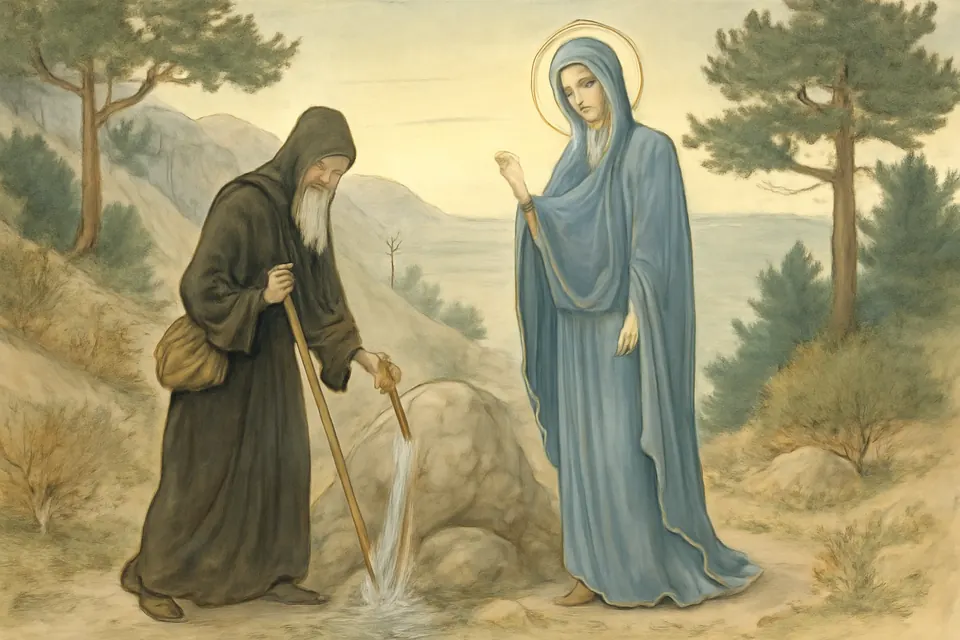
The best-known wonder of his life is the spring of the Mother of God. During a famine all the monks left the Lavra, and Athanasius himself set out to go. On the road he met a woman under a shining veil. "Would you forsake the monastery which was intended for glory from generation unto generation, just for a morsel of dry bread? Where is your faith?" she asked. "I am the Mother of the Lord." She told him to strike a stone with his staff, and water gushed out. The OCA's life says the spring "exists even now." His Life also records that he saw the Mother of God many times. We count these wonders as traditional, carried by his Lives and by the living memory of the Holy Mountain.
Why St. Athanasius is honored by monks
The Church gives him no formal patronage beyond his own monastery, but he is the father of Athonite community life, and monks everywhere in the Orthodox world look to him as a model of the abbot who builds, rules and prays. His monastery has kept his rule and his memory for more than a thousand years.
Symbols of St. Athanasius the Athonite in art
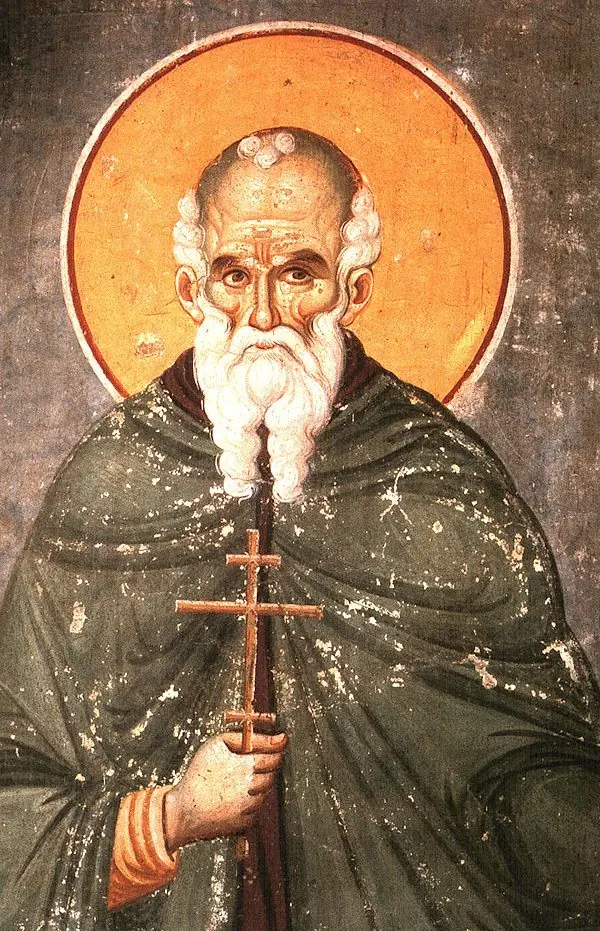
- Old monk with a long white beard and a high, bald forehead: the portrait type fixed by the great Athonite frescoes.
- Dark mantle and cowl: the habit of a great-schema monk and abbot.
- Cross or abbot's staff: his authority as founder and the staff that struck the rock.
- Scroll: words of instruction to his monks, as in the 1547 fresco at Dionysiou.
- The Lavra or the spring: in some icons, his monastery or the scene with the Mother of God.
To tell him from St. Athanasius of Alexandria, look at the clothing: the Alexandrian is a bishop in a vestment with crosses and an omophorion, while the Athonite is always a monk.

Feast day and the Great Lavra
We keep his memory on July 5, with his six disciples who died with him, and the Great Lavra keeps it as its patronal feast. Monk Chariton of Karoulia writes that the core of the main church was built by the saint around the year 1000 and that his tomb lies in the chapel of the Forty Martyrs, next to the church. Only men may visit Mount Athos, as has been the custom for over a thousand years. Find other saints of July on our feast days page.
Praying with St. Athanasius the Athonite
The Orthodox Church honors him with the hymns of his feast; we know of no English prayer to him with a separate origin. Let us ask him, who nearly left his monastery in a famine and was turned back by the Mother of God, to pray for us when we lose heart: St. Athanasius, help us to stay where God has placed us, to trust Him for our daily bread, and to say with you, even in disaster, "Glory to Thee, O God."
Frequently asked questions
Who was St. Athanasius the Athonite?
A monk born in Trebizond about 920 and educated in Constantinople, who founded the Great Lavra on Mount Athos around 963. He organized the scattered hermits of Athos into monasteries living under a common rule, which is why he is called the father of Athonite monasticism.
When is the feast of St. Athanasius the Athonite?
July 5. He is remembered with six disciples, five of whom died with him when the church dome collapsed. It is also the patronal feast of the Great Lavra.
How did St. Athanasius the Athonite die?
Around the year 1000 he climbed with six monks to inspect the top of a church under construction. It collapsed. Five monks died at once; Athanasius was heard to cry, "Glory to Thee, O God! Lord, Jesus Christ, help me!" and was found dead under the rubble.
Is St. Athanasius the Athonite the same as St. Athanasius of Alexandria?
No. Athanasius of Alexandria was a fourth-century bishop who defended the Council of Nicaea, with his feast on May 2. Athanasius the Athonite lived six centuries later and founded the Great Lavra on Mount Athos.
Keep exploring
Sources
- Venerable Athanasius, founder of the Great Lavra and Coenobitic Monasticism on Mount Athos, and his six disciples, Orthodox Church in America. His life, the spring of the Theotokos and his death
- Mount Athos, Catholic Encyclopedia (1907). His reform of Athonite monasticism and the support of John Tzimiskes
- Monk Chariton of Karoulia, The Holy Monastery of the Great Lavra, Pemptousia. The founding around 963, his tomb in the chapel of the Forty Martyrs, and the katholikon