St. Peter of Verona (St. Peter Martyr)
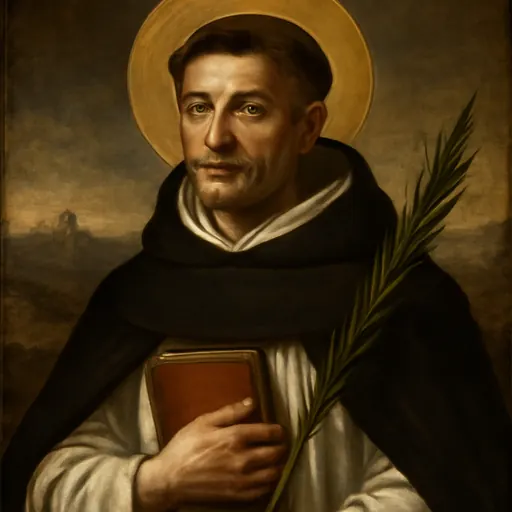
St. Peter of Verona, also called St. Peter Martyr, was a Dominican friar and preacher killed on the road from Como to Milan on April 6, 1252. Tradition says that as he lay dying he wrote Credo, "I believe," in his blood. He was canonized less than a year later, and the Dominicans keep his memorial on June 4.
Who was St. Peter of Verona?
St. Peter of Verona, known everywhere as St. Peter Martyr, was a Dominican friar of the 13th century who spent his life preaching against the Cathar heresy in northern Italy. On April 6, 1252, a hired killer cut him down on the road from Como to Milan. Tradition says he died professing the Creed and wrote Credo, "I believe," in his own blood. Pope Innocent IV canonized him in March 1253, eleven months later, one of the fastest canonizations the Church has ever made.
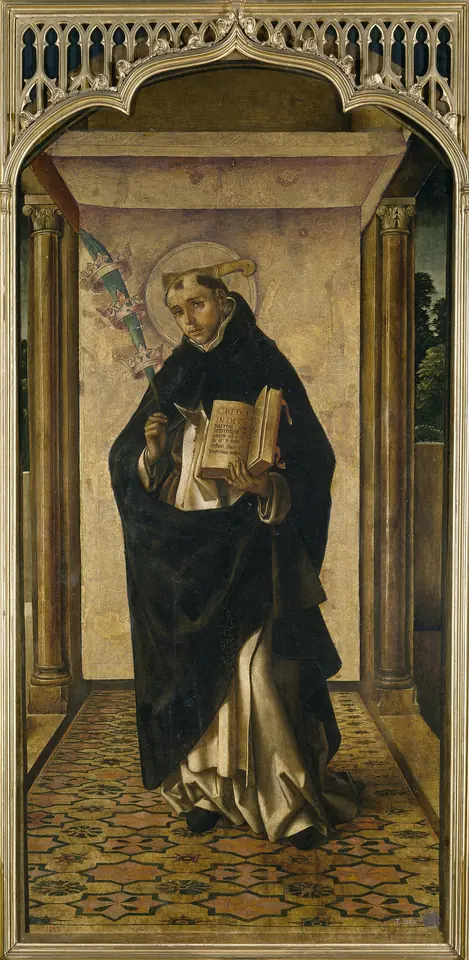
He was the first martyr of the Order of Preachers, and for centuries he was one of the most painted saints in Italy. You can recognize him at once: a Dominican in black and white with a blade in his head.
The life of St. Peter of Verona
A Catholic boy in a Cathar home
Peter was born in Verona around 1205. His parents belonged to the Cathars, whom the old sources call Manichees: a sect that taught that the material world was evil and had not been made by the good God. Even so, they sent him to a Catholic school.
The Golden Legend, written about fifteen years after his death, tells that when he was seven his uncle asked what he had learned at school. The boy recited the opening of the Creed: "I believe in God, the Father almighty, Creator of heaven and earth." His uncle told him not to say it, since in the Cathar view God had not made the visible world. The child held his ground and argued so well that the uncle went to Peter's father and told him to take the boy out of school before he grew up to fight them. The story is traditional, but it fits everything Peter did later.

A friar from St. Dominic's own hands
Peter went on to the University of Bologna. There, as a teenager, he met St. Dominic and entered the new Order of Friars Preachers. The Roman Martyrology and the Dominicans both say he received the habit from Dominic himself, who died in Bologna in August 1221.
He spent about thirty years as a friar. He preached in Rome, Florence, Bologna, Genoa, Como and Milan, and crowds came out to meet him. The Catholic Encyclopedia notes that he spared no one: he denounced Catholics "who confessed the Faith by words, but in deeds denied it" as sharply as he answered the heretics. He served his brothers as prior and founded lay confraternities in honor of the Blessed Virgin and for the defense of the faith.
In Florence, according to the New Daily Compass and older Servite tradition, he became a spiritual father to the seven founders of the Servants of Mary, the Servites, and encouraged their new order.

Inquisitor of Lombardy
In 1251 Pope Innocent IV made Peter inquisitor for Milan and Lombardy, where the Cathars were strong. His work was to preach, examine and call back those who had fallen into heresy, and the sources agree it won many conversions. It also made him enemies. He told a friend that every time he raised the chalice at Mass he asked for the grace of martyrdom, and in a sermon shortly before his death he said openly that money had been paid to have him killed.
The road from Como to Milan
On April 6, 1252, Peter was walking back from Como to Milan with a fellow friar, Brother Domenico. On the way, an assassin named Carino of Balsamo, hired by Cathar leaders in Milan, attacked them. He struck Peter on the head with a heavy blade. The Catholic Encyclopedia says Peter rose to his knees, recited the first article of the Creed, dipped his fingers in his blood and wrote "Credo in Deum" on the ground. Carino then stabbed him in the heart. Brother Domenico was badly wounded and died a few days later.
The Golden Legend adds that Peter commended his spirit to God with Christ's words, "Into thy hands," and it compares his death to the Passion: Christ was sold for thirty pieces of silver, Peter for forty pounds. The friars, clergy and people of Milan came out in procession for his body, so many that they could not get it into the city that night.
A saint within a year
So many cures were reported at his tomb that Innocent IV canonized him in March 1253. The Catholic Encyclopedia gives the date as March 25. The pope's bull of canonization speaks of him as "a red rose" produced by "the flourishing Order of Preachers."
The assassin who became a friar
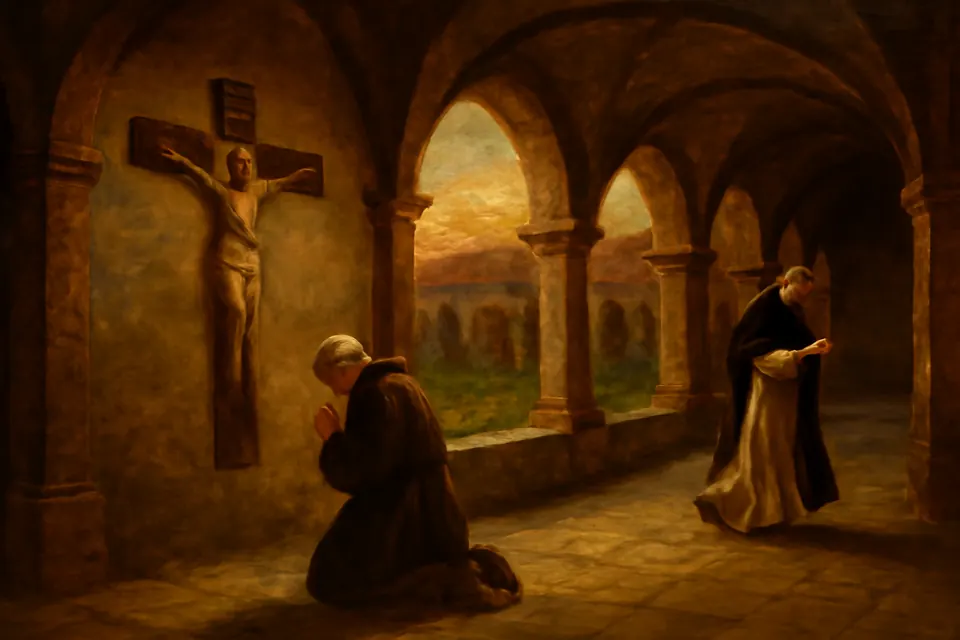
The most beautiful sequel belongs to his killer. Carino of Balsamo repented, confessed his crime and asked to enter the Dominican Order. He was received as a lay brother at the friary in Forlì and lived there in prayer and penance for about forty years, under the guidance of Blessed James Salomoni. He died in 1293 with a reputation for holiness and is honored locally as Blessed Carino. The martyr who prayed for the conversion of heretics won the soul of the man who killed him.
The miracles of St. Peter of Verona
The Catholic Encyclopedia says Peter worked many miracles in his life and that they grew even more numerous after his martyrdom, which is why he was canonized so quickly. The stories below are labeled from the sources we have.
- The cloud in Milan: traditional. The Golden Legend says that during a public dispute in Milan on a blazing day, a Cathar bishop challenged Peter to prove his holiness by shading the crowd. Peter prayed, made the sign of the cross, and a cloud spread over the people "like a pavilion" for as long as the sermon lasted. The museum of Sant'Eustorgio says it happened in the square in front of the basilica.
- The false Madonna: traditional. In the scene Foppa painted, Peter exposes a Cathar trick. People were being led to venerate an image of the Madonna; when Peter held up the consecrated Host before it, the figure showed horns and was revealed as the work of the devil.
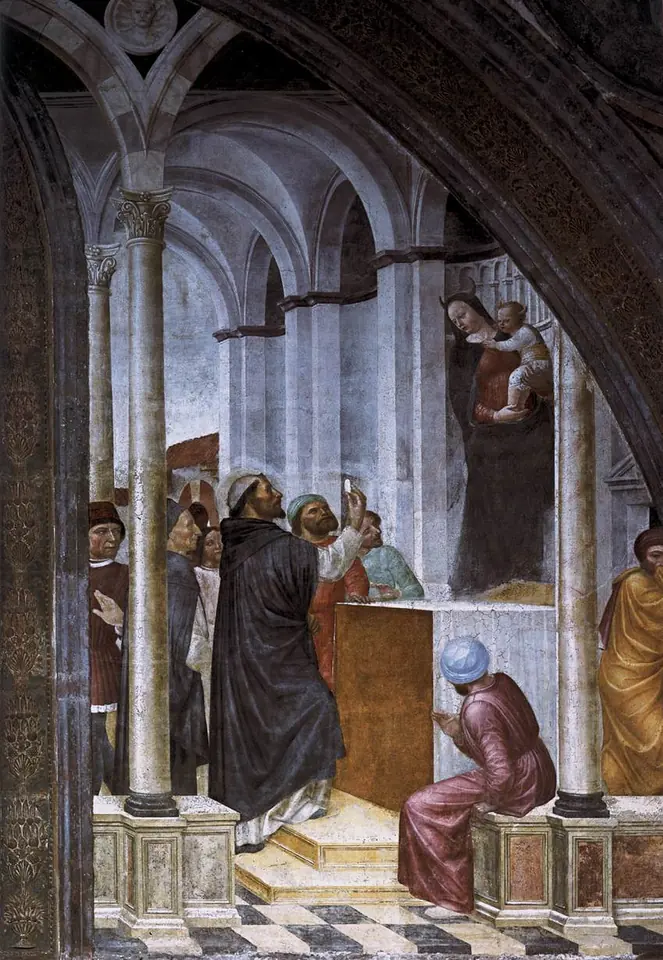
- The healed foot: traditional. Tradition holds that a young man confessed to Peter that he had kicked his mother, then in his remorse cut off the foot, and that Peter restored it.

- Healings in his lifetime: traditional. The Golden Legend tells of a man lame for five years who walked after Peter blessed him, a mute young man who spoke, and a nobleman's son cured of a throat disease when Peter laid his cope on him.
- Healings after his death: reported. The Golden Legend collects cures at his tomb and through his prayers as far away as Germany and Compostela, among them a German nun of the abbey of Oetenbach, cured of a crippled knee after making a "pilgrimage" to Milan in her heart, praying a hundred Our Fathers for each day's journey.
Why St. Peter Martyr is the patron saint of inquisitors
Peter died in the office of inquisitor, so he became the patron of inquisitors, and the Dominican Order, which long carried that office, honors him as its first martyr. We can also ask his prayers for converts and for families divided over the faith: he was a Catholic child of a heretical household, he spent his life calling people back to the Church, and his own murderer became a holy friar. See more on our patron saints page.
Symbols of St. Peter of Verona in art
Peter is easy to spot in Italian and Spanish churches. Look for:
- The Dominican habit: white tunic and black cloak.
- A knife or cleaver in his head: the blow that killed him. Older works show a falchion or broad blade; some later painters make it smaller.
- A dagger in his chest: the second wound, less often shown.
- A palm: the sign of a martyr.
- A book: the preacher and defender of the faith.
- The word Credo: in scenes of his death he writes it on the ground.
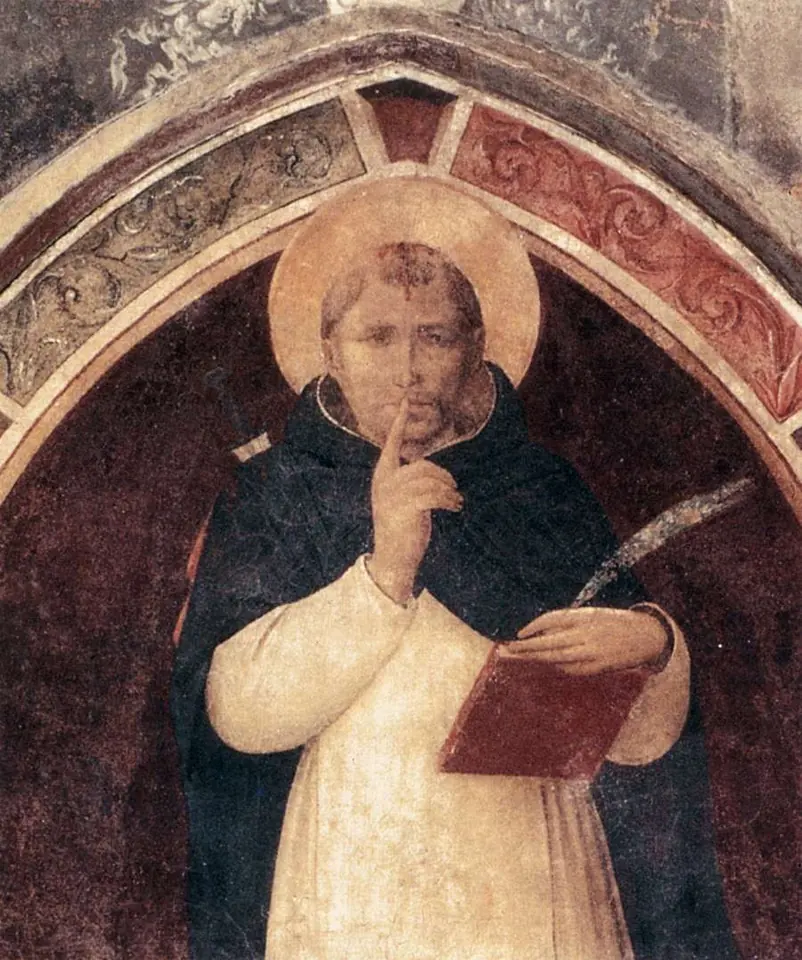
- A finger to his lips: Fra Angelico's fresco in the cloister of San Marco shows him asking the friars for silence, and it became one of his best-known images.
How to tell him from other Dominicans: St. Dominic often has a star and a dog with a torch, St. Thomas Aquinas a sun on his chest, and St. Vincent Ferrer wings or a trumpet. Only Peter has the blade.
Feast day and customs
The Dominican Order keeps the memorial of St. Peter of Verona on June 4, the anniversary of the translation of his relics. The Roman Martyrology commemorates him on April 6, the day of his death. For almost four centuries his feast stood on April 29 in the General Roman Calendar, and Catholics who use the 1962 Missal still keep it on that day. See other saints of these dates on our feast days page.
In the Middle Ages his feast was kept with the solemnity of the ancient feasts. Dom Prosper Guéranger writes that servile work was forbidden and that the faithful brought small branches to the Dominican churches to be blessed in his honor. The Roman Ritual later kept a blessing of palms and branches for his feast.
His tomb in Milan
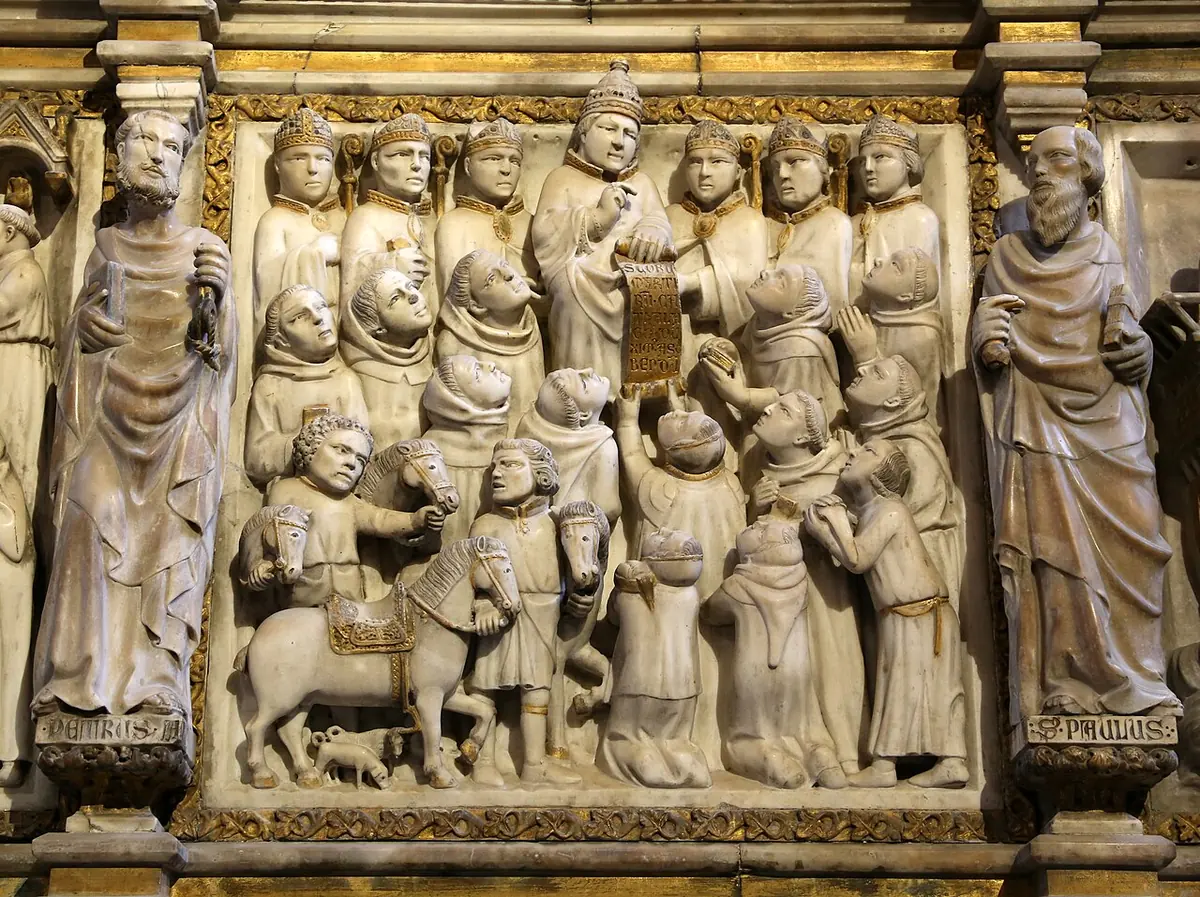
Peter's body was carried to Milan and buried in the Dominican basilica of Sant'Eustorgio. In 1336–1339 the sculptor Giovanni di Balduccio carved a great marble tomb for him, the Arca di San Pietro Martire, commissioned by the friars with help from Azzone Visconti, lord of Milan. Eight reliefs on the sarcophagus tell his story, from the healing of a mute man and the miracle of the cloud to his martyrdom, funeral, canonization and translation. Statues of the Virtues hold it up, and a tabernacle on top holds the Virgin with St. Dominic and St. Peter Martyr.
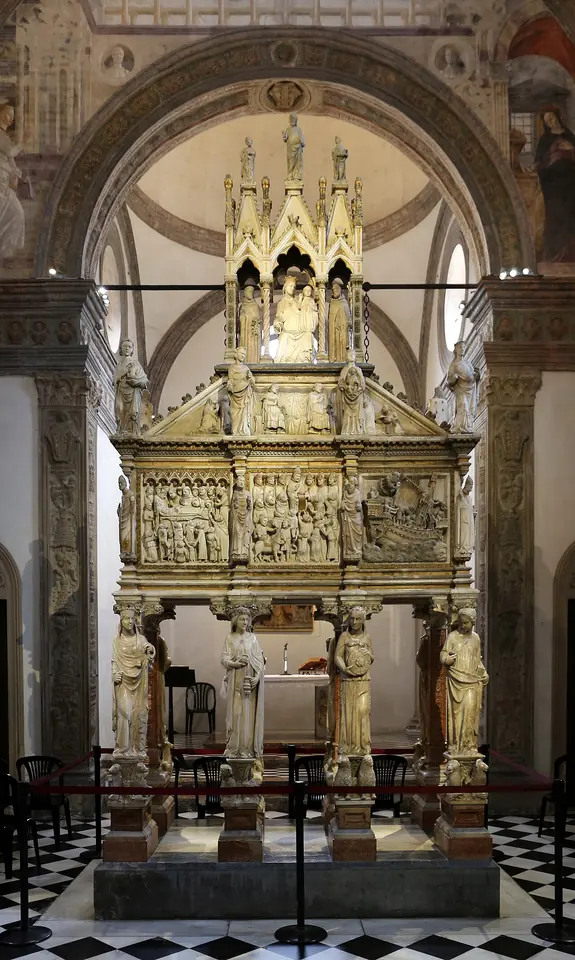
Between 1462 and 1468 the Florentine banker Pigello Portinari, head of the Medici bank in Milan and devoted to St. Peter Martyr, built a chapel at Sant'Eustorgio for his own burial, and Vincenzo Foppa painted it with scenes of the saint's life. The Arca was moved there and has stood in the center of the Portinari Chapel since 1875. Pilgrims can visit it through the museum of Sant'Eustorgio.
Prayer to St. Peter of Verona
The traditional Roman Missal gives this collect for his feast on April 29. In the translation used by Missale Meum:
Grant us grace, we beseech thee, O Almighty God, to follow with zeal conformable thereto after the pattern of that great example of faith, thy blessed Martyr Peter, who, for the spreading of the same faith, did so run as to obtain the palm of martyrdom.
The Latin original is short: Praesta, quaesumus, omnipotens Deus: ut beati Petri Martyris tui fidem congrua devotione sectemur; qui, pro eiusdem fidei dilatatione, martyrii palmam meruit obtinere.
Let us ask St. Peter Martyr to pray for all who preach the faith, for families divided over belief, and for the conversion of anyone who has done us harm, as his own killer was converted.
Frequently asked questions
Who killed St. Peter of Verona?
A hired assassin named Carino of Balsamo, paid by Cathars in Milan, struck him on the head on April 6, 1252, and then stabbed him. Carino later repented, became a Dominican lay brother at Forlì and spent the rest of his life in penance. He died there in 1293 and is honored locally as Blessed.
When is the feast of St. Peter Martyr?
The Dominican Order keeps his memorial on June 4, the anniversary of the translation of his relics. The Roman Martyrology remembers him on April 6, the day he died. Before 1969 his feast was on April 29, and Catholics who follow the 1962 Missal still keep it then.
Why does St. Peter Martyr have a knife in his head?
It recalls how he died. His killer struck him on the head with a heavy blade, and then, finding him still alive, stabbed him in the chest. Painters show a cleaver or knife in his head, and sometimes a dagger in his chest, the way other martyrs carry the instrument of their death.
What did St. Peter of Verona write in his blood?
Tradition says that after the first blow he fell to his knees, began to recite the Creed and wrote the word Credo ("I believe") on the ground with his own blood. The Catholic Encyclopedia gives the words as "Credo in Deum"; Dominican sources give "Credo in unum Deum."
Is St. Peter of Verona the same as St. Peter the Apostle?
No. St. Peter the Apostle died in Rome in the first century. Peter of Verona lived in the 13th century and is called "Peter Martyr" to tell him apart. He was the first martyr of the Dominican Order.
Keep exploring
Sources
- Catholic Encyclopedia (1911): St. Peter of Verona
- Jacobus de Voragine, The Golden Legend, Caxton translation, Volume 3: Of S. Peter of Milan (Fordham Medieval Sourcebook)
- Chiostri di Sant'Eustorgio: L'arca di san Pietro martire
- Chiostri di Sant'Eustorgio: Vincenzo Foppa's frescoes in the Portinari Chapel
- Dominican Nuns, Monastery of Our Lady of Grace: St. Peter Martyr, June 4
- The New Daily Compass: Saint Peter of Verona
- Dom Prosper Guéranger, The Liturgical Year, April 29: St. Peter of Verona (Salve Maria Regina transcription)
- Missale Meum: St. Peter of Verona, April 29, Collect (1962 Roman Missal)