St. Paulinus of Nola

St. Paulinus of Nola (about 354–431) was a rich Roman senator and governor from Bordeaux who, with his wife Therasia, gave away his fortune and settled at the shrine of St. Felix in Nola, near Naples, where he became bishop around 409. A poet and the friend of Augustine and Ambrose, he is honored on June 22 and is the patron of bell-founders.
Who was St. Paulinus of Nola?
St. Paulinus of Nola was a Roman aristocrat who had everything his world could offer, wealth, a senator's rank and a governorship, and gave it all to the poor to live for Christ beside the tomb of a martyr. Born around 354 in Bordeaux, he became a monk, a priest and finally bishop of Nola, near Naples, and he died there on June 22, 431.
He was also one of the finest Christian poets of his age. Pope Benedict XVI, who gave a general audience to him in 2007, quoted the line that sums up his life: "To my mind the only art is the faith, and Christ is my poetry."

The life of St. Paulinus
Governor of Campania
Paulinus came from a leading family of Aquitaine and was educated by the poet Ausonius. While still young he rose to be governor of Campania, the region around Naples. There, Benedict XVI recounts, he was struck by the "simple and intense faith" of the people who came to the tomb of the martyr St. Felix at what is now Cimitile, just outside Nola. As governor he built a road for the pilgrims and a hospice for the poor.
He went to Milan to learn from St. Ambrose and was baptized in Bordeaux by Bishop Delphinus. The Catholic Encyclopedia adds that St. Martin of Tours had cured him of an eye disease.
Giving it all away
Paulinus married Therasia, a devout Christian from Spain. Their only son died eight days after birth, and the loss turned both of them toward God. Together they sold their estates for the poor. The people of Barcelona pressed him into ordination as a priest at Christmas in 394 or 395, and in 395 the couple moved to Nola, where they lived as brother and sister in a small community of prayer beside the shrine of St. Felix.
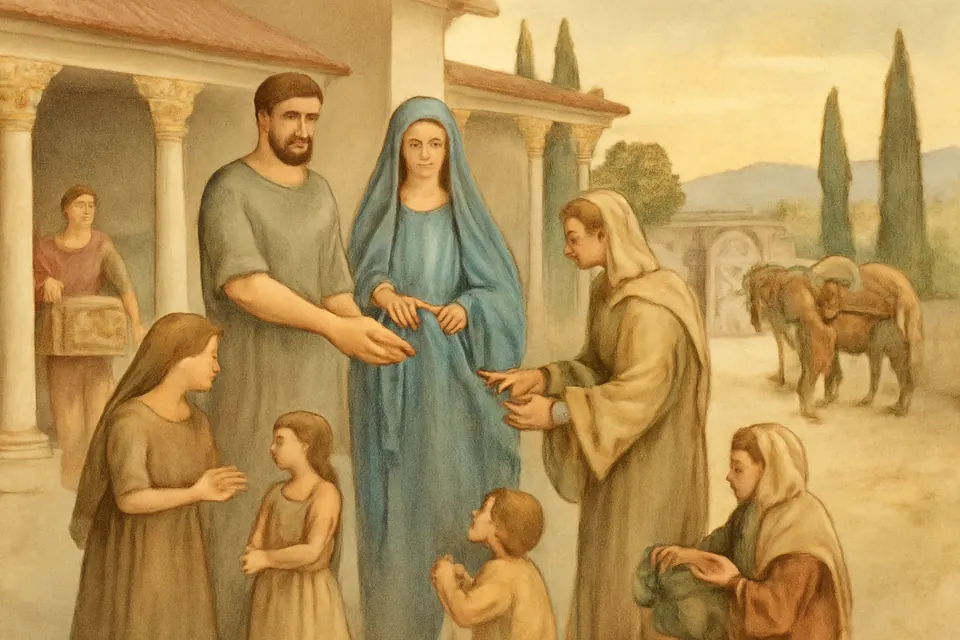
His old teacher Ausonius felt betrayed and wrote him bitter letters. Paulinus answered that giving to the poor was not contempt for earthly goods but the best use of them. In a letter to Sulpicius Severus he wrote that selling one's possessions "is not the completion but only the beginning of the race in the stadium."
The house of St. Felix
At Nola Paulinus built a large new basilica beside the old chapel of Felix, with porticos painted with scenes from Scripture so that the country people who could not read might learn from them. The poor lived on the ground floor of his monastery. He called them his "masters," Benedict XVI notes, and liked to say that their prayers were the foundations of his house. Every year on the feast of St. Felix he wrote a new poem in the martyr's honor.

Bishop and friend
Around 409 the people of Nola chose him as their bishop, and he served about twenty years. He was a great friend by letter to St. Augustine, St. Jerome, Sulpicius Severus and many more. To Augustine, whom he never met, he wrote that Christians far apart still "are members of one body, we have one head, we are steeped in one grace, we live on one loaf, we walk on one road and we dwell in the same house."
He died on June 22, 431. He was buried in Nola, later carried to Benevento and then to Rome, and in 1908 Pope Pius X ordered his relics returned to the cathedral of Nola, where they rest today.
Miracles and legends
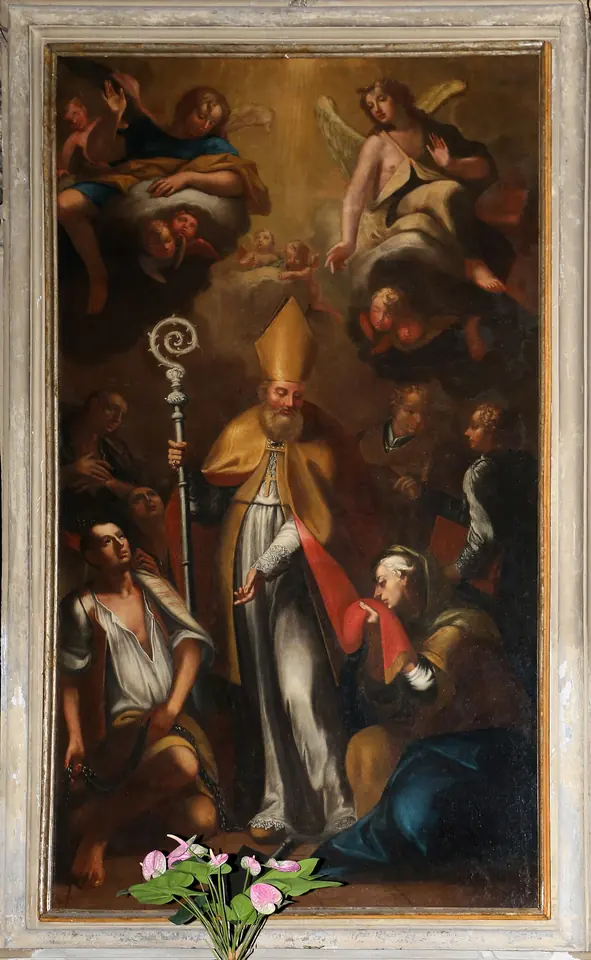
The best-known story about Paulinus comes from St. Gregory the Great, writing about 160 years later in his Dialogues. When the Vandals carried off captives from Campania, a widow came to Paulinus for money to ransom her son. He had nothing left to give but himself, so he went to Africa and offered himself as a slave in the young man's place. He worked as the gardener of the Vandal king's son-in-law until the king learned in a dream who he was. Paulinus was set free and asked only one reward, the freedom of all the captives from his city, who sailed home with him in ships laden with wheat.
Benedict XVI noted plainly that "the historical truth of this episode is disputed." The great Vandal raid on Campania came in 455, after Paulinus's death. We keep the story as traditional: it shows the bishop the people of Nola remembered, one who would give his own freedom for the poor.
Why St. Paulinus is the patron of bell-founders
Tradition credits Paulinus with bringing bells into the church's worship, and the Latin word for bell, campana, has long been linked with his region of Campania. No early source supports the story, but it is centuries old, and bell-founders and ringers took him as their patron. A stained-glass window in the cathedral of Linz, Austria, shows him in its scene of the blessing of bells.

Symbols of St. Paulinus of Nola in art
- Bishop's miter and crozier: he was bishop of Nola for some twenty years.
- A chain: the chains of the captives, and of his own slavery in Gregory's story.
- A bell: for the legend that he introduced bells.
- Lilies: the flowers of Nola's welcome, the source of the Festa dei Gigli.
- A spade or garden tools: his work as a gardener in Africa, in the same story.
- Sometimes a model of a church: his basilica beside the tomb of St. Felix.
In Italian churches he is usually an older bishop in a red cope, often with captives or the poor at his feet. With a chain and a bell, he is hard to mistake.
The Festa dei Gigli in Nola
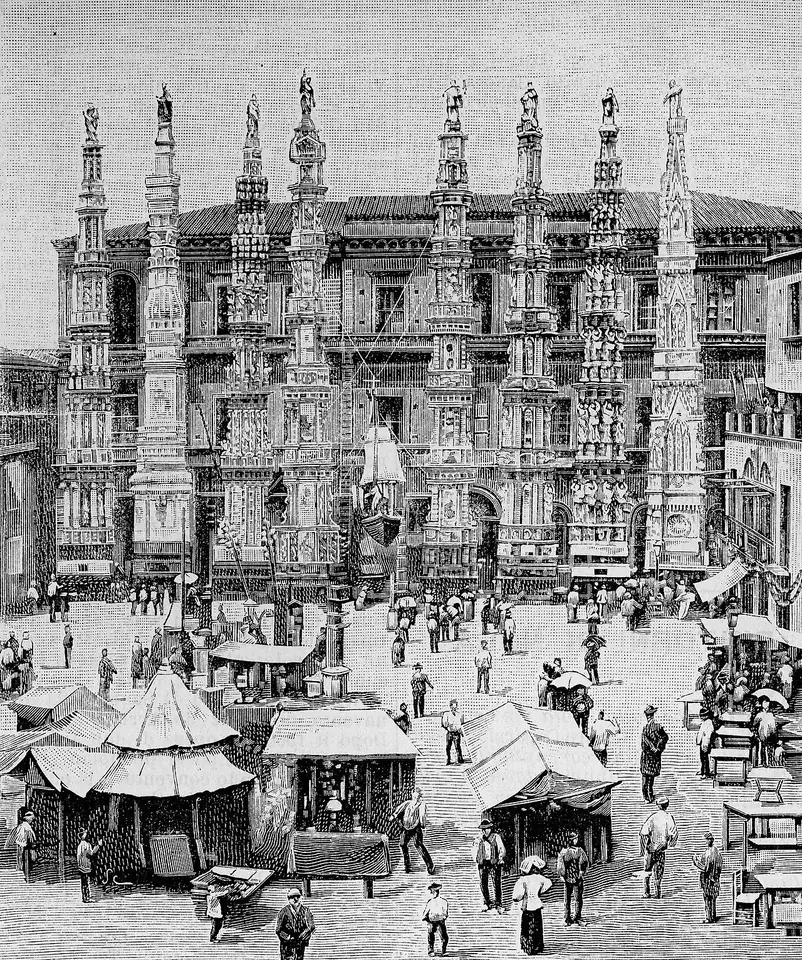
Each year on the Sunday after his feast, Nola celebrates the Festa dei Gigli, the Feast of the Lilies. Groups named for the town's old trades build eight towering wooden obelisks, the "lilies," and a great boat with a statue of the saint, and teams of men carry them through the streets on their shoulders, dancing them to music. Local tradition says the feast recalls the lilies with which the people greeted Paulinus on his return from Africa. The feast is on UNESCO's list of the intangible cultural heritage of humanity.
Praying with St. Paulinus
There is no traditional English prayer to St. Paulinus with a known origin. On his memorial the Church prays the Mass and the Liturgy of the Hours of a holy pastor. Let us pray with his own words, "Christ is my poetry," and ask St. Paulinus to obtain for us a generous heart toward the poor, faithful friendships in Christ, and freedom for all who are held captive. See the other saints of June on our feast days page.
Frequently asked questions
What is St. Paulinus of Nola the patron saint of?
Of the city of Nola and, by an old tradition, of bell-founders and bell-ringers. The bell connection comes from a legend that he introduced church bells, and from the Latin word campana for bell, linked with his region of Campania. There is no early evidence that he did, but the tradition is centuries old.
When is the feast of St. Paulinus of Nola?
June 22, the day he died in 431. It is an optional memorial on the General Roman Calendar. In Nola the great feast, with its towering wooden 'lilies,' falls on the Sunday after June 22.
Was St. Paulinus of Nola married?
Yes. He married Therasia, a Christian noblewoman from Spain. Their only son died a few days after birth, and the couple chose to give their wealth to the poor and live together in chastity and prayer beside the shrine of St. Felix at Nola.
What is the Festa dei Gigli?
The Feast of the Lilies in Nola, held in honor of St. Paulinus. Teams of men carry eight towering wooden obelisks, the 'lilies,' and a boat through the streets on their shoulders. Local tradition says it recalls the lilies with which the people welcomed Paulinus home from captivity.
Keep exploring
Sources
- Benedict XVI, General Audience of 12 December 2007: Saint Paulinus, Bishop of Nola, vatican.va. His conversion, his poems and letters, and the quotations on this page
- St. Paulinus of Nola, Catholic Encyclopedia (1911), New Advent. The basilica at Nola, his surviving works, and the journeys of his relics
- Gregory the Great, Dialogues, Book III, chapter 1 (1911 translation), tertullian.org. The story of the widow's son and the Vandal king