St. Marina the Monk
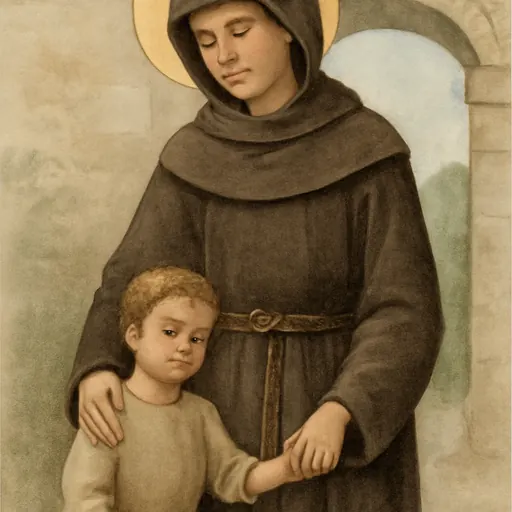
St. Marina the monk was a woman who lived as the monk Brother Marinos so she could stay with her widowed father in a monastery. Falsely accused of fathering an innkeeper's grandson, she took the blame and raised the child; her innocence came to light at her death. Her feast is June 18 (Latin) and February 12 (Byzantine).
Who was St. Marina the monk?
St. Marina the monk was a young Christian woman named Mary who lived for most of her life as a monk among men, under the name Marinos. She did it for love of her father and of God. When she was accused of a sin she never committed, she kept her secret and her silence, raised the child laid at her door, and died a monk. Only the brothers who came to wash her body for burial learned who she was.
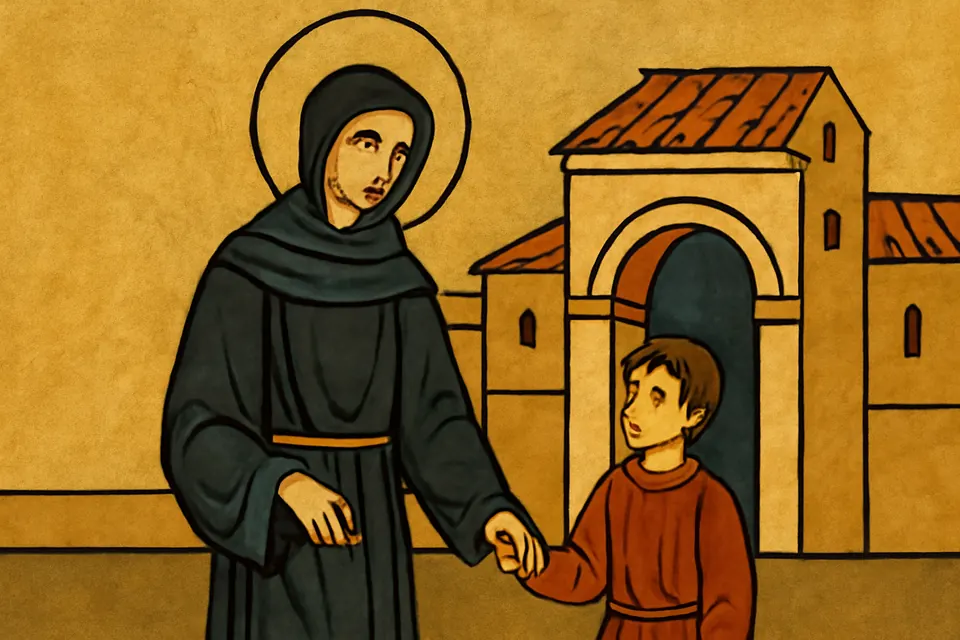
Her story spread across the whole Christian world. Nicholas Constas, who translated the oldest Greek life for Dumbarton Oaks' Holy Women of Byzantium (1996), lists versions in Latin, Syriac, Coptic, Ethiopic, Armenian and Arabic, and later in medieval German and French. The French scholar Marcel Richard dated that oldest Greek life to between 525 and 650, probably written in Syria; the earliest surviving copy, a manuscript at the Vatopedi monastery on Mount Athos, is from the 10th century. The life itself gives no date and no city, so where she lived depends on which version you read: near Alexandria in the Orthodox synaxarion, in Bithynia in many Western books, in Lebanon's Qadisha Valley in Maronite tradition.
Don't confuse her with St. Marina of Antioch, the virgin martyr whom the Greeks call Marina and the Latins St. Margaret. Two different women, two different stories.
The life of St. Marina the monk
The episodes below follow the old Greek life in Constas's translation. As with every story of this kind, we hold it as traditional: a holy story the Church has told for fifteen centuries, not a record checked by historians.
"Do you wish to save your own soul and see mine destroyed?"
A devout man named Eugenios lost his wife and raised their only daughter, Mary, alone. When she was grown, he told her he was giving her everything he owned, because he was leaving the world "in order to save my soul." She wept and answered him: "Father, do you wish to save your own soul and see mine destroyed?"
He said a girl could not live in a monastery of men. She had already thought of that. She would cut off her hair, dress as a man and go in with him. Eugenios gave his goods to the poor, cut his daughter's hair, put her in men's clothes and changed her name to Marinos. "Child, take heed how you conduct yourself," he told her, "for you are about to enter into the midst of fire."
Brother Marinos
Marinos grew in obedience, humility and fasting, eating only every second day. Some of the monks took the beardless young brother with the soft voice for a eunuch; others put it down to her fasting. After her father died she stayed on, and the life says God gave her the gift of healing those troubled by demons.
The false accusation
The monastery, forty monks strong, sent brothers out on business once a month, and they stayed at an inn on the way. On one trip a soldier seduced the innkeeper's daughter and told her to blame "the young monk" if she became pregnant. She did. The furious innkeeper stormed into the monastery, and when Marinos returned, the abbot confronted her.
Marinos did not defend herself. She fell on her face and said, "Forgive me, father, for I have sinned as a man." The abbot threw her out.
Three years at the gate
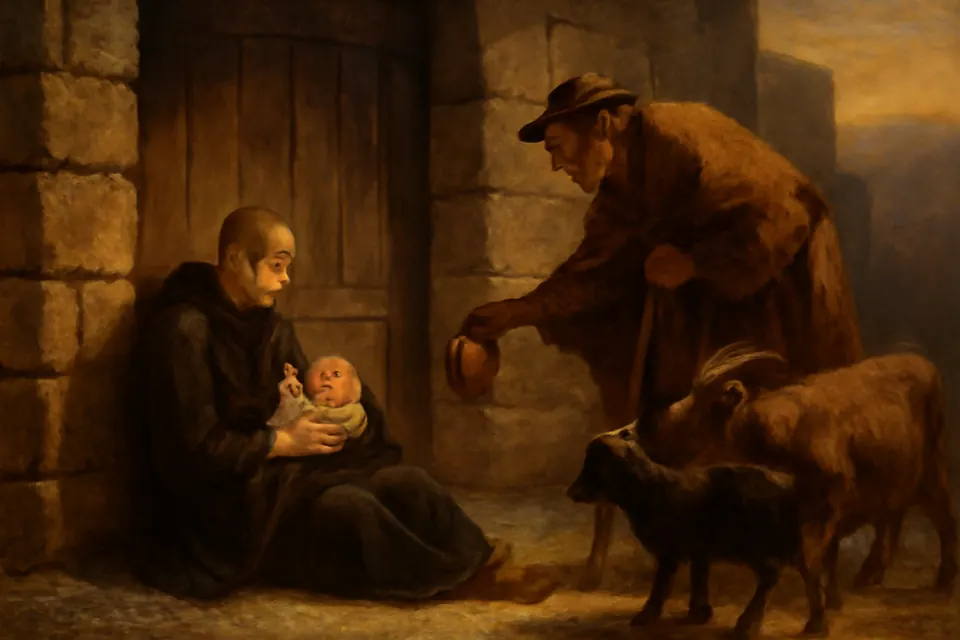
She sat down outside the monastery gate and stayed there through cold and heat. When the innkeeper's daughter bore a son, her father carried the baby to the gate, threw him down before Marinos, and left. Marinos picked him up. "Why should this wretched babe perish here with me?" she said, and she begged milk from the shepherds and nursed the child as a father would.
After three years the brothers pleaded for her. They told the abbot that if he would not forgive Marinos, they would leave too: how could they ask God to forgive their own sins? He let her back in as "the last and least of all," and gave her the lowliest chores. The boy followed her everywhere, crying "Dada, Dada." He grew up in the monastery and in time became a monk himself.
The secret revealed
One day the abbot noticed Marinos had not been in choir for three days. The brothers found her dead in her cell. As they prepared her body for burial they discovered she was a woman, and they cried out with one voice, "Lord, have mercy." The abbot threw himself at her feet and begged forgiveness; the life says a voice told him that because he had acted without knowing, his sin was forgiven. Then he sent for the innkeeper and told him the truth.
Miracles of St. Marina
None of St. Marina's miracles has been formally investigated; her cult is far older than the canonization process. Using this encyclopedia's labels:
- Healing of the possessed in her lifetime: traditional. The old life says she healed those troubled by demons by laying her hand on them.
- The accuser freed at her tomb: traditional. After the burial, the innkeeper's daughter came possessed by a demon, confessed before everyone that the soldier was the father, and was healed at Marina's tomb.
- A storm calmed on the voyage to Venice: traditional. The Venetian hagiographer Pietro Nadal, writing in the 1300s, says she saved the men carrying her body from a storm at sea, a story told of many relic voyages.
- The recovery of Padua in 1509: reported. Venice credited her intercession, as described below.
Why St. Marina is the patron of the falsely accused
No saint fits the falsely accused better. She could have cleared her name in a sentence. She chose instead to carry another's sin for years, sleeping in the open and raising a child who was not hers, and she left her innocence in God's hands. That is why we ask her prayers when we are slandered, blamed for what we did not do, or misjudged by those we love. Find others on our patron saints page.
Hers is also a story about the abbot, the brothers and the innkeeper, all of whom had to ask forgiveness at her bier. It reminds every community how easily we condemn on rumor.
Symbols of St. Marina in art
Artists show Marina in two ways, and both are easy to recognize once you know her story:
- A monk's habit with short hair or a cowl: she is dressed as a monk, often with a softer, feminine face, so viewers know the secret.
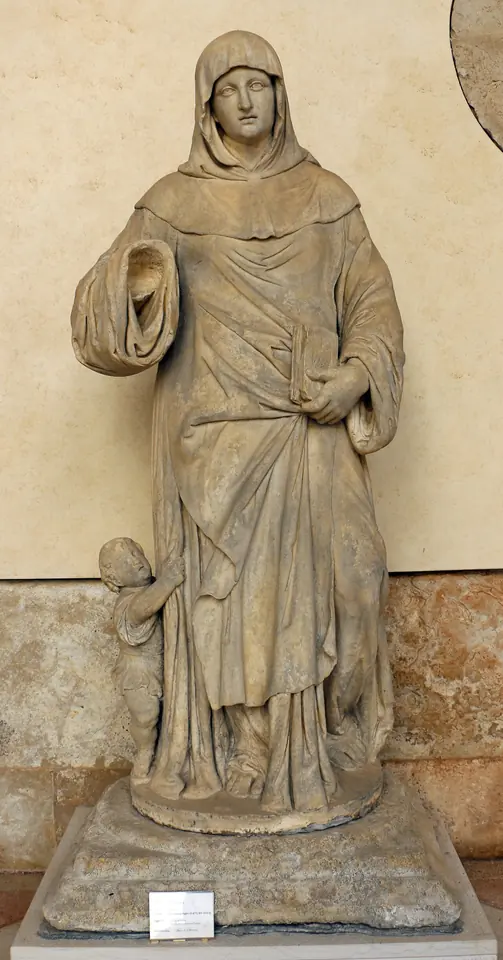
- A small child: the boy she raised, standing at her side, held by the hand or carried in her arms. This is her most common attribute.
- The innkeeper and his daughter: in story cycles, the accusers appear bringing the baby to the monastery.
- A monastery gate or door: where she was brought as a girl and where she lived in exile.
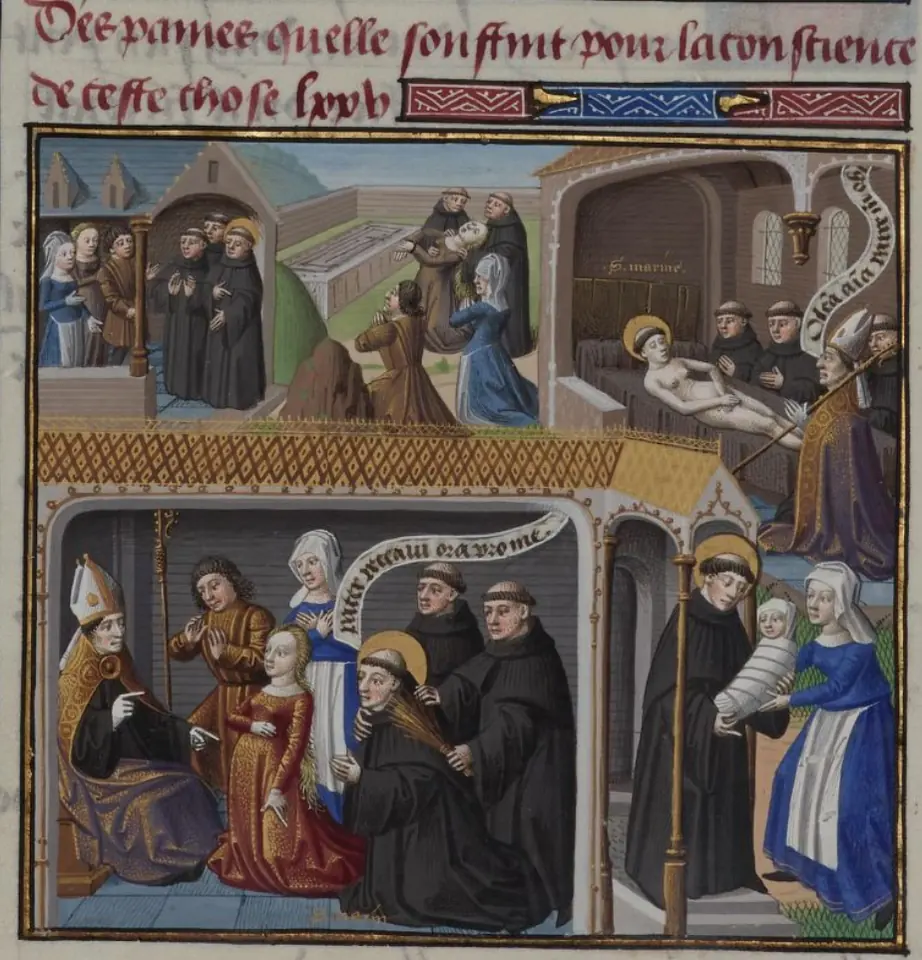
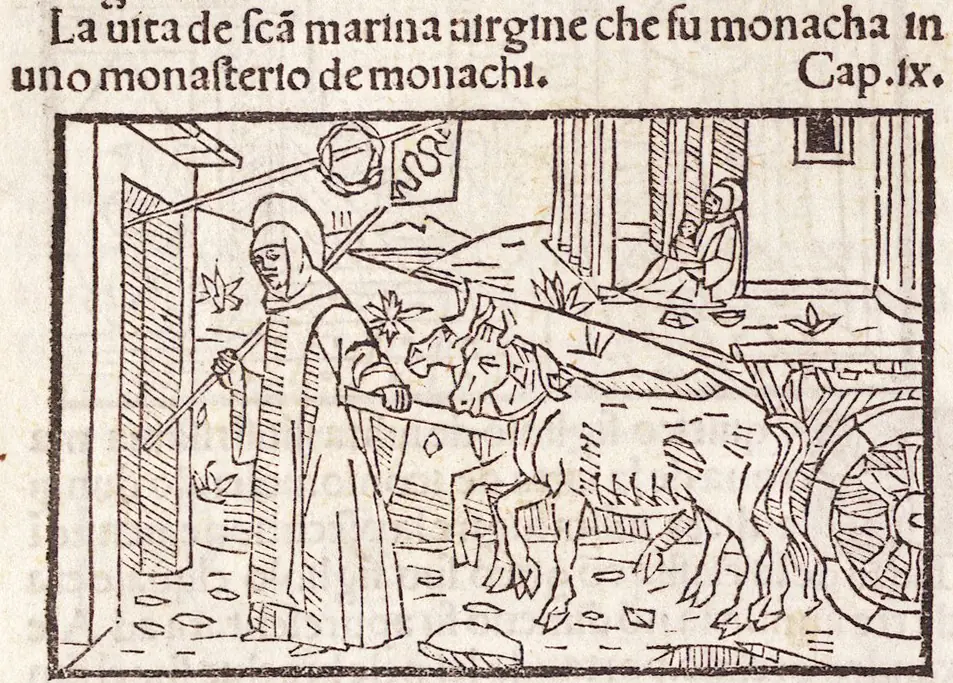
Medieval manuscripts like the Speculum historiale page above tell her story in scenes. Single figures in churches show her as a monk with the child. A late medieval Polish altarpiece pairs her with St. Mary of Egypt, two women who left the world in unusual ways.
In Eastern icons she is a nun or monastic woman, usually unlabeled except for her name, sometimes shown with her father Eugene. In Venice, look for her in a monk's hooded habit with the child at her feet, like the statue Lorenzo Bregno carved for her old church.
St. Marina in Venice
Venice holds her body. The 14th-century chronicle of Doge Andrea Dandolo says that in the second year of Doge Jacopo Tiepolo's reign, about 1229 or 1230, a merchant named Giovanni da Bora persuaded the keepers of her body at a monastery outside Constantinople, with prayers and a payment, to give it to him. He brought it home to his parish church of San Liberale near the Rialto, which was rededicated to her. (The Orthodox life gives the year as 1113, a date the art historian Giulia Bordi notes doesn't match Tiepolo's reign.) The Roman Martyrology still records "the translation of St. Marina, virgin" at Venice on July 17.
Her feast became a civic holiday after July 17, 1509, when Venice recovered Padua during the War of the League of Cambrai. The Venetians credited her intercession, and from 1512 the doge, the Senate and the clergy went in procession to her church every July 17.
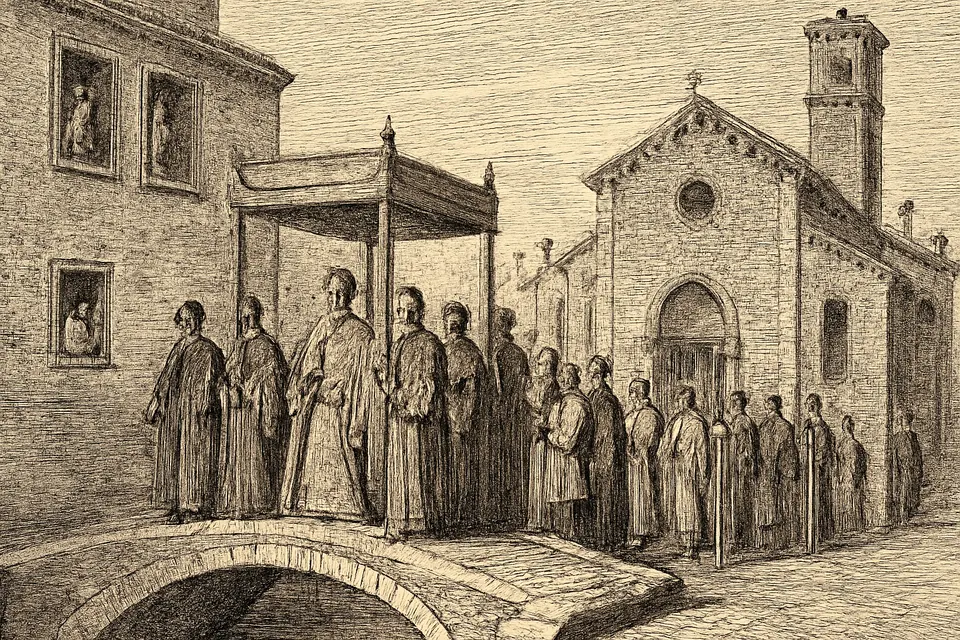
The church of Santa Marina was closed in 1810 and demolished in 1820. Her body was moved to the nearby church of Santa Maria Formosa, where it rests on her own altar beneath a painting of the saint teaching the boy she raised. Her old reliquary went to the Museo Correr.

St. Marina in Lebanon
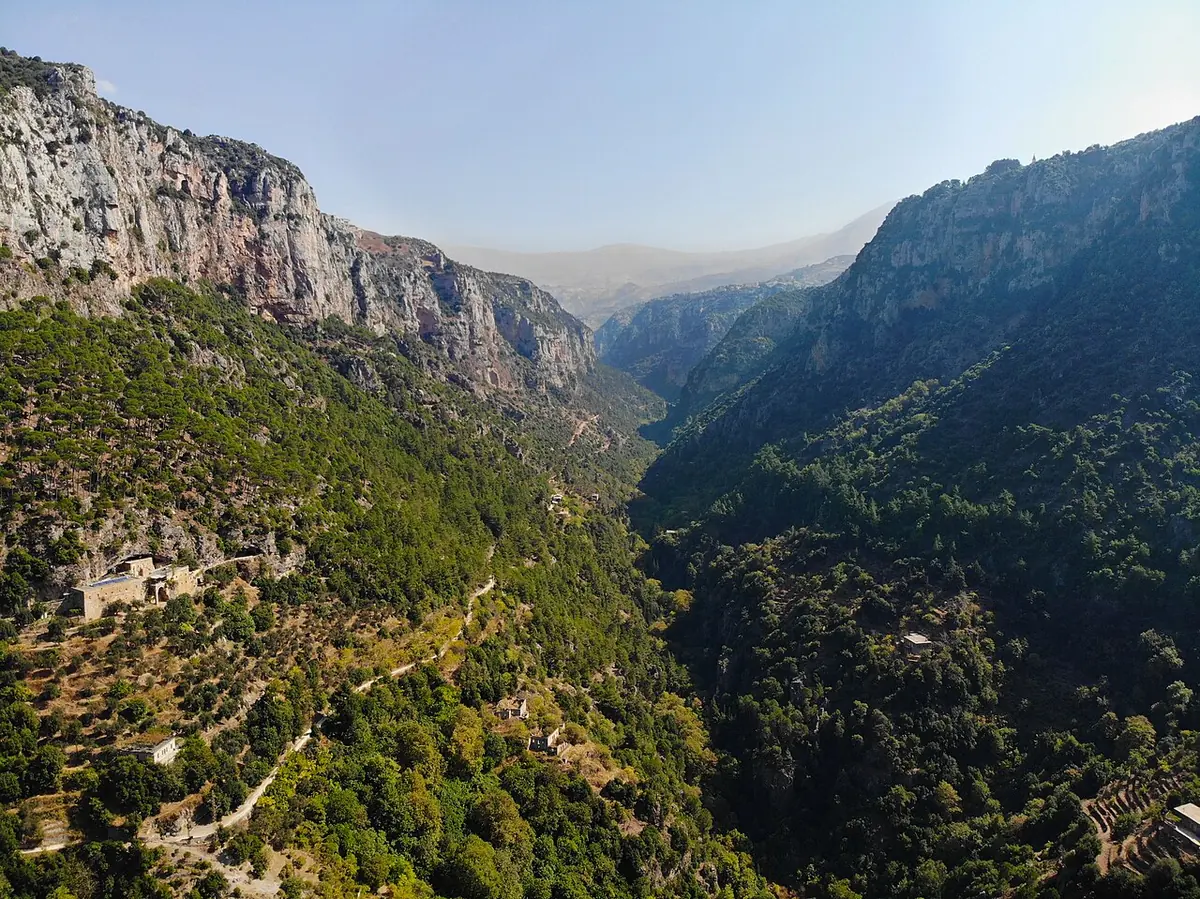
The Maronite Church of Lebanon tells her story as its own. Maronite tradition places Marina's monastery at Qannoubine, in the deep Qadisha Valley, the patriarchs' seat for centuries. Near the monastery is St. Marina's Grotto, a cave hermitage where, the tradition says, she lived with the child after her expulsion and was buried. The 17th-century Maronite Patriarch Estephan Douaihy wrote that the Crusaders took her body to Venice and left only her left hand in the cave.

The grotto became a place of pilgrimage and the burial place of seventeen Maronite patriarchs who lived at Qannoubine. Patriarch Elias Hoayek restored it in 1909, building a stone front and a new marble altar.
Feast day of St. Marina the monk
Her days differ by church:
- June 18: the older Roman Martyrology lists "St. Marina, virgin" at Alexandria. Western calendars have usually taken this as her day. See the feast days calendar.
- February 12: the Byzantine synaxarion of Constantinople commemorates her, with her father Eugene, as Mary called Marinus. The Orthodox Church and the Byzantine Catholic churches keep this day.
- July 17: the translation of her relics to Venice.
Prayer to St. Marina the monk
We have no prayer to her from her own lifetime. The prayers of the Byzantine liturgy for February 12 are the oldest texts addressed to her that we can cite. The Orthodox kontakion for her day praises her for arming herself with purity of soul and constant prayer and driving off the hordes of demons, and begs her to intercede for those who honor her. The OCA prints the full text on its website.
The old Greek life itself ends with an invitation that is still the best way to honor her:
Let us then, beloved, zealously emulate the blessed Mary and her patient endurance, so that on the day of judgment we may find mercy from our Lord Jesus Christ, to Whom belongs glory and dominion to the ages of ages. Amen.
When we are wronged, let us ask St. Marina to pray for us, that we may bear it with her patience and forgive as she did.
Frequently asked questions
Who was St. Marina the monk?
She was a young woman whose father became a monk after her mother's death. She cut her hair, dressed as a man and entered the monastery with him under the name Marinos. After his death she was accused of fathering a child, accepted years of punishment without defending herself, and raised the boy. The monks learned she was a woman only when they prepared her body for burial.
When is St. Marina the monk's feast day?
The older Roman Martyrology lists a St. Marina, virgin, at Alexandria on June 18. The Orthodox Church and the Byzantine Catholic churches keep her, as Mary called Marinus, together with her father Eugene on February 12. Venice remembers the arrival of her relics on July 17.
Is St. Marina the monk the same as St. Marina of Antioch?
No. St. Marina of Antioch, known in the West as St. Margaret, was a virgin martyr famous for the dragon in her legend. Marina the monk was not a martyr; she died peacefully in her monastery. The two are often mixed up because the Greeks call Margaret "Marina."
Where are the relics of St. Marina the monk?
Her body has been in Venice since about 1229 or 1230, when the merchant Giovanni da Bora brought it from a monastery outside Constantinople. It now rests on a side altar in the church of Santa Maria Formosa. In Lebanon, Maronite tradition says her left hand stayed in her grotto at the Qannoubine Monastery.
What is St. Marina the monk the patron saint of?
Because she bore a false accusation in silence for years, Christians ask her prayers when they are falsely accused or slandered. Venice also credited her intercession for the recovery of Padua on her feast in 1509.
Keep exploring
Sources
- Orthodox Church in America: Venerable Mary (who was called Marinus), and her father, Venerable Eugene, at Alexandria
- Holy Women of Byzantium: Ten Saints' Lives in English Translation, ed. Alice-Mary Talbot (Dumbarton Oaks, 1996), Life of St. Mary/Marinos, trans. Nicholas Constas
- G. A. B. Bordi, "Identità in (tras)formazione: Marina il monaco... e del suo culto a Venezia," Venezia Arti 32 (2023)
- The Roman Martyrology (English translation, 1916), June 18 and July 17
- Directory of Churches in Lebanon: Qannoubine valley, St Marina's Grotto
- Orthodox Church in America: Troparion and Kontakion of Venerable Mary (Marinus)