St. Alice of Schaerbeek
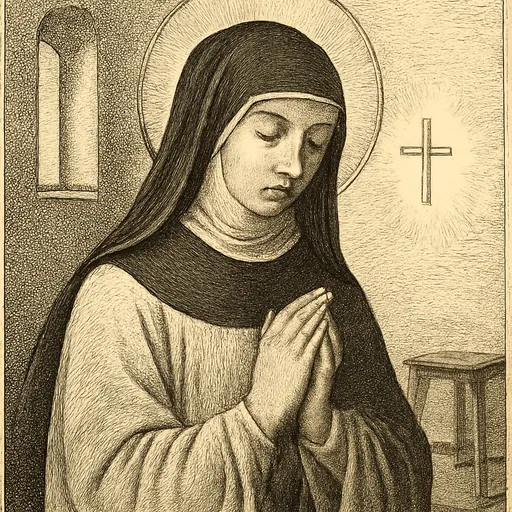
St. Alice of Schaerbeek (Aleydis) was a Cistercian nun near Brussels who caught leprosy in her early twenties, lived apart in a cell, and went blind and paralyzed before she died in 1250, offering it all to God for others. She is the patron saint of the blind and the paralyzed, and her feast day is June 11.
Who was St. Alice?
When people ask about St. Alice, they almost always mean St. Alice of Schaerbeek, a young Cistercian nun who lived and died at La Cambre Abbey, just outside medieval Brussels, in the first half of the 13th century. She caught leprosy in her early twenties, was moved into a little cell apart from her sisters, slowly lost her sight and the use of her limbs, and died on June 11, 1250. She is the patron saint of the blind and of paralyzed people.
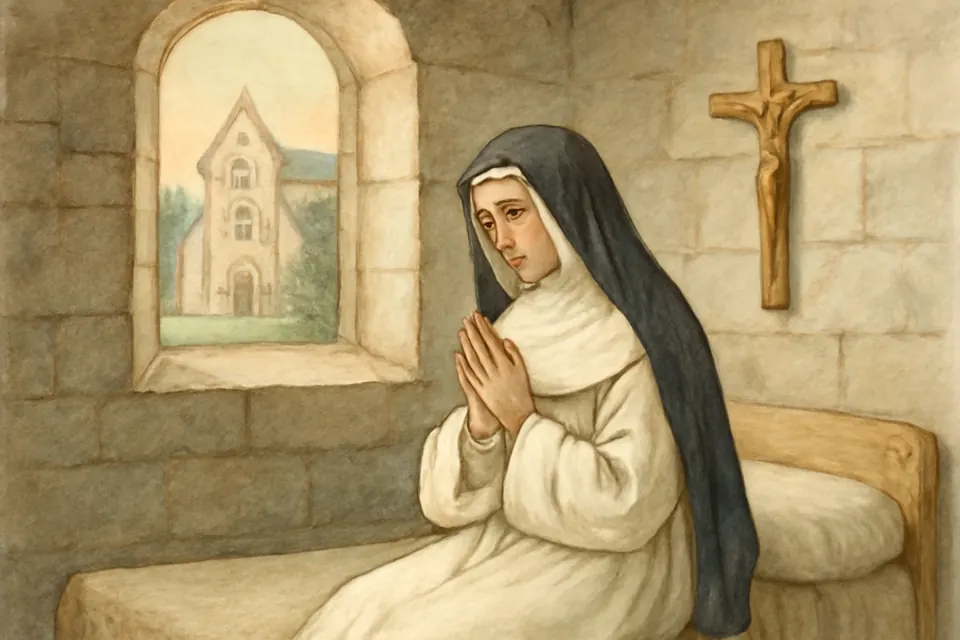
Her name comes down to us in many forms. The Latin Life calls her Aleydis; the Dutch say Aleydis or Aleide, the French Alix or Aleyde, and the Roman Martyrology Adelaide. Alice is simply the English form, since Alice and Adelaide are the same old Germanic name, Adelheid.
Telling the St. Alices apart
Because Alice and Adelaide are one name, a few holy women can turn up under it:
- St. Alice (Aleydis) of Schaerbeek, died 1250, feast June 11: the Cistercian nun of this page and the "St. Alice" of most holy cards and medals.
- St. Adelaide of Italy (931–999), feast December 16: the Holy Roman Empress, wife of Otto the Great, whose life was written by St. Odilo of Cluny. The Catholic Encyclopedia notes that her relics were enshrined in Hanover. Some older books call her Alice.
- St. Adelaide of Vilich (died about 1015), feast February 5: a German abbess near Bonn.
- Blessed Alix Le Clerc (1576–1622): a French foundress of teaching sisters, beatified but not canonized.
If you are choosing a patron named Alice, St. Alice of Schaerbeek is the one the name usually points to.
The life of St. Alice of Schaerbeek
Almost everything we know comes from a Latin Life written within a generation of her death. The Belgian historian P. F. X. de Ram, writing in the Biographie nationale de Belgique in 1866, describes its author as a contemporary, apparently a Cistercian who served as confessor at La Cambre. The Bollandist Daniel Papebroch printed it in the Acta Sanctorum in 1698. A modern English translator, the Trappist Martinus Cawley, thought the author was probably an abbot.
A child at La Cambre
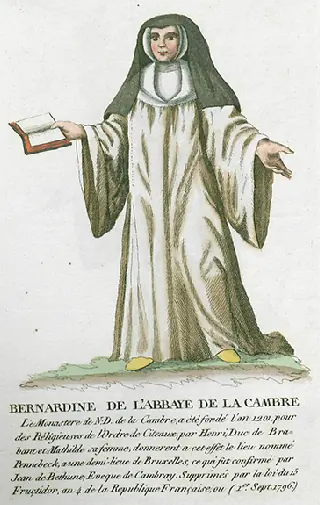
Alice was born at Schaerbeek, then a village a short walk northeast of Brussels and now one of its busiest districts. At seven she was sent to the Cistercian nuns of La Cambre to be educated. The abbey was new: a noblewoman named Gisèle had founded it around 1201 in a wooded valley southeast of the city, and its Latin name, Camera Beatae Mariae, the Chamber of Our Lady, recalls the room at Nazareth where Mary received the angel. The monks of Villers Abbey had spiritual charge of the house.

De Ram says the girl stood out among her companions for her charm, her quick mind and good memory, her kindness and her lively piety. She stayed at La Cambre for the rest of her life. When she was old enough she took the habit and made her profession there. (Some English accounts call her a lay sister; the Roman Martyrology simply calls her a virgin of the Cistercian Order.) A sister of hers named Ida also became a nun at La Cambre and outlived her by many years.
The golden cross
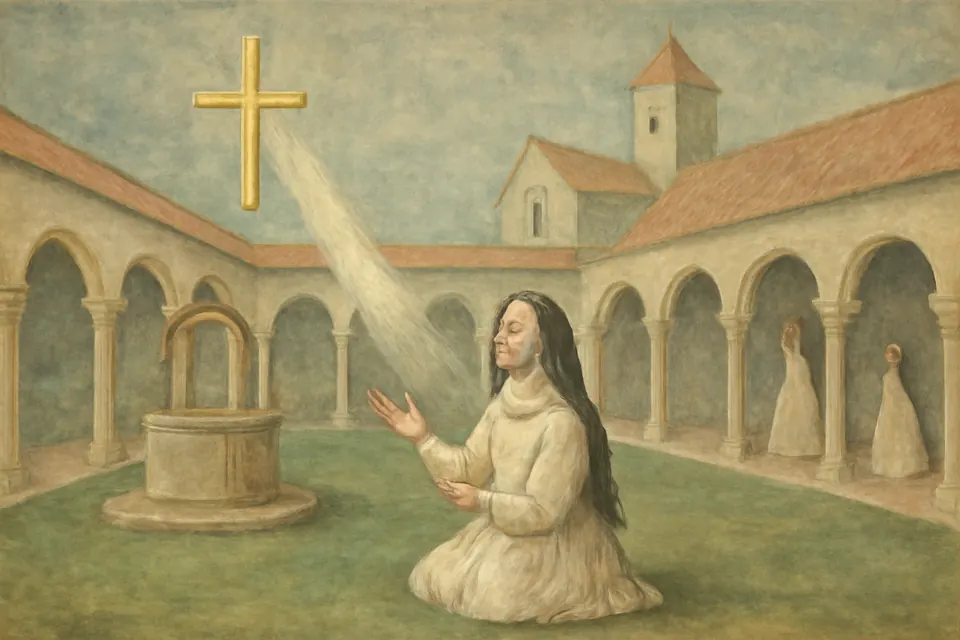
Her Life tells that while she was still young in the monastery, God showed her a vision in which she was given a golden cross. Her biographers read it as a sign of the sufferings ahead of her: a cross, but a precious one.
Leprosy
The Roman Martyrology says that she was struck with leprosy at twenty-two. In the 13th century that meant separation. To protect the community, Alice was moved out of the common life into a small dwelling built for her at the far edge of the monastery grounds. She would never again sing in choir with her sisters or eat with them in the refectory.

What strikes every reader of her Life is how she took it. She offered her pain to God for the conversion of sinners and for the souls in purgatory. The French calendar Nominis sums up the tradition: Christ came to visit her, she lived with him in constant familiarity, and she said that she was very happy in spite of everything.
"Where the part is, there is the whole"
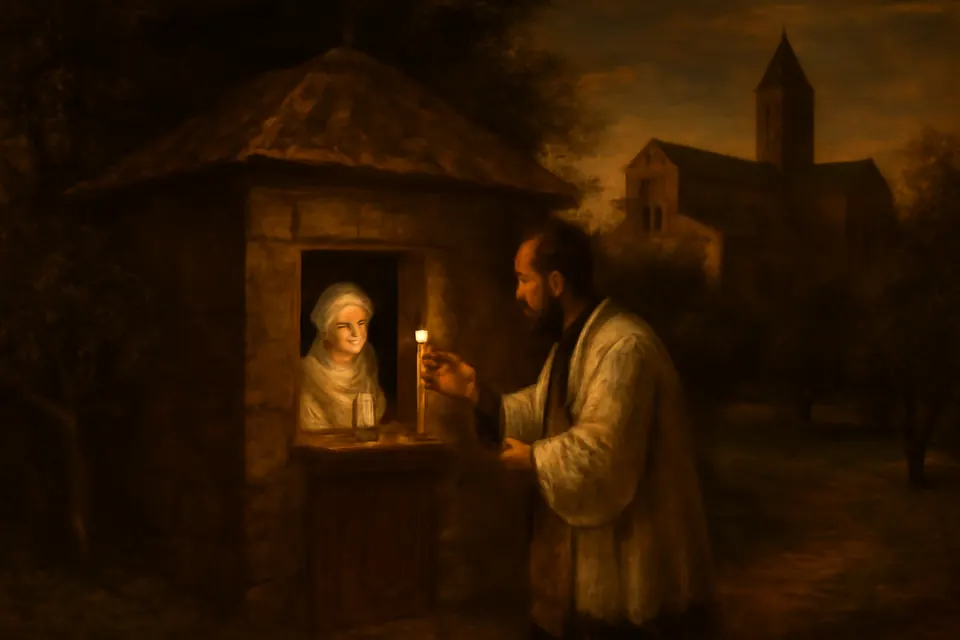
One thing grieved her. For fear of spreading the disease, she was not allowed to drink from the chalice at Mass, as communicants then still sometimes did. Her Life says that Christ himself appeared to console her, telling her that whoever tastes his Body should rejoice that he is refreshed by the Blood as well, and giving the reason in words the biography preserves in Latin:
quia ubi pars, ibi totum; nec pars potest dici, sed totum debet reputari
"Because where the part is, there is the whole; it cannot be called a part, but must be counted as the whole." (Our translation.) It is the Church's own teaching on Holy Communion, given to a sick woman at the window of her cell: Christ is wholly present under each kind.
Blindness and paralysis
The disease spread. In 1249 it destroyed her eyes. Her Life says she offered this new loss for the intentions of William, King of the Romans, and of King Louis IX of France, St. Louis, who had just left on crusade. A later tradition, recorded by Nominis, says she had even asked to be blind so that nothing would distract her from prayer.
By the end she could not move. The Roman Martyrology puts it in one plain sentence: in her last years, blind as well, not one member of her body was left healthy except her tongue, to sing the praises of God.
A year's notice
On June 11, 1249, the feast of St. Barnabas, Alice received a vision telling her she would remain on earth one more year. She died at La Cambre exactly a year later, on Saturday, June 11, 1250, still a young woman. Her biographer adds that those at her bedside saw her soul go straight to heaven. (De Ram gives June 15 as the date of her death; June 11 is the date of her Life and of the Martyrology.)
Visions and miracles of St. Alice
Alice is not a wonder-worker in the usual sense. The marvels in her story are inward ones, and all of them are traditional: recorded in her 13th-century Life, never formally examined by the Church.
- The golden cross: a vision in her youth foretelling her sufferings.
- Christ's words on Communion: that receiving the host, she received him whole.
- The year's warning: a vision on June 11, 1249, followed by her death on June 11, 1250.
- Her death: witnesses saw her soul rise to heaven.
Her Italian biographer in Santi e Beati also notes miracles attributed to her, without detail. No miracle has been investigated or approved in the modern sense, because her veneration was approved as an ancient cult, not through a canonization process.
Why St. Alice is the patron saint of the blind
She is the patron of the blind and the paralyzed because she became both. She lost her sight and the use of her body to leprosy and still praised God with the one thing left to her, her voice. People living with blindness, paralysis, leprosy and long illness ask her prayers, and so do those who care for them. See our patron saints page for others who stand with the sick, among them St. Lucy, also invoked for the eyes, and St. Margaret of Castello, a blind and disabled woman of the same century.
Her Life has been read for centuries by Cistercians as a short school of the monastic life: stability, obedience, love of the Eucharist, and suffering joined to Christ's. Her order traces its way of life to St. Bernard of Clairvaux.
Symbols of St. Alice in art
St. Alice has no long tradition in painting, and you won't find her in the great museum altarpieces. Images of her are mostly modern and devotional, made for Belgian churches, Cistercian houses and holy cards. To recognize her, look for:
- A young woman in the Cistercian habit: a white or cream tunic, often with a black veil and scapular, the dress of the "Bernardine" nuns of La Cambre.
- Hands joined in prayer: her prayer was the work of her life once she could do nothing else.
- A golden cross: recalling the vision of her youth.
- The Eucharistic host or a chalice: for Christ's words to her about Holy Communion.
- Closed eyes or a bandage: for her blindness, in some modern images.
There are no Eastern icons of her; she is a saint of the Latin West and especially of Brabant.
Feast day and where St. Alice is honored
The Roman Martyrology keeps her memory on June 11. Her cult grew slowly. On July 1, 1702, Pope Clement XI allowed the Feuillants, a reformed congregation of Cistercian monks, to celebrate her feast. It was extended to the whole Cistercian Order in 1870, and in 1907 Pope St. Pius X authorized it for every diocese in Belgium. The Cistercians and the Archdiocese of Mechelen-Brussels celebrate her on June 15. Find her neighbors on our feast days calendar.
La Cambre Abbey was closed in 1796 under French rule and sold. Its church, refectory and chapter-house wing keep their medieval character, and the grounds still give their name to the Bois de la Cambre, the great wooded park of southern Brussels. No shrine of her relics survives there.

In Schaerbeek, the town of her birth, a parish church on the avenue Dailly is dedicated to her.

Prayer to St. Alice
There is no traditional prayer to St. Alice of Schaerbeek in general use, and we won't put words in her mouth. Cistercian communities pray the proper texts of her feast in the liturgy of their order. For the rest of us, we can ask her intercession simply: St. Alice, you lost your sight and your strength and still sang God's praises; pray for all who are blind, paralyzed or worn down by long illness, and for those who care for them.
Her own life suggests how to pray with her: to offer what we suffer for others, as she offered hers for sinners, for the souls in purgatory and for a king on a long journey, and to receive the Lord in Holy Communion trusting, as she was told, that where he is given, he is given whole.
Frequently asked questions
Which St. Alice is the patron saint of the blind?
St. Alice of Schaerbeek, also called Aleydis or Adelaide, the Cistercian nun of La Cambre near Brussels who died in 1250. She went blind and lost the use of her limbs from leprosy, so she is invoked for the blind and the paralyzed. Most "St. Alice" medals and holy cards mean her.
When is St. Alice's feast day?
June 11, the day she died in 1250, in the Roman Martyrology. Cistercians and the Archdiocese of Mechelen-Brussels keep it on June 15. St. Adelaide of Italy, whose name is also sometimes rendered Alice, is a different saint, remembered on December 16.
Is St. Alice a canonized saint?
She was never canonized by the modern process, which didn't exist in her day. The Church approved her public veneration step by step: Pope Clement XI allowed a Cistercian congregation to keep her feast in 1702, the cult was extended to the whole Cistercian Order in 1870, and Pope St. Pius X confirmed it for all the dioceses of Belgium in 1907.
Is Alice a saint's name for Confirmation?
Yes. Alice is a medieval form of Adelaide (Adelheid), so a girl named Alice can take St. Alice of Schaerbeek or St. Adelaide of Italy as her patron. See our Confirmation saints guide for more.
What miracles is St. Alice known for?
Her Life tells of visions rather than public wonders, all traditional: a golden cross that foretold her suffering, Christ's assurance about Holy Communion, and a vision a year before her death telling her she had one year left. She died on that day a year later. No miracle has been formally investigated.
Keep exploring
- Patron saint pages
- EyesHealing
- Appears in
- Female saints
- Feast-day calendar
- Saints remembered in JuneSaint of the dayWhat saint is my birthday?
- More
- Saints A to ZPatron saints A to ZExplore every section
Sources
- Santi e Beati: Sant' Aleide di Schaerbeek, Vergine (Goffredo Venuta), with the Roman Martyrology entry
- Biographie nationale de Belgique, vol. 1 (1866): Adélaïde, Bienheureuse, by P. F. X. de Ram (Wikisource)
- Nominis: Sainte Adélaïde, Cistercienne à la Cambre (+ 1250)
- Kenyon College: Excerpts from The Life of Alice the Leper (trans. Martinus Cawley)
- Catholic Encyclopedia (1907): St. Adelaide (Empress)
- Acta Sanctorum, June, vol. 2 (1698), p. 476: De B. Aleyde Scharembekana (Life edited by Daniel Papebroch)
- Roman Martyrology, June 11