St. Alexander of Comana, the Charcoal Burner

St. Alexander of Comana, called the Charcoal Burner, was a learned man of third-century Pontus who hid his gifts by working as a poor charcoal burner, until St. Gregory the Wonderworker chose him as bishop of Comana. He governed his church wisely and died a martyr, burned for the faith. We keep his feast on August 11; the Orthodox Church honors him on August 12.
Who was St. Alexander of Comana?
St. Alexander of Comana, the Charcoal Burner, was a bishop and martyr of the third century in Pontus, the hill country along the Black Sea in what is now northern Turkey. He was an educated man, remembered in the Roman Martyrology as a "most eloquent philosopher," who chose to live as a poor charcoal burner so that no one would honor him. God had other plans. St. Gregory the Wonderworker, the great bishop of nearby Neocaesarea, picked him out of the crowd and made him bishop of Comana. He ruled that church well and died for Christ in the fire.
His story is short, and we owe it to one source. The Catholic Encyclopedia points out that his name does not appear in any of the old Greek or Roman calendars. We know him because St. Gregory of Nyssa, in his sermon on the life of St. Gregory Thaumaturgus, stopped to tell how Alexander was chosen.
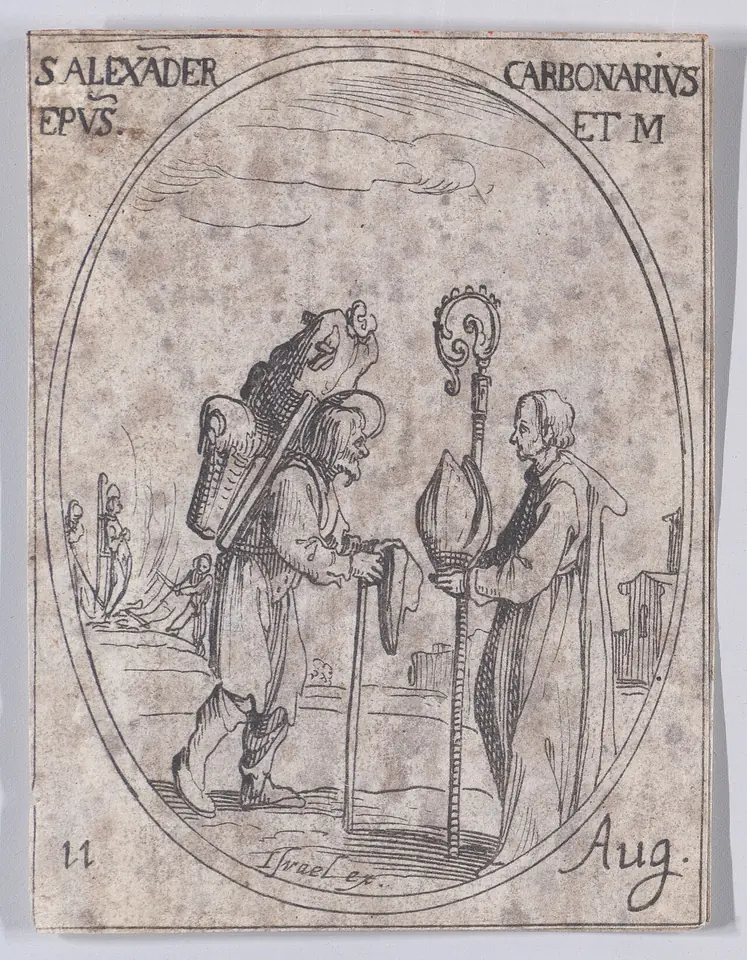
The charcoal burner of Comana
Comana in Pontus was a busy town on the river Iris, not far from Neocaesarea. The Bollandists wrote a long study just to settle which of the several towns called Comana was Alexander's, and they decided for this one.
Alexander had studied philosophy and the Scriptures, but he set it all aside. He took up the dirtiest work in town, burning wood into charcoal and selling it in the square, with his face and clothes always black with soot. The Catholic Encyclopedia says he did it "out of humility" and "to escape worldly honours." The Orthodox life describes it as a holy foolishness taken on for Christ's sake. People treated him with contempt, which was what he wanted.

Chosen by St. Gregory the Wonderworker
When the church of Comana needed a bishop, the leading men asked Gregory the Wonderworker to come and preside over the choice. Some wanted a nobleman, some a learned speaker, some a rich man. Gregory turned them all down. A bishop, he told them, should be judged first by a pure heart and a holy life, not by birth or polish.
Someone in the crowd laughed and said that, by that rule, they might as well take Alexander the charcoal burner. Gregory did not laugh. He had the man brought in. Alexander came in his rags, black with soot, and stood quietly while the assembly jeered.
Gregory took him aside and questioned him, and the truth came out: this was a philosopher and a man who knew the Scriptures, who had chosen poverty for the Lord's sake. The Orthodox life adds that Gregory had him washed and dressed in clean clothes at his own house. When Alexander came back before the people and answered Gregory's questions about Scripture, they were amazed and elected him at once. Gregory ordained him priest and then consecrated him bishop, and the new bishop preached to his people with a grace that won them over.
The Catholic Encyclopedia sums him up as "a saint and a man of great capabilities." He governed his church, it says, "with remarkable wisdom."

His martyrdom
Alexander died a martyr. When persecution came, he refused to sacrifice to the gods, and he was burned to death. The Catholic Encyclopedia places this in the persecution of the emperor Decius, about 250, which fits the lifetime of Gregory the Wonderworker. The Orthodox life tells it under Diocletian, early in the fourth century, and notes that some sources say Decius. We cannot be sure of the year.
Miracles and veneration
No miracles of St. Alexander are recorded, in his life or after his death. His story is a story about how God sees, not about wonders. For centuries his memory lived only in Gregory of Nyssa's sermon. The Latin Church later entered him in the Roman Martyrology on August 11, and the Orthodox Church honors him as a hieromartyr, a priest-martyr, on August 12. No shrine or relics of him are known today.
Symbols of St. Alexander of Comana in art
Pictures of St. Alexander are rare, and the few we have play on the two halves of his life:
- The charcoal burner's load: a basket or sack on his back, ragged clothes and a dark face. In Jacques Callot's etching he is labeled S. Alexander Carbonarius, the charcoal man.
- Miter and crozier: the bishop he became. Callot sets the beggar's load and the bishop's staff side by side in one small picture.
- Fire: in Eastern images and lives, the flames of his martyrdom.
In Orthodox icons he looks like other early bishop-martyrs, in a bishop's omophorion holding a Gospel book, and his name is the surest way to recognize him.
Feast day and how we honor him
We keep the feast of St. Alexander of Comana on August 11, and the Orthodox Church on August 12. See the feast day calendar for other saints of the season.
No traditional prayer to St. Alexander has come down to us. We honor him by asking his intercession in our own words, especially when we are tempted to judge people by their looks, their money or their rank. Let us ask St. Alexander, who chose to be overlooked, to pray that we may see others as Gregory saw him.
The lesson of the charcoal burner
Gregory of Nyssa told the story to show the holiness of his hero, the Wonderworker, who could see a bishop under the soot. It works the other way too. Alexander had real gifts and hid them, not out of laziness but out of love for the hidden life of Christ. When the Church called him, he came, and in the end he gave his life.
Frequently asked questions
Who was St. Alexander the Charcoal Burner?
He was a third-century philosopher of Pontus who, out of humility, lived as a poor charcoal burner. When St. Gregory the Wonderworker came to Comana to choose a bishop, the townspeople mockingly suggested Alexander. Gregory took them at their word, found a holy and gifted man, and made him bishop.
When is the feast of St. Alexander of Comana?
August 11 in the Roman Martyrology. The Orthodox Church commemorates him as the Hieromartyr Alexander, Bishop of Comana, on August 12.
How did St. Alexander of Comana die?
He was burned to death for refusing to deny Christ. The Catholic Encyclopedia places his martyrdom in the persecution of Decius (249–251); some Orthodox lives place it under Diocletian.
How do we know about St. Alexander of Comana?
Almost entirely from St. Gregory of Nyssa's sermon on the life of St. Gregory the Wonderworker, preached in the late fourth century, which tells the story of his election.
Keep exploring
Sources
- Catholic Encyclopedia (1907): St. Alexander (of Comana). His absence from the old calendars, Gregory of Nyssa as the only source, the Bollandists on the location of Comana, death by fire under Decius, and the Martyrology's "philosophus disertissimus"
- Orthodox Church in America: Hieromartyr Alexander, Bishop of Comana (August 12). The Eastern telling, with his washing and reclothing in Gregory's house and his sermon to the people; martyrdom under Diocletian or Decius