St. Bassa of Edessa, Martyr, and Her Three Sons

St. Bassa of Edessa was a Christian wife and mother who raised her three sons, Theognis, Agapius and Pistus, in the faith and encouraged them to die for Christ in the persecution of Maximian Galerius in the early 300s. Her husband, a pagan priest, had denounced them. After many torments she was beheaded and followed her sons. We keep her feast on August 21.
Who was St. Bassa of Edessa?
St. Bassa of Edessa was a Christian wife and mother who lived at the turn of the fourth century, in the last and fiercest of the Roman persecutions. She had been raised in the faith from childhood and married a pagan priest. She taught her three sons, Theognis, Agapius and Pistus, to love Christ. When their father turned them in, the boys died as martyrs, and Bassa, after long suffering, followed them. We keep the feast of the mother and her sons together on August 21.
Her story reaches us in two forms. The Roman Martyrology gives a short notice. The Greek tradition, which the Orthodox Church keeps in its synaxarion, tells a much longer tale full of wonders. They agree on what matters most: a mother who handed on the faith and did not take it back when it cost her children's lives.
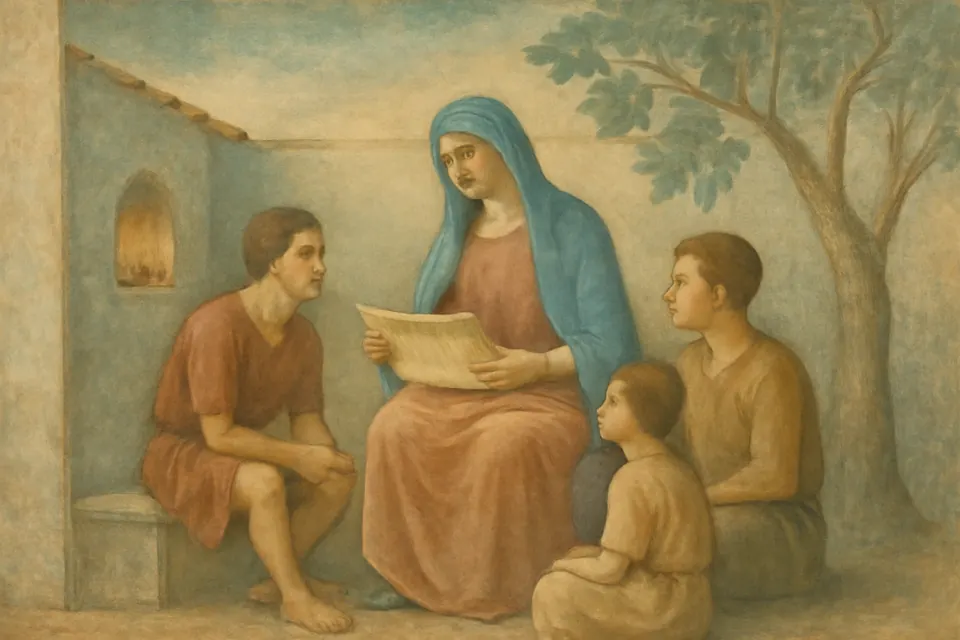
A mother and three sons
The Orthodox account says Bassa lived in Edessa in Macedonia, in what is now northern Greece. Her husband served the gods as a priest. During the reign of Maximian Galerius, who ruled the eastern provinces from 305 to 311, he denounced his own wife and children to the governor.
The boys were ordered to sacrifice to the idols and refused. Theognis, the eldest, was torn with iron claws and beheaded. Agapius was flayed and, the account says, did not make a sound. Pistus, the youngest, was tortured and beheaded like his brothers. One Greek account places their deaths at Edessa; another says they died at Larissa in Thessaly, their homeland.
The Roman Martyrology puts the heart of it in a single line. Bassa, it says, was the pious mother who "exhorted to martyrdom and sent before her bearing their crowns" her three sons. The names say something too. Pistus is Greek for "faithful," and the Latin martyrology calls him by the same word in Latin, Fidelis.
Bassa in prison and at sea
The rest of the Greek account is told in the style of the old martyr legends, and we should take it as traditional. Bassa was thrown into prison and left to weaken with hunger, but an angel came and strengthened her with heavenly food. She was put to fire, water and wild beasts and came through unharmed. Brought into a pagan temple, she shattered the statue of Zeus.

Then she was thrown into a whirlpool in the sea. To everyone's surprise, a ship sailed up, and three radiant men pulled her out of the water. St. Nicodemus of the Holy Mountain, the great Greek compiler of saints' lives, suggested that they were her own sons, already in glory, come to help their mother. After eight days at sea the ship brought her to the island of Alona, near Cyzicus in the Sea of Marmara. There the governor had her beaten with rods and beheaded.
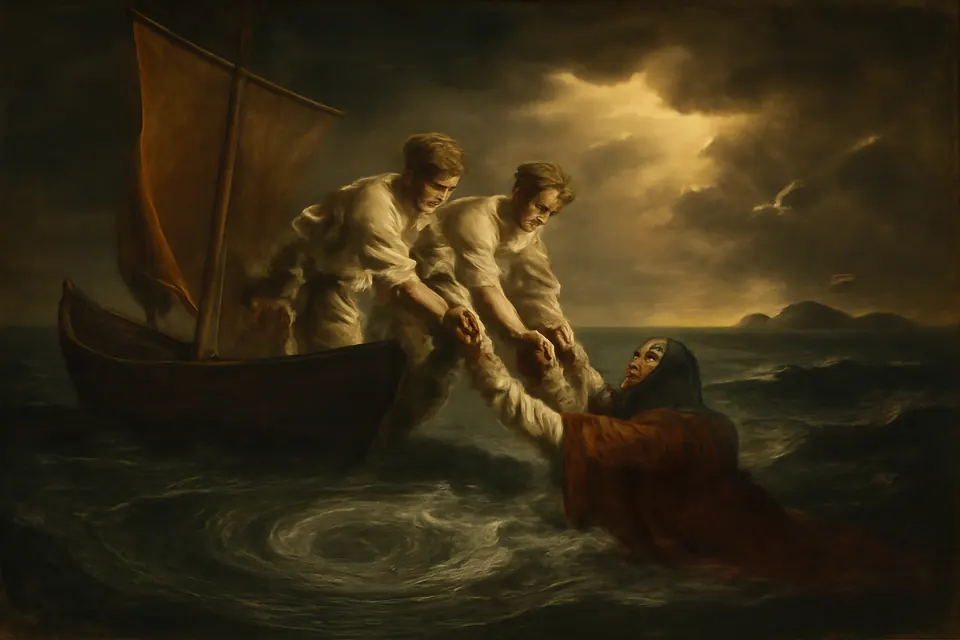
Which Edessa?
There were two cities called Edessa in the Roman world: Edessa in Macedonia, a town in northern Greece that still has the name, and the much more famous Edessa in Syria, today's Şanlıurfa in Turkey. The Roman Martyrology of 1916 places Bassa "at Edessa, in Syria." The Greek tradition, which knows her story far better, places her in Macedonian Edessa, and her death on an island in the Sea of Marmara fits a Greek setting. We cannot settle it, and there is no need to.
Miracles of St. Bassa
Every wonder in her story is traditional: the angel who fed her in prison, her escape from fire, water and beasts, the shattering of the idol and the three shining men who lifted her from the sea. They come from the Greek acts of her martyrdom, not from any formal investigation. The plain fact behind them, kept in both East and West, is that a mother and her three sons died for Christ.
Symbols of St. Bassa in art
Bassa is rarely painted alone. In Eastern calendar icons she stands among the saints of August 21, shown as women martyrs usually are: veiled, in a long mantle, holding a cross. Some icons add her three sons beside her. We know of few Western images of her. If you meet a veiled woman with a martyr's palm and three boys, also holding palms, the subject may be Bassa, though St. Felicitas of Rome, with her seven sons, is far more often shown.
Feast day and honor
Both the Roman Martyrology and the Orthodox calendar keep her feast with her sons on August 21. Her cult is old: according to the Orthodox Church in America, there was already a church in honor of St. Bassa at Chalcedon by the year 450, the city of St. Euphemia, just across the water from Constantinople. No relics of hers are known today.
Prayer to St. Bassa and her sons
We know of no traditional Western prayer to her. The Orthodox Church sings this troparion (Tone 4) on her feast:
Your holy martyr Bassa and her sons, O Lord, / through their sufferings have received incorruptible crowns from You, our God. / For having Your strength, they laid low their adversaries, / and shattered the powerless boldness of demons. / Through their intercessions, save our souls.
Let us ask St. Bassa to pray for Christian mothers, especially those whose husbands do not share their faith, and for parents who fear for children who confess Christ in hard places.
Frequently asked questions
Who was St. Bassa of Edessa?
A Christian mother of the early fourth century, married to a pagan priest, who raised her three sons as Christians. When the husband denounced them, the sons were martyred, and Bassa, after imprisonment and torture, was beheaded.
When is the feast of St. Bassa?
August 21, with her sons, in both the Roman Martyrology and the Orthodox calendar.
What were the names of St. Bassa's sons?
Theognis (Theogonius in the Roman Martyrology), Agapius and Pistus. The Roman Martyrology gives the youngest the Latin form of his name, Fidelis; both mean "faithful."
Which Edessa was St. Bassa from?
The Greek tradition, followed by the Orthodox Church in America, places her in Edessa in Macedonia, in northern Greece. The older Roman Martyrology says Edessa in Syria. One Greek account says the sons died at Larissa in Thessaly.
Keep exploring
Sources
- Orthodox Church in America: Martyr Bassa of Edessa and her sons Theogonius, Agapius, and Pistus. Her marriage, the deaths of her sons, the angel in prison, the rescue at sea, her death on Alona and the church at Chalcedon
- Orthodox Church in America: Troparion and Kontakion of St. Bassa and her sons. Text of the troparion
- The Roman Martyrology (1916 English edition), August 21. Her listing with her sons Theogonius, Agapius and Fidelis, "at Edessa, in Syria"