St. John of Rila (876–946): Hermit, Wonderworker and Patron of Bulgaria
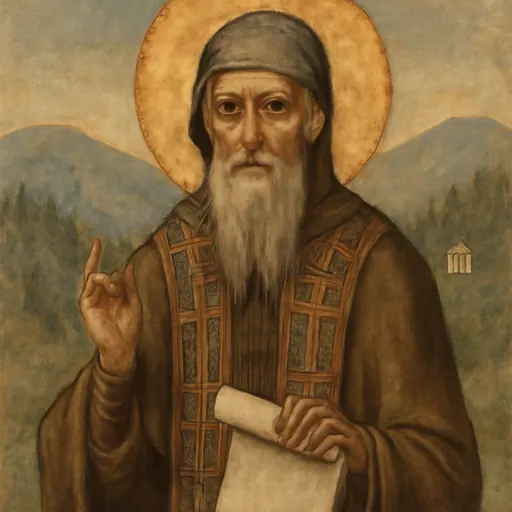
St. John of Rila (876–946), called Ivan Rilski in Bulgarian, was a hermit who lived for decades in caves and a hollow tree in the Rila Mountains and founded the monastery that still bears his name. The Bulgarian Orthodox Church honors him as the heavenly protector of the Bulgarian nation. His main feast is August 18, with a second feast on October 19, and he is the patron saint of Bulgaria.
Who was St. John of Rila?
St. John of Rila is the great hermit of Bulgaria. Born in 876, only a few years after the Bulgarians accepted Christianity, he gave away everything, lived for decades alone in caves, in the hollow of a tree and on a bare crag in the Rila Mountains, and drew so many disciples that they built a monastery around his cave. He died on August 18, 946, at about 70. The Bulgarian Orthodox Church calls him the heavenly protector of the Bulgarian nation, and the monastery he began is still the heart of Bulgarian Orthodoxy.
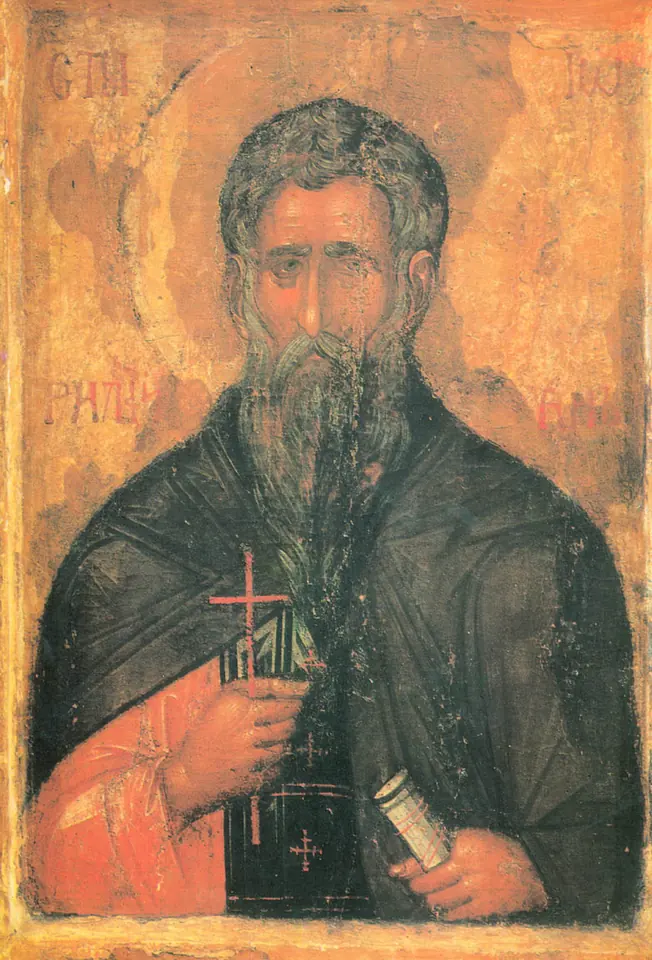
His life comes down to us through Bulgarian, Greek and Russian tradition. Here we follow the life published by the Orthodox Church in America, and we say where history ends and the old stories begin.
The life of St. John of Rila
The orphan cowherd
He was born in the village of Skrino, near Sredets, today Sofia. Orphaned young, he worked as a cowherd for a rich man. One day he lost a cow and her calf and was beaten for it. He prayed, found them on the far side of the swollen river Struma, and, the story goes, spread his ragged shirt on the water, made the sign of the cross over it and crossed with the calf in his arms as if on dry land. The rich man, who saw it from the trees, rewarded him and sent him away. John gave away what he had and left the village.
Caves, a hollow tree and a rock
No one knows where he was tonsured a monk. He lived first on a bare hilltop, eating wild plants, until robbers beat him and drove him off. He then lived in a deep cave for twelve years. His young nephew Luke joined him there, until Luke's father came, cursed John as a kidnapper and took the boy home; on the way a snake bit Luke and he died. John often prayed at his nephew's grave.
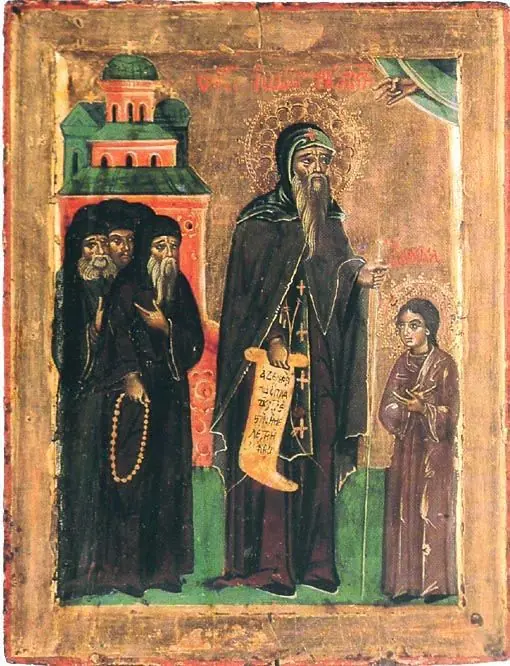
Next he moved deeper into the Rila wilderness and lived in the hollow of a tree, eating beans that grew beside it. When word of him spread, he climbed to a high rock and lived there for seven years under the open sky. The Bulgarian tsar Peter I (927–969) wanted to meet him; John wrote him a letter and, out of humility, declined.
The monastery and the Testament
At last John accepted disciples, and they built a monastery with a church in the cave where he had first lived. He led them wisely until his death on August 18, 946. Five years before he died, he wrote out in his own hand a Testament for his disciples. The OCA calls it one of the finest works of Old Bulgarian literature, and John Paul II at Rila called it "an extraordinary teaching on the quest for and experience of God."

The miracles of St. John of Rila
- Crossing the Struma on his shirt (traditional). The cowherd's miracle above.
- The beans that would not be stolen (traditional). Shepherds chasing their frightened sheep found the hermit, and he invited them to eat his beans. One of them filled his pockets on the sly; on the way home the pods were empty. They came back ashamed, and John told them with a smile that these beans were given by God for life in the wilderness.
- Healings by his prayer (reported in his life). After the shepherds' story spread, people brought him the sick and those troubled by evil spirits, and he healed them by prayer. The OCA life adds that his relics at Rila still grant grace-filled help to all the believers who come.

The journeys of his relics
His body did not rest quietly. According to the OCA, about 980 his relics were carried to Sredets (Sofia). In 1183 King Béla III of Hungary seized them during a campaign and took them to Esztergom, then sent them back with honor in 1187. On October 19, 1238, they were moved to the new Bulgarian capital, Tarnovo. On July 1, 1469, under Ottoman rule, they came home to Rila Monastery, where they rest today. Each of these days is still remembered.

Symbols of St. John of Rila in icons
- An old monk with a long gray or white beard, thin and ascetic.
- The monastic habit and the great-schema, the embroidered garment of a monk of the highest rank.
- A scroll, often unrolled, for his Testament to his disciples.
- A hand raised in blessing, or a small cross.
- Rila Monastery or the mountains behind him, and in life-scene icons, his cave and his hollow tree.

Feast days, Rila Monastery and prayer
His feasts are August 18 (his repose), October 19 (the translation to Tarnovo) and July 1 (the return to Rila). Rila Monastery stands high in the mountains south of Sofia, a UNESCO World Heritage site and the largest monastery in Bulgaria. When Pope John Paul II came there in May 2002 to venerate the relics, he asked: "What would Bulgaria be without the Monastery of Rila, which in the darkest periods of your national history kept the flame of faith burning?" For other saints and their days, see our feast days and patron saints pages.

The Orthodox Church sings this troparion on his feast, in the translation of the Orthodox Church in America:
Your life was a foundation of repentance / and a model of compunction, / an image of consolation and spiritual perfection, / equal to the angels, O venerable one. / You persevered in prayer, fasting and tears, O Father John; / intercede with Christ God for our souls.
Let us ask him to pray for Bulgaria, for all monks and nuns, and for the unity of Christians East and West: Holy Father John, pray to God for us.
Frequently asked questions
When is the feast of St. John of Rila?
August 18, the day he died in 946. The Orthodox Church also celebrates October 19, when his relics were moved to Tarnovo in 1238, and July 1, when they came back to Rila Monastery in 1469.
Why is St. John of Rila the patron saint of Bulgaria?
He is the great ascetic of the early Bulgarian Church, who lived only a few decades after Bulgaria became Christian. His monastery kept the faith alive through the centuries of Ottoman rule; as Pope John Paul II said there in 2002, 'What would Bulgaria be without the Monastery of Rila, which in the darkest periods of your national history kept the flame of faith burning?'
Where are the relics of St. John of Rila?
At Rila Monastery in the mountains south of Sofia, where they returned in 1469 after nearly five centuries in Sofia and Tarnovo. Pilgrims venerate them in the monastery's main church.
Is St. John of Rila a Catholic saint?
He is a saint of the Orthodox Church from the centuries before East and West divided. Pope John Paul II called him 'Blessed John of Rila,' had him depicted in the mosaics of the Redemptoris Mater Chapel in the Vatican, and made a pilgrimage to venerate his relics at Rila on May 25, 2002.
Keep exploring
Sources
- Orthodox Church in America: Repose of Venerable John, Abbot of Rila. His life, the cowherd and the river, the bean miracle, his Testament, the movements of his relics in 980, 1183, 1187, 1238 and 1469
- Orthodox Church in America: Translation of the relics of Venerable John, Abbot of Rila
- Orthodox Church in America: Repose of Venerable John, Abbot of Rila, Troparion and Kontakion
- John Paul II, Pilgrimage to the Holy Monastery of Rila, May 25, 2002