St. Gregory of Sinai

St. Gregory of Sinai (about 1265–1346) was a Greek monk who learned the prayer of the heart on Crete, taught it to many disciples on Mount Athos. His writings on stillness and the Jesus Prayer are in the Philokalia. The Orthodox Church keeps his feast on August 8 and his repose on November 27.
Who was St. Gregory of Sinai?
St. Gregory of Sinai was a fourteenth-century Orthodox monk who did more than anyone of his time to spread hesychasm, the prayer of inner stillness, across the monasteries of the Byzantine and Slavic world. He took his name from Mount Sinai, where he became a monk, but his great work was done on Mount Athos and in the mountains of the Bulgarian border, where he gathered disciples who carried his teaching north to Bulgaria, Serbia, Romania and Russia.
The Orthodox Church keeps his feast on August 8, and also honors him on November 27, the day he died in 1346. Almost everything we know of him comes from one book: the Life written by his disciple Kallistos, who later became Patriarch of Constantinople.
The life of St. Gregory of Sinai
Captive and pilgrim
Gregory was born in the 1260s, traditionally in 1265, in a village at the southern end of the bay of Smyrna, today's Izmir in Turkey. While he was still young, raiders carried him and his family off for ransom to Laodicea in Syria. The local Christians noticed the boy for the beauty of his chanting in church, and the family was ransomed.
He went first to Cyprus, where a hermit gave him the first habit of a monk, and then to Mount Sinai. At the ancient monastery of St. Catherine he was fully tonsured and gave himself to the fasts, vigils and long hours of standing prayer of the Sinai fathers, the tradition of St. John Climacus. The OCA life says he served there as cook, baker and copyist.

The old man on Crete
Other monks grew jealous of him, and Gregory left Sinai with a companion, Gerasimos. A storm drove their boat to Crete, and they took it as a sign. They found a cave and lived on bread and water until an old monk named Arsenios came to them. Arsenios taught Gregory that everything he had done so far belonged to praxis, the outward struggle, and that he must now turn inward, to the guarding of the mind and the prayer of the heart.

Athos
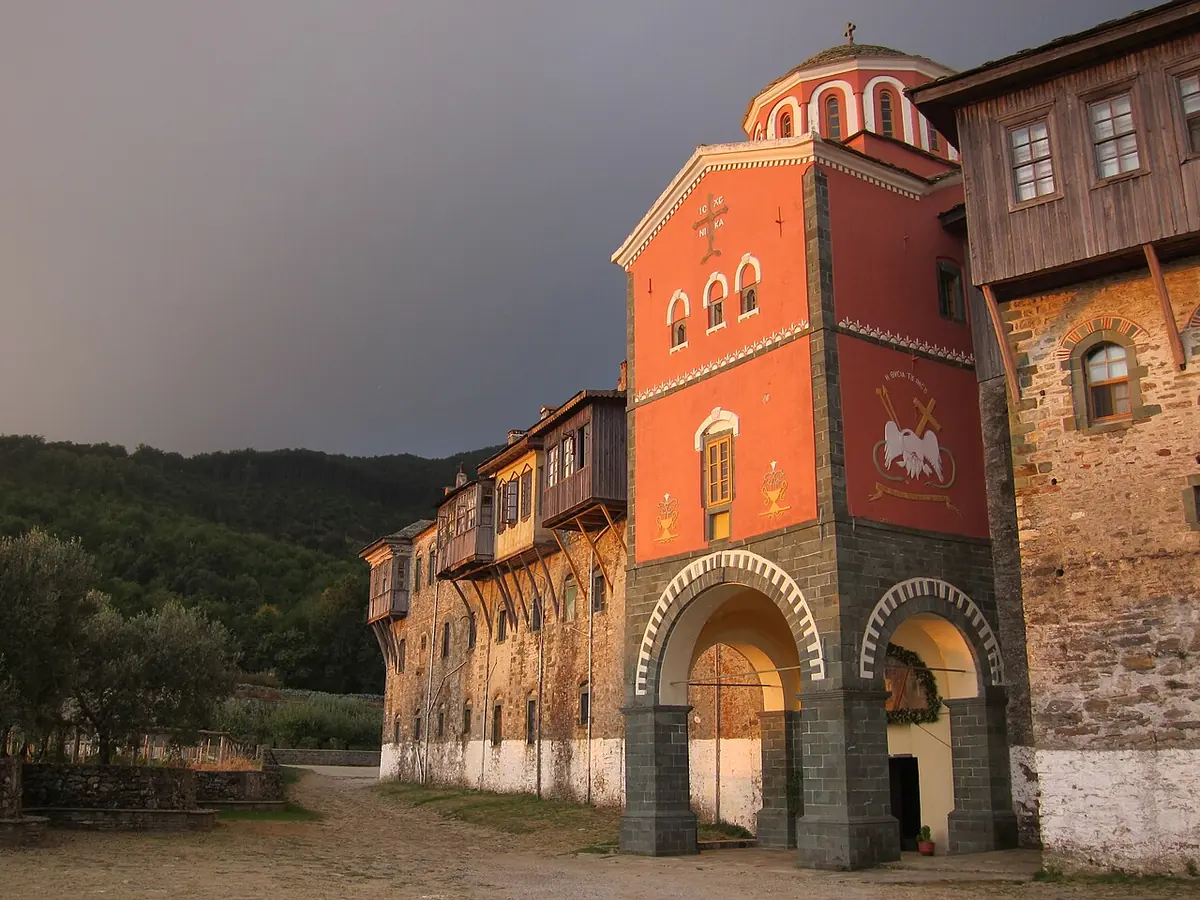
From Crete Gregory went to Mount Athos and searched for teachers of this inner prayer. He found almost none. He settled at last at Magoula, a small skete near the monastery of Philotheou, where three monks lived the life he sought. There, Kallistos writes, praying the Jesus Prayer, he underwent "a good and strange transformation," and his cell was filled with light.
Disciples came "like bees to honey": learned monks and simple ones, Greeks and Slavs. One of them, a Bulgarian named Kliment, had been a shepherd. Gregory stayed apart from the public disputes over hesychasm that St. Gregory Palamas was soon to win, and gave himself to prayer and to teaching.
Paroria
Turkish raids on Athos grew worse, and after years of wandering, with stops at Thessaloniki, Chios, Lesbos and Constantinople, Gregory and his disciples settled in the Strandzha Mountains above the Black Sea, on the border of Byzantium and Bulgaria. The Bulgarian tsar Ivan Alexander protected and supported the new monastery at Paroria. There Gregory trained the next generation of Balkan monks, among them St. Theodosius of Tarnovo and St. Romylos.
Kallistos tells how, knowing his death was near, Gregory went to an isolated cell with one disciple and for three days fought off a horde of demons, neither eating nor sleeping, until a great peace came over him. He died on November 27, 1346.

Miracles of St. Gregory of Sinai
- The light in his cell on Athos: traditional. Kallistos writes that his cell was filled with light as he prayed, as old Arsenios had foretold.
- His victory over the demons at death: traditional, from the same Life.
His Life tells of grace rather than wonders, and Kallistos himself said these gifts could not "safely be described to uninitiated persons."
The writings of St. Gregory of Sinai
His teaching survives in the Philokalia, the great collection of Orthodox texts on prayer: 137 texts "On Commandments and Doctrines," further chapters, ten texts on the signs of grace and delusion, fifteen on stillness and seven on prayer. The OCA life sums up one of his warnings: to study the commandments without keeping them is to take the shadow for the real thing. Hymns to the Holy Trinity bearing his name are sung in the Slavonic Octoechos.
Symbols of St. Gregory of Sinai in art
Icons of him are not common, and they follow the pattern of the monastic fathers. Look for:
- The great schema: the black mantle and embroidered cowl of the most ascetic monks.
- A scroll: often with a line of his teaching on prayer.
- A prayer rope: for the Jesus Prayer he taught.
- A long gray beard: he died in his eighties.
Without an inscription he is hard to tell from other hermits, so read the name on the icon.
Feast day
His feast is August 8 (August 21 on the Julian calendar), with other remembrances on April 6 and November 27. Strangely, as Bishop Sergios of a monastery dedicated to him has noted, no ancient service in his honor survives. Find other saints of August on our feast days page, and learn the prayer he taught on our page about the Jesus Prayer.
Praying with St. Gregory of Sinai
Since no traditional service to him survives, we don't print a prayer here. His own counsel was to pray the Jesus Prayer with attention and stillness: "Lord Jesus Christ, Son of God, have mercy on me."
Let us ask St. Gregory of Sinai to pray for monks and all who struggle to pray, for those who wander in search of God, and for the Church in Bulgaria and on the Holy Mountain. Holy Father Gregory, pray to God for us.
Frequently asked questions
When is the feast day of St. Gregory of Sinai?
August 8 in the Orthodox calendar (August 21 for churches on the Julian calendar). He is also remembered on April 6 and on November 27, the day he died in 1346.
What did St. Gregory of Sinai teach?
Hesychasm, the way of inner stillness in which the monk keeps the mind in the heart through constant prayer, above all the Jesus Prayer, "Lord Jesus Christ, Son of God, have mercy on me."
Where can I read St. Gregory of Sinai's writings?
In the fourth volume of the Philokalia, which contains his 137 texts on commandments and doctrines and his texts on stillness and prayer. The English translation by Palmer, Sherrard and Ware is the standard one.
Keep exploring
Sources
- Orthodox Church in America: Venerable Gregory of Sinai. His captivity, tonsure on Cyprus, his writings and his commemorations
- Bishop Sergios, The Second Feast of the Monastery (St. Gregory of Sinai Monastery, August 2005, archived). The Life by Patriarch Kallistos as the only source, Arsenios on Crete, the skete of Magoula, Paroria and Tsar Ivan Alexander, his last days, his three feasts and the lack of a service