Blessed Edward Bamber, Lancashire Priest and Martyr
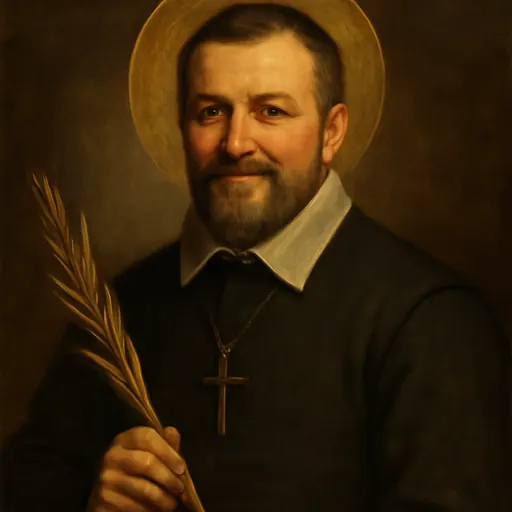
Blessed Edward Bamber (about 1600–1646), known on the mission as Reding, was a Lancashire priest who was arrested on landing at Dover, escaped from his guards on the road to Lancaster, served the Catholics of Lancashire for years, and spent three years in Lancaster Castle before he was condemned. He was martyred at Lancaster on August 7, 1646, and beatified in 1987.
Who was Blessed Edward Bamber?
Blessed Edward Bamber was a Lancashire priest of the seventeenth century, known on the mission as Mr. Reding, who served the hidden Catholics of his home county through years of danger and civil war. He was arrested three times and escaped twice. After three years in Lancaster Castle he was condemned for being a priest and executed at Lancaster on August 7, 1646, with two other priests. Pope John Paul II beatified him in 1987.
The life of Blessed Edward Bamber
From the Fylde to Spain
Edward was the son of Richard Bamber and was born about 1600 at the Moor, the old family house near Poulton in the part of Lancashire called the Fylde. After grammar school at home he was sent abroad. Bishop Challoner, writing from the notes of the eighteenth-century collector John Knaresborough, says he studied at the English College at Valladolid and was ordained there; a Lancashire tradition gives the English College at Seville instead. Lancaster Castle's history of its martyrs dates his ordination in Spain to 1626.
Arrested at Dover
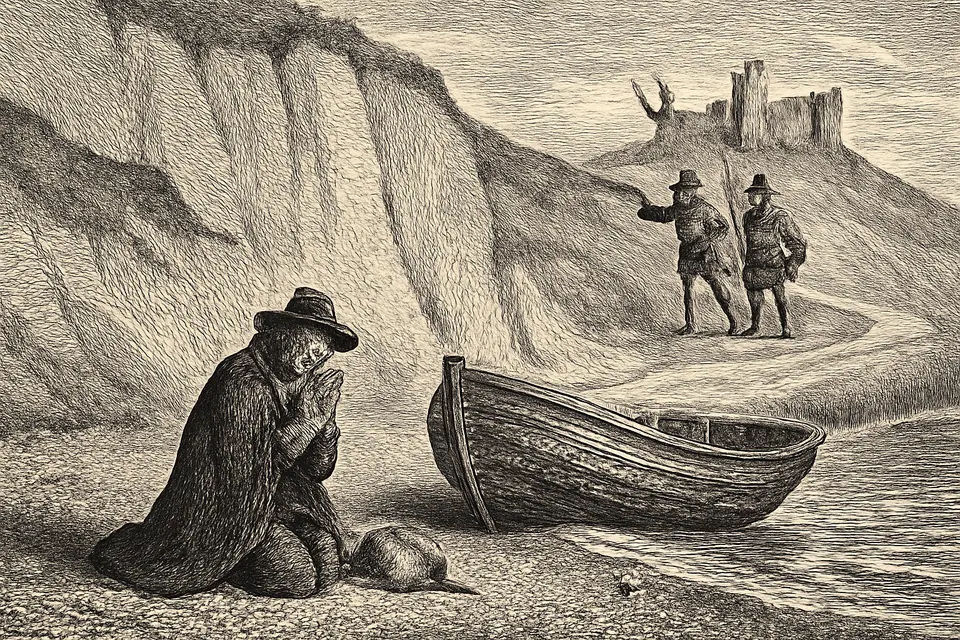
When he landed at Dover, he fell on his knees on the shore to thank God for a safe crossing. The governor of Dover Castle saw him, guessed he was a priest, and had him arrested. Edward did not deny it, but argued that he had not been on English soil long enough to fall under the statute, and so he was put on a ship and banished.
Escapes in Lancashire
He came back, and was soon arrested near Standish in Lancashire, probably while serving as chaplain at Standish Hall, the house of a Catholic family. On the way to Lancaster Castle his guards lodged for the night at an inn beyond Preston, the Old Green Man near Claughton-on-Brock. The guards drank themselves stupid, and in the dead of night Edward climbed out of a window in his shirt. In the morning he was found wandering in the fields by Mr. Singleton of Broughton Tower, who, according to a letter of 1707, had been told in a dream the night before that he would find a man in that very field. Mr. Singleton took him home and cared for him. The dream is a traditional story, preserved by the Lancashire priest John Martin from the memory of the country people.

For years afterward he worked in Lancashire under the name Reding, teaching the Catholics in his care, debating with Protestants, and going wherever he was needed. A fellow priest who shared his prison later wrote that his courage seemed "above the power and strength of man."
Three years in Lancaster Castle
Arrested a third time, he was committed to Lancaster Castle. He escaped once more and walked all night, only to find himself in the morning very near the town. He took it as a sign that God wanted him to suffer there, and gave himself up. Because the civil war stopped the judges riding their circuits, he waited three years for his trial.

In August 1646 the assizes were held at last. Two fallen Catholics, Malden and Osbaldeston, swore they had seen him baptize and perform a marriage. On that evidence the jury found him guilty, and he heard the sentence for high treason without any sign of fear.
August 7, 1646
He was drawn on a sledge to the place of execution with two other priests, the Franciscan John Woodcock and Thomas Whitaker. A felon named Croft was brought out to die with them. Edward spoke to him tenderly, reminding him that Christ had shown mercy to the good thief, and promised: "I a priest and minister of Jesus Christ will instantly in His name and by His authority absolve thee." The officials and ministers raged, but Croft declared he would die a Catholic, confessed his public sins aloud, and Edward absolved him in front of the crowd.
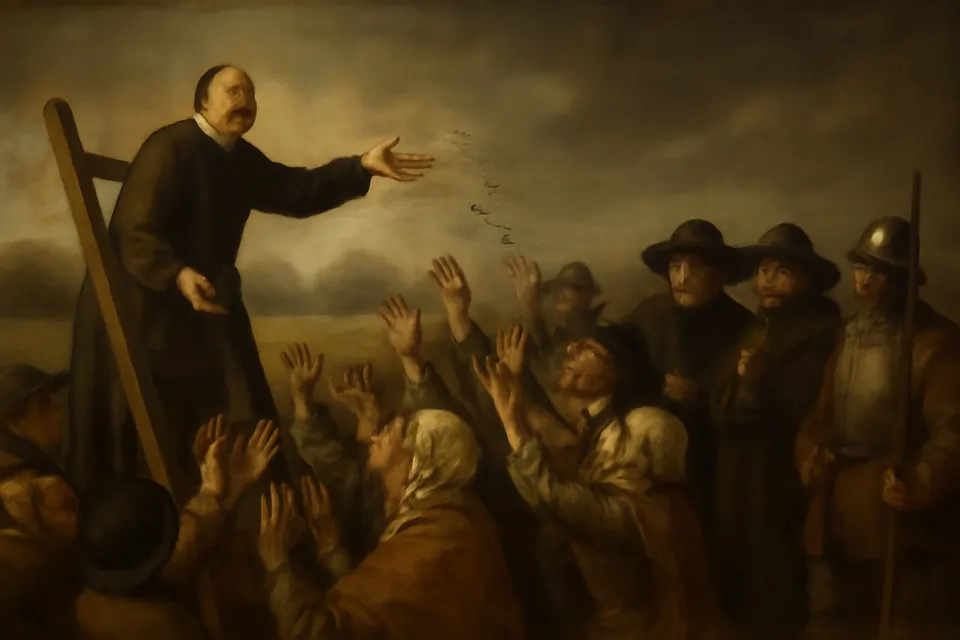
He sent word to friends not to grieve, "For, says he, I hope to pray for them in heaven." On the ladder he took out a handful of money and threw it among the people, saying with a smile that God loved a cheerful giver. He was turning to encourage Thomas Whitaker, who was visibly afraid, when the sheriff ordered the hangman to finish him. He was cut down while still alive and butchered. Woodcock and Whitaker followed him; they were the last priests put to death at Lancaster.
A martyr beatified
A priest imprisoned at Lancaster wrote an account of the three deaths, and an ode on their martyrdom survives in Challoner's Memoirs. As a martyr, Edward needed no approved miracle. Pope John Paul II beatified him with Woodcock, Whitaker and eighty-two others on November 22, 1987. A Catholic multi-academy trust of schools in the Diocese of Lancaster is named for him.

Symbols of Blessed Edward Bamber in art
There is no old portrait. Modern images, such as the icon of the Lancaster martyrs at St. Joseph's in Lancaster, show:
- The ladder and rope: the gallows of Lancaster, which he climbed by a ladder.
- A handful of coins: his last gift to the crowd, a sign that belongs to him alone.
- The martyr's palm: the sign of his martyrdom.
- Plain dark clothes or a cassock: for the hunted priest of the mission.
Feast day and prayer
We keep his feast on August 7. See other saints of August on our feast days page, and read about what a martyr is.
There is no traditional prayer to Blessed Edward that we can cite, so we do not print one. Let us ask him to pray for priests who serve in hard places, for prisoners waiting for justice, and for everyone facing death, that like the felon Croft they may find mercy at the last hour.
Frequently asked questions
Who was Blessed Edward Bamber?
A Catholic priest from the Fylde in Lancashire, trained in Spain, who worked in secret in his home county under the name Reding and was executed at Lancaster in 1646 for being a priest.
When is the feast of Blessed Edward Bamber?
August 7, the day he died. He is also remembered with the eighty-five martyrs of England and Wales on November 22.
What did Edward Bamber do at his execution?
He persuaded a condemned felon named Croft to die a Catholic and absolved him in front of the crowd. Then, on the ladder, he threw a handful of money to the people, saying that God loved a cheerful giver.
Who died with Blessed Edward Bamber?
Two other priests, Blessed John Woodcock, a Franciscan, and Blessed Thomas Whitaker. They were the last priests executed at Lancaster.
Keep exploring
Sources
- Richard Challoner, Memoirs of Missionary Priests, ed. J. H. Pollen (1924), pp. 481–484. Knaresborough's account of his trial and death, John Martin's letter of 1707 on the Dover arrest and the escapes, the felon Croft, and the stanzas of the ode
- Bede Camm, Ven. Edward Bamber, Catholic Encyclopedia (1907). The Old Green Man Inn near Claughton-on-Brock and Mr. Singleton of Broughton Tower
- Lancaster's Catholic Martyrs, Lancaster Castle. His ordination in Spain in 1626 and the beatification of the Lancaster martyrs in 1987
- The History of Edward Bamber, Blessed Edward Bamber Catholic Multi Academy Trust. His birthplace at Carleton and the three years' delay of his trial because of the civil war
- Pope John Paul II, Homily for the beatification of eighty-five English martyrs, November 22, 1987 (vatican.va)